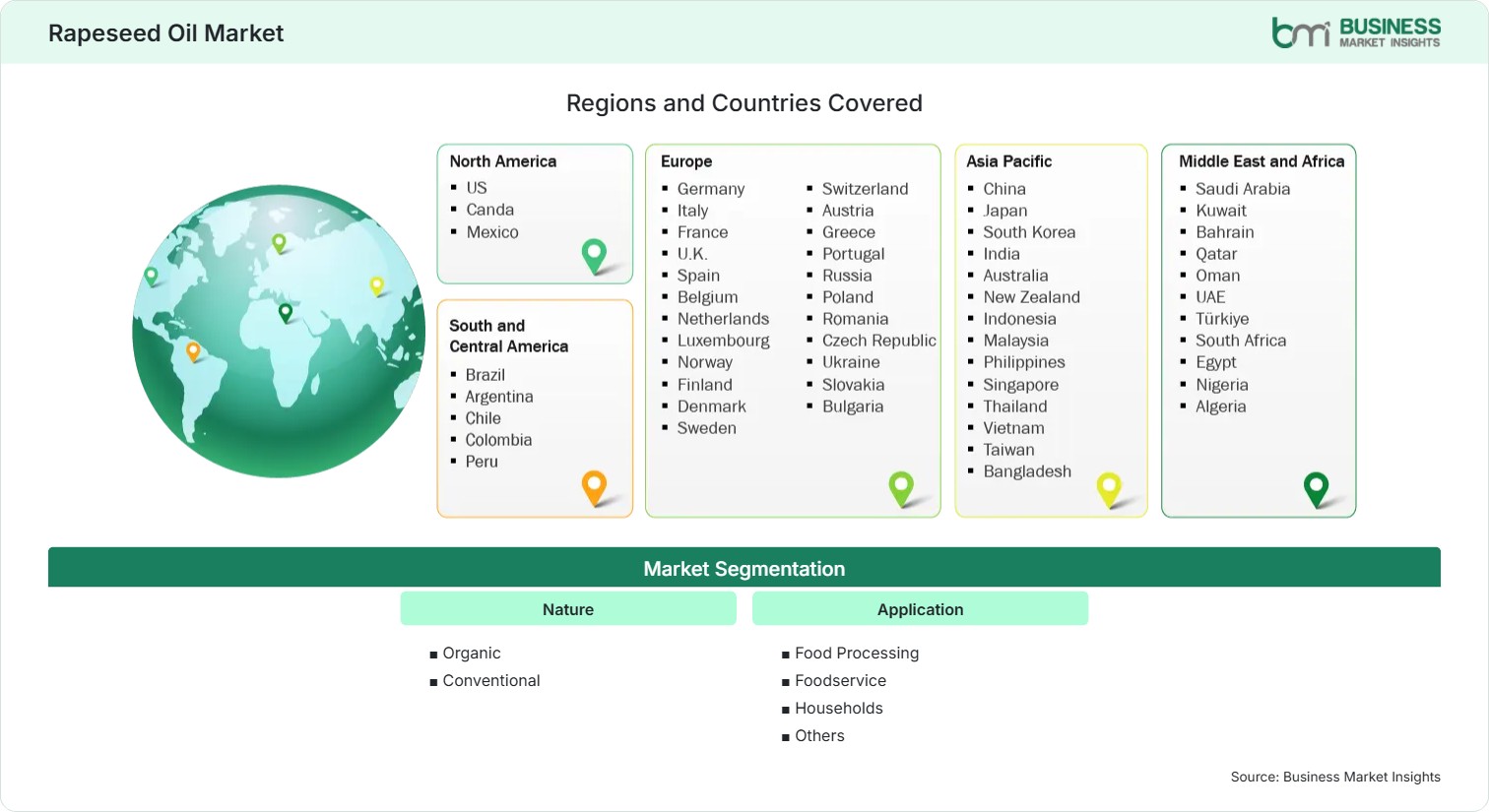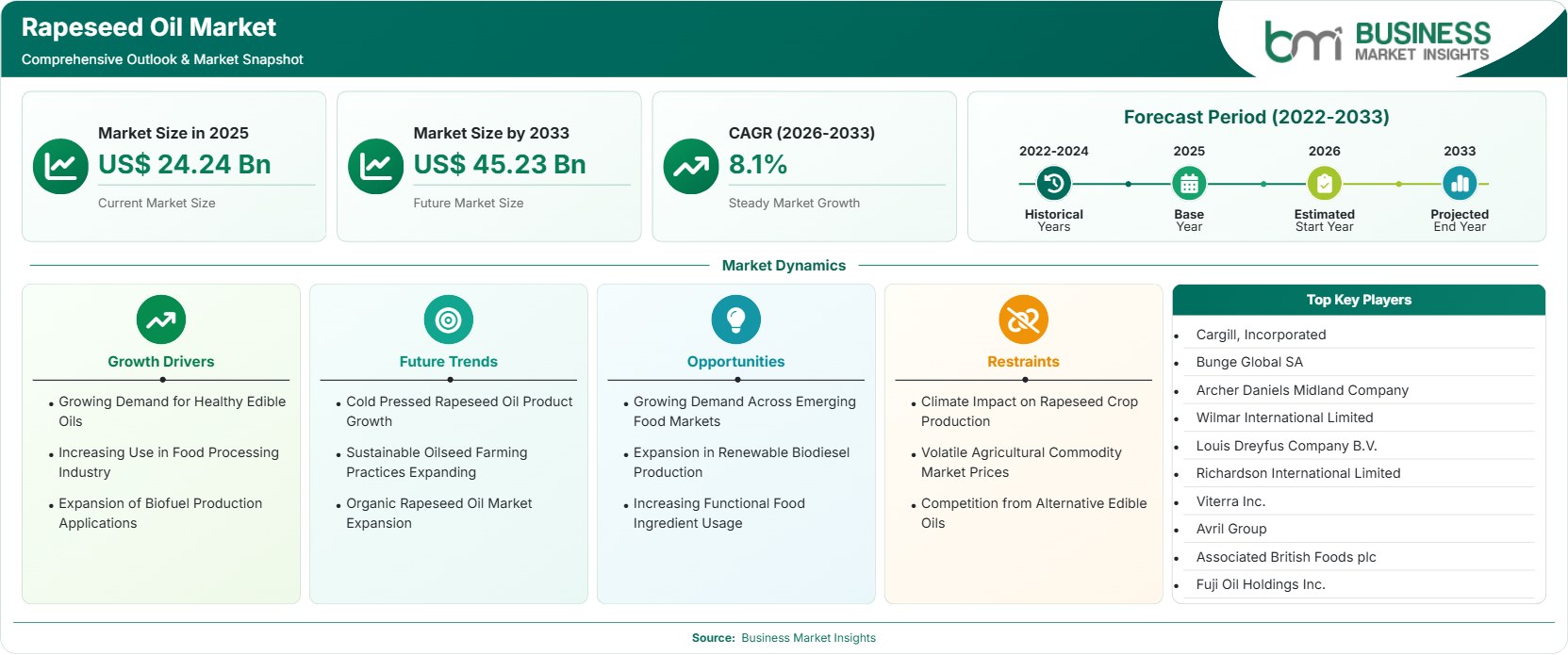
Rapeseed Oil Market Regional Highlights
North America Rapeseed Oil Market
North America accounted for 22%–26% share in 2025 and is projected to grow at a CAGR of 7.6%–8.2% from 2026–2033. The region benefits from strong agricultural production, established food processing industries, increasing consumer awareness of healthy oils, and growing biodiesel demand. The United States and Canada are major contributors due to extensive rapeseed cultivation and advanced oil processing infrastructure.
- The United States is witnessing increased demand for rapeseed oil due to rising consumption of healthier edible oils.
- Food manufacturers are incorporating rapeseed oil into processed foods due to its functional properties and nutritional advantages.
- Renewable fuel initiatives are increasing demand for rapeseed-based biodiesel applications.
- Agricultural producers are adopting improved cultivation practices to enhance rapeseed yield and supply stability.
US Rapeseed Oil Market
The US represented 18%–22% share in 2025 and is expected to grow at a CAGR of 7.7%–8.3% from 2026–2033. Growth is supported by increasing demand for premium cooking oils, expansion of food processing applications, and rising interest in renewable biofuel production.
- Consumers are increasingly shifting toward healthier vegetable oils with improved nutritional profiles.
- Foodservice operators are adopting rapeseed oil for frying, cooking, and food preparation applications.
- Biodiesel producers are exploring plant-based feedstocks to support renewable fuel targets.
- Domestic oil processing capabilities are supporting market supply and distribution.
US Rapeseed Oil Market
The US represents the largest consuming market within North America and is expected to register a CAGR of 7.3%–7.7% during 2026–2033 while accounting for 52%–56% of the regional market in 2025. Growing renewable diesel production, increasing food manufacturing activities, and expanding investments in domestic oilseed processing continue to support long-term market expansion.
- Rapid expansion of renewable diesel facilities is increasing procurement of vegetable oils, encouraging processors to strengthen domestic crushing capacity and improve supply chain integration.
- Major food manufacturers continue to reformulate products using healthier edible oils to satisfy consumer demand for improved nutritional profiles and clean-label food products.
- Investments in advanced refining technologies and logistics infrastructure are improving production efficiency while supporting reliable distribution across industrial and retail channels.
- Agricultural innovation, including precision farming and improved seed genetics, continues to enhance crop productivity and strengthen domestic raw material availability.
Europe Rapeseed Oil Market
Europe held 30%–33% of the global market in 2025 and is forecast to grow at a CAGR of 7.8%–8.2% during 2026–2033. Strong biodiesel demand, mature edible oil consumption, and stringent sustainability regulations continue to support regional development. Germany remains the leading country, while Poland is projected to record the fastest growth with a CAGR of 8.5%–8.9% during the forecast period.
- European renewable energy regulations continue to stimulate biodiesel production, increasing demand for sustainably sourced vegetable oils across transportation and industrial applications.
- Germany maintains regional leadership through advanced crushing infrastructure, strong food manufacturing capabilities, and consistent investments in oilseed processing technologies.
- Poland is emerging as the fastest-growing country owing to expanding processing capacity, agricultural modernization, and increasing domestic demand for packaged food products.
- Sustainability certification, carbon reduction initiatives, and traceable agricultural sourcing continue to influence procurement strategies among regional processors and food manufacturers.
- Continuous investments in energy-efficient refining technologies are helping producers improve operational performance while reducing environmental impact.
Asia Pacific Rapeseed Oil Market
Asia Pacific accounted for 29%–32% of the global market in 2025 and is projected to register the fastest regional expansion with a CAGR of 8.8%–9.3% during 2026–2033. Rising disposable incomes, rapid urbanization, expanding food processing industries, and increasing consumption of packaged foods continue to accelerate regional demand. China leads the regional market, while India is expected to record the highest growth with a CAGR of 9.4%–9.8%.
- China remains the leading regional consumer due to its large food processing sector, expanding edible oil demand, and continuous investments in refining infrastructure.
- India is expected to witness the fastest expansion as rising household incomes, changing dietary preferences, and government support for edible oil security encourage greater consumption.
- Growing investments in modern refining facilities are improving production efficiency while reducing dependence on imported refined edible oils.
- Expanding organized retail, e-commerce grocery platforms, and premium food consumption are creating additional demand for healthier edible oil products.
- International manufacturers continue to strengthen regional partnerships and distribution networks to capitalize on rising food industry demand.
Rest of World Rapeseed Oil Market
The Rest of World region accounted for 18%–21% of the global market in 2025 and is expected to expand at a CAGR of 7.9%–8.3% during 2026–2033.
South & Central America continues to benefit from expanding oilseed cultivation and food processing investments, while the Middle East & Africa experiences increasing demand driven by population growth, food imports, and expanding packaged food consumption. Brazil leads regional demand, whereas the UAE is projected to register the fastest growth with a CAGR of 8.6%–9.0%.
- Brazil continues to strengthen regional demand through expanding food manufacturing activities, improving oilseed processing capabilities, and growing consumption of healthier edible oils.
- The UAE is witnessing increasing demand supported by premium food consumption, modern retail expansion, and investments in food processing and distribution infrastructure.
- Rising investments in logistics, storage facilities, and port infrastructure are improving edible oil supply chain efficiency across emerging economies.
- Increasing urbanization and higher disposable incomes continue to support consumption of packaged foods requiring high-quality vegetable oils.
- Government initiatives focused on food security and agricultural diversification are encouraging investments across edible oil processing and supply chain infrastructure.