
Fats and Oils Market Outlook: Size, Share, Trends, Growth Analysis, Competitive Landscape & Forecast, 2026-2033

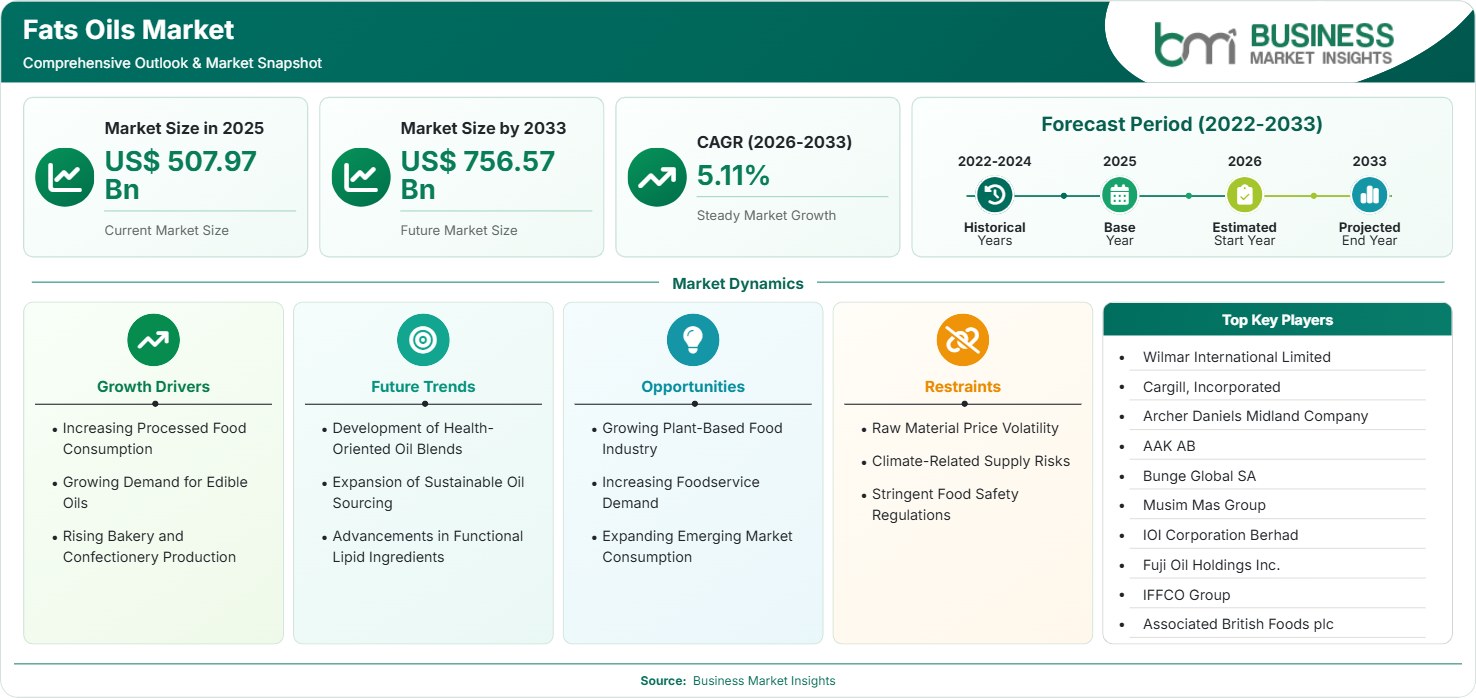
The Fats and Oils Market size was valued at US$ 507.97 Billion in 2025 and is projected to reach US$ 756.57 Billion by 2033, growing at a CAGR of 5.11% during 2026–2033, driven by rising processed food demand, expanding edible oil consumption, and increasing applications across food, cosmetics, nutraceuticals, and biofuel sectors.

Report Coverage
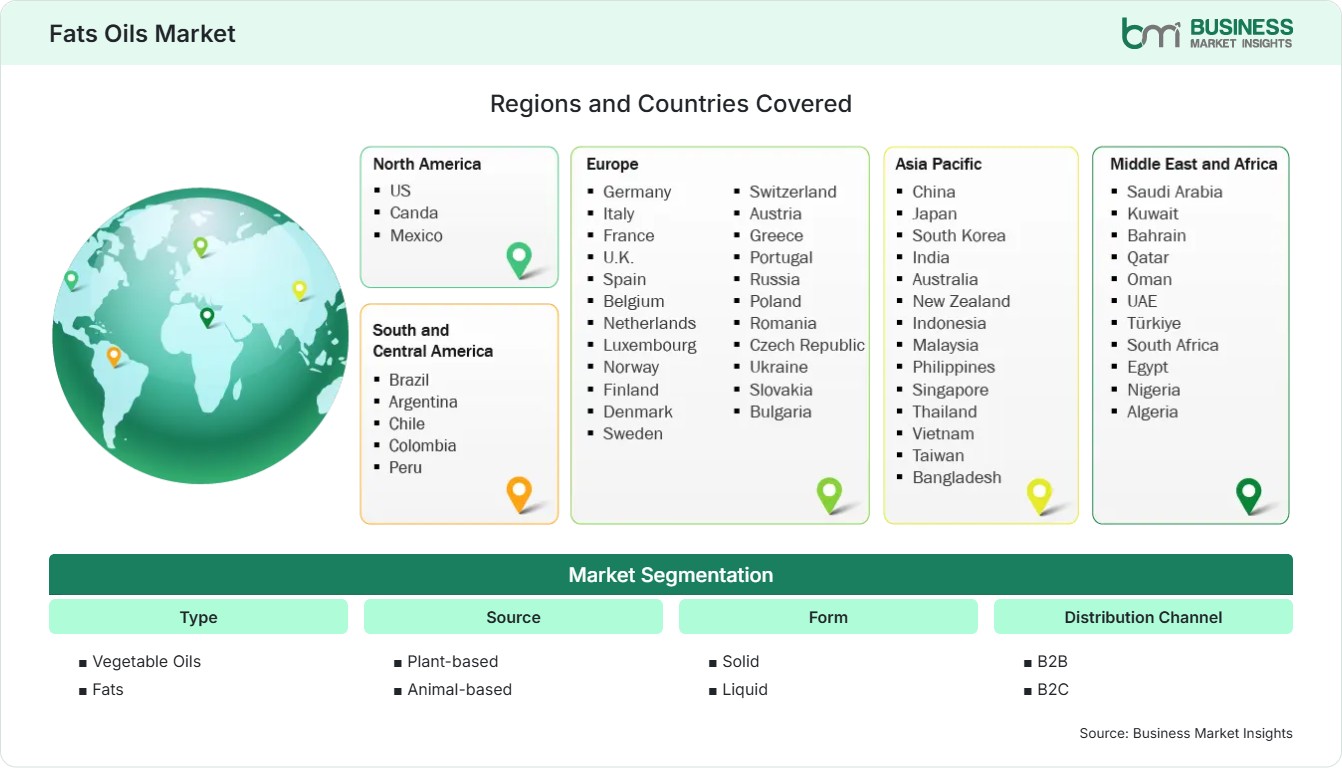
  • Type: Vegetable Oils , Fats
  • Source: Plant-based, Animal-based
  • Form: Solid, Liquid
  • Distribution Channel: B2B, B2C
  • End-Use: Food , and Non-Food
US$ 507.97 Bn Market size in 2025
US$ 756.57 Bn Market Size by 2033
5.11% CAGR, 2026 - 2033
2026-2033 Forecast Period

AI Overview

Fats and Oils Market Summary

  • North America Region: North America holds a 22%–26% share in 2025, growing with a CAGR of 4.5%–5.5% during 2026–2033, supported by demand for functional oils, clean-label ingredients, sustainable sourcing, advanced processing technologies, and expanding foodservice applications. The U.S. market analysis indicates steady expansion with a CAGR of 4.8%–5.8% through 2026–2033, influenced by consumer preference for healthier oils, premium formulations, and industrial demand.
  • Fastest Growing Region: Asia Pacific represents the fastest-growing region with a 35%–39% share in 2025 and a CAGR of 5.8%–6.8% during 2026–2033, supported by population growth, rising disposable incomes, urbanization, increasing packaged food consumption, and expanding food processing industries across emerging economies.
  • Leading Segment: Vegetable Oils lead with a 68%–72% share in 2025 and a CAGR of 5.0%–6.0% during 2026–2033, driven by widespread culinary applications, industrial processing demand, health-focused formulations, and increasing adoption of sunflower, soybean, palm, and canola oils.
  • High Growth Segment: Non-Food End-Use applications demonstrate strong growth with a CAGR of 6.0%–7.0% during 2026–2033 and a 18%–22% share in 2025, supported by expanding biofuel production, cosmetic formulations, nutraceutical applications, and demand for renewable raw materials.
  • Key Market Opportunity: Growing demand for sustainable, plant-based, and specialty oils creates opportunities through alternative sourcing, functional ingredient innovation, biofuel expansion, and advanced processing technologies targeting evolving consumer and industrial requirements.
  • Major Market Players: Wilmar International Limited, Cargill, Incorporated, Archer Daniels Midland Company, AAK AB, Bunge Global SA, Musim Mas Group, IOI Corporation Berhad, Fuji Oil Holdings Inc., IFFCO Group, and Associated British Foods plc.
Strategic Insights

Fats and Oils Market: Strategic Insights

Fats and Oils Market Strategic Framework
FREE PDF
Request your free sample
Request free sample
Stakeholder View

Key Takeaways

  • The value chain is becoming increasingly integrated, with producers focusing on agricultural sourcing, processing efficiency, refining capabilities, and distribution networks to strengthen supply reliability and improve margins.
  • Specialty oils and functional fats provide higher-value opportunities as manufacturers respond to demand for healthier formulations, plant-based alternatives, nutritional enrichment, and customized ingredient solutions across industries.
  • Innovation is shifting toward sustainable extraction methods, improved oil modification technologies, and advanced formulations that enhance stability, nutritional value, and application performance in food and non-food products.
  • Asia Pacific provides a strong investment environment due to expanding food processing industries, rising consumer spending, agricultural development, and increasing demand from rapidly urbanizing populations.
  • Strategic partnerships, capacity expansions, and acquisitions are shaping competitive positioning as companies seek regional presence, sustainable sourcing capabilities, and access to emerging application areas.
Geographic Outlook

Fats and Oils Market Regional Highlights

North America Fats and Oils Market

North America accounted for a 22%–26% share in 2025 and is projected to expand at a CAGR of 4.5%–5.5% during 2026–2033. The region benefits from advanced food processing infrastructure, strong demand for premium oils, and established distribution networks. The United States and Canada remain key contributors, supported by innovation in functional ingredients, sustainable sourcing, and healthier oil formulations.

  • Growing consumer preference for healthier cooking oils is encouraging manufacturers to introduce low-saturated-fat options, organic variants, and specialty formulations across retail and foodservice channels.
  • Advanced processing capabilities and strong agricultural infrastructure enable regional producers to improve efficiency, develop innovative products, and maintain competitive positions in global supply networks.
  • Increasing demand from packaged food manufacturers is supporting consumption growth through expanded applications in snacks, bakery products, ready-to-eat meals, and convenience food categories.
  • Sustainability initiatives are influencing sourcing decisions as companies prioritize certified raw materials, traceability systems, and environmentally responsible production practices.

US Fats and Oils Market

The U.S. market represented a 17%–21% share within North America in 2025 and is expected to grow at a CAGR of 4.8%–5.8% from 2026–2033. The Fats and Oils Market growth in the U.S. is supported by innovation in functional ingredients, renewable fuel applications, and consumer interest in healthier dietary options.

  • Expanding demand for plant-based ingredients is encouraging manufacturers to increase production of soybean, canola, sunflower, and specialty vegetable oils.
  • Foodservice recovery and restaurant expansion are supporting higher consumption of cooking oils and specialty fats across commercial culinary applications.
  • Growing biofuel initiatives are creating additional demand for vegetable oils as renewable feedstock sources.
  • Advanced research in nutrition and ingredient functionality is supporting development of customized oil solutions.

Europe Fats and Oils Market

Europe held a 20%–24% share in 2025 and is projected to grow at a CAGR of 4.2%–5.2% during 2026–2033. The region is characterized by strong sustainability regulations, advanced food manufacturing, and demand for high-quality ingredients. The Fats and Oils Market share is influenced by clean-label trends, renewable energy initiatives, and premium product demand.

  • European manufacturers are adopting sustainable sourcing programs to meet environmental standards and consumer expectations for responsible production.
  • Demand for functional oils and specialty fats is increasing across bakery, confectionery, dairy alternatives, and nutritional product segments.
  • Regulatory focus on food quality and transparency is encouraging investments in advanced refining and processing technologies.
  • Biofuel policies are supporting greater utilization of renewable oil-based feedstocks across energy applications.
  • Innovation in plant-based food products is creating new opportunities for vegetable oil suppliers and ingredient manufacturers.

Asia Pacific Fats and Oils Market

Asia Pacific accounted for a 35%–39% share in 2025 and is estimated to expand at a CAGR of 5.8%–6.8% during 2026–2033. The Fats and Oils Market share is strengthened by increasing edible oil demand, industrial applications, and investments in processing infrastructure.

  • Rising packaged food consumption across developing economies is increasing demand for refined vegetable oils, specialty fats, and processed food ingredients.
  • Expanding middle-class populations in China and India are driving higher consumption of branded edible oils and premium nutritional formulations.
  • Indonesia and Malaysia continue influencing palm oil supply chains through production capacity, export activities, and sustainability-focused cultivation practices.
  • Growing investments in food manufacturing facilities are creating opportunities for oil processors, refiners, and ingredient suppliers across emerging markets.
  • Increasing adoption of plant-based diets and functional ingredients is encouraging innovation in healthier oil alternatives and specialty formulations.

Rest of World Fats and Oils Market

South and Central America, Middle East, and Africa collectively represented a 14%–18% share in 2025 and are expected to grow at a CAGR of 4.7%–5.7% during 2026–2033. Brazil, Argentina, South Africa, and Gulf countries contribute significantly through agricultural production, food processing, and industrial applications. The Fats and Oils Market growth in these regions is supported by expanding consumption, improving supply chains, and increasing demand for renewable resources.

Emerging economies are investing in agricultural modernization and domestic processing capabilities to reduce import dependence and improve value chain efficiency.

  • Brazil and Argentina are strengthening soybean oil production capabilities through agricultural expansion and advanced processing infrastructure development.
  • Middle Eastern countries are increasing edible oil imports and investing in food manufacturing capacity to support growing consumer markets.
  • African markets are experiencing rising demand due to population growth, urbanization, and expansion of packaged food consumption.
  • Renewable fuel initiatives in selected countries are creating additional applications for vegetable oils and sustainable feedstocks.
  • Regional producers are focusing on improved logistics, storage infrastructure, and processing technology to enhance market competitiveness.
Global Market Geography
FREE PDF
Request your free sample
Request free sample
Segment Analysis

Fats and Oils Market Segmentation

Type

Type segmentation demonstrates strong dominance of vegetable oils due to extensive culinary, industrial, and commercial applications. Vegetable oils accounted for a 68%–72% share in 2025, while the segment is projected to expand at a CAGR of 5.0%–6.0% between 2026–2033. The Fats and Oils Market scope continues expanding through increasing demand for healthier oils, specialty formulations, and sustainable ingredient solutions across food and non-food industries.

  • Vegetable Oils: Includes Sunflower, Palm, Soybean, Canola/Rapeseed, Coconut, and Others, enabling diverse food processing, cooking, industrial manufacturing, nutraceutical, and personal care applications while supporting nutritional requirements, product functionality, cost efficiency, and sustainable ingredient innovation across global end-use industries.
  • Fats: Includes Butter, Tallow, Lard, Fish Oil, and Others, supporting bakery, confectionery, dairy, foodservice, nutraceutical, oleochemical, and industrial applications while providing texture, stability, flavor enhancement, functional performance, and specialized formulation requirements across diverse end-use industries.

Source

Source segmentation reflects changing preferences toward sustainable, traceable, and functional raw materials. Plant-based sources represent the leading category with broad food and industrial adoption. The Fats and Oils Market share is influenced by sustainability objectives, dietary shifts, and regulatory focus on responsible sourcing. Source categories are expected to maintain steady expansion through 2026–2033 as manufacturers diversify supply strategies.

  • Plant-based: Dominates consumption through vegetable oil availability, sustainability advantages, nutritional positioning, and broad applications across food and industrial sectors.
  • Animal-based: Supports specialized applications requiring specific functional properties, including dairy, meat processing, supplements, and industrial formulations.

Form

Form segmentation highlights differences in application requirements, processing conditions, and consumer preferences. Liquid oils maintain strong adoption due to cooking applications, food processing requirements, and industrial versatility. Solid fats continue supporting bakery, confectionery, and specialized formulations. The Fats and Oils Market trends indicate increasing demand for customized formats designed for improved stability, texture, and nutritional performance.

  • Solid: Used extensively in bakery, confectionery, spreads, and processed foods requiring structural properties and controlled melting characteristics.
  • Liquid: Preferred for cooking, frying, food manufacturing, and applications requiring easy handling, blending capability, and consumer convenience.

Distribution Channel

Distribution channel segmentation reflects evolving purchasing patterns among industrial buyers and consumers. B2B channels remain dominant due to large-volume requirements from food manufacturers, restaurants, and industrial users. B2C channels continue expanding through branded edible oils and retail products. The market demonstrates increasing channel diversification as companies strengthen direct distribution and digital commerce strategies.

  • B2B: Represents industrial procurement through manufacturers, processors, foodservice operators, and commercial users requiring consistent supply and customized solutions.
  • B2C: Expands through retail availability, branded products, online platforms, and increasing consumer demand for premium edible oils.

End-Use

End-use segmentation highlights broad utilization across food and non-food industries. Food applications represent the largest consumption category due to widespread usage in processing and culinary activities. The Fats and Oils Market trends show increasing diversification into cosmetics, supplements, and biofuels as industries seek renewable and functional ingredients. The segment structure supports continued innovation across multiple applications.

  • Food: Includes Food & Beverage Processing and Foodservice/Culinary, supporting processed food manufacturing, bakery, confectionery, dairy products, frying, commercial kitchens, restaurants, catering services, and institutional food preparation while ensuring product quality, texture, flavor, and operational efficiency across global food industries.
  • Non-Food: Includes Nutraceuticals & Supplements, Cosmetics & Personal Care, Biofuels, and Others, enabling nutritional formulations, skincare products, renewable fuel production, industrial applications, and specialty formulations while supporting sustainability initiatives, functional performance, and expanding non-food commercial opportunities.
Market Forces

Fats and Oils Market Dynamics

Key Market Drivers

Increasing Processed Food Consumption

Rising processed food consumption is strengthening demand for functional oils and fats used in snacks, bakery products, ready-to-eat meals, and packaged foods. According to the global food industry reports, lifestyle changes, urbanization, and the trend of convenient consumption have been increasing the presence of processed foods in developing countries. The Fats and Oils Market growth is driven by demand for ingredients to enhance the qualities of taste, shelf life, and stabilization. The market trends show increasing use of specialty fats, healthier oil combinations, and customized products. Food processors are upgrading ingredient technology to cater to consumers' needs for improving the nutritional value of their products.

Growing Demand for Edible Oils

The increased demand for edible oils is leading to an expansion of the production capacity, processing facilities, and logistics within the most productive agricultural belts of the world. Edible oils continue to be critical components in domestic cooking, food industries, and food services. The increasing demand for oils is facilitated by population increase, higher incomes, and new eating habits in developing countries. Companies have been concentrating their efforts on improving technologies, sustainability of their products, and the quality of their offerings to cater to changing consumer preferences.

Rising Bakery and Confectionery Production

Expansion of bakery and confectionery industries is increasing demand for specialized fats that provide texture, stability, and improved product performance. Manufacturers use customized fat formulations in chocolates, pastries, biscuits, spreads, and frozen products to achieve consistent quality. The expansion of the market for premium bakery items and convenience food products is prompting the development of application-specific products by suppliers. Food manufacturers are opting for functional fats, which help in providing better labeling and nutrition. The increased investment in manufacturing automation and product diversification is creating more opportunities for ingredient suppliers in bakery and confectionery markets worldwide.

Key Market Opportunities

Growing Plant-Based Food Industry

Expansion of plant-based food categories is creating new opportunities for oil and fat producers supplying alternative proteins, dairy substitutes, and functional food products. Consumer interest in sustainable and health-focused diets is increasing demand for plant-derived ingredients with improved nutritional profiles. Specialty oils, fractionated fats, and novel extraction technology are areas where investments are being made in order to support the growth of product innovation. Fats and Oils Market Forecasts suggest there are growing opportunities as a result of collaborations between ingredient providers and food innovators developing future food solutions.

Increasing Foodservice Demand

An increase in the number of restaurants, catering companies, and institutional food services has raised the demand for quality oils and fats. In order to meet the requirements of the food service industry, oils and fats must be able to be used for frying, cooking, baking, and other preparation processes. The growth of food chains in developing countries is providing business opportunities for oil suppliers. Manufacturers have started to produce oils with enhanced stability and efficiency.

Expanding Emerging Market Consumption

The rising consumption levels in Asia Pacific, Africa, and Latin America are providing opportunities by virtue of increasing demands for food, urbanization, and improved infrastructure within the retail sector. The rising populations and the rising income levels of households have been responsible for increased consumption of oils and processed foods. The production industry is investing in processing plants, storage facilities, and distribution networks to cater to rising consumption demands. New market opportunities exist for firms offering low-cost and nutritious oils. Partnerships with agricultural firms in the region are now essential.

Market Restraints and Challenges

Raw Material Price Volatility

Factor: Fluctuations in agricultural commodity prices, including soybean, palm, sunflower, and other oilseed crops, create uncertainty in production costs. Impact: Fluctuations in price impact the margin, procurement strategies, and pricing policy for consumers. The factors that affect the raw materials include weather patterns, geo-political problems, trade barriers, and fluctuations in agricultural output. Manufacturers have started entering into long-term agreements, diversifying their supply chain, and utilizing inventory control practices to minimize the risk. However, the cost stability is still difficult to maintain due to constant changes in global agriculture market.

Climate-Related Supply Risks

Factor: Changing climate patterns, extreme weather events, and environmental pressures affect crop productivity and agricultural supply reliability. Impact: Reduced yields can increase sourcing challenges, raise input costs, and create supply constraints for oil-producing regions. Palm oil, soybean, sunflower, and rapeseed production are particularly influenced by weather variability and sustainability requirements. Long-term supply security depends on improving cultivation efficiency, adopting sustainable production approaches, and strengthening collaboration across agricultural value chains.

Company Analysis

Competitive Landscape

The competitive environment includes global commodity processors, ingredient manufacturers, agricultural supply chain companies, and specialty fat producers. Fats and Oils Market analysis highlights competition around sustainable sourcing, processing efficiency, product innovation, supply chain integration, and development of value-added oil and fat solutions.

Company Name

Overview

Products and Services relevant to this market

Wilmar International Limited

Global agribusiness company involved in oilseed processing, edible oils, and integrated agricultural supply chains worldwide.

Palm oil, soybean oil, specialty fats, consumer edible oils, oleochemicals, and food ingredient solutions.

Cargill, Incorporated

International food and agriculture company providing commodity processing and ingredient solutions across global markets.

Vegetable oils, animal fats, specialty oils, food ingredients, and sustainable sourcing solutions.

Archer Daniels Midland Company

Global agricultural processor specializing in oilseed processing, nutrition, and food ingredient development.

Soybean oil, vegetable oils, specialty fats, lecithin, and customized ingredient solutions.

AAK AB

Specialty fats and oils producer focused on value-added lipid solutions for food and industrial applications.

Bakery fats, confectionery fats, dairy alternatives, specialty oils, and customized lipid formulations.

Bunge Global SA

Agricultural commodities company providing processing, sourcing, and distribution services across global food markets.

Vegetable oils, edible oils, oilseed processing, specialty ingredients, and sustainable supply solutions.

Musim Mas Group

Integrated palm oil company operating across cultivation, processing, refining, and downstream applications.

Palm oil derivatives, specialty fats, oleochemicals, and sustainable palm-based ingredients.

IOI Corporation Berhad

Malaysian plantation and resource-based company producing palm oil products and related ingredients.

Refined palm oils, specialty fats, oleochemical products, and food ingredient solutions.

Fuji Oil Holdings Inc.

Food ingredient manufacturer specializing in oils, fats, and plant-based food technologies.

Chocolate fats, emulsified oils, functional fats, and plant-based ingredient solutions.

IFFCO Group

Food products company supplying edible oils, fats, and consumer food solutions across regions.

Cooking oils, specialty fats, food ingredients, and consumer oil brands.

Associated British Foods plc

Diversified international food company with ingredient manufacturing and agricultural operations.

Vegetable oils, bakery ingredients, food manufacturing solutions, and specialty ingredient products.

Trust & Transparency

Research Methodology

The market analysis combines proprietary research with secondary data from government agencies, company disclosures, regulatory filings, industry databases and expert interviews. Market estimates are validated through data triangulation, cross-market benchmarking and analyst review.

View Full Research Methodology

Questions Answered

Frequently Asked Questions

What insights are included in the Fats and Oils Market Report?

The report evaluates market dynamics, segmentation, competitive strategies, regional developments, investment opportunities, and industry trends influencing future growth across food and non-food applications.

How are manufacturers addressing changing consumer preferences for healthier products?

Companies are developing low-saturated-fat oils, functional ingredients, fortified formulations, and plant-based alternatives to align with consumer interest in nutrition and wellness. Innovation in extraction and processing technologies supports these product developments.

What role do emerging economies play in future market expansion?

Emerging economies contribute through rising food consumption, urbanization, expanding retail networks, and increasing processed food demand. Countries across Asia Pacific, Africa, and Latin America are creating new opportunities for producers and distributors.

How are sustainability initiatives affecting oil and fat producers?

Sustainability programs are encouraging producers to improve traceability, adopt responsible agricultural practices, reduce environmental impacts, and develop certified sourcing models. These initiatives are becoming important factors in supplier selection among global food companies.

What factors are influencing demand for specialty fats in food manufacturing?

Specialty fats demand is increasing due to requirements for improved texture, stability, shelf life, and nutritional performance in bakery, confectionery, dairy alternatives, and processed food applications. Manufacturers are increasingly seeking customized lipid solutions.

Access the Full Fats and Oils Market Report

Get segment-level forecasts, regional estimates, competitive benchmarking, company profiles and downloadable Excel datasets.

Access the full Fats and Oils Market Report
350 pages PDF & Excel | 2026-08-21
Similar Research

Related Market Reports