
Olive Oil Market Outlook: Size, Share, Trends, Growth Analysis, Competitive Landscape & Forecast, 2026–2033

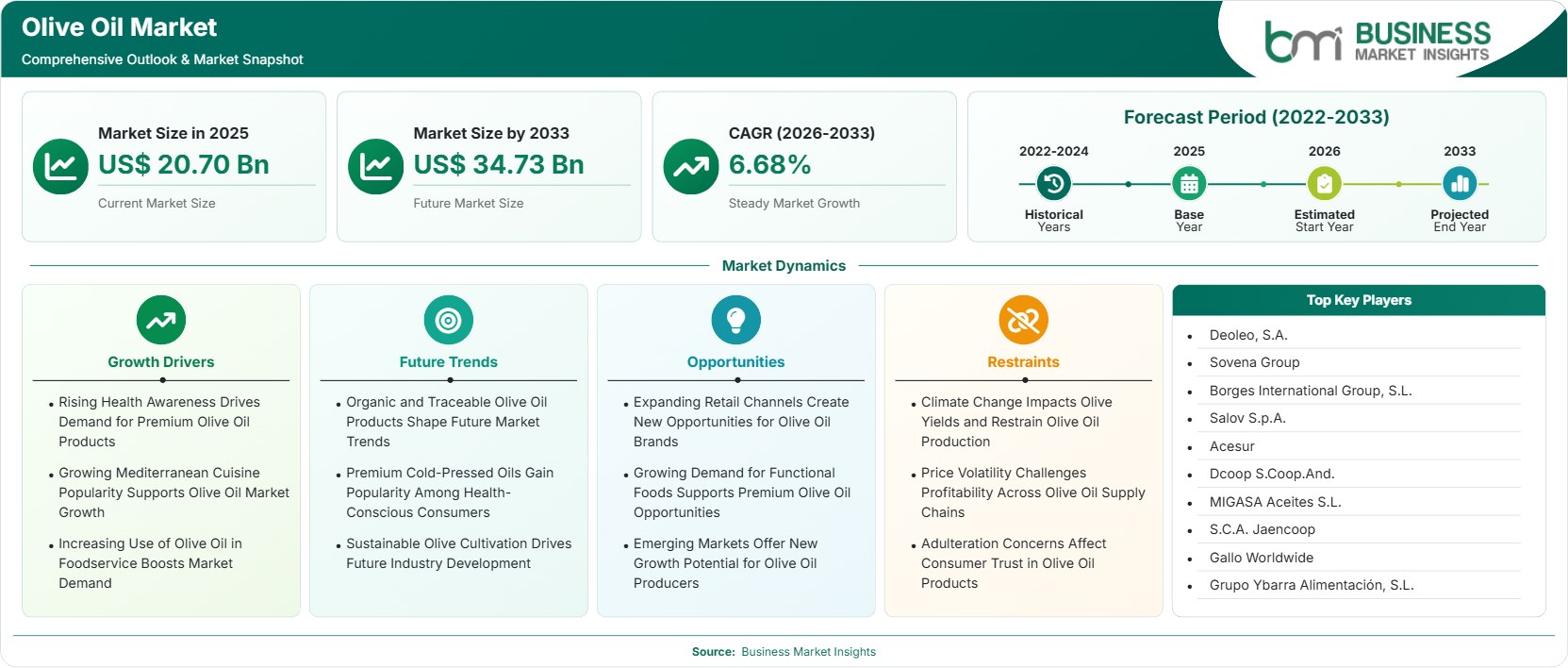
The Olive Oil Market size was valued at US$ 20.70 Billion in 2025 and is projected to reach US$ 34.73 Billion by 2033, growing at a CAGR of 6.68% during 2026–2033, driven by rising health awareness, premiumization, expanding retail channels, functional food demand, and emerging-market penetration.

Report Coverage
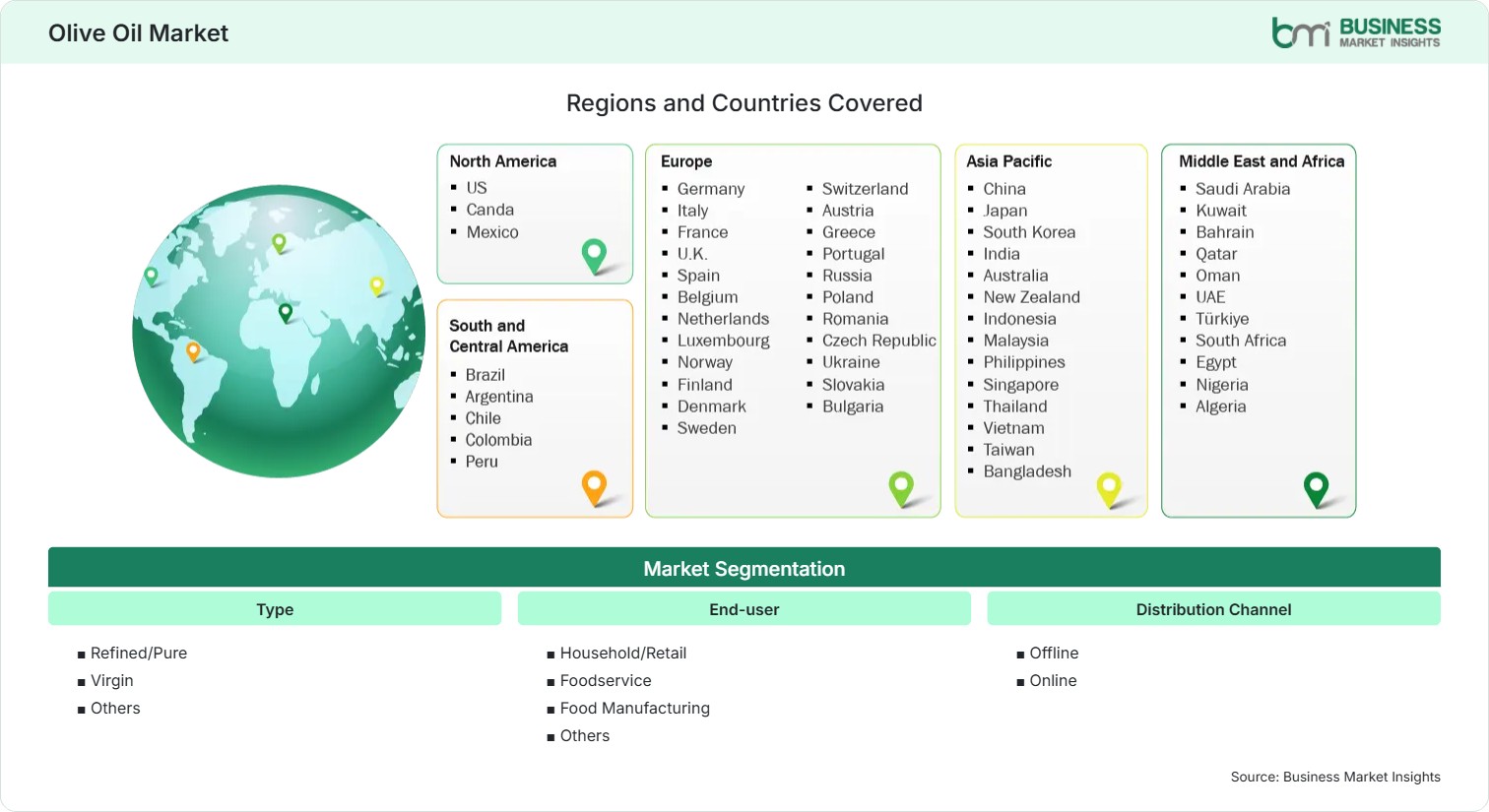
  • Type: Refined/Pure, Virgin, Others
  • End-user: Household/Retail, Foodservice, Food Manufacturing, Others
  • Distribution Channel: Offline, Online
US$ 20.70 Bn Market size in 2025
US$ 34.73 Bn Market Size by 2033
6.68% CAGR, 2026 - 2033
2026-2033 Forecast Period

01 AI Overview

Olive Oil Market Summary

  • North America Region: North America holds market share of 14%–18% in 2025, growing with a CAGR of 6.00%–7.00% influenced by health-conscious consumption, premium extra virgin olive oil, and retail diversification. The US represents the region's largest market, with a CAGR of 6.20%–7.20% from 2026 to 2033, supported by premium food trends, and expanding online grocery channels.
  • Fastest Growing Region: Asia Pacific holds market share of 10%–14% in 2025, growing with a CAGR of 8.00%–9.00% driven by rising disposable incomes, e-commerce expansion, and increasing consumer familiarity with Mediterranean cooking and olive oil's nutritional positioning.
  • Leading Segment: Virgin holds market share of 42%–46% in 2025, growing with a CAGR of 7.00%–8.00% driven by premiumization, consumer preference for minimally processed oils, and increasing availability through specialty retail and online channels.
  • High Growth Segment: Online holds market share of 10%–14% in 2025, growing with a CAGR of 10.00%–11.00% driven by digital grocery adoption, premium product discovery, direct-to-consumer brands, consumer education, and convenient home delivery.
  • Key Market Opportunity: Producers can capture premium value through traceable sourcing, certified quality, emerging-market expansion, and differentiated products targeting health-conscious and culinary consumers.
  • Major Market Players: Deoleo, S.A., Sovena Group, Borges International Group, S.L., Salov S.p.A., Acesur, Dcoop S.Coop.And., MIGASA Aceites S.L., S.C.A. Jaencoop, Gallo Worldwide, Ybarra Alimentacion, S.L.
02 Strategic Insights

Olive Oil Market: Strategic Insights

Olive Oil Market Strategic Framework
FREE PDF
Request your free sample
Request free sample
03 Stakeholder View

Key Takeaways

  • The value chain remains highly sensitive to agricultural conditions, with cultivation, harvesting, milling, storage, bottling, and distribution costs directly influencing retail pricing and producer margins.
  • Virgin and premium extra virgin products offer the strongest value-creation potential as consumers increasingly prioritize quality, authenticity, health attributes, and traceable origin.
  • Product innovation is moving toward organic, cold-extracted, single-origin, infused, and functional-positioned oils, enabling brands to differentiate beyond conventional commodity offerings.
  • Asia Pacific provides an attractive expansion opportunity because rising incomes, growing health awareness, and increasing familiarity with Mediterranean cuisine are broadening the consumer base.
  • Strategic acquisitions, cooperative consolidation, and partnerships across cultivation, milling, bottling, and distribution can improve scale, strengthen sourcing, and enhance international market access.
  • Climate resilience is becoming a strategic investment priority as producers seek drought-tolerant cultivation practices, improved irrigation efficiency, advanced agricultural monitoring, and diversified sourcing strategies.
04 Geographic Outlook

Olive Oil Market Regional Highlights

North America Olive Oil Market

North America accounts for 14%–18% share in 2025 and is projected to grow at a CAGR of 6.00%–7.00% through 2033. Demand is supported by health awareness, premium culinary products, Mediterranean diets, and foodservice consumption. Olive Oil Market share benefits from strong US demand and expanding specialty retail. The Market growth is supported by premium extra virgin products, digital grocery adoption, private-label expansion, and consumer interest in origin.

  • US consumers are increasingly incorporating olive oil into everyday cooking, salads, dressings, and finishing applications, supporting demand for premium and extra virgin varieties.
  • Premiumization is encouraging retailers to expand shelves dedicated to organic, single-origin, certified, and cold-extracted oils with stronger quality and provenance positioning.
  • Foodservice operators are increasing olive oil usage across Mediterranean, Italian, and health-oriented menus, strengthening demand from restaurants, hotels, and institutional food provider.

US Olive Oil Market

The US olive oil market represents approximately 76%–80% of North American demand in 2025 and is projected to grow at a CAGR of 6.20%–7.20% through 2033. The market is supported by increasing health awareness, premium food consumption, and growing Mediterranean culinary influence. Demand is also expanding across food manufacturing and foodservice.

  • Premium extra virgin olive oil is gaining shelf visibility as consumers increasingly seek products associated with health, freshness, quality, and culinary versatility.
  • Restaurant and foodservice demand is expanding as Mediterranean and health-focused menus become more mainstream across urban and suburban markets.
  • Digital commerce provides smaller specialty producers with direct access to consumers, supporting niche products differentiated by geographic origin, certification, and production method.

Europe Olive Oil Market

Europe olive oil market holds 52%–56% share in 2025 and is projected to grow at a CAGR of 5.50%–6.50%. Spain, Italy, Greece, and Portugal remain leading markets and production centers, while Germany, France, and the United Kingdom offer attractive consumption opportunities. Spain is estimated at 5.00%–6.00% CAGR, while Germany is positioned at 6.50%–7.50% CAGR.

  • Spain remains central to global supply because of its extensive olive cultivation and processing ecosystem, making harvest conditions and production costs strategically important for international markets.
  • Italy maintains strong consumer and culinary relevance, with premium regional products and origin-based differentiation supporting value creation across retail and foodservice channels.
  • Greece benefits from strong domestic consumption and established extra virgin olive oil culture, while producers increasingly emphasize quality, traceability, and export opportunities.
  • Northern European markets provide growth potential as consumers increasingly adopt Mediterranean dietary patterns and seek healthier alternatives to selected conventional cooking oils.
  • European producers are strengthening sustainability and traceability initiatives as consumers and retailers place greater emphasis on responsible cultivation, quality assurance, and transparent sourcing.

Asia Pacific Olive Oil Market

Asia Pacific accounts for 10%–14% share in 2025 and Asia Pacific olive oil market forecast to record the fastest regional CAGR of 8.00%–9.00%. China, Japan, Australia, India, and South Korea are leading markets, while Southeast Asia provides additional growth potential. India is estimated at 9.00%–10.00% CAGR, supported by rising incomes and health awareness. China is positioned at 8.50%–9.50% CAGR as premium food consumption, urbanization, and modern retail expansion support adoption.

  • China offers substantial long-term potential as urban consumers increasingly explore premium imported foods, healthier cooking oils, and Mediterranean-inspired dietary choices.
  • India is experiencing growing interest in olive oil across urban households, premium retail, wellness-oriented consumers, and foodservice applications.
  • Japan and South Korea offer opportunities for premium products as consumers demonstrate interest in high-quality ingredients, functional nutrition, and international culinary trends.
  • Southeast Asian markets are attracting brand investment as expanding modern retail and e-commerce platforms improve consumer access to imported and premium olive oils.

Rest of World Olive Oil Market

South and Central America account for 7%–9% share in 2025 and are projected to grow at a CAGR of 6.50%–7.50%. Brazil, Argentina, Chile, and Mexico lead regional demand, supported by rising health awareness and expanding premium food consumption. Brazil is estimated at 7.00%–8.00% CAGR, while Mexico is positioned at 7.00%–8.00% CAGR. The Middle East and Africa represent 8%–10% share in 2025 and are projected to grow at a CAGR of 6.00%–7.00%. Saudi Arabia, the UAE, Turkey, Morocco, and South Africa offer attractive opportunities.

  • Brazil's expanding premium food segment is creating opportunities for imported and domestic olive oil brands, particularly through supermarkets, specialty retailers, and online grocery platforms.
  • Mexico offers growth potential as consumers increasingly adopt healthier cooking practices and international culinary styles, supporting demand across retail and foodservice channels.
  • Gulf markets provide attractive opportunities for premium olive oil through hospitality, tourism, luxury retail, and high-income consumers seeking high-quality imported food products.
  • African markets offer longer-term potential as modern retail expands and health-oriented consumption increases, although affordability and consumer education remain important adoption considerations.
Global Market Geography
FREE PDF
Request your free sample
Request free sample
05 Segment Analysis

Olive Oil Market Segmentation

Type

Virgin holds 42%–46% olive oil market share in 2025 and is projected to grow at a CAGR of 7.00%–8.00% between 2026–2034. Demand is supported by health awareness, premiumization, Mediterranean diets, and consumer preference for minimally processed products.

  • Refined/Pure: Refined and pure olive oils serve everyday cooking and food manufacturing applications, supported by comparatively accessible pricing, neutral flavor profiles, and broad household usage.
  • Virgin: Virgin olive oil benefits from premium positioning, natural processing attributes, culinary versatility, and consumer interest in quality, health, freshness, and Mediterranean dietary patterns.

End-user

Household/Retail represents the largest end-user category, while foodservice provides strong growth potential through restaurants, hotels, and institutional kitchens. Demand is supported by health-conscious consumers, Mediterranean cuisine, premiumization, and broader culinary adoption.

  • Household/Retail: Household consumption remains central to demand, supported by everyday cooking, premiumization, specialty products, health awareness, and expanding supermarket and online grocery distribution.
  • Foodservice: Restaurants, hotels, catering businesses, and institutional kitchens increasingly use olive oil across cooking, dressings, marinades, and finishing applications, supporting commercial volume demand.
  • Food Manufacturing: Food manufacturers incorporate olive oil into sauces, dressings, prepared foods, bakery products, snacks, and specialty formulations seeking premium ingredients and Mediterranean positioning.

Distribution Channel

Offline channels hold the dominant share, while online distribution is projected to grow at a CAGR of 10.00%–11.00% between 2026–2034. Supermarkets, hypermarkets, specialty stores, and traditional retailers provide broad consumer access. Market trends increasingly favor digital channels for premium products because e-commerce supports direct engagement, product education, subscription models, and geographic expansion.

  • Offline: Supermarkets, hypermarkets, specialty food stores, and traditional retailers remain important because consumers value product availability, physical comparison, promotions, and established grocery purchasing habits.
  • Online: E-commerce enables premium brands to reach wider audiences, communicate origin and quality attributes, offer subscriptions, and provide convenient home delivery for repeat purchases.
06 Market Forces

Olive Oil Market Dynamics

Key Market Drivers

Rising Health Awareness Drives Demand for Premium Olive Oil Products

Health awareness is driving increased consumer demand for olive oil, as they prefer to use it as their oil of choice in preparing balanced meals. The extra-virgin and virgin oils have benefited from being marketed as unrefined, with natural components that appeal to health-conscious consumers. Their demand is also driven by nutritional awareness and the incorporation of the Mediterranean diet into other parts of the world. Premium oils have been favored by consumers who are becoming more concerned about freshness, origin, production methods, and quality certification, rather than buying oil based on price alone. Olive Oil Market trends increasingly emphasize high-quality extra virgin products, and packaging that protects product freshness and communicates authenticity.

Growing Mediterranean Cuisine Popularity Supports Olive Oil Market Growth

The global popularity of Mediterranean cuisine has boosted the consumption of olive oil in cooking, foodservice, and food production. Specialized restaurants focusing on Italian, Greek, Spanish, and other types of Mediterranean cuisine are adding to the demand for olive oil not only as a cooking agent but also as a garnishing ingredient. Olive oil is used increasingly in home cooking in recipes inspired by the Mediterranean cuisine, and that is driving repeat purchases from retailers. Social media, culinary content, travel, and culinary tourism have been speeding up the introduction to the use of traditional olive oil products. Food producers are offering sauces, dressings, ready-to-eat meals, and snack products containing olive oil.

Increasing Use of Olive Oil in Foodservice Boosts Market Demand

Foodservice is an important source of demand for olive oil as restaurants and commercial kitchens make use of olive oil in various methods of preparation and in different menu items. There is growth in restaurant traffic, upscale dining, Mediterranean cuisines, and healthy menu planning which is generating demand among foodservices. The foodservice buyers generate demand for bulk packages and steady supply of the product, which is an advantage for the producers who have reliable sources of supply and logistics. In addition to that, hotels and hospitality companies play their role in generating demand through their breakfast services, salad bars, culinary uses, and upscale dining concepts.

Key Market Opportunities

Expanding Retail Channels Create New Opportunities for Olive Oil Brands

The expansion of retail chains presents an opportunity for producers to connect with consumers through supermarkets, specialty shops, convenience stores, and e-commerce sites. The premium product line could differentiate itself through distinct packaging, geographic origins, certification, and traceability. E-commerce retail offers extra benefits in that case, since producers can tell customers all about harvesting, extraction processes, quality, and culinary applications without being restricted by the limited shelf space of regular shops. Direct selling to consumers would enable producers to enhance customer loyalty through subscription services.

Growing Demand for Functional Foods Supports Premium Olive Oil Opportunities

The growth of consuming functional foods presents opportunities for olive oil companies to adopt positioning based on health factors. There are more people searching for food that supports their health objectives, making way for producers to introduce premium food products focusing on natural composition, quality, and health friendliness. Extra virgin quality, organic production, polyphenols content, origin, and special extraction processes can be used as differentiation tools for the product depending on the regulatory environment. Functional positioning can help to charge a premium price when combined with product details. Manufacturers of food products can use olive oil in their food products.

Emerging Markets Offer New Growth Potential for Olive Oil Producers

Emerging markets present ample opportunity since increasing income levels and dietary diversity prompt consumers to investigate premium cooking oils. This trend is most prevalent in middle and upper classes living in cities where they have been exposed to foreign cuisine, shopping trends, wellness trends, and food media. Market entry can be enhanced through the use of small pack sizes, local education, aggressive pricing, and supermarket and e-commerce alliances. Future success depends on maintaining premium status while remaining affordable and communicating effectively.

Market Restraints and Challenges

Climate Change Impacts Olive Yields and Restrain Olive Oil Production

Factors: Increased heat, drought, unpredictable rainfall, water scarcity, and unusual weather may negatively affect olive blossoming, fruit production, and yield. Such factors increase risks to agriculture and place greater pressure on olive producers to adopt irrigation practices, effective cultivation methods, and proper orchard management. Impact: Reduced or unstable yields result in tightening supply, an increase in raw materials costs, and high price volatility. This factor leads to higher costs of sourcing and processing olives, higher retail prices, and possible consumption of cheaper edible oils.

Price Volatility Challenges Profitability Across Olive Oil Supply Chains

Factor: The level of harvest production volume, weather, energy prices, labor costs, shipping costs, and global supply can generate large price volatility in olive oil. Producers and wholesalers working under inflexible levels of inventory could be unable to keep their margins stable in the case of changes in input prices. Impact: Inconsistent prices can reduce margins for producers, processors, wholesalers, and food service providers while making long-term procurement planning more difficult.

07 Company Analysis

Competitive Landscape

The Olive Oil Market analysis indicates competition among vertically integrated producers, agricultural cooperatives, international brands, bottlers, and food companies. Competitive positioning depends on olive sourcing, milling expertise, quality consistency, brand reputation, geographic origin, packaging, distribution reach, and ability to secure supply during adverse harvest conditions.

Company Name

Overview

Products and Services relevant to this market

Deoleo, S.A.

Major global olive oil company with a broad portfolio of established consumer brands and international distribution capabilities.

Extra virgin, virgin, refined olive oils, branded products, retail packaging, and international olive oil distribution.

Sovena Group

Vertically integrated olive oil producer with activities spanning cultivation, processing, packaging, and international distribution.

Olive oil production, private-label products, bottled oils, bulk supply, and value-added olive oil solutions.

Borges International Group, S.L.

International food company with strong Mediterranean positioning and extensive experience in olive oil and related products.

Extra virgin and conventional olive oils, specialty oils, Mediterranean food products, and retail offerings.

Salov S.p.A.

Italian olive oil company with international brands and expertise across sourcing, blending, bottling, and distribution.

Extra virgin, virgin, and refined olive oils, branded products, specialty oils, and foodservice formats.

Acesur

Spanish olive oil producer with extensive sourcing, processing, bottling, and international market capabilities.

Extra virgin, virgin, refined olive oils, branded products, private-label supply, and foodservice packaging.

Dcoop S.Coop.And.

Large agricultural cooperative organization with significant olive oil production and processing capabilities.

Bulk olive oil, extra virgin products, refined oils, processing, cooperative sourcing, and international supply.

MIGASA Aceites S.L.

Spanish oil producer and distributor with broad capabilities across olive oil sourcing, processing, and commercialization.

Olive oils, blended oils, bottled products, private-label solutions, and foodservice supply.

S.C.A. Jaencoop

Spanish olive oil cooperative focused on olive cultivation, milling, and commercialization of high-quality products.

Extra virgin olive oil, cooperative-produced oils, bulk supply, bottled products, and origin-focused offerings.

Gallo Worldwide

Portuguese food company with strong consumer recognition in olive oil and Mediterranean food categories.

Olive oil, extra virgin olive oil, branded retail products, specialty formats, and foodservice solutions.

Ybarra Alimentacion, S.L.

Spanish food producer with established expertise in olive oils and Mediterranean culinary products.

Extra virgin and conventional olive oils, specialty oils, bottled products, and foodservice-oriented offerings.

10 Trust & Transparency

Research Methodology

The market analysis combines proprietary research with secondary data from government agencies, company disclosures, regulatory filings, industry databases and expert interviews. Market estimates are validated through data triangulation, cross-market benchmarking and analyst review.

View Full Research Methodology

11 Questions Answered

Frequently Asked Questions

How does climate change affect olive oil producers?

Climate-related drought, heat, irregular rainfall, and extreme weather can reduce yields and increase production costs.

Why is Asia Pacific is growing in olive oil market report?

Rising disposable incomes, health awareness, urbanization, premium food consumption, and growing familiarity with Mediterranean cuisine are expanding olive oil adoption.

How is e-commerce changing olive oil distribution?

Online channels allow consumers to access specialty and premium products beyond local retail assortments. Brands can also use digital platforms to communicate origin, quality, extraction methods, and product usage.

Which olive oil type has the strongest market position?

Virgin olive oil holds a leading position because of its broad consumer acceptance, premium positioning, culinary versatility, and association with minimally processed products and Mediterranean dietary patterns.

What is driving premium olive oil demand?

Premium demand is being supported by health awareness, Mediterranean dietary adoption, interest in extra virgin quality, product traceability, origin differentiation, and consumer willingness to pay more for perceived quality and authenticity.

Access the Full Olive Oil Market Report

Get segment-level forecasts, regional estimates, competitive benchmarking, company profiles and downloadable Excel datasets.

Access the full Olive Oil Market Report
350 pages PDF & Excel | 2026-08-12