
Rainwater Harvesting Market Outlook: Size, Share, Trends, Growth Analysis, Competitive Landscape & Forecast, 2026-2033

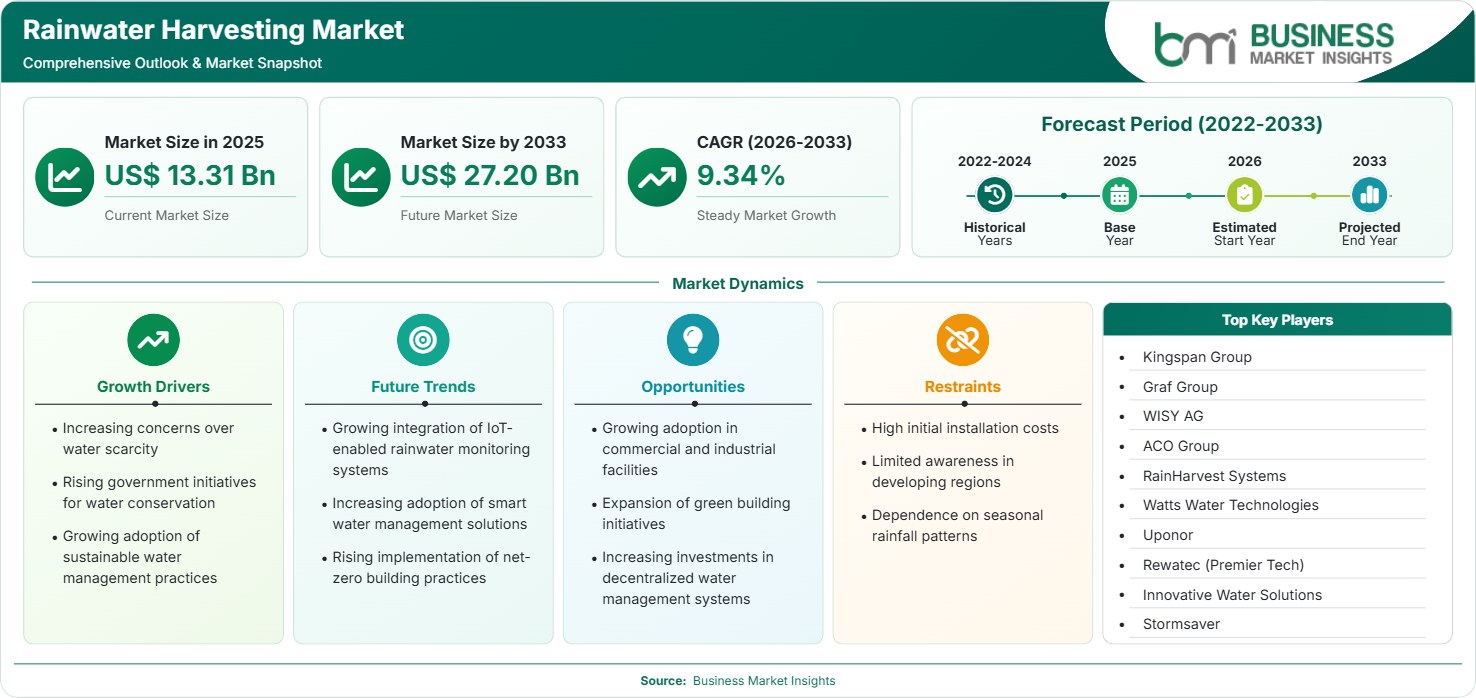
The Rainwater Harvesting Market size was valued at US$ 13.31 Billion in 2025 and is projected to reach US$ 27.20 Billion by 2033, growing at a CAGR of 9.34% during 2026–2033, driven by increasing water scarcity concerns, government conservation initiatives, sustainable infrastructure development, and decentralized water management investments.

Report Coverage
  • Type: Rain Barrel System, Dry System, Wet System, Green Roof System
  • Harvesting Method: Above Ground Harvesting, Under Ground Harvesting
  • Installation: Industrial, Commercial, Residential, Agricultural
US$ 13.31 Bn Market size in 2025
US$ 27.20 Bn Market Size by 2033
9.34% CAGR, 2026 - 2033
2026-2033 Forecast Period

01 AI Overview

Rainwater Harvesting Market Summary

  • North America Region: North America holds a 32%–35% share in 2025, growing at a CAGR of 8%–10% during 2026–2033, supported by water conservation regulations, green infrastructure adoption, and climate resilience programs. The US market expands at a CAGR of 8%–10%, driven by sustainable construction, commercial installations, and municipal water management initiatives.
  • Fastest Growing Region: Asia Pacific accounts for a 30%–33% share in 2025, expanding at a CAGR of 11%–13% during 2026–2033, supported by rapid urbanization, groundwater depletion concerns, government conservation programs, and increasing investments in decentralized water management systems.
  • Leading Segment: Above Ground Harvesting represents a 55%–58% share in 2025, advancing at a CAGR of 8%–10% during 2026–2033, supported by residential acceptance, lower installation complexity, maintenance advantages, and growing awareness of sustainable household water solutions.
  • High Growth Segment: Green Roof System holds a 12%–15% share in 2025, expanding at a CAGR of 12%–14% during 2026–2033, driven by green building adoption, urban stormwater management requirements, climate adaptation initiatives, and sustainable architecture practices.
  • Key Market Opportunity: Commercial and industrial facilities provide significant opportunities through increasing water conservation requirements, sustainable building standards, operational cost reduction goals, and investments in decentralized water management infrastructure.
  • Major Market Players: Kingspan Group, Graf Group, WISY AG, ACO Group, RainHarvest Systems, Watts Water Technologies, Uponor, Rewatec (Premier Tech), Innovative Water Solutions, Stormsaver.
02 Strategic Insights

Rainwater Harvesting Market: Strategic Insights

Rainwater Harvesting Market Strategic Framework
FREE PDF
Request your free sample
Request free sample
03 Stakeholder View

Key Takeaways

  • The market ecosystem includes manufacturers of storage tanks, filtration systems, pumps, collection components, installation providers, construction companies, and sustainability consultants supporting integrated water management solutions.
  • Commercial complexes, industrial facilities, agricultural operations, and urban infrastructure projects represent high-potential application areas due to increasing demand for water independence and sustainable resource utilization.
  • Technology development is moving toward automated monitoring systems, improved filtration efficiency, modular designs, and digitally connected solutions that enhance system performance and reduce maintenance requirements.
  • Asia Pacific offers strong investment potential due to rising urban populations, increasing water scarcity challenges, government conservation programs, and expanding sustainable infrastructure development.
  • Strategic partnerships and acquisitions are increasing as established water management companies expand capabilities in storage technologies, decentralized systems, and environmentally responsible infrastructure solutions.
  • Green construction standards and environmental regulations are becoming important demand drivers as developers integrate water conservation systems into new and renovated buildings.
04 Geographic Outlook

Rainwater Harvesting Market Regional Highlights

North America Rainwater Harvesting Market

North America accounted for a 32%–35% share in 2025 and is projected to expand at a CAGR of 8%–10% from 2026–2033. The region benefits from sustainable construction practices, water conservation policies, and increasing adoption across commercial and institutional facilities. Rainwater Harvesting Market share remains strong due to environmental regulations, climate adaptation investments, and growing demand for efficient water resource management.

  • The United States remains the leading regional market due to commercial adoption, drought management initiatives, and increasing sustainable infrastructure investments.
  • Canada demonstrates rising adoption through environmental programs, green building projects, and increasing focus on stormwater management solutions.
  • Government incentives and municipal conservation initiatives are encouraging wider implementation of collection and storage technologies.
  • Advanced filtration systems and smart monitoring solutions are improving reliability across residential and commercial applications.

US Rainwater Harvesting Market

The US accounted for a 27%–30% share in 2025 and is expected to grow at a CAGR of 8%–10% between 2026–2033. The country benefits from increasing water conservation awareness, sustainable construction practices, and demand from commercial facilities. Adoption is supported by climate concerns, regulatory initiatives, and corporate sustainability targets.

  • Commercial buildings are increasingly implementing systems to reduce water consumption and improve environmental performance.
  • Residential adoption is rising due to drought conditions, conservation awareness, and availability of efficient collection technologies.
  • Industrial users are integrating rainwater systems to support operational efficiency and reduce reliance on municipal water supplies.

Europe Rainwater Harvesting Market

Europe represented a 22%–25% share in 2025 and is projected to grow at a CAGR of 9%–11% during 2026–2033. The region benefits from strict sustainability regulations, green building initiatives, and climate resilience strategies. Germany, the United Kingdom, and France are major markets, with Germany expanding at 10%–12% CAGR and the UK growing at 9%–11% CAGR.

  • Germany leads adoption through advanced environmental standards and sustainable building requirements supporting efficient water management systems.
  • The United Kingdom demonstrates growth through urban resilience projects and increasing commercial sustainability commitments.
  • France supports market development through environmental regulations promoting water conservation and resource efficiency.
  • European municipalities are investing in decentralized water systems to manage stormwater and climate-related challenges.

Asia Pacific Rainwater Harvesting Market

Asia Pacific held a 30%–33% share in 2025 and is expected to register the highest CAGR of 11%–13% during 2026–2033. The region benefits from rapid urbanization, groundwater stress, and government-led conservation programs. India, China, and Southeast Asian countries are major contributors, with India growing at 12%–14% CAGR due to strong water management initiatives.

  • India shows strong adoption due to groundwater depletion concerns, regulatory support, and increasing residential and institutional installations.
  • China is expanding through sustainable urban development programs and investments in efficient water infrastructure.
  • Southeast Asian markets are adopting decentralized systems to improve water availability and support urban growth.
  • Infrastructure modernization projects are creating demand for advanced collection, storage, and filtration technologies.

Rest of World Rainwater Harvesting Market

South and Central America, along with Middle East and Africa, represented a 10%–13% share in 2025 and are projected to grow at a CAGR of 10%–12% through 2033. Brazil, Mexico, UAE, and South Africa are emerging markets due to water stress, agricultural requirements, and sustainable development initiatives.

  • Brazil is adopting rainwater systems through agricultural applications, urban conservation programs, and environmental management initiatives.
  • Mexico demonstrates demand growth due to drought challenges, industrial requirements, and increasing water efficiency awareness.
  • Middle Eastern countries are investing in alternative water solutions to strengthen resource security and reduce dependency.
  • African regions are implementing systems for agricultural resilience, community water access, and local resource management.
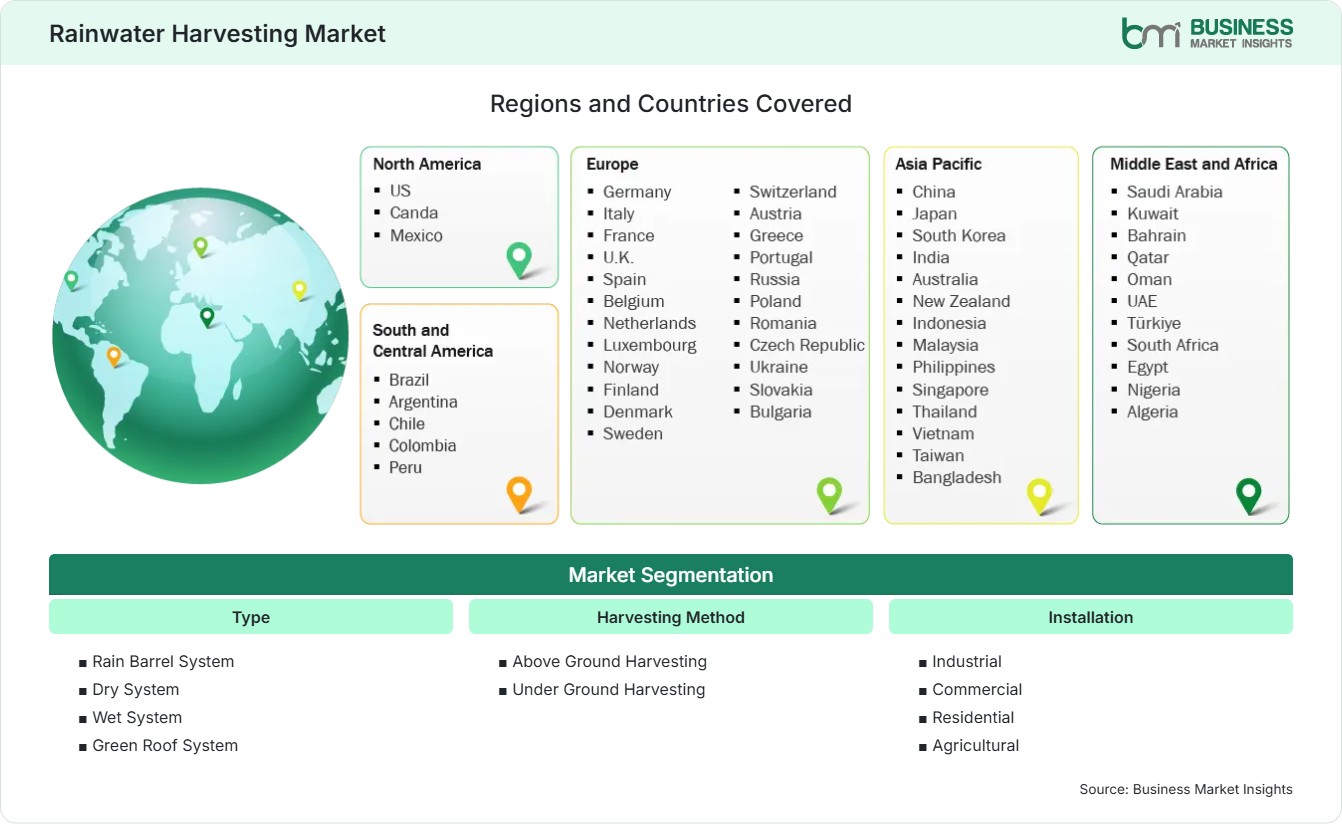
Global Market Geography
FREE PDF
Request your free sample
Request free sample
05 Segment Analysis

Rainwater Harvesting Market Segmentation

Type

The Type segment accounted for a 100% market structure in 2025, with Rain Barrel System holding a 30%–33% share and growing at a CAGR of 8%–10% between 2026–2034. The segment is influenced by residential adoption, affordable installation, and increasing demand for decentralized water conservation solutions. The Rainwater Harvesting Market scope is expanding as households, businesses, and institutions implement efficient collection technologies.

  • Rain Barrel System: Rain barrel systems provide economical rainwater storage for residential and small-scale applications. Adoption is increasing due to easy installation, low maintenance requirements, and growing household interest in sustainable water conservation.
  • Dry System: Dry systems improve collection efficiency by reducing standing water issues through direct drainage designs. They are increasingly used where maintenance simplicity, compact installation, and reliable water storage performance are priorities.
  • Wet System: Wet systems connect multiple drainage points through underground piping networks to centralized storage areas. They are suitable for larger properties requiring enhanced collection capacity and efficient water distribution.
  • Green Roof System: Green roof systems combine vegetation layers with rainwater retention capabilities. Adoption is rising due to sustainable building requirements, urban stormwater control needs, and increasing demand for environmentally efficient construction designs.

Harvesting Method

The Harvesting Method segment represented a 100% market structure in 2025, with Above Ground Harvesting accounting for a 55%–58% share and expanding at a CAGR of 8%–10% between 2026–2034. The segment benefits from easier installation, lower infrastructure requirements, and residential acceptance. Under Ground Harvesting adoption is increasing in commercial and industrial projects requiring larger storage capacity and improved space utilization.

  • Above Ground Harvesting: Above ground harvesting systems provide accessible storage solutions with simpler installation procedures. They are widely adopted in residential buildings, small commercial facilities, and locations requiring cost-effective water collection systems.
  • Under Ground Harvesting: Underground harvesting systems support higher-capacity storage while preserving surface space. They are preferred in urban developments, industrial facilities, and commercial projects requiring integrated water management infrastructure.

Installation

The Installation segment accounted for a complete market structure in 2025, with Commercial installations representing a 28%–31% share and growing at a CAGR of 10%–12% between 2026–2034. Growth is supported by sustainability targets, green building standards, and operational water reduction goals. Industrial, residential, and agricultural applications continue expanding as users seek reliable alternatives for water resource management.

  • Industrial: Industrial installations support manufacturing operations by reducing dependence on external water sources. Adoption is increasing through sustainability goals, operational efficiency requirements, and demand for reliable water supply alternatives.
  • Commercial: Commercial installations are expanding across offices, hotels, educational facilities, and retail properties. Growth is supported by green building initiatives, regulatory compliance, and efforts to reduce water consumption.
  • Residential: Residential systems are gaining adoption due to increasing awareness of water conservation, household sustainability goals, and government initiatives encouraging efficient water management practices.
  • Agricultural: Agricultural installations support irrigation requirements and drought resilience. Farmers are adopting rainwater systems to improve water availability, reduce dependency on uncertain rainfall patterns, and enhance resource efficiency.
06 Market Forces

Rainwater Harvesting Market Dynamics

Key Market Drivers

Increasing Concerns Over Water Scarcity

Growing water scarcity is one of the strongest factors accelerating adoption of rainwater collection systems across residential, agricultural, commercial, and industrial applications. Population growth, urban expansion, and changing rainfall patterns are increasing pressure on traditional water resources. The Rainwater Harvesting Market growth is supported by rising awareness of sustainable water solutions and increasing demand for alternative sources. The United Nations has identified water stress as a major global sustainability challenge, encouraging governments and organizations to invest in conservation infrastructure. Rainwater systems provide decentralized solutions that improve water security, support groundwater management, and reduce dependency on conventional supply networks.

Rising Government Initiatives for Water Conservation

The government-run programs for water conservation have been making it more favorable for rainwater harvesting systems by imposing rules and regulations, incentives, and sustainable development strategies. Several areas have begun implementing building codes that involve the installation of water-efficient measures in construction projects. The investments in stormwater management and ground water recharge programs by the government are providing ample chances for the system manufacturers. The government has been favoring decentralized approaches for improving the sustainability of water resources and decreasing the burden on centralized systems.

Growing Adoption of Sustainable Water Management Practices

Sustainability commitments from businesses, governments, and property developers are increasing integration of rainwater harvesting systems into modern infrastructure. Organizations are adopting water-efficient technologies to improve environmental performance and meet sustainability objectives. The Rainwater Harvesting Market trends indicate rising demand for integrated solutions combining storage, filtration, and monitoring capabilities. Green building certifications are encouraging developers to include water conservation systems in new projects. Climate adaptation strategies are further supporting adoption as communities seek reliable solutions to manage rainfall variability and improve long-term water availability.

Key Market Opportunities

Growing Adoption in Commercial and Industrial Facilities

Commercial and industrial organizations are among the major prospects when firms look to cut down costs associated with water usage and enhance their sustainability profile. Large organizations need systems that will ensure proper management of water used in landscaping, cooling, cleaning, and other processes. Harvesting rainwater gives another option and can contribute towards efficiency and environmental regulations. Growing corporate responsibility and regulation are prompting companies to invest in innovative ways of collecting rainwater. Firms that offer scalable storage and filtration systems, and water tracking technology are in position to capitalize on the opportunity.

Expansion of Green Building Initiatives

Green building initiatives are creating additional opportunities for rainwater harvesting system providers as developers integrate sustainable solutions into new construction projects. Environmental certifications and energy-efficient building standards increasingly include water conservation requirements. Green roofs, efficient drainage systems, and integrated water reuse technologies are becoming important components of sustainable architecture. The Rainwater Harvesting Market Forecasts indicate continued expansion as urban planners prioritize climate-resilient buildings and environmentally responsible infrastructure. Increased construction activity across developed and emerging markets will support adoption among residential communities, commercial properties, and public infrastructure projects.

Increasing Investments in Decentralized Water Management Systems

Growing investment is being made in decentralized water management systems as there is a growing search for alternatives to the conventional centralized infrastructure. The flexibility of localized systems makes them useful in situations where there are water shortages, inadequate infrastructure, and climatic problems. Rainwater harvesting provides the ability for communities, industries, and agriculture to use water efficiently. The markets for emerging economies show huge opportunities for growth because of increasing urbanization and water security problems. The companies that have innovative designs and efficient filters and digital platforms will be able to capitalize on these opportunities.

Market Restraints and Challenges

High Initial Installation Costs

Factor: Rainwater harvesting systems require upfront investment for storage tanks, filtration equipment, piping infrastructure, and professional installation services. Impact: The high-cost factor may be an obstacle to the implementation of such systems in households, small enterprises, and markets that are financially sensitive despite the eventual savings. The problem becomes even more difficult in areas where awareness has been heightened, yet the ability to invest has not. This problem has been addressed by manufacturers through modular and easy-to-install products at reasonable prices. This can be further facilitated through government incentives for lower initial cost requirements.

Limited Awareness in Developing Regions

Factor: Developing regions often experience limited awareness regarding rainwater harvesting benefits, installation processes, and long-term economic advantages. Impact: Lack of understanding hinders adoption rates, even when there are many issues of water shortage and need for proper resource management. Education, campaigns by the government and demonstrations within communities are necessary for improving the rate of adoption. Collaboration between manufacturers and the development agencies, together with local authorities, can facilitate knowledge exchange and adoption. Increasing awareness will continue to be necessary for the growth of adoption in areas with increasing water shortage.

07 Company Analysis

Competitive Landscape

The Rainwater Harvesting Market analysis highlights competition among water management companies, storage solution providers, infrastructure specialists, and sustainable technology developers. Companies are focusing on advanced collection systems, modular designs, filtration efficiency, smart monitoring capabilities, and customized solutions for residential, commercial, industrial, and agricultural applications.

Company Name

Overview

Products and Services relevant to this market

Kingspan Group

Global provider of sustainable water management and storage solutions serving multiple industries.

Rainwater harvesting tanks, storage solutions, water management systems, filtration technologies.

Graf Group

German manufacturer specializing in decentralized water management solutions.

Rainwater tanks, infiltration systems, storage products, wastewater solutions.

WISY AG

Water technology company focused on innovative rainwater collection systems.

Rainwater filters, collection components, pumping systems, water reuse solutions.

ACO Group

Infrastructure solutions provider supporting water management and drainage applications.

Drainage systems, stormwater management, collection infrastructure, filtration solutions.

RainHarvest Systems

Specialist provider of residential and commercial rainwater harvesting equipment.

Rainwater collection systems, storage tanks, filtration units, installation solutions.

Watts Water Technologies

Water technology company offering solutions for efficient water management.

Water control systems, filtration products, plumbing solutions, rainwater management components.

Uponor

Infrastructure technology company specializing in water distribution solutions.

Water management systems, piping solutions, sustainable building infrastructure.

Rewatec (Premier Tech)

Water treatment and storage solutions provider operating globally.

Rainwater harvesting tanks, treatment systems, decentralized water solutions.

Innovative Water Solutions

Provider of customized water conservation and harvesting systems.

Rainwater collection systems, storage solutions, filtration technologies, consulting services.

Stormsaver

UK-based rainwater harvesting specialist supporting commercial projects.

Rainwater harvesting systems, maintenance services, monitoring solutions, commercial installations.


10 Trust & Transparency

Research Methodology

The market analysis combines proprietary research with secondary data from government agencies, company disclosures, regulatory filings, industry databases and expert interviews. Market estimates are validated through data triangulation, cross-market benchmarking and analyst review.

View Full Research Methodology

11 Questions Answered

Frequently Asked Questions

How does the Rainwater Harvesting Market Report support strategic decisions?

The report provides insights into regional opportunities, competitive positioning, application trends, technology developments, and investment opportunities for industry participants.

What role does sustainability regulation play in market development?

Sustainability regulations encourage developers and organizations to implement water-efficient infrastructure, support green building standards, and improve long-term resource conservation practices.

How are technologies improving rainwater harvesting efficiency?

Advanced filtration, automated monitoring, modular storage systems, and smart water management technologies are improving collection efficiency, maintenance, and operational performance.

Which application areas provide the strongest growth potential?

Commercial facilities, industrial sites, agricultural operations, and sustainable residential developments provide strong opportunities due to increasing water management requirements and environmental objectives.

What factors are increasing adoption of rainwater harvesting market?

Increasing water scarcity, government conservation programs, sustainable building requirements, and demand for decentralized water solutions are accelerating adoption across multiple end-use sectors.

Access the Full Rainwater Harvesting Market Report

Get segment-level forecasts, regional estimates, competitive benchmarking, company profiles and downloadable Excel datasets.

Access the full Rainwater Harvesting Market Report
350 pages PDF & Excel | 2026-08-04