
Rainscreen Cladding Market Outlook: Size, Share, Trends, Growth Analysis, Competitive Landscape & Forecast, 2026-2033

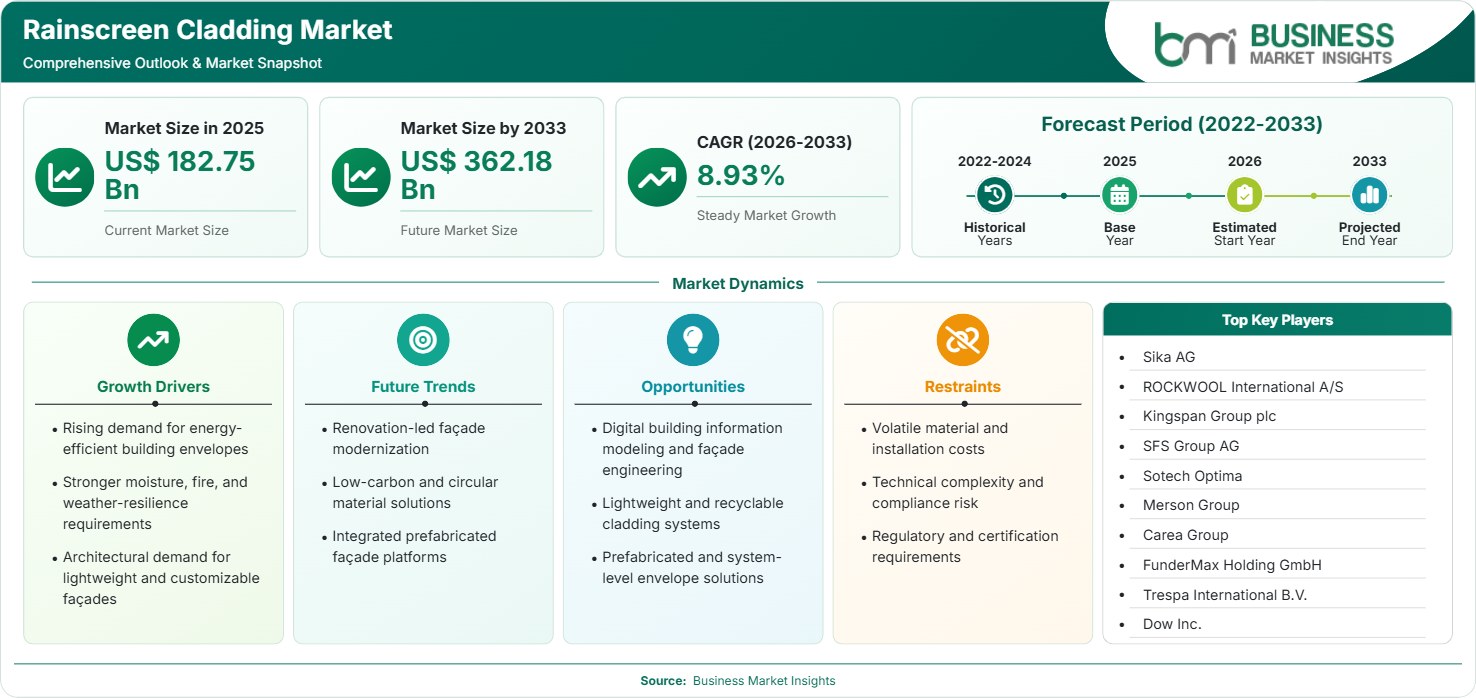
The Rainscreen Cladding Market size was valued at US$ 182.75 Billion in 2025 and is projected to reach US$ 362.18 Billion by 2033, growing at a CAGR of 8.93% during 2026–2033, driven by energy efficiency, moisture management, renovation, fire safety, and sustainable façade design.

Report Coverage
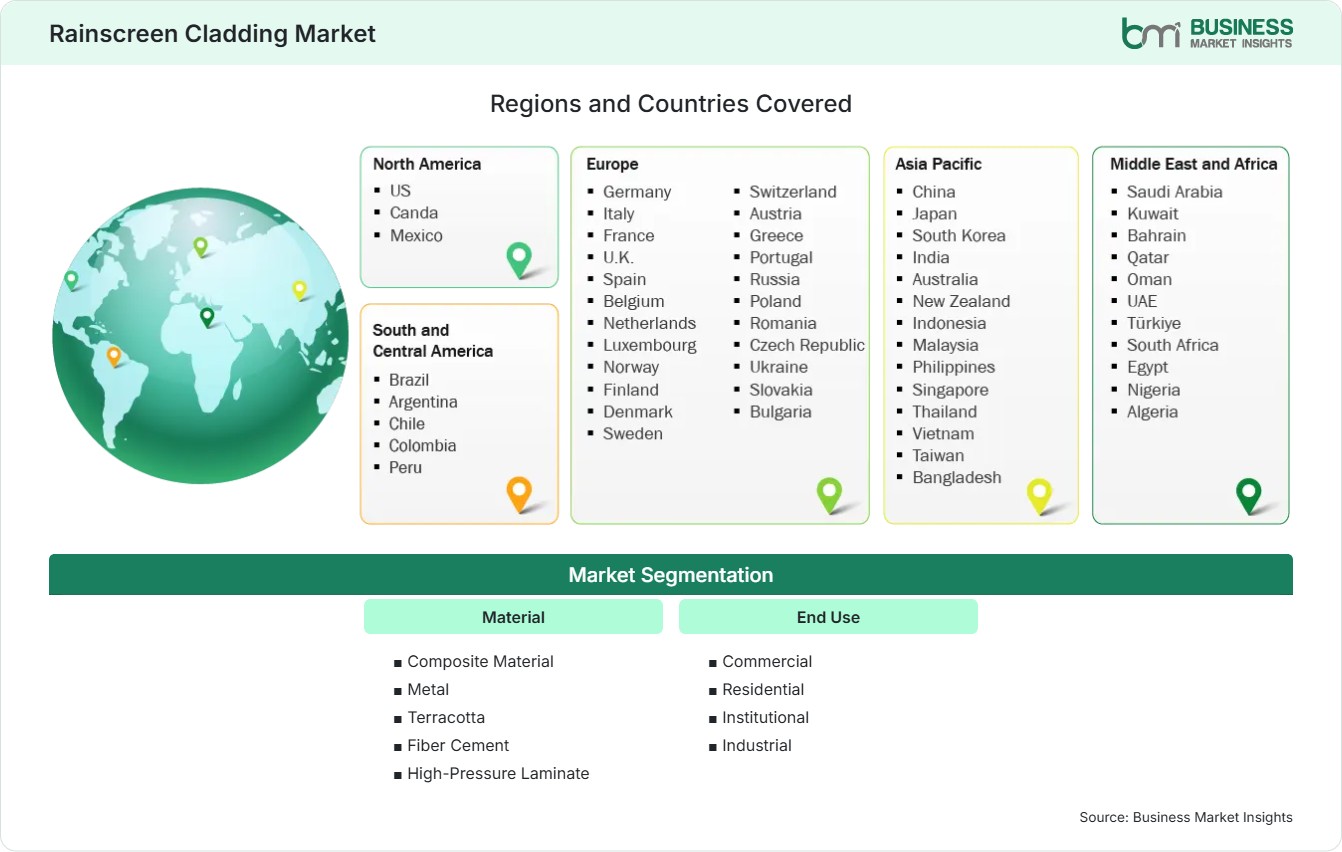
  • Material: Composite Material, Metal, Terracotta, Fiber Cement, High-Pressure Laminate
  • End Use: Commercial, Residential, Institutional, Industrial
US$ 182.75 Bn Market size in 2025
US$ 362.18 Bn Market Size by 2033
8.93% CAGR, 2026 - 2033
2026-2033 Forecast Period

AI Overview

Rainscreen Cladding Market Summary

  • North America Region: North America holds a 26%–29% share of the Rainscreen Cladding Market in 2025, growing at a 7.0%–7.4% CAGR, influenced by commercial construction, façade renovation, energy codes, moisture protection, and demand for durable envelope systems. The US remains the regional anchor, with approximately 6.8%–7.5% CAGR through 2033, supported by green-building investment and commercial redevelopment. External market evidence places North America among the largest regional markets and identifies energy-efficient construction as a principal demand driver.
  • Fastest Growing Region: Asia Pacific holds a 20%–24% share in 2025 and is projected to expand at a 9.0%–9.8% CAGR, supported by urbanization, infrastructure investment, high-rise construction, climate resilience, and expanding adoption of ventilated façades.
  • Leading Segment: Composite Material holds a 32%–36% share in 2025 and is projected to expand at an 8.4%–9.1% CAGR, supported by lightweight construction, design flexibility, thermal integration, prefabrication, and demand for durable architectural envelopes.
  • High Growth Segment: Metal is positioned as the high-growth segment, expanding at a 9.6%–10.2% CAGR, as lightweight panels, recyclable aluminium, concealed fixing, fire-performance requirements, and architectural customization increase adoption across commercial projects.
  • Key Market Opportunity: Building renovation, low-carbon materials, prefabricated façade assemblies, digital design tools, and climate-resilient envelopes create investment opportunities where performance certification and installation expertise can command premium margins.
  • Major Market Players: Sika AG, ROCKWOOL International A/S, Kingspan Group plc, SFS Group AG, Sotech Optima, Merson Group, Carea Group, FunderMax Holding GmbH, Trespa International B.V., Dow Inc., and Other Key Players.
Strategic Insights

Rainscreen Cladding Market: Strategic Insights

Rainscreen Cladding Market Strategic Framework
FREE PDF
Request your free sample
Request free sample
Stakeholder View

Key Takeaways

  • The value chain is moving toward integrated façade packages covering panels, insulation, subframes, membranes, cavity barriers, fixings, sealants, engineering, and installation. This favors suppliers capable of coordinating multiple performance requirements rather than competing solely on panel pricing.
  • Commercial projects provide the broadest specification base, while institutional and residential refurbishment offer additional upside. Commercial applications benefit from repeatable façade designs, stricter performance specifications, and the need to minimize lifecycle maintenance.
  • Product development is moving toward thinner, lighter, more recyclable, fire-resilient, and thermally optimized assemblies. Concealed fixing and prefabricated subframes are becoming important because they improve façade appearance while reducing installation complexity.
  • Asia Pacific offers the strongest expansion potential because urban construction, infrastructure investment, and modern façade adoption are advancing simultaneously. India, China, Japan, and Southeast Asian markets provide differentiated opportunities across new construction and refurbishment.
  • Strategic positioning increasingly centers on complementary insulation, façade engineering, fastening, and building-material capabilities. Suppliers can capture greater value by combining technical specifications with distribution and installer networks.
  • Buyers are increasingly evaluating façade systems through durability, fire performance, thermal bridging, maintenance, and environmental documentation. This favors suppliers able to demonstrate tested system-level performance rather than isolated product characteristics.
Geographic Outlook

Rainscreen Cladding Market Regional Highlights

North America Rainscreen Cladding Market

North America is projected to account for 26%-29% of the market value in 2025 and to grow at a 7.0%-7.4% CAGR from 2026 to 2033. Factors such as construction projects, energy efficiency, renovation, and weather resistance play an important role in stimulating demand. North America has developed expertise in façade engineering and rainscreen systems standards. Most activities in this region are conducted in the United States, whereas Canada has strong growth prospects due to cold-weather construction. Regional evidence also identifies North America as a leading market, with 2025 revenue estimates and a 7.2% forecast CAGR.

  • Commercial redevelopment remains an important demand center as owners upgrade exterior envelopes for energy performance, weather resistance, appearance, and lower maintenance requirements across offices, retail properties, and mixed-use developments.
  • Fire performance and moisture management increasingly influence specifications, encouraging architects to select tested assemblies combining insulation, cavity barriers, subframes, membranes, and cladding rather than treating façade components independently.
  • Canada provides a strong application environment because cold temperatures, freeze-thaw cycles, wind exposure, and energy-performance requirements increase the value of durable ventilated envelope systems.
  • The regional Rainscreen Cladding Market share is supported by established contractors, façade consultants, and manufacturers capable of delivering customized systems for institutional and commercial construction.

US Rainscreen Cladding Market

The US accounts for about 68%–72% of demand in North America and is forecast to grow at a 6.8%–7.5% CAGR from 2022 to 2033. Factors such as commercial development, institutional buildings, building facade retrofitting, and green-building criteria are behind adoption. Building envelope improvements are important when old buildings need to be more resistant to moisture and heat. Current market analysis reports 7.5% CAGR for the US market until 2034 and 6.8% for 2025–2034, which justifies our modeling approach.

  • US demand is increasingly specification-driven, with architects prioritizing tested assemblies that address wind loading, water management, thermal bridging, fire performance, and installation sequencing.
  • Renovation provides a substantial addressable pool because façade systems can improve existing buildings without requiring complete structural replacement, particularly across urban commercial and institutional properties.
  • The Rainscreen Cladding Market growth outlook benefits from energy-efficient building objectives, weather-resilient design, and continued investment in commercial and institutional construction.

Europe Rainscreen Cladding Market

The Europe region has a market share of 42%-45% in global demand as of 2025, expected to grow at a CAGR of 7.4%-8.0% till 2033. The Europe region possesses strengths in performance buildings, advanced façade technology, renovation experience, and experience with ventilated façades. Germany, the United Kingdom, France, Italy, and the Netherlands are leading countries in Europe, and Poland and Spain have promising growth opportunities. Research in 2025 reveals that Europe holds a 43.85% market share of global demand.

  • Germany and the UK remain important specification markets because energy performance, fire safety, refurbishment, and façade durability strongly influence building-envelope decisions across commercial and residential projects.
  • France and the Netherlands benefit from established architectural use of ventilated façade systems, particularly where appearance, moisture management, and energy performance must be integrated.
  • Poland is positioned as a higher-growth European market as modern commercial buildings and refurbishment projects increase demand for engineered façade assemblies.
  • The regional Rainscreen Cladding Market share is reinforced by established manufacturers, specialist installers, façade consultants, and technical standards supporting system-level procurement.

Asia Pacific Rainscreen Cladding Market

The Asia Pacific region accounts for about 20%–24% of demand in 2025 and is forecast to grow at a 9.0%–9.8% CAGR through 2033. The region stands out as the fastest-growing market owing to a wide variety of markets, including China, Japan, India, South Korea, Australia, and Southeast Asia. Urban development, high-rise buildings, infrastructure investments, and awareness of the latest envelope technologies will fuel adoption. India presents strong growth prospects due to sustainable materials and façade engineering becoming increasingly integrated into commercial and residential developments.

  • China provides scale through extensive urban development, commercial construction, infrastructure projects, and demand for lightweight façade systems capable of supporting complex architectural designs.
  • India is developing rapidly as green-building adoption, premium residential construction, commercial real estate, and institutional projects increase demand for weather-resistant and energy-conscious façades.
  • Japan and South Korea favor technically advanced systems where durability, seismic considerations, thermal performance, and precise installation are important procurement criteria.
  • Southeast Asia offers expanding opportunities as humid climates and heavy rainfall increase the value of ventilated cavities, drainage pathways, and moisture-management strategies.

Rest of World Rainscreen Cladding Market

The Rest of World accounts for about 5%-8% of global demand by 2025 and is projected to grow at a CAGR of 6.5%-7.3% through 2033. South & Central America will be driven by urban redevelopment, commercial buildings, and increased preference for durable exterior materials. Brazil, Mexico, Chile, Colombia, and Argentina provide the best opportunities in the region. The selection of material will depend on climatic exposure, maintenance costs, and installation facilities in the region.

The Middle East & Africa present distinctive opportunities due to commercial, hospitality, institutional, and mixed-use developments. Saudi Arabia, the United Arab Emirates, and South Africa are the key regions for demand growth, with Saudi Arabia showing the most favorable project momentum. Climatic conditions will favor solar resistance, moisture management, durability, and product maintenance in this region. Rainscreen Cladding Market share in this region will be lower than in developed regions; however, specialized projects can facilitate premium product adoption.

  • Latin American developers increasingly evaluate façade systems through lifecycle performance, particularly where heavy rainfall, high solar exposure, and maintenance costs influence building ownership economics.
  • Saudi Arabia and the UAE provide high-value opportunities because large commercial, hospitality, and mixed-use developments often incorporate distinctive architectural envelopes and advanced façade technologies.
  • South Africa offers demand across commercial and institutional buildings, with performance requirements shaped by climate exposure, energy efficiency, and building durability.
  • The regional Rainscreen Cladding Market growth outlook depends strongly on project financing, imported material costs, technical expertise, and availability of qualified façade installers.
Global Market Geography
FREE PDF
Request your free sample
Request free sample
Segment Analysis

Rainscreen Cladding Market Segmentation

Material

The Material category includes composite material, metal, terracotta, fiber cement, high-pressure laminate, and more. Composite Material is considered the dominant category, accounting for 32%-36% of the market share by 2025 and growing at an 8.4%-9.1% CAGR from 2025 to 2034. Choice is influenced by appearance, weight, longevity, fire performance, construction, recyclability, cost, and ease of installation. The scope of the Rainscreen Cladding Market is evolving toward engineered products.

  • Composite Material: Lightweight composite panels provide architectural flexibility, efficient fabrication, and broad color options, supporting commercial façades where appearance, installation speed, and controlled panel dimensions influence project economics.
  • Metal: Aluminium and steel panels provide lightweight construction, recyclability, dimensional precision, and strong architectural flexibility, supporting commercial and institutional façades requiring concealed fixing and customized profiles.
  • Terracotta: Terracotta combines durability, natural appearance, and weather resistance, attracting architects seeking long-life façades with material character and strong visual differentiation in premium developments.
  • Fiber Cement: Fiber cement offers dimensional stability, fire-resistant options, and practical installation characteristics, supporting residential, institutional, and commercial projects seeking durable façade performance with restrained maintenance requirements.
  • High-Pressure Laminate: High-pressure laminate provides extensive design flexibility, surface durability, and efficient panel fabrication, making it suitable for visually demanding façades across education, commercial, residential, and institutional buildings.

End-Use

The End-Use category comprises Commercial, Residential, Institutional, and Industrial end-uses. Commercial construction is considered the leading end-use category, accounting for a 42% to 47% share by 2025 and an 8.1% to 8.8% CAGR up to 2034. This end-use benefits from office, retail, hospitality, and mixed-use construction, where high-durability architectural envelopes are needed.

  • Commercial: Commercial buildings prioritize façade aesthetics, weather protection, energy performance, and predictable installation, supporting broad adoption across offices, retail centers, hospitality properties, and mixed-use developments.
  • Residential: Residential applications are expanding through multifamily construction, premium housing, refurbishment, and energy-efficiency upgrades where durable façade systems can improve appearance and moisture protection.
  • Institutional: Institutional projects emphasize durability, fire performance, lifecycle maintenance, and design consistency, supporting adoption across schools, universities, healthcare facilities, civic buildings, and public infrastructure.
  • Industrial: Industrial facilities use rainscreen systems where weather resistance, maintenance access, durability, and rapid construction are important, particularly for production, logistics, warehouse, and specialized industrial buildings.
Market Forces

Rainscreen Cladding Market Dynamics

Key Market Drivers

Rising Demand for Energy-Efficient Building Envelopes

Performance of energy systems is changing façade designs to incorporate insulation, ventilation, moisture management, and reduced thermal bridging. This market is expanding due to the ability of ventilated spaces to separate the weathering effect from insulated walls and improved insulation and detailing. Policy from Europe is highly relevant, as building renovation and efficiency requirements create a need for deep-envelope solutions. The demand from North America is also due to the emphasis on efficient energy construction. Studies conducted on building stock across the globe show that developing countries could have much more floor space by the year 2070, hence the relevance of good envelope design in the future. Manufacturers reacting to these needs are creating matching insulation, subframe, membrane, and panel products.

Stronger Moisture, Fire, and Weather-Resilience Requirements

Waterproofing and fire protection have emerged as crucial factors in the procurement process, as facade systems can lead to structural damage, indoor environmental issues, remediation costs, and brand damage. The ventilated cavity provides an outlet for drainage and drying. Meanwhile, cavity barriers and fire-tested materials meet the fire safety standards. According to ROCKWOOL's 2025 report, its NyRock Rainscreen 032 insulation was tested under conditions similar to Category 4 hurricane conditions. Regulations for building in several developed countries are tightening the rules regarding exterior walls. As such, Rainscreen Cladding Market trends show a preference for certified products, tested fixing arrangements, fire resistance data, and engineering services. Consumers have become less likely to assess panel performance independent of the substructure, insulation, cavity barriers, and installation method.

Architectural Demand for Lightweight and Customizable Façades

Architectural differentiation is driving demand for material systems that can create a wide range of colors, textures, sizes, geometries, and even hidden fixings without adding too much structural weight. The composite panels, aluminum systems, high-pressure laminate, fiber cement, and terracotta enable the architect to find that middle ground between aesthetics and the requirement for the envelope. Prefabrication means that dimensional precision is vital because the panels will be manufactured, drilled, finished, and tested before going to the site. SFS provides NVELOPE systems that allow both exposed and hidden fastening and are flexible in the materials used and the cavity depth, reflecting the industry trend towards customizable support systems.

Key Market Opportunities

Renovation-Led Façade Modernization

Renovation provides one of the strongest investment opportunities because aging buildings can receive improved thermal, moisture, fire, and aesthetic performance without complete reconstruction. European building stock offers excellent opportunities due to the large number of buildings that need their facades renovated to meet performance requirements. The commercial sector presents a particular opportunity because, for such investments, there is a way to show the return in terms of energy cost savings, reduced maintenance, higher tenant requirements, and asset repositioning. There are options for incorporating various insulation and cladding into the rainscreen system design, depending on the walls' existing conditions. For these reasons, the Rainscreen Cladding Market Forecasts indicate potential not only in new construction but also in retrofit engineering, facade replacement, and building envelope rehabilitation. Companies capable of performing surveys, design, fabrication, and installation of systems can benefit more from renovation opportunities, since renovation requires more sophisticated technical skills.

Low-Carbon and Circular Material Solutions

Environmental performance is creating new possibilities for recyclable metals, composite materials made of recycled materials, responsibly sourced materials, and mechanically reversible fixings. Circularity may decrease demolition waste if panels and fixings are designed for deconstruction, reuse, refurbishing, and recycling. SFS points out removable TUF-S fixings as one possible solution that may help with recovering and recycling the panels, especially fiber cement. Producers can create greater differentiation by providing environmental declarations, lifecycle information, evidence of recycled content, and an end-of-life plan. The possibility applies to manufacturers, architects, developers, procurers, and institutions that want to demonstrate their environmental performance. Those who will unite low-carbon material development with good finishing and documentation will be preferred despite higher product prices.

Integrated Prefabricated Façade Platforms

A prefabricated façade system can help address labor shortages, tight schedules, quality inconsistencies, and complex installation processes by shifting a large portion of the work to a factory-controlled environment. Systems that integrate insulation, membrane, rails, cavity barrier, and panels can minimize site interfaces and facilitate quality assurance efforts. The potential is especially applicable to high-rise residential, institutional, and commercial structures, where repetitive façade elements enable a standardized manufacturing process. Digital building information modeling can further facilitate coordination efforts by linking façade geometry, positioning, material quantities, and installation sequences. Suppliers can leverage their competitive edge by providing engineered systems and not just individual components. The potential also applies to modular construction, in which façade systems can be coordinated with other systems before delivery.

Market Restraints and Challenges

Volatile Material and Installation Costs

Factor: aluminium, steel, energy-intensive materials, transportation, and skilled installation can experience substantial cost fluctuations, particularly when construction demand and commodity markets move unevenly.

Impact: higher project budgets can delay procurement, encourage material substitution, or compress contractor margins. Rainscreen systems also require coordinated brackets, rails, insulation, membranes, fasteners, and cavity barriers, making the total installed cost more sensitive to component availability than a simple panel purchase. Industry research identifies unstable raw-material prices and installation charges as constraints on overall rainscreen pricing. Manufacturers can mitigate the impact through local sourcing, standardized components, prefabrication, inventory planning, and value-engineered configurations. However, premium systems remain exposed when project specifications lock in particular materials or proprietary fixing solutions, limiting procurement flexibility and increasing sensitivity to cost escalation during long construction cycles.

Technical Complexity and Compliance Risk

Factor: rainscreen performance depends on correct cavity dimensions, drainage paths, fixing locations, thermal interfaces, membranes, insulation, cavity barriers, and installation tolerances.

Impact: design or installation errors can reduce moisture management, increase thermal bridging, create fire-safety concerns, or trigger expensive remedial work. The complexity is amplified in refurbishment projects because existing substrates may be irregular or undocumented. Regulatory requirements also differ between countries, forcing manufacturers to maintain extensive technical documentation and project-specific compliance evidence. SFS emphasizes customized rainscreen support solutions and technical coordination, reflecting the need for system-level engineering rather than component-only sales. Smaller contractors may face training and certification barriers, while architects can face greater design responsibility. These factors favor established suppliers with testing infrastructure, engineering teams, installer education, and dependable technical support.

Company Analysis

Competitive Landscape

The Rainscreen Cladding Market analysis indicates a fragmented competitive environment spanning insulation manufacturers, façade-material producers, fastening specialists, chemical suppliers, and integrated building-envelope companies. Competition is increasingly based on tested system performance, sustainability documentation, installation efficiency, customization, technical support, and project specification relationships.

Company Name

Overview

Products and Services relevant to this market

Sika AG

Swiss construction-materials company with broad building-envelope expertise and strong façade bonding and sealing capabilities.

Façade adhesives, sealants, moisture-management systems, rendering solutions, bonding technologies, and cladding installation support.

ROCKWOOL International A/S

Denmark-based insulation specialist with strong expertise in stone wool and fire-performance solutions.

Rockpanel ventilated façade products, stone wool rainscreen insulation, cavity solutions, fire-performance systems, and technical support.

Kingspan Group plc

Ireland-based building-products group with extensive insulation and façade-system capabilities across international markets.

Rainscreen façade systems, insulation boards, cavity solutions, support systems, façade cassettes, and technical performance guidance.

SFS Group AG

Swiss fastening and building-envelope specialist serving façade contractors, manufacturers, and designers.

NVELOPE rainscreen subframes, brackets, rails, fasteners, concealed fixing solutions, and façade engineering support.

Sotech Optima

UK specialist focused on engineered rainscreen façade support and architectural cladding solutions.

Optima rainscreen systems, façade support components, brackets, rails, and project-specific engineering services.

Merson Group

US-based materials and façade specialist serving architectural and building-envelope applications.

Architectural cladding materials, façade components, engineered solutions, fabrication support, and project-specific envelope products.

Carea Group

French manufacturer recognized for mineral and architectural façade solutions serving building projects.

Carea façade panels, rainscreen cladding systems, mineral materials, architectural finishes, and technical façade solutions.

FunderMax Holding GmbH

Austrian materials company specializing in durable high-pressure laminate architectural surfaces.

Exterior HPL panels, façade cladding systems, decorative surfaces, fixing solutions, and architectural design support.

Trespa International B.V.

Netherlands-based architectural materials manufacturer focused on durable exterior panel technologies.

Trespa Meteon façade panels, rainscreen applications, concealed and mechanical fixing options, and façade design support.

Dow Inc.

US materials-science company supplying construction chemicals and performance materials used in building-envelope applications.

Sealants, silicone technologies, construction chemicals, weatherproofing materials, and façade-related performance solutions.

Other Key Players

Includes regional manufacturers, specialist façade contractors, material suppliers, and system integrators competing across local markets.

Panels, subframes, fasteners, insulation, membranes, fabrication, engineering, installation, maintenance, and façade consultancy services.

Trust & Transparency

Research Methodology

The market analysis combines proprietary research with secondary data from government agencies, company disclosures, regulatory filings, industry databases and expert interviews. Market estimates are validated through data triangulation, cross-market benchmarking and analyst review.

View Full Research Methodology

Questions Answered

Frequently Asked Questions

What does the Rainscreen Cladding Market Report help buyers evaluate?

It supports evaluation of regional demand, material opportunities, end-use applications, competitive positioning, technology developments, market drivers, constraints, and investment priorities across the global façade ecosystem.

How are manufacturers addressing sustainability requirements?

Manufacturers are developing recyclable materials, recycled-content products, mechanically removable fixings, environmental documentation, and longer-life finishes. These measures support circularity while helping architects and developers evaluate façade systems through lifecycle performance.

What role does prefabrication play in rainscreen projects?

Prefabrication can improve dimensional accuracy, reduce site labor, standardize fixing positions, and shorten installation schedules. It is particularly valuable for repetitive façades in high-rise residential, commercial, and institutional projects.

How does façade material selection influence project economics?

Material selection affects panel cost, structural support requirements, fabrication, installation speed, maintenance, replacement cycles, and environmental documentation. Lightweight materials may reduce structural and installation demands, while premium finishes can increase upfront cost but support architectural value.

Why is rainscreen cladding increasingly used in building renovation projects?

Rainscreen systems can add weather protection, improve thermal performance, modernize façades, and accommodate insulation upgrades without requiring complete structural replacement. Their modular construction can also support phased refurbishment.

Access the Full Rainscreen Cladding Market Report

Get segment-level forecasts, regional estimates, competitive benchmarking, company profiles and downloadable Excel datasets.

Access the full Rainscreen Cladding Market Report
350 pages PDF & Excel | 2026-08-31