
Prescription Sunglasses Market Outlook: Size, Share, Trends, Growth Analysis, Competitive Landscape & Forecast, 2026-2033

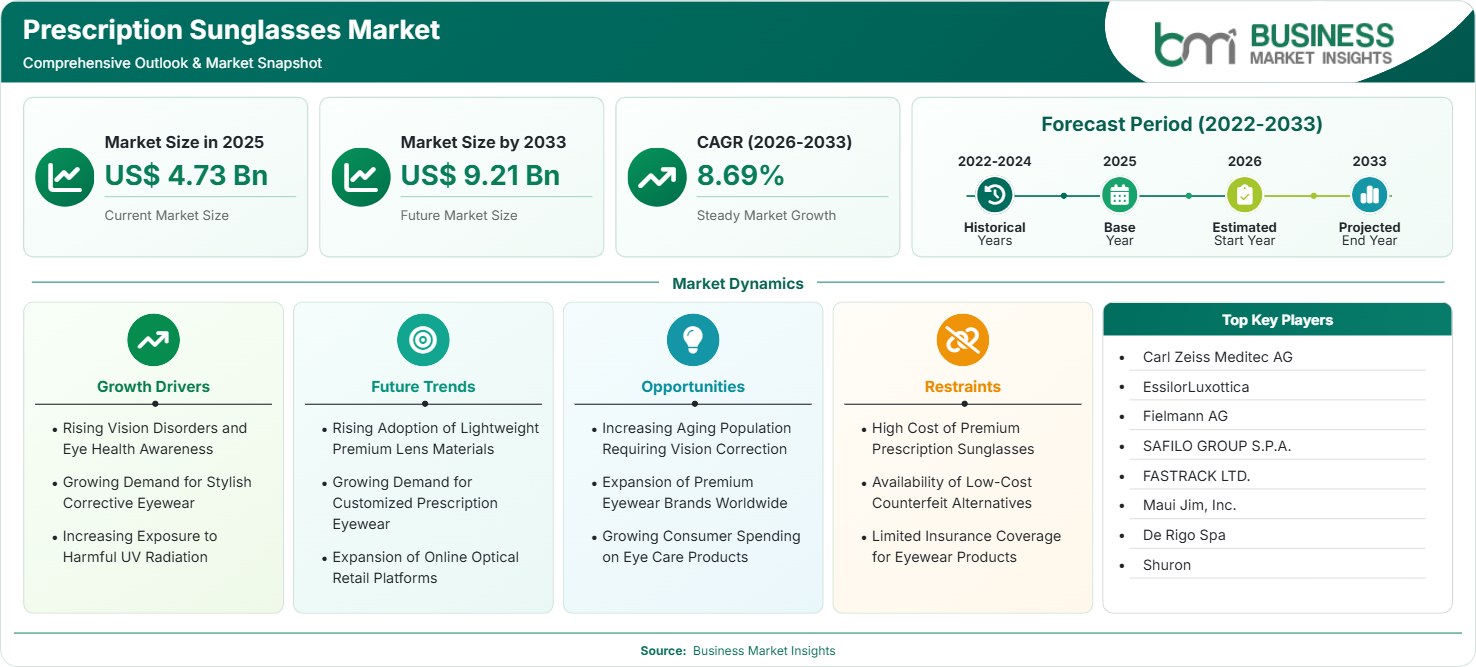
The Prescription Sunglasses Market size was valued at US$ 4.73 Billion in 2025 and is projected to reach US$ 9.21 Billion by 2033, growing at a CAGR of US$ 8.69% during 2026–2033, driven by rising vision correction needs, premium eyewear adoption, UV protection awareness, and expanding online retail opportunities.

Report Coverage
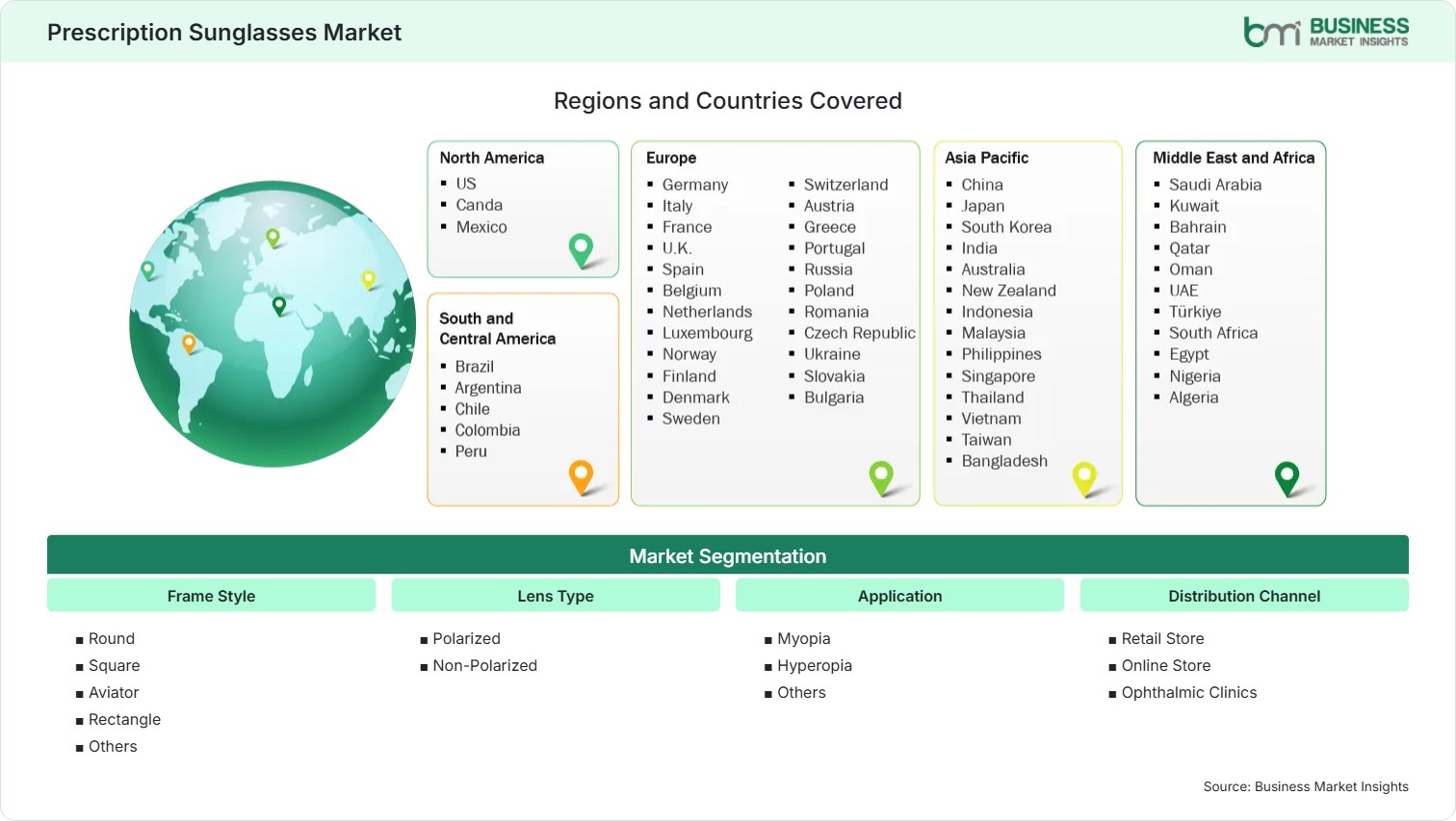
  • Frame Style: Round, Square, Aviator, Rectangle, Others
  • Lens Type: Polarized, Non-Polarized
  • Application: Myopia, Hyperopia, Others
  • Distribution Channel: Retail Store, Online Store, Ophthalmic Clinics
US$ 4.73 Bn Market size in 2025
US$ 9.21 Bn Market Size by 2033
8.69% CAGR, 2026 - 2033
2026-2033 Forecast Period

01 AI Overview

Prescription Sunglasses Market Summary

  • North America Region: North America holds a 34%–37% share in 2025, growing with a CAGR of 8.0%–9.0% influenced by high eyewear spending, optical innovation, and prescription lens adoption. The US market maintains strong demand across premium eyewear consumers, expanding at a CAGR of 8.2%–9.2% through 2033.
  • Fastest Growing Region: Asia Pacific holds a 27%–30% share in 2025, growing with a CAGR of 9.0%–10.0% supported by increasing vision correction requirements, urbanization, rising disposable income, and expanding optical retail networks.
  • Leading Segment: Polarized lens type holds a 58%–61% share in 2025, growing with a CAGR of 8.5%–9.5% driven by enhanced glare reduction, outdoor lifestyle trends, and consumer preference for protective eyewear solutions.
  • High Growth Segment: Online Store distribution holds a 24%–27% share in 2025, growing with a CAGR of 10.0%–11.0% supported by digital shopping platforms, virtual try-on technologies, and broader consumer accessibility.
  • Key Market Opportunity: Increasing demand for customized eyewear, advanced lens technologies, and direct-to-consumer channels creates opportunities for manufacturers to improve personalization, expand customer reach, and strengthen premium product portfolios.
  • Major Market Players: Carl Zeiss Meditec AG, EssilorLuxottica, Fielmann AG, SAFILO GROUP S.P.A., FASTRACK LTD., Maui Jim, Inc., De Rigo S.p.A., Shuron, and additional industry participants.
02 Strategic Insights

Prescription Sunglasses Market: Strategic Insights

Prescription Sunglasses Market Strategic Framework
FREE PDF
Request your free sample
Request free sample
03 Stakeholder View

Key Takeaways

  • The value chain is evolving through closer collaboration between lens manufacturers, frame producers, optical retailers, and digital platforms, enabling faster customization, improved product availability, and enhanced consumer experiences.
  • Myopia management requirements, premium lifestyle eyewear demand, and outdoor protection needs are creating attractive opportunities for companies focusing on advanced prescription lenses and personalized frame solutions.
  • Innovation is concentrated around lightweight materials, polarized technologies, blue light filtering capabilities, digital fitting tools, and sustainable eyewear production approaches that improve product differentiation.
  • Asia Pacific provides a strong expansion opportunity due to increasing optical awareness, growing urban populations, and rising adoption of branded eyewear products across China, India, and Southeast Asian markets.
  • Strategic partnerships and acquisitions within eyewear ecosystems are enabling companies to strengthen manufacturing capabilities, expand distribution networks, and integrate technology-driven solutions into product portfolios.
04 Geographic Outlook

Prescription Sunglasses Market Regional Highlights

North America Prescription Sunglasses Market

North America Prescription Sunglasses Market share accounted for a 34%–37% in 2025 and is projected to expand at a CAGR of 8.0%–9.0% from 2026–2033. The region benefits from mature optical retail infrastructure, strong consumer purchasing power, and demand for premium corrective eyewear. The Prescription Sunglasses share remains concentrated in the US, supported by advanced lens technologies and established eyewear brands.

  • Consumers are increasingly selecting prescription sunglasses with polarized lenses, advanced coatings, and lightweight materials for outdoor activities and daily usage.
  • Optical retailers are integrating digital consultation tools and virtual fitting technologies to improve purchasing convenience and customer engagement.
  • Premium eyewear brands are expanding product availability through online channels, supporting broader access to customized prescription solutions.
  • Healthcare awareness initiatives and regular vision examinations are supporting demand for corrective eyewear products among aging populations.

US Prescription Sunglasses Market

The US represented a 29%–32% share in 2025 and is expected to grow at a CAGR of 8.2%–9.2% during 2026–2033. The country remains a major contributor due to strong eyewear spending, established optical networks, and increasing consumer preference for multifunctional products combining fashion and vision correction.

  • Rising participation in outdoor recreation activities is increasing demand for protective prescription eyewear with enhanced UV filtering capabilities.
  • Consumers are adopting premium brands offering customized lenses, designer frames, and advanced prescription compatibility options.
  • Online eyewear platforms are improving accessibility through home trials, digital measurements, and personalized recommendations.
  • Optical clinics continue supporting product adoption by integrating prescription services with specialized eyewear offerings.

Europe Prescription Sunglasses Market

Europe Prescription Sunglasses Market held a 25%–28% share in 2025 and is forecast to register a CAGR of 7.5%–8.5% between 2026–2033. Germany, France, Italy, and the UK represent leading markets due to strong eyewear traditions, advanced optical services, and premium fashion influence. Sustainability initiatives and innovative materials are supporting regional growth.

  • Germany demonstrates adoption through advanced optical retail networks, premium eyewear manufacturing, and strong consumer preference for quality products.
  • Italy benefits from established eyewear design capabilities and global brand presence supporting premium prescription sunglasses demand.
  • France and the UK are expanding through fashion-driven eyewear adoption and increasing consumer interest in protective lenses.
  • European sustainability regulations are encouraging manufacturers to explore recyclable materials and environmentally responsible production methods.

Asia Pacific Prescription Sunglasses Market

Asia Pacific represented a 27%–30% share in 2025 and is expected to achieve a CAGR of 9.0%–10.0% through 2033, making it the fastest-growing region. China, India, Japan, and South Korea are major contributors due to rising vision correction requirements, urbanization, and expanding branded eyewear adoption. The Prescription Sunglasses Market trend is supported by increasing digital retail penetration.

  • China is witnessing higher demand due to myopia prevalence, expanding optical chains, and increasing acceptance of premium eyewear brands.
  • India is experiencing growth through rising eye care awareness, improving retail infrastructure, and increasing disposable income among urban consumers.
  • Japan and South Korea are adopting advanced lens technologies due to strong consumer interest in innovation and design.
  • Online eyewear platforms are expanding regional accessibility by offering customized prescription products and convenient purchasing options.

Rest of World Prescription Sunglasses Market

Rest of World Prescription Sunglasses Market accounted for a 7%–10% share in 2025 and is projected to grow at a CAGR of 7.0%–8.0% during 2026–2033. South America and Middle Eastern markets are expanding through increasing optical awareness, premium product adoption, and retail development. Brazil, Saudi Arabia, and the UAE represent important markets with rising demand for branded corrective eyewear.

  • Brazil is developing through expanding optical retail networks, increasing vision care awareness, and demand for fashionable prescription eyewear.
  • Middle Eastern countries are adopting premium eyewear products due to higher purchasing power and lifestyle-focused consumer preferences.
  • Saudi Arabia and UAE investments in healthcare infrastructure support improved access to optical services and specialized products.
  • African markets are gradually expanding through urbanization, improving healthcare access, and increasing availability of international eyewear brands.
Global Market Geography
FREE PDF
Request your free sample
Request free sample
05 Segment Analysis

Prescription Sunglasses Market Segmentation

Frame Style

Frame style segmentation reflects consumer preferences for aesthetics, comfort, and lifestyle compatibility, with the segment accounting for a 40%–43% share in 2025 and expanding at a CAGR of 8.0%–9.0% between 2026–2034. Fashion trends, personalization demand, and designer collaborations are influencing purchasing decisions. The Prescription Sunglasses Market scope is expanding as brands introduce diverse styles combining optical performance with contemporary designs.

  • Round: Round frames attract consumers seeking vintage-inspired designs and versatile styling options. They are popular among fashion-conscious users requiring corrective lenses with distinctive appearances and lightweight comfort.
  • Square: Square frames offer structured designs suitable for professional and casual users. Demand is supported by their modern appearance, broad compatibility, and availability across premium eyewear collections.
  • Aviator: Aviator frames remain popular due to their classic appeal and outdoor suitability. Manufacturers are adapting designs with prescription compatibility and advanced lens technologies for wider consumer adoption.
  • Rectangle: Rectangle frames provide a balanced combination of durability, professional styling, and everyday usability. They are widely adopted among consumers preferring minimal designs and functional eyewear solutions.

Lens Type

Lens type segmentation highlights growing preference for enhanced optical protection and visual comfort. Polarized lenses accounted for a 58%–61% share in 2025 and are projected to grow at a CAGR of 8.5%–9.5% between 2026–2034. Consumers increasingly prioritize glare reduction, outdoor performance, and UV protection. Non-polarized options remain relevant for cost-conscious users seeking corrective sunglasses.

  • Polarized: Polarized lenses reduce reflected glare and improve visual clarity, supporting adoption among outdoor enthusiasts, drivers, and consumers seeking enhanced eye protection.
  • Non-Polarized: Non-polarized lenses provide affordable corrective eyewear options and remain widely used among consumers prioritizing basic sun protection and vision correction requirements.

Application

Application segmentation is influenced by increasing prevalence of vision disorders and growing demand for customized corrective eyewear. Myopia represented a 52%–55% share in 2025 and is expected to grow at a CAGR of 8.5%–9.5% between 2026–2034. Rising screen exposure, changing lifestyles, and increasing eye health awareness are supporting adoption across age groups.

  • Myopia: Myopia applications drive demand due to increasing nearsightedness prevalence and growing requirements for prescription sunglasses that provide both correction and outdoor protection.
  • Hyperopia: Hyperopia applications support market expansion through demand among consumers requiring distance vision correction combined with comfortable and fashionable eyewear options.

Distribution Channel (Retail Store, Online Store, and Ophthalmic Clinics)

Distribution channel segmentation reflects shifting consumer purchasing behavior and expanding access to optical products. Retail stores accounted for a 55%–58% share in 2025 and are expected to grow at a CAGR of 7.0%–8.0% between 2026–2034. Online platforms are gaining momentum through digital tools, while clinics provide trusted prescription services.

  • Retail Store: Retail stores remain important due to personalized consultations, physical product trials, professional guidance, and established relationships between consumers and optical providers.
  • Online Store: Online channels are expanding through virtual try-on solutions, digital prescription verification, wider product selection, and convenient purchasing experiences for consumers.
  • Ophthalmic Clinics: Ophthalmic clinics support adoption by combining eye examinations, prescription services, and recommendations for suitable corrective sunglasses based on patient requirements.
06 Market Forces

Prescription Sunglasses Market Dynamics

Key Market Drivers

Rising Vision Disorders and Eye Health Awareness

The increase in the number of people suffering from refractive errors as well as increased knowledge about preventive eye care will facilitate demand for corrective eye wear. According to the World Health Organization, millions of people across the world suffer from poor eyesight, thus increasing the demand for optical products. The prescription sunglasses market growth is driven by the need for consumers to be able to purchase solutions for correction combined with protection from sun exposure. The trends in the category of prescription sunglasses are due to an increase in the number of eye exams, changes in lifestyle, and focus on eye care.

Growing Demand for Stylish Corrective Eyewear

Consumers are increasingly viewing eyewear as a fashion accessory rather than only a medical necessity, encouraging brands to develop stylish prescription sunglasses collections. Collaboration with fashion designers, high-quality raw materials, and customized frames have contributed to product differentiation. The new generation is increasingly looking for fashion accessories that resonate with their identity and lifestyles. Social media effect and changes in buying behavior have also increased the popularity of premium eyewear classes. Manufacturers are also focusing on designing new and unique frames along with lightweight material and wide styles to cater to various customers.

Increasing Exposure to Harmful UV Radiation

Growing awareness of ultraviolet radiation risks is encouraging consumers to adopt protective eyewear with prescription capabilities. Participation in outdoor activities, changes in weather conditions, and growing recreational activities have led to the increasing need for sunglasses with UV protection and comfortable vision. The World Health Organization has emphasized the significance of protecting the eyes from UV exposure in various statements, thus helping consumers understand more about it. Companies are using innovative coatings, polarized lenses, and strong materials for providing higher levels of protection. This is resulting in stronger adoption among those consumers who need correction for their vision.

Key Market Opportunities

Increasing Aging Population Requiring Vision Correction

The expanding global aging population is creating opportunities for prescription eyewear manufacturers as vision correction requirements increase with age. Aging customers are looking for comfortable, safe, and practical eyewear products that will cater to their different visual requirements. Business organizations could tap into these markets by creating light weight frames, superior lens technology, and customized options for mature customers. Cooperation with the health sector and provision of optical services could add more value in this respect. The Prescription Sunglasses Market Forecasts reveal that there are future opportunities in this market due to demographic shifts which will create a need for vision correction products combined with sun protection features.

Expansion of Premium Eyewear Brands Worldwide

Premium eyewear expansion across emerging and developed markets is creating opportunities for companies to introduce differentiated prescription sunglasses collections. International brands are focusing more on retailing channels, online shopping, and localized products for reaching out to newer consumer segments. Discretionary income and consumer preference for branded accessories are contributing to premium category expansion. Brands can enhance their competitive positions through unique design, sustainability of materials, and better customization services. Collaboration between fashion and optical brands is leading to development of innovative products through integration of fashion, technology, and vision care.

Growing Consumer Spending on Eye Care Products

Increasing healthcare awareness and consumer willingness to invest in quality vision products are creating opportunities for manufacturers and retailers. There is an increasing focus on eye wear that is durable, high quality lenses, and items that provide protection. The advent of digital commerce platforms is allowing more and more people access to such products that have simplified both product discovery and purchase. Improving health care systems in emerging economies is providing additional business opportunities for firms in the optics industry. Companies that offer both cost-effective and premium products will be able to reach out to larger segments of the population.

Market Restraints and Challenges

High Cost of Premium Prescription Sunglasses

Factor: Premium prescription sunglasses often require advanced lenses, specialized coatings, designer frames, and customized manufacturing processes, increasing overall product costs.

Impact: High prices tend to constrain adoption among price-sensitive consumers, prompting them to seek cheaper alternatives. This is especially true in new economies, where cost is a significant factor influencing consumer decisions. Companies have been tackling this problem by widening their product offerings, improving their manufacturing processes, and diversifying their pricing options. However, ensuring optical quality while cutting costs is one of the challenges facing firms in reaching mass-market consumers.

Availability of Low-Cost Counterfeit Alternatives

Factor: The increasing availability of counterfeit eyewear products that offer similar appearances at lower prices creates competitive pressure for established brands.

Impact: Counterfeit alternatives can reduce consumer trust, affect brand value, and limit revenue opportunities for legitimate manufacturers. However, such glasses can also be defective in meeting the required optical quality, UV protection, or prescription accuracy. The firms have taken several measures in response, including authentication techniques, stricter distribution controls, and consumer education programs. IP protection and transparency regarding product information are other important measures for premium eyewear firms competing with counterfeiters.

07 Company Analysis

Competitive Landscape

The Prescription Sunglasses Market analysis indicates a competitive environment driven by global eyewear manufacturers, optical technology providers, and premium lifestyle brands. Companies are focusing on advanced lens materials, customized prescription solutions, omnichannel distribution, and brand differentiation. Strategic licensing agreements, product innovation, and expansion into digital retail channels are shaping competition as consumers increasingly seek eyewear combining vision correction, protection, and fashion appeal.

Company Name

Overview

Products and Services relevant to this market

Carl Zeiss Meditec AG

Medical technology company specializing in optical solutions and vision care technologies globally.

Precision optical lenses, ophthalmic technologies, vision correction solutions, and diagnostic equipment.

EssilorLuxottica

Global eyewear company integrating lens manufacturing, frames, retail networks, and premium brands.

Prescription lenses, sunglasses, optical frames, polarized lenses, and digital eyewear solutions.

Fielmann AG

European optical retailer providing eyewear products and professional vision services.

Prescription sunglasses, optical consultations, customized lenses, and retail distribution services.

SAFILO GROUP S.P.A.

Italian eyewear manufacturer producing branded prescription frames and sunglasses worldwide.

Prescription eyewear collections, designer sunglasses, optical frames, and licensed brand products.

FASTRACK LTD.

Lifestyle eyewear brand offering affordable fashion-oriented eyewear products.

Sunglasses, prescription-compatible frames, youth-focused designs, and optical accessories.

Maui Jim, Inc.

Premium eyewear company focused on advanced lens technologies and outdoor protection.

Polarized prescription sunglasses, glare reduction lenses, and premium eyewear collections.

De Rigo S.p.A.

Italian eyewear manufacturer managing international brands and optical distribution networks.

Prescription sunglasses, luxury eyewear collections, optical frames, and licensed products.

Shuron

Eyewear manufacturer specializing in classic frame designs and prescription solutions.

Custom eyewear frames, prescription sunglasses, heritage designs, and optical accessories.


10 Trust & Transparency

Research Methodology

The market analysis combines proprietary research with secondary data from government agencies, company disclosures, regulatory filings, industry databases and expert interviews. Market estimates are validated through data triangulation, cross-market benchmarking and analyst review.

View Full Research Methodology

11 Questions Answered

Frequently Asked Questions

How are brands differentiating themselves in the competitive eyewear industry?

Companies are differentiating through premium materials, sustainable manufacturing, advanced lens technologies, designer collaborations, and personalized services. Brand identity, retail experience, and technology integration are becoming important factors influencing customer loyalty.

Which applications are creating stronger demand for prescription sunglasses?

Myopia correction remains a major application area due to increasing vision correction requirements worldwide. Hyperopia correction and lifestyle-driven eyewear needs are also supporting demand among consumers seeking functional and protective sunglasses.

What role does online retail play in this Prescription Sunglasses Market Report?

Online channels improve accessibility through virtual try-on tools, digital prescription verification, wider product selections, and convenient purchasing options. These capabilities are helping brands reach consumers beyond traditional optical retail networks.

How does lens technology impact prescription sunglasses adoption?

Advanced lens technologies improve visual clarity, UV protection, glare reduction, and comfort. Polarized and coated lenses are becoming preferred choices among consumers who require prescription correction while participating in outdoor activities or seeking premium eyewear experiences.

What consumer trends are influencing the Prescription Sunglasses Market?

Consumers are increasingly seeking eyewear that combines medical functionality with fashion appeal. Demand is rising for polarized lenses, lightweight frames, customized designs, and products suitable for outdoor lifestyles. Digital shopping experiences and personalized recommendations are also influencing purchasing decisions.

Access the Full Prescription Sunglasses Market Report

Get segment-level forecasts, regional estimates, competitive benchmarking, company profiles and downloadable Excel datasets.

Access the full Prescription Sunglasses Market Report
350 pages PDF & Excel | 2026-08-04