Market Summary
Executive Summary and Global Market Analysis
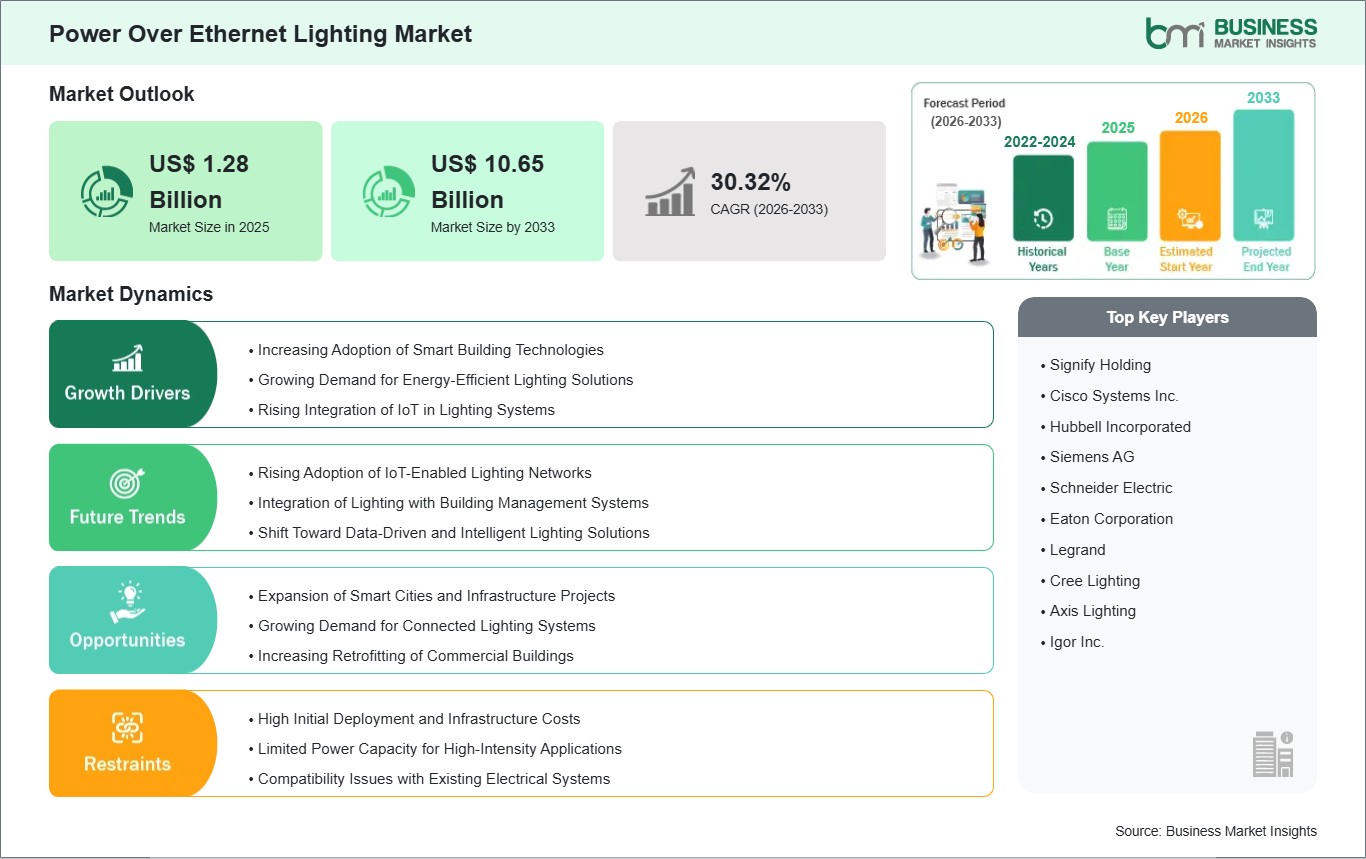
The power over ethernet lighting market is gaining traction due to the increasing demand for energy-efficient and connected lighting solutions. PoE lighting systems use Ethernet cables to deliver both power and data, enabling centralized control, automation, and enhanced energy management. These systems are widely used in commercial and industrial environments to improve operational efficiency and reduce energy consumption.
The growing adoption of smart building technologies and IoT-enabled infrastructure is driving the demand for PoE lighting solutions. These systems offer advantages such as simplified installation, reduced wiring complexity, and enhanced scalability. Additionally, they support integration with building management systems, enabling intelligent control of lighting environments. Technological advancements in LED lighting and network infrastructure are further supporting the growth of the market.
The ability to collect and analyze data through connected lighting systems is enabling improved decision-making and operational efficiency. As organizations continue to focus on sustainability and digital transformation, the demand for PoE lighting systems is expected to increase, supporting strong market growth during the forecast period.
Segment Analysis
Power Over Ethernet Lighting Market Segmentation
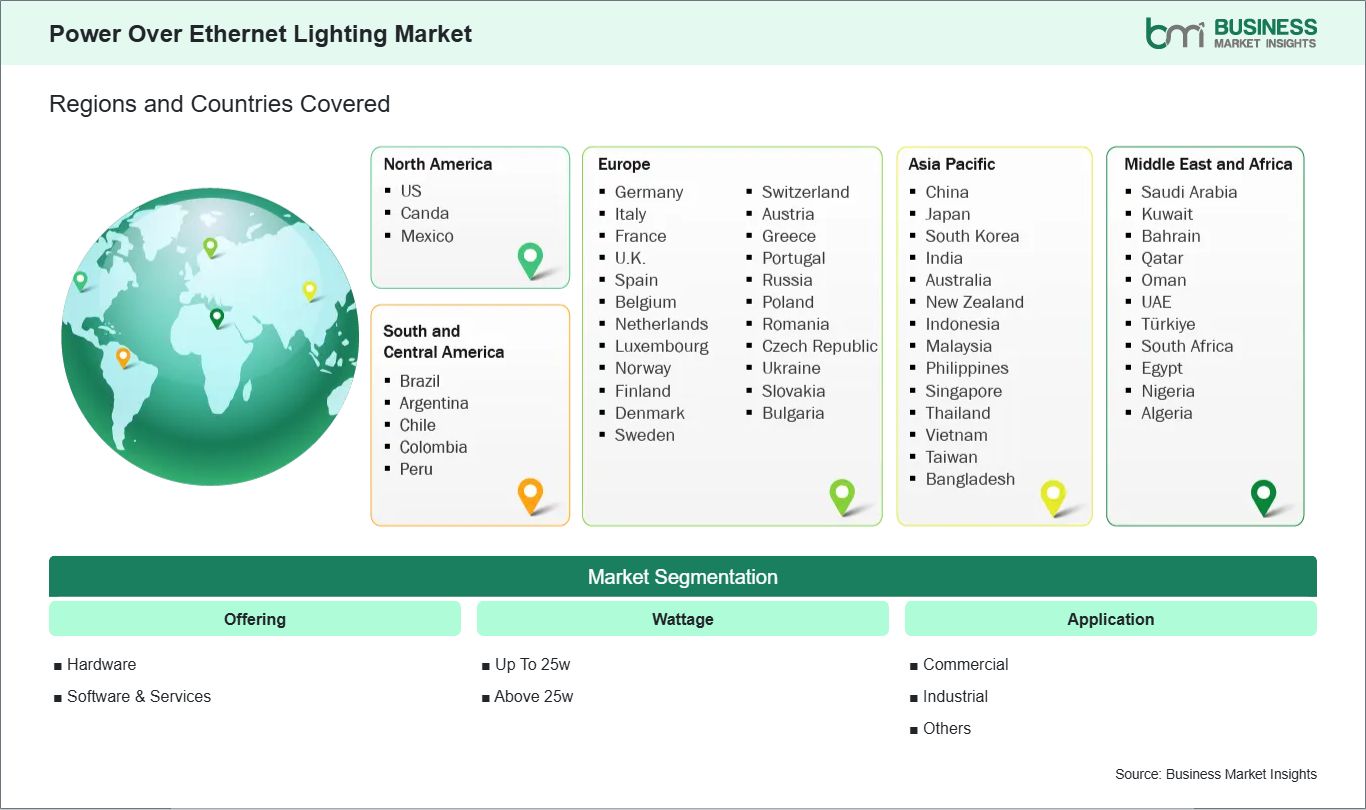
Key segments that contributed to the derivation of the Power Over Ethernet Lighting market analysis are offering, wattage, and application.
- By offering, the power over ethernet lighting market is segmented into Hardware and Software & Services. The Hardware segment dominated the market in 2025.
- By wattage, the power over ethernet lighting market is segmented into Up to 25W and Above 25W. The Up to 25W segment dominated the market in 2025.
- By application, the power over ethernet lighting market is segmented into Commercial, Industrial, and Others. The Commercial segment dominated the market in 2025.
Market Forces
Power Over Ethernet Lighting Market Drivers and Opportunities
Increasing Adoption of Smart Building Technologies
The rising adoption of smart building technologies is a major factor propelling the power over Ethernet (PoE) lighting market. Modern commercial buildings are increasingly incorporating sophisticated systems designed to enhance energy efficiency, occupant comfort, and operational control. Lighting is a vital component of these smart building ecosystems. PoE lighting systems facilitate centralized control, real-time monitoring, and automation via a unified network infrastructure. This allows building managers to adjust lighting based on occupancy, natural daylight, and user preferences, thereby improving overall efficiency.
Furthermore, integrating PoE lighting with other building systems, such as HVAC and security, enhances operational coordination and resource management while reducing energy consumption in large facilities. Organizations are also prioritizing sustainability and pursuing green building certifications, further driving the interest in energy-efficient lighting solutions. PoE lighting aligns with these sustainability goals by minimizing power consumption and enabling intelligent energy management. Consequently, as smart building adoption accelerates worldwide, demand for PoE lighting systems is projected to grow significantly, fueling market expansion.
Expansion of Smart Cities and Infrastructure Projects
There are many opportunities for the market for power-over-Ethernet (PoE) lighting to grow due to the proliferation of smart city projects, which many governments around the world are investing in to provide better-quality living conditions, improved efficiency, and sustainability through better integrated advanced infrastructure. The PoE lighting product category has unique advantages for smart city applications with regards to providing connectivity to other devices and the ability to manage systems of PoE lighting from one point. In addition, PoE lighting can work with other types of sensors and communications networks to create an intelligent lighting system that provides comprehensive control of the lighting in all areas of a smart city. Smart city projects may include energy-efficient, code-compliant buildings; upgrades to existing public infrastructure; and improved digital connectivity through the use of technology. PoE lighting can help achieve each of these goals by providing scalable and flexible lighting solutions that will assist in reducing energy consumption and maintenance costs.
Additionally, PoE lighting products are designed to be able to collect data through sensors that are connected to the lights. Data collected through the use of PoE lighting can be used for monitoring occupancy and/or measuring environmental conditions, which can be used to support urban planning and resource management. Overall, the volume of investment in smart city development continues to grow, and as that investment grows, demand for PoE lighting products will continue to grow; thus, the growth of PoE lighting products represents a tremendous opportunity for companies operating in the PoE lighting industry.
Size and Share Analysis
Power Over Ethernet Lighting Market Size and Share Analysis
The global Power Over Ethernet Lighting market is experiencing steady growth, with market size and share analysis reflecting evolving treatment preferences and competitive dynamics among key players. The report evaluates important subsegments categorized within offering, wattage, and application, highlighting their respective contributions to overall market performance.
By offering, the Hardware subsegment dominated the market in 2025 due to strong demand for PoE switches, LED luminaires, and cabling infrastructure, which are essential for deployment, enabling power and data transmission while forming the backbone of connected lighting systems.
By wattage, the Up to 25W subsegment dominated the market in 2025 due to its wide adoption in indoor commercial environments, offering sufficient illumination, energy efficiency, lower installation costs, and full compatibility with existing PoE standards used across office and retail lighting systems.
By application, the Commercial subsegment dominated the market in 2025 due to increasing adoption of smart lighting systems in offices, retail, and hospitality sectors, driven by energy efficiency requirements, automation trends, cost savings, and growing demand for connected building infrastructure solutions.
Report Coverage
Power Over Ethernet Lighting Market Report Coverage and Deliverables
The "Power Over Ethernet Lighting Market Size and Forecast (2022 - 2033)" report provides a detailed analysis of the market covering below areas:
- Power Over Ethernet Lighting market size and forecast at the regional and country levels for segments covered under the scope
- Power Over Ethernet Lighting market trends, as well as drivers, restraints, and opportunities
- Power Over Ethernet Lighting market analysis covering key trends, regional framework, major players, regulations, and recent developments
- Industry landscape and competition analysis covering market concentration, heat map analysis, prominent players, and recent developments for the Power Over Ethernet Lighting market
- Detailed company profiles, including SWOT analysis
Geographic Insights
Power Over Ethernet Lighting Market Geographic Insights
The geographical scope of the Power Over Ethernet Lighting market report is divided into: North America, Asia Pacific, Europe, Middle East & Africa, and South & Central America. North America held the largest share in 2025.
North America held a significant share in the power over ethernet lighting market due to the high adoption rate of smart building technologies and advanced IT infrastructure. The United States and Canada are leading countries in terms of smart lighting adoption in commercial and institutional buildings. Organizations in this region are adopting energy-efficient lighting solutions to minimize operating costs. PoE lighting is widely adopted in this region because it can be easily connected with existing IT networks. The presence of prominent players in this industry is another reason for the growth of this market. The government is also promoting energy-saving policies, which is boosting the demand for advanced lighting solutions. As smart lighting is becoming more prevalent with advancements in IoT technology, North America is expected to remain at the top in terms of power over ethernet lighting market share.
Industry Activity
Recent Developments
The Power Over Ethernet Lighting market is evaluated by gathering qualitative and quantitative data post primary and secondary research, which includes important corporate publications, association data, and databases. A few of the key developments in the Power Over Ethernet Lighting market are:
- In February 2023, Cisco Systems announced that it expanded its Digital Building solutions with advanced Power over Ethernet (PoE) capabilities to enable integrated lighting, automation, and energy-efficient smart building infrastructure.
- In March 2022, onsemi announced that it launched new Power over Ethernet (PoE) interface solutions designed for smart building applications, including PoE lighting, enabling efficient power delivery and simplified system integration.
- In May 2023, Acuity Brands announced that it introduced new nLight-enabled PoE lighting and control solutions to support intelligent buildings with centralized lighting management and enhanced energy efficiency.
- In June 2024, Signify announced updates to its connected lighting portfolio, including Interact systems compatible with PoE-based smart building infrastructure for integrated lighting control and IoT-enabled services.
Trust & Transparency
Research Methodology
The market analysis combines proprietary research with secondary data from government agencies, company disclosures, regulatory filings, industry databases and expert interviews. Market estimates are validated through data triangulation, cross-market benchmarking and analyst
review.
View Full Research Methodology
Key Sources Referred:
International Electrotechnical Commission Institute of Electrical and Electronics Engineers International Organization for Standardization Bureau of Indian Standards Central Electricity Authority Ministry of Power Indian Electrical and Electronics Manufacturers' Association European Committee for Electrotechnical Standardization VDE Association for Electrical Electronic & Information Technologies Company Websites Company Annual Reports Company Investor Presentations