
Potassium Iodide Market Outlook: Size, Share, Trends, Growth Analysis, Competitive Landscape & Forecast, 2026-2033

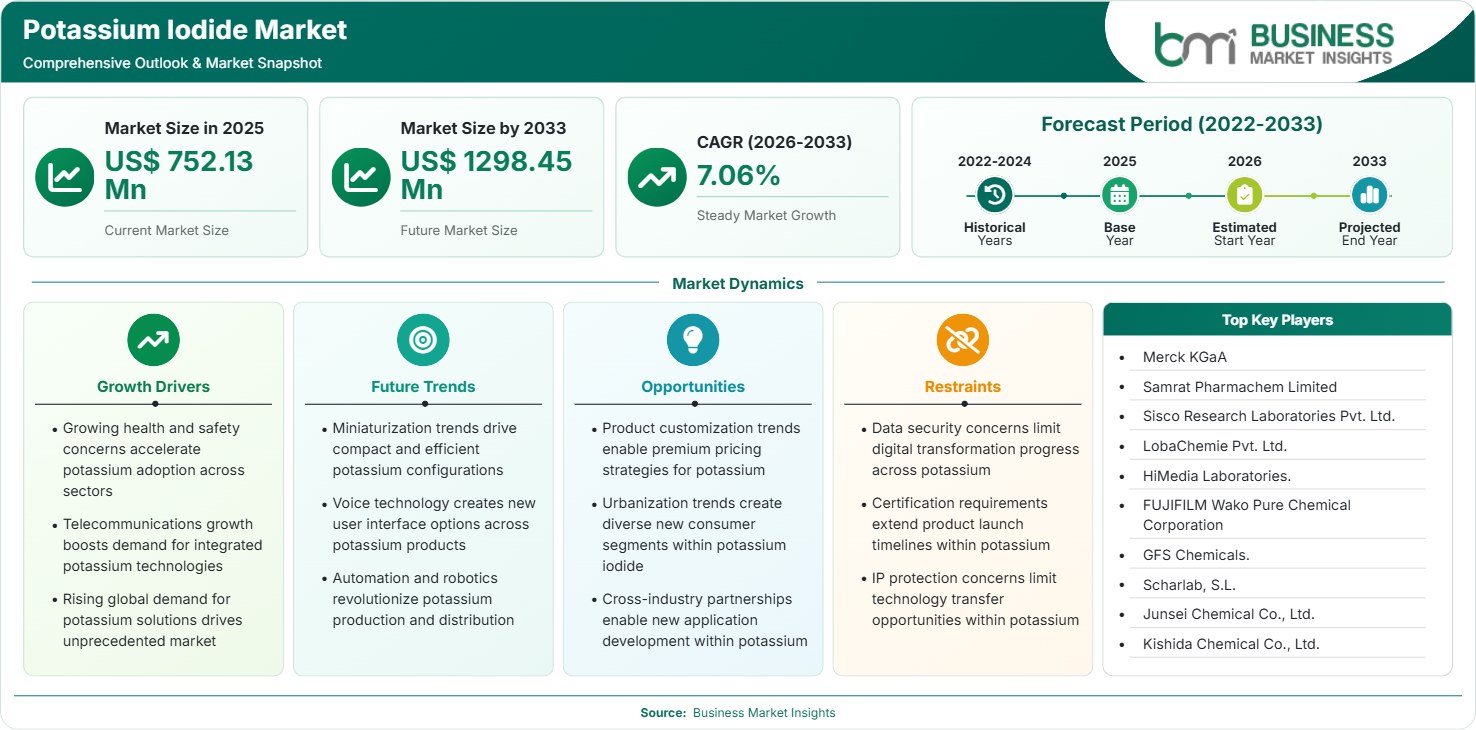
The Potassium Iodide Market size was valued at US$ 752.13 Million in 2025 and is projected to reach US$ 1,298.45 Million by 2033, growing at a CAGR of 7.06% during 2026–2033. Rising pharmaceutical consumption, increasing demand for iodine fortification, expanding laboratory reagent applications, and emergency preparedness initiatives are driving adoption, while investments in specialty chemicals and healthcare infrastructure continue creating long-term growth opportunities.

Report Coverage
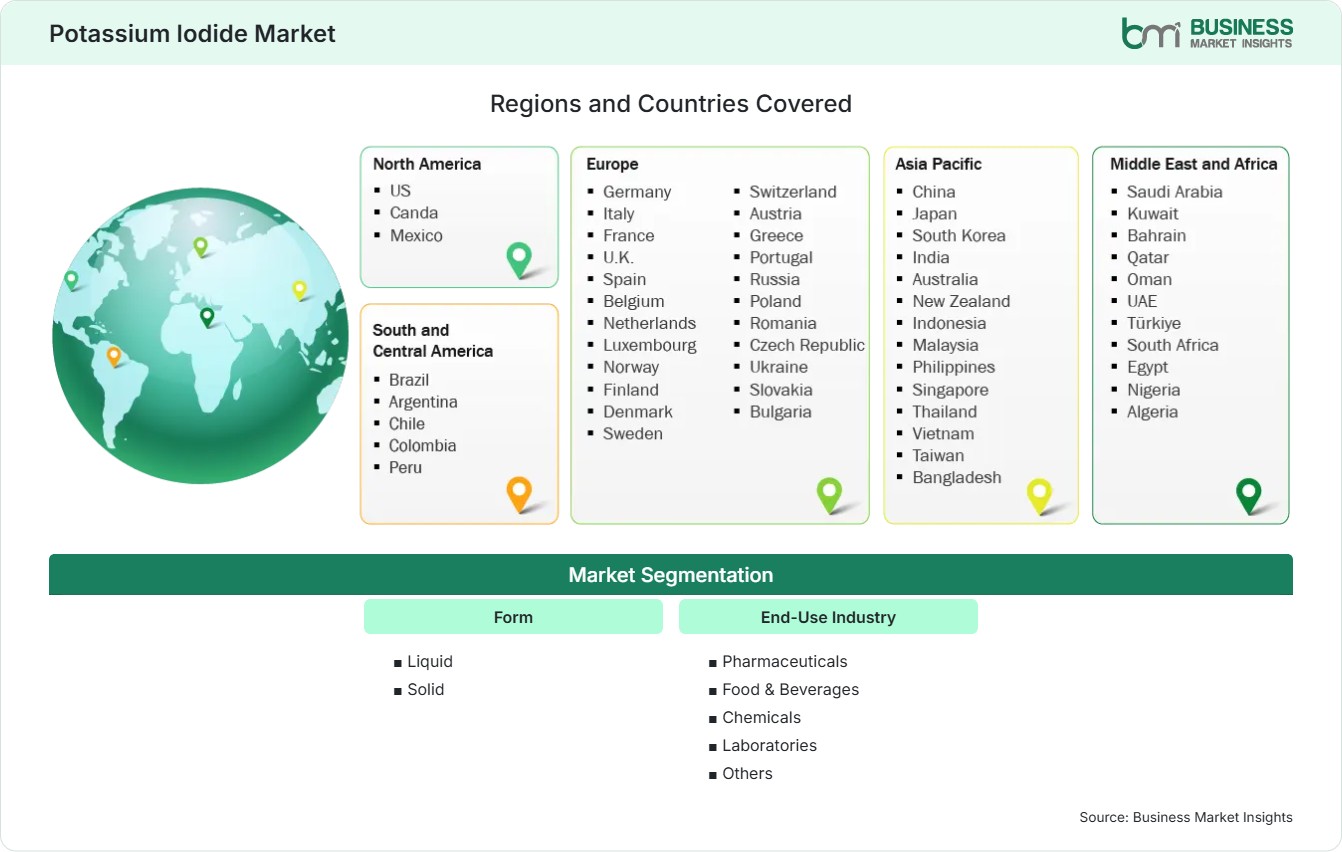
  • Form: Liquid, Solid
  • End-Use Industry: Pharmaceuticals, Food & Beverages, Chemicals, Laboratories, Others
US$ 752.13 Mn Market size in 2025
US$ 1298.45 Mn Market Size by 2033
7.06% CAGR, 2026 - 2033
2026-2033 Forecast Period

AI Overview

Potassium Iodide Market Summary

  • North America Region: North America holds a market share of 34%–37% in 2025, growing with a CAGR of 6.6%–6.9% during 2026–2033. Pharmaceutical manufacturing, laboratory reagent demand, emergency preparedness programs, healthcare investments, and high-quality chemical production collectively strengthen regional consumption while supporting long-term industrial expansion across multiple application sectors. The U.S. dominates regional demand through advanced pharmaceutical production, government preparedness initiatives, and specialty chemical manufacturing, expanding at a CAGR of 6.7%–7.0%.
  • Fastest Growing Region: Asia Pacific accounts for 28%–31% of the market in 2025 and is expected to register a CAGR of 8.0%–8.4% during 2026–2033. Expanding pharmaceutical production, food fortification initiatives, laboratory investments, growing healthcare expenditure, and increasing specialty chemical manufacturing continue accelerating commercial demand across developing economies throughout the region.
  • Leading Segment: Pharmaceuticals represents 44%–47% market share in 2025 and is projected to expand at a CAGR of 7.2%–7.5% during 2026–2033. Growing production of thyroid medications, radiological preparations, emergency medical stockpiles, and pharmaceutical-grade iodine formulations sustain strong consumption across regulated healthcare manufacturing environments worldwide.
  • High Growth Segment: Liquid form contributes 38%–41% market share in 2025 while advancing at a CAGR of 7.8%–8.2% during 2026–2033. Higher laboratory usage, pharmaceutical formulation flexibility, rapid dissolution characteristics, and expanding diagnostic applications continue supporting stronger adoption across industrial and healthcare end users.
  • Key Market Opportunity: Expansion of pharmaceutical manufacturing capacities, strategic government iodine reserve programs, increasing diagnostic imaging procedures, and advanced laboratory research investments collectively create substantial opportunities for premium-grade potassium iodide manufacturers globally over the forecast period.
  • Major Market Players: Merck KGaA; Samrat Pharmachem Limited; Sisco Research Laboratories Pvt. Ltd.; Loba Chemie Pvt. Ltd.; HiMedia Laboratories Pvt. Ltd.; FUJIFILM Wako Pure Chemical Corporation; GFS Chemicals, Inc.; Scharlab, S.L.; Junsei Chemical Co., Ltd.; Kishida Chemical Co., Ltd.
Strategic Insights

Potassium Iodide Market: Strategic Insights

Potassium Iodide Market Strategic Framework
FREE PDF
Request your free sample
Request free sample
Stakeholder View

Key Takeaways

  • The industry value chain continues evolving toward integrated production, combining iodine sourcing, high-purity refining, pharmaceutical processing, and specialized distribution to improve supply reliability and product consistency across regulated industries.
  • Pharmaceutical manufacturing remains the strongest commercial opportunity, while diagnostic imaging chemicals, laboratory reagents, and food fortification applications provide additional long-term revenue diversification for producers and distributors.
  • Manufacturers are investing in higher-purity production technologies, automated quality control systems, and advanced analytical testing capabilities to meet increasingly stringent pharmaceutical and laboratory specifications.
  • Asia Pacific presents one of the most attractive investment destinations due to expanding pharmaceutical manufacturing capacity, supportive industrial policies, improving healthcare infrastructure, and increasing domestic specialty chemical production.
  • Strategic partnerships between chemical manufacturers, pharmaceutical companies, and research institutions are accelerating product innovation, strengthening supply security, and improving regional distribution capabilities for high-purity iodine compounds.
  • Companies emphasizing regulatory compliance, sustainable manufacturing practices, diversified iodine sourcing, and premium product portfolios are expected to strengthen competitive positioning as healthcare and laboratory applications continue expanding globally.
Geographic Outlook

Potassium Iodide Market Regional Highlights

North America Potassium Iodide Market

North America accounted for 34%–37% of the global market share in 2025 and is projected to register a CAGR of 6.6%–6.9% during 2026–2033. The region benefits from a mature pharmaceutical ecosystem, stringent quality standards, advanced laboratory infrastructure, and government preparedness programs supporting iodine stockpiles. Robust investments in specialty chemicals and radiopharmaceutical production continue to strengthen regional demand. The Potassium Iodide Market share remains the largest globally due to established healthcare systems, high-value chemical manufacturing, and consistent research and development spending across regulated industries.

  • Growing production of pharmaceutical-grade potassium iodide for thyroid medications, diagnostic imaging agents, and radiation emergency preparedness programs continues strengthening demand across healthcare institutions and pharmaceutical manufacturers throughout North America.
  • Government agencies maintain strategic iodine reserves to enhance public health preparedness against nuclear emergencies, creating stable long-term procurement opportunities for manufacturers supplying pharmaceutical-grade and emergency-response formulations.
  • Expanding investments in analytical laboratories, biotechnology research, and academic institutions increase consumption of high-purity reagents used for scientific testing, quality assurance, and pharmaceutical development applications.
  • Continuous adoption of automated manufacturing systems, advanced purification technologies, and strict pharmacopeial compliance enables regional producers to maintain premium product quality while supporting exports to international pharmaceutical markets.
  • Increasing collaboration between pharmaceutical companies and specialty chemical suppliers accelerates product innovation, improves supply-chain resilience, and supports reliable availability of high-purity potassium iodide for critical healthcare applications.

US Potassium Iodide Market

The United States represented 79%–82% of the North American Potassium Iodide Market demand in 2025 and is anticipated to expand at a CAGR of 6.7%–7.0% during 2026–2033. Strong pharmaceutical manufacturing capabilities, advanced biotechnology research, federal emergency preparedness initiatives, and increasing radiopharmaceutical production continue supporting domestic consumption. Significant investments in laboratory infrastructure and regulated chemical manufacturing strengthen long-term market fundamentals while ensuring consistent demand for pharmaceutical-grade potassium iodide across healthcare and research sectors.

  • Expansion of domestic pharmaceutical manufacturing facilities continues increasing demand for pharmaceutical-grade iodine compounds used in thyroid medications, sterile formulations, and specialized therapeutic products requiring exceptionally high purity standards.
  • Federal preparedness programs supporting strategic medical stockpiles sustain procurement of potassium iodide tablets and related formulations for emergency response, strengthening long-term purchasing stability across government agencies.
  • Advanced research institutions and biotechnology companies continue increasing procurement of analytical-grade reagents to support drug discovery, life sciences research, and laboratory testing applications across multiple scientific disciplines.
  • Growing investments in domestic specialty chemical production improve supply-chain security, reduce dependence on imports, and encourage innovation in purification technologies supporting premium-quality chemical manufacturing.

Europe Potassium Iodide Market

Europe accounted for 25%–28% of the Potassium Iodide Market share in 2025 and is forecast to grow at a CAGR of 6.8%–7.2% during 2026–2033. Strong pharmaceutical manufacturing, strict regulatory compliance, and well-developed laboratory networks continue driving regional demand. Germany remains the leading national market due to its advanced chemical industry, while Poland and Eastern European countries are emerging as higher-growth manufacturing locations supported by expanding pharmaceutical investments and improving research infrastructure.

  • Germany leads regional consumption through its established pharmaceutical manufacturing base, advanced specialty chemical industry, and continuous investments in research laboratories supporting healthcare innovation and high-purity reagent production.
  • France and the United Kingdom continue expanding pharmaceutical research activities, increasing demand for analytical chemicals used in quality testing, drug development, and clinical laboratory applications.
  • Poland records one of the fastest regional growth rates, supported by pharmaceutical manufacturing expansion, favourable industrial investment policies, and increasing exports of regulated healthcare products.
  • European manufacturers continue investing in environmentally responsible production technologies and enhanced purification processes to meet evolving sustainability objectives while maintaining compliance with stringent pharmaceutical regulations.
  • Cross-border collaboration between research institutions and specialty chemical companies strengthens innovation, enhances product quality, and supports regional competitiveness within global pharmaceutical supply chains.

Asia Pacific Potassium Iodide Market

Asia Pacific represented 28%–31% of global demand in 2025 and is expected to achieve the fastest regional expansion with a CAGR of 8.0%–8.4% during 2026–2033. Rapid pharmaceutical manufacturing growth, expanding laboratory infrastructure, increasing healthcare expenditure, and stronger food fortification initiatives continue accelerating regional demand. The Potassium Iodide Market growth is particularly supported by industrial expansion in India and China alongside increasing investments in specialty chemicals serving domestic and export-oriented pharmaceutical industries.

  • China remains the largest regional consumer owing to its extensive pharmaceutical production capacity, integrated chemical manufacturing ecosystem, and increasing investments in advanced pharmaceutical ingredients and laboratory chemicals.
  • India is projected to record one of the highest growth rates across Asia Pacific, supported by expanding pharmaceutical exports, contract manufacturing activities, and rising investments in specialty chemical production facilities.
  • Japan continues maintaining strong demand through high-quality pharmaceutical manufacturing, advanced research institutions, and sustained investments in analytical laboratory infrastructure supporting life science innovation.
  • Southeast Asian countries continue strengthening food fortification programs, healthcare investments, and pharmaceutical production capacities, creating additional opportunities for regional potassium iodide suppliers.
  • Increasing government support for domestic pharmaceutical manufacturing and research infrastructure enhances regional competitiveness while encouraging production of high-value pharmaceutical-grade chemical intermediates.

Rest of World Potassium Iodide Market

The Rest of World accounted for 8%–11% of the global Potassium Iodide Market in 2025 and is projected to expand at a CAGR of 6.9%–7.3% during 2026–2033. South & Central America continue benefiting from improving pharmaceutical manufacturing capabilities and healthcare investments. Meanwhile, the Middle East & Africa are witnessing rising laboratory infrastructure development, increasing food fortification initiatives, and stronger public healthcare preparedness programs that collectively support steady long-term market expansion across emerging economies.

Government healthcare modernization programs across several Middle Eastern countries continue encouraging investments in pharmaceutical production, while Brazil remains the leading South & Central American market. Saudi Arabia demonstrates one of the strongest regional growth prospects owing to expanding healthcare manufacturing capabilities, laboratory investments, and industrial diversification strategies.

  • Brazil leads South & Central America through growing pharmaceutical production, expanding healthcare expenditure, and increasing laboratory research activities supporting greater consumption of pharmaceutical-grade iodine compounds.
  • Saudi Arabia records strong growth supported by industrial diversification initiatives, healthcare manufacturing investments, and expanding pharmaceutical production capacities aligned with long-term national development strategies.
  • South Africa continues strengthening analytical laboratory capabilities and healthcare infrastructure, increasing demand for specialty chemicals used in research, diagnostics, and pharmaceutical quality assurance.
  • Rising awareness of iodine deficiency prevention and government-supported food fortification initiatives contribute to stable long-term consumption across several emerging economies throughout Latin America and the Middle East.
  • International specialty chemical suppliers continue expanding regional distribution partnerships, improving product availability, technical support, and regulatory compliance across developing pharmaceutical and laboratory markets.
Global Market Geography
FREE PDF
Request your free sample
Request free sample
Segment Analysis

Potassium Iodide Market Segmentation

Form

The Form segment accounted for a significant portion of industry demand in 2025, with Solid products holding 59%–62% market share and the segment advancing at a CAGR of 6.7%–7.0% during 2026–2033. Product selection depends on application requirements, shelf-life expectations, transportation convenience, and formulation flexibility. The Potassium Iodide Market scope continues expanding as manufacturers develop higher-purity formulations tailored for pharmaceutical, laboratory, and industrial applications.

  • Liquid: Liquid potassium iodide is widely used in pharmaceutical formulations, laboratory preparations, and analytical testing due to rapid dissolution, formulation flexibility, and ease of incorporation into healthcare and research applications.
  • Solid: Solid potassium iodide remains the dominant product form owing to superior storage stability, simplified transportation, extended shelf life, and broad utilization across pharmaceutical manufacturing, food fortification, and emergency preparedness programs.

End-Use Industry

The Pharmaceuticals segment represented the largest end-use category with 44%–47% market share in 2025 and is anticipated to expand at a CAGR of 7.2%–7.5% during 2026–2033. Increasing production of thyroid therapies, radiopharmaceutical preparations, diagnostic formulations, and regulated pharmaceutical ingredients continues supporting demand. The Potassium Iodide Market trends are increasingly influenced by healthcare investments, regulatory quality standards, and expanding pharmaceutical manufacturing capacities worldwide.

  • Pharmaceuticals: Pharmaceutical manufacturers extensively utilize potassium iodide in thyroid disorder treatments, radiation protection formulations, and pharmaceutical intermediates requiring high purity and stringent regulatory compliance.
  • Food & Beverages: Food manufacturers incorporate potassium iodide into iodine fortification programs to address nutritional deficiencies while complying with national food safety regulations and public health initiatives.
  • Chemicals: Chemical producers employ potassium iodide as a specialty reagent, catalyst component, and intermediate supporting synthesis processes, industrial formulations, and advanced chemical manufacturing operations.
  • Laboratories: Research laboratories depend on analytical-grade potassium iodide for scientific experimentation, chemical analysis, educational research, and pharmaceutical quality control requiring consistent purity standards.
  • Others: Other industrial applications include photographic chemicals, environmental testing, veterinary formulations, and niche specialty manufacturing where controlled iodine chemistry supports product performance and process efficiency.
Market Forces

Potassium Iodide Market Dynamics

Key Market Drivers

Growing Demand from the Global Pharmaceutical Industry

The pharmaceutical industry continues to represent the largest consumer of potassium iodide owing to its essential role in thyroid disorder treatment, radiation protection medicines, and radiopharmaceutical formulations. According to the World Health Organization (WHO), thyroid disorders remain among the most common endocrine conditions worldwide, supporting continuous demand for iodine-based therapeutic ingredients. Expanding pharmaceutical manufacturing capacities in India, China, the United States, and Europe are increasing procurement of high-purity potassium iodide for regulated drug production. The Potassium Iodide Market growth is further supported by rising investments in generic medicine manufacturing, improved healthcare accessibility, and stricter pharmaceutical quality regulations requiring certified analytical-grade raw materials across global production facilities.

Expansion of Laboratory Research and Analytical Testing

Rapid growth in pharmaceutical research, biotechnology, environmental testing, and academic scientific studies has increased the consumption of analytical-grade potassium iodide worldwide. Highly pure chemicals are essential in research labs for synthesis, titration, microbial analysis, and quality assurance. Investment by the government in biological sciences, genomics, and healthcare has been increasing the development of laboratory facilities in developed and developing countries. The increase in partnership between academic institutions and biotech and pharmaceutical industries has also contributed to the rise in the demand for top-notch laboratory chemicals. The ongoing developments in the field of instrumentation and regulatory testing have also enhanced the need for high-quality potassium iodide.

Increasing Government Focus on Emergency Preparedness

Most governments of various nations are still keeping strategic supplies of potassium iodide tablets to safeguard the population from any radiation of radioactive iodine. North American, European, and Asian organizations regularly replenish their emergency supplies of potassium iodide in order to keep the product within its expiration period. International nuclear safety guidance published by organizations such as the International Atomic Energy Agency (IAEA) has reinforced preparedness planning among member countries. Health organizations are also raising awareness about emergency response strategies that employ the use of iodine prophylaxis. This ensures a regular cycle of procurement for the pharmaceutical companies while promoting investments in facilities that manufacture medical products that comply with this requirement.

Key Market Opportunities

Growing Pharmaceutical Manufacturing in Emerging Economies

Emerging economies continue investing heavily in pharmaceutical production, creating long-term opportunities for suppliers of pharmaceutical-grade potassium iodide. India, China, Indonesia, Vietnam, and several Middle Eastern countries are expanding domestic medicine manufacturing through supportive industrial policies and healthcare investments. The Potassium Iodide Market Forecasts indicate that the demand will be consistent due to the production of thyroid drugs, diagnostic agents, and regulated pharmaceutical ingredients by contract manufacturing companies. Increased exports of generic drugs, increased health care access, and adherence to international manufacturing standards push drug manufacturers to build new purification plants and premium formulations suitable for use in regulated pharmaceuticals.

Advancement of Nuclear Medicine and Diagnostic Imaging

The rapid expansion of nuclear medicine and diagnostic imaging services creates attractive growth opportunities for manufacturers supplying high-purity potassium iodide. Hospitals and diagnostic centres increasingly rely on radiopharmaceutical procedures for cancer diagnosis, cardiac imaging, and specialised clinical investigations. There is a high likelihood that investment in healthcare aimed at establishing sophisticated diagnostic infrastructures will continue to drive up the demand for active ingredients in making nuclear medicine. The increase in imaging technology, growing awareness among patients, and the increasing prevalence of chronic illnesses are contributing towards escalating the number of procedures. This presents an opportunity for manufacturers of high-quality products.

Expansion of Food Fortification and Nutrition Programs

Government-led nutrition programmes addressing iodine deficiency continue creating new commercial opportunities for food-grade potassium iodide producers. Several developing economies are strengthening national food fortification initiatives to improve public health outcomes and reduce iodine deficiency disorders. The world health organization and UNICEF along with other international organizations remain involved in supporting programs for salt iodization, thus increasing the use of iodine compounds in food processing industries. The awareness of consumers about their health in terms of nutrition along with the support of regulations for fortified food products will help increase the demand for potassium iodide in food manufacturing.

Market Restraints and Challenges

Dependence on Limited Iodine Raw Material Sources

Factor: Iodine production at the global level continues to be a process carried out by very few nations, including Chile and Japan, and hence the entire chain is vulnerable to production disruptions and mining uncertainties.

Impact: Manufacturers might face fluctuations in the availability of raw materials as well as cost associated with procurement of those materials. Price fluctuations of iodine might decrease margins for companies involved in the production of chemicals while making procurement riskier for pharmaceutical manufacturers due to their requirement of potassium iodide.

Stringent Regulatory Compliance and Quality Requirements

Factor: Potassium iodide of pharmaceutical grade must conform to stringent pharmacopoeial standards of international standard and good manufacturing practice (GMP) and quality validation.

Impact: Compliance results in increased costs of production, delays in the time required for approval of products, and ongoing need to invest in analysis and manufacturing capabilities. Smaller firms can face difficulties entering the market due to the cost of obtaining certifications, and already existing companies have to constantly make investments to stay competitive in the market.

Company Analysis

Competitive Landscape

The competitive environment reflects a combination of multinational specialty chemical manufacturers and regional producers serving pharmaceutical, laboratory, food, and industrial customers. The Potassium Iodide Market analysis indicates that competition is primarily based on product purity, regulatory compliance, manufacturing capability, distribution networks, and long-term supply agreements with pharmaceutical and research organizations.

Company Name

Overview

Products and Services Relevant to this Market

Merck KGaA (Germany)

Global science and technology company supplying high-purity laboratory chemicals, pharmaceutical raw materials, and analytical reagents through an extensive international distribution network.

Pharmaceutical-grade potassium iodide, laboratory reagents, analytical chemicals, life science materials, research chemicals, and specialty ingredients for regulated pharmaceutical and laboratory applications.

Samrat Pharmachem Limited (India)

Indian specialty chemical manufacturer serving pharmaceutical, food, and industrial sectors with iodine derivatives and high-purity chemical products for domestic and export markets.

Potassium iodide, iodine derivatives, pharmaceutical intermediates, food-grade chemicals, specialty inorganic salts, and customized chemical manufacturing solutions.

Sisco Research Laboratories Pvt. Ltd. (India)

Established laboratory chemical supplier providing analytical reagents, research chemicals, and specialty compounds to research institutes, pharmaceutical companies, and academic laboratories.

Analytical-grade potassium iodide, laboratory reagents, reference standards, research chemicals, microbiology products, and laboratory consumables.

Loba Chemie Pvt. Ltd. (India)

International supplier of laboratory chemicals and fine chemicals with strong distribution across pharmaceutical, industrial, and academic research sectors.

Potassium iodide reagents, analytical chemicals, laboratory solvents, pharmaceutical chemicals, buffer solutions, and specialty laboratory products.

HiMedia Laboratories Pvt. Ltd. (India)

Leading life sciences company specializing in microbiology media, laboratory reagents, and research chemicals supporting pharmaceutical and biotechnology industries.

Potassium iodide, microbiology reagents, laboratory chemicals, molecular biology products, culture media, and diagnostic laboratory solutions.

FUJIFILM Wako Pure Chemical Corporation (Japan)

Premium Japanese manufacturer recognized for ultra-high-purity laboratory reagents, pharmaceutical chemicals, and advanced analytical products for research and industrial customers.

Pharmaceutical-grade potassium iodide, guaranteed reagents, analytical chemicals, diagnostic reagents, fine chemicals, and laboratory testing materials.

GFS Chemicals, Inc. (U.S.)

U.S.-based specialty chemical producer serving pharmaceutical, industrial, research, and electronic industries with high-purity inorganic and organic chemical products.

Potassium iodide, inorganic reagents, laboratory chemicals, custom chemical manufacturing, analytical standards, and specialty industrial chemicals.

Scharlab, S.L. (Spain)

European manufacturer of laboratory reagents and analytical chemicals supplying research organizations, pharmaceutical companies, and industrial laboratories worldwide.

Potassium iodide reagents, laboratory chemicals, analytical solutions, microbiology products, solvents, and quality-control reagents.

Junsei Chemical Co., Ltd. (Japan)

Japanese producer of laboratory reagents and specialty chemicals focused on high-purity analytical products supporting scientific research and industrial quality control.

Potassium iodide, analytical reagents, laboratory chemicals, specialty inorganic compounds, research chemicals, and quality-testing materials.

Kishida Chemical Co., Ltd. (Japan)

Long-established Japanese specialty chemical manufacturer supplying research laboratories, universities, pharmaceutical companies, and industrial manufacturers with premium-grade reagents.

Potassium iodide, laboratory reagents, pharmaceutical chemicals, analytical standards, fine chemicals, and industrial specialty chemical solutions.

Trust & Transparency

Research Methodology

The market analysis combines proprietary research with secondary data from government agencies, company disclosures, regulatory filings, industry databases and expert interviews. Market estimates are validated through data triangulation, cross-market benchmarking and analyst review.

View Full Research Methodology

Questions Answered

Frequently Asked Questions

What does the Potassium Iodide Market Report include?

The report provides market size, forecasts, regional analysis, segmentation, competitive landscape, market dynamics, key company profiles, recent developments, and strategic insights for stakeholders.

What factors are creating future business opportunities?

Growth opportunities are emerging from pharmaceutical manufacturing expansion, food fortification programs, nuclear medicine, diagnostic imaging, laboratory research, and increasing investments in healthcare infrastructure across developing economies.

Which end-use industry generates the highest demand?

The pharmaceutical industry remains the largest consumer because potassium iodide is widely used in thyroid medications, radiopharmaceutical preparations, emergency medical stockpiles, and pharmaceutical-grade formulations.

Which region dominates the market?

North America leads the global market owing to its advanced pharmaceutical manufacturing, strong laboratory infrastructure, government emergency preparedness programs, and high regulatory standards for specialty chemicals.

What are the primary applications of potassium iodide?

Potassium iodide is primarily used in pharmaceutical formulations, thyroid disorder treatment, radiation emergency medicines, laboratory reagents, food fortification, analytical chemistry, and specialty chemical manufacturing.

Access the Full Potassium Iodide Market Report

Get segment-level forecasts, regional estimates, competitive benchmarking, company profiles and downloadable Excel datasets.

Access the full Potassium Iodide Market Report
350 pages PDF & Excel | 2026-08-17
Similar Research

Related Market Reports