Market Summary
Executive Summary and Global Market Analysis
Pervious pavement systems are engineered surface materials that allow water to pass through the pavement layer and into the underlying ground. Their use supports stormwater control, reduces surface runoff, and improves site permeability in built environments where conventional paving often limits natural drainage. These systems are increasingly specified in urban design projects where water management and surface performance must be addressed together.
Adoption is supported by stricter runoff management requirements, expanding paved infrastructure, and the need for resilient surface designs in dense construction settings. Municipal planners, commercial developers, and landscape designers are integrating permeable materials into project specifications to address drainage constraints without relying entirely on additional underground systems.
By type, pervious concrete remains widely recognized for load-bearing surfaces and controlled water infiltration, while porous asphalt is used where smoother finishes are preferred. Interlocking concrete pavers offer design flexibility and modular maintenance advantages. Across design categories, hydrological performance remains central, while structural considerations shape product selection for demanding installation conditions.
Material development is moving toward improved pore stability, better compressive balance, and more predictable long-term drainage behavior. Installation techniques are also becoming more refined, with greater attention to sub-base preparation, mix consistency, and lifecycle maintenance. This evolution is helping the industry align functional water management performance with durability expectations across public and private projects.
The competitive environment is shaped by product differentiation, application expertise, and alignment with project specifications rather than volume expansion alone. Participants compete through technical support, surface performance consistency, and portfolio breadth across paving formats. Market positioning increasingly depends on the ability to address drainage objectives, structural requirements, and installation practicality within a single offering.
Segment Analysis
Pervious Pavement Market Segmentation
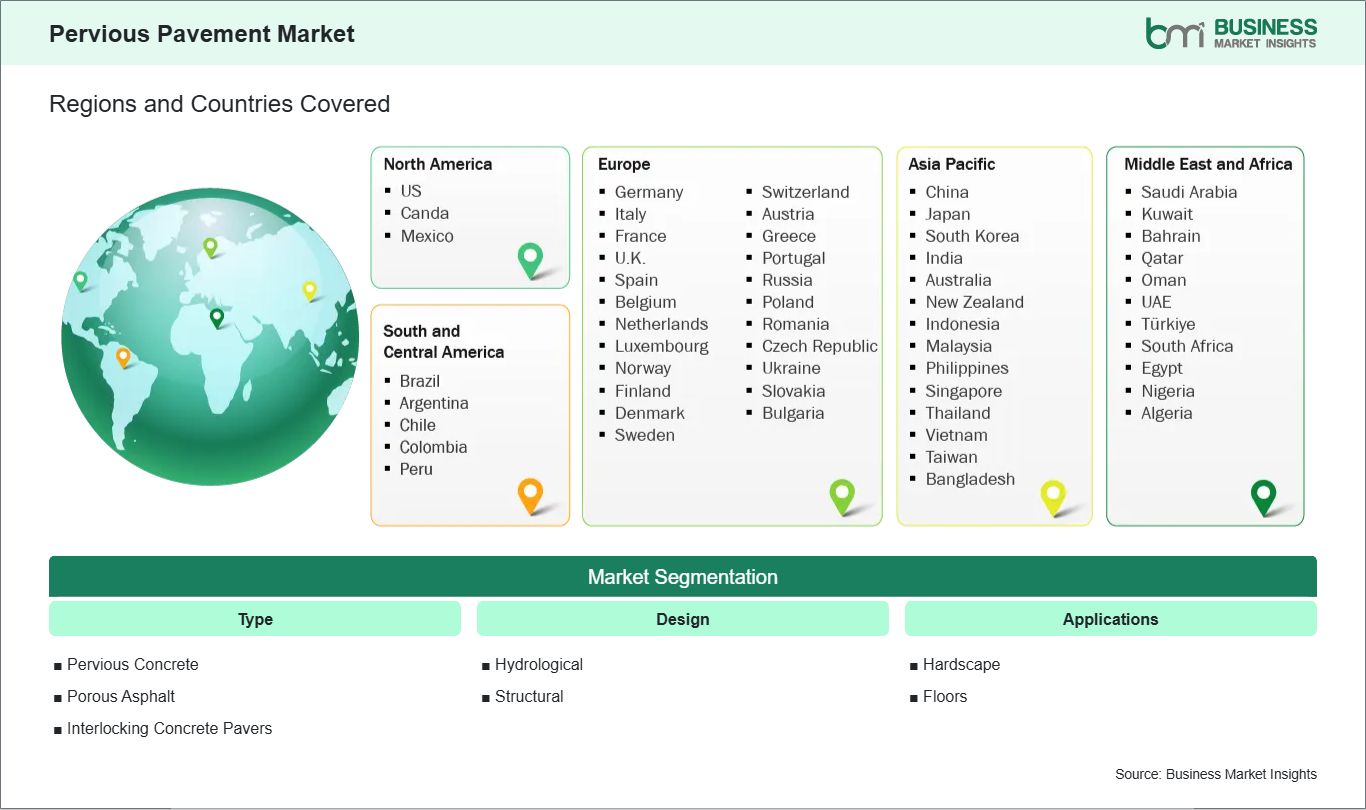
The pervious pavement market is segmented based on type, design, application, reflecting its critical role in effective stormwater management, urban heat island mitigation, and groundwater recharge.
By Type
Pervious Concrete: Preferred for rigid surfaces requiring drainage and structural integrity.
Porous Asphalt: Chosen for smoother surface finish and adaptable site integration.
Interlocking Concrete Pavers: Favored for modular layouts and easier localized maintenance.
By Design
Hydrological: Emphasizes infiltration efficiency and runoff management performance.
Structural: Focuses on load response, stability, and long-term surface endurance.
By Applications
Hardscape: Accounts for outdoor surfaces in civic, commercial, and landscape projects.
Floors: Extends use into controlled environments requiring permeable surface functionality.
Market Forces
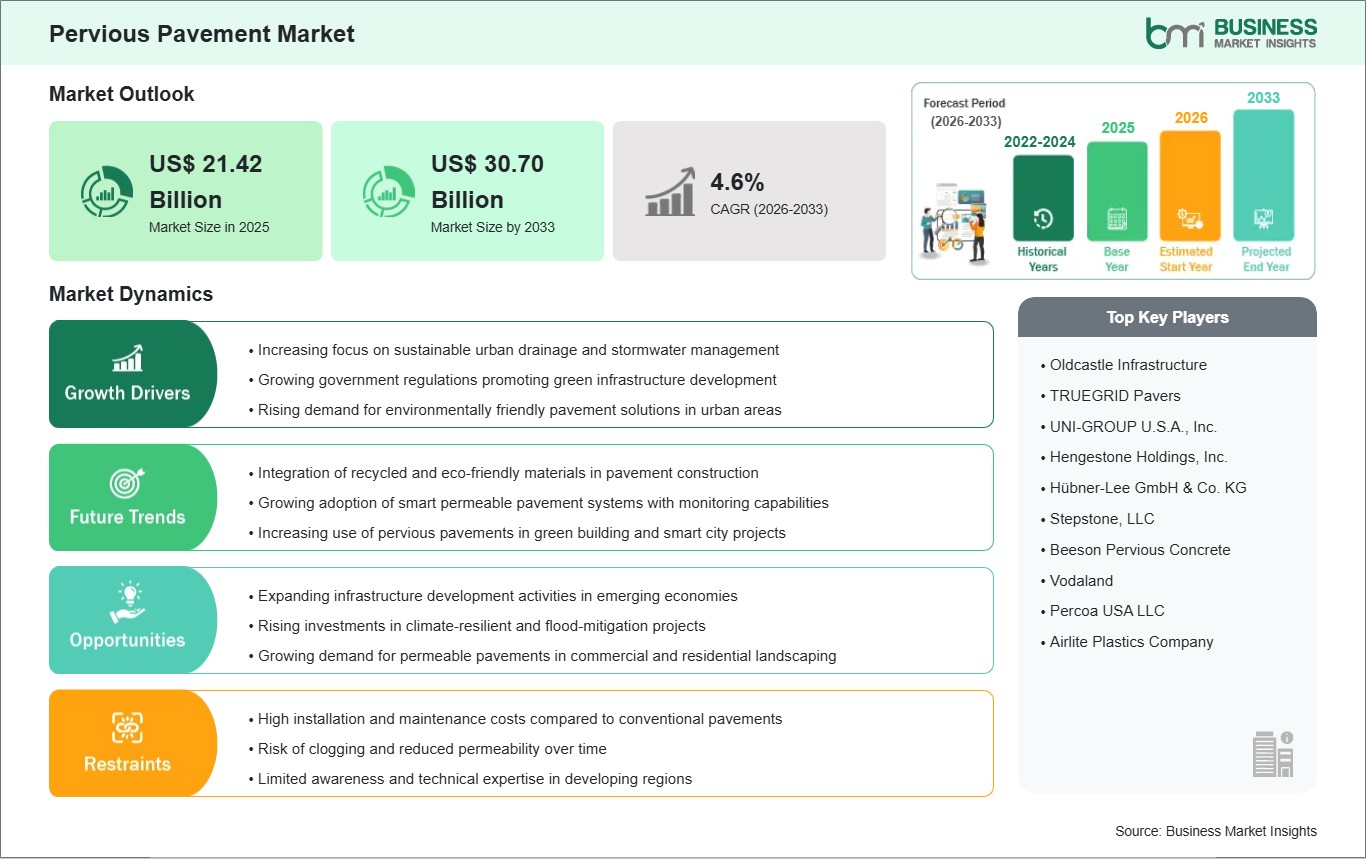
Pervious Pavement Market Drivers and Opportunities
Stormwater Management Requirements Across Urban Infrastructure
Urban expansion has intensified the amount of sealed ground area, creating persistent pressure on drainage systems during rainfall events. This condition has increased the need for surface materials that manage water at the point of contact. Pervious pavement is therefore being specified more often in site designs where runoff control, infiltration, and paved usability must coexist within limited development footprints.
The impact of this shift extends beyond compliance and shapes how paved surfaces are planned in commercial and public settings. Designers increasingly evaluate permeable materials as part of integrated water-sensitive construction strategies. This relevance is especially clear in projects where drainage performance, land utilization, and surface durability must be addressed within one coordinated infrastructure solution.
Integration into Sustainable Site Design and Multifunctional Surfaces
Site planning is increasingly favoring materials that combine environmental function with usable surface performance. This trend is encouraging innovation in permeable paving formats that support both drainage and aesthetic integration. Applications in plazas, pathways, parking areas, and landscaped hardscape settings illustrate how the sector can serve technical requirements while maintaining design flexibility.
Future scope is shaped by broader incorporation into development models that prioritize resilient land use and distributed water handling. Expansion potential remains notable in institutional, municipal, and mixed-use projects where multifunctional surfaces are gaining strategic relevance. This direction can widen deployment across settings that require durable paving, environmental responsiveness, and adaptable design outcomes.
Size and Share Analysis
Pervious Pavement Market Size and Share Analysis
The pervious pavement market was valued at USD 21.42 Billion in 2025 and is projected to reach USD 30.70 Billion by 2033, registering a CAGR of 4.6% during 2026 - 2033. This trajectory reflects steady commercial relevance supported by wider incorporation of permeable surface systems into drainage-conscious construction approaches and long-term site planning frameworks.
Among type categories, pervious concrete holds a prominent position due to its balance of structural capacity and infiltration functionality. Hydrological design remains highly influential because water management performance often guides early material selection. These segment patterns reflect how technical requirements shape product prioritization across commercial, civic, and landscape-oriented paving decisions.
Hardscape applications account for a leading share of market use because permeable paving is widely incorporated into outdoor surface planning. The segment aligns well with parking areas, pedestrian zones, courtyards, and civic landscapes where runoff mitigation and surface accessibility are considered together. Floors represent a more selective application base shaped by project-specific functional and design requirements.
Report Coverage
Pervious Pavement Market Report Coverage and Deliverables
The "Pervious Pavement Market Size and Forecast (2022:2033)" report provides a detailed analysis of the market covering below areas:
- Market size and forecast at global, regional, and country levels for all market segments covered under the scope
- Market trends, as well as drivers, restraints, and opportunities
- Market analysis covering key trends, global and regional framework, major players, regulations, and recent developments
- Industry landscape and competition analysis covering market concentration, heat map analysis, prominent players, and recent developments for the market
- Detailed company profiles, including SWOT analysis
Geographic Insights
Pervious Pavement Market Geographic Insights
The Pervious Pavement market shows diverse regional adoption patterns influenced by urban land pressure, drainage policy evolution, and infrastructure design priorities. Across the global landscape, deployment trends reflect how cities are reassessing paved surfaces as part of broader water-sensitive planning. Demand conditions differ by region, yet the underlying emphasis on runoff control and resilient site construction continues to shape commercial relevance.
North America maintains a mature application environment supported by established stormwater frameworks and familiarity with permeable surface engineering. The region sees strong use in parking layouts, pedestrian areas, municipal upgrades, and institutional developments. Specification practices are comparatively developed, which supports repeat use of pervious concrete, porous asphalt, and permeable paver systems in projects where drainage and surface performance are assessed together.
Asia Pacific presents a broader mix of emerging demand conditions shaped by rapid construction activity, dense urban expansion, and increasing exposure to waterlogging challenges. The market is gaining traction in projects that seek practical drainage integration without major redesign of surrounding infrastructure. Adoption pathways vary across countries, but the sector is receiving stronger attention in public realm development, mixed-use construction, and climate-responsive urban planning initiatives.
Europe continues to align permeable paving use with sustainable drainage strategies, landscape architecture, and public-space modernization programs. Material selection often reflects a balance between performance expectations and visual integration. In emerging markets across the Middle East, Africa, and South and Central America, deployment remains more selective but is advancing where flood mitigation, site efficiency, and adaptable urban surfaces are becoming more prominent in infrastructure planning.
Industry Activity
Recent Developments
The Pervious Pavement market is evaluated by gathering qualitative and quantitative data post primary and secondary research, which includes important corporate publications, association data, and databases. Recent developments and news in the market include:
- Februray 2026, TRUEGRID expanded its modular permeable pavement grid systems for parking lots, industrial yards, and stormwater compliance projects.
- January 2026, Unilock introduced a new permeable concrete paver line designed for residential and commercial hardscape applications.
Trust & Transparency
Research Methodology
The market analysis combines proprietary research with secondary data from government agencies, company disclosures, regulatory filings, industry databases and expert interviews. Market estimates are validated through data triangulation, cross-market benchmarking and analyst
review.
View Full Research Methodology
Key Sources Referred:
World Bank – Global Trade IndicatorsWorld Trade Organization (WTO)(International Monetary Fund )IMFInternational Trade Administration (ITA)Company websiteCompany annual reportsCompany investor presentations