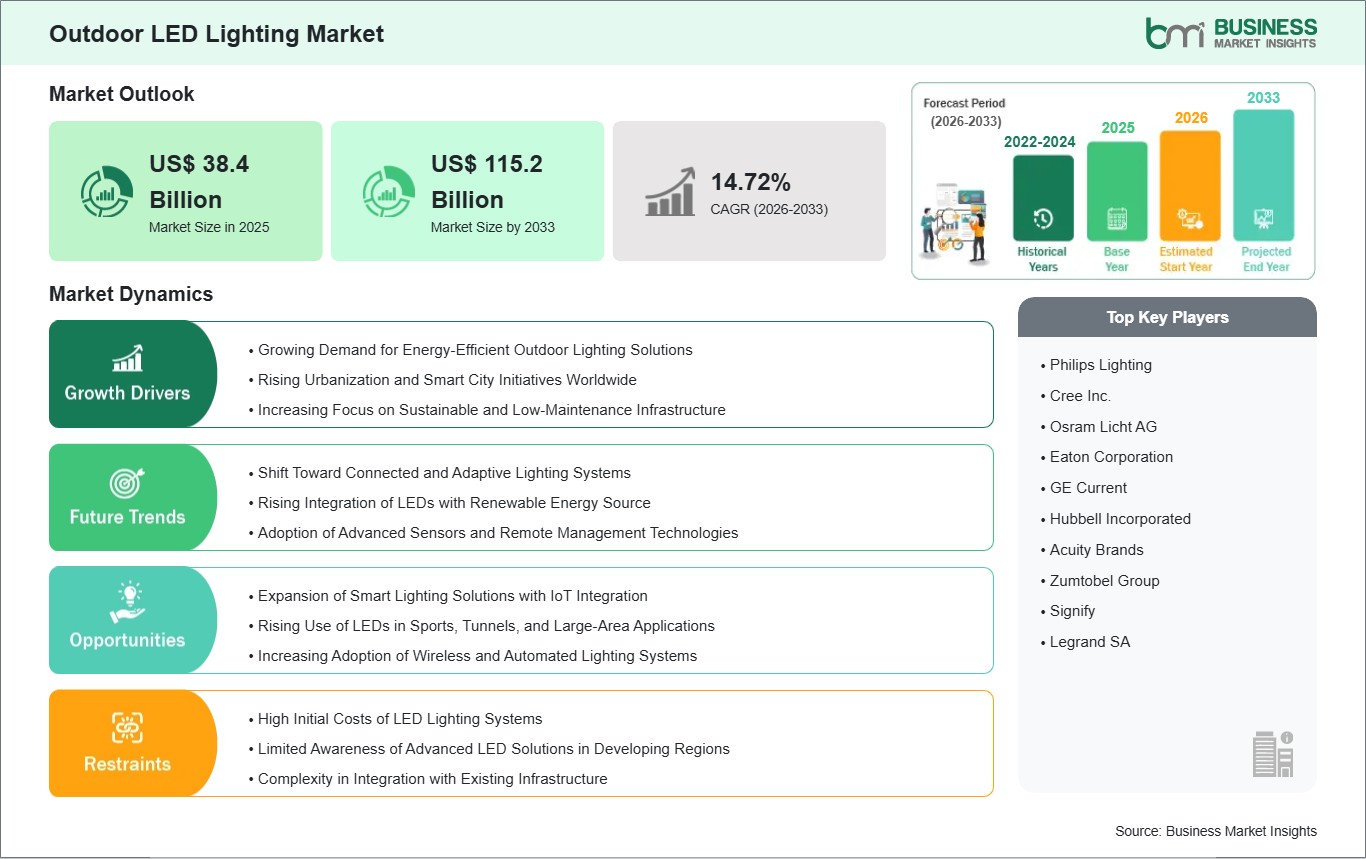
The Outdoor LED Lighting Market size is expected to reach US$ 115.2 Billion by 2033 from US$ 38.4 Billion in 2025. The market is estimated to record a CAGR of 14.72% from 2026 to 2033.
Due to a growing trend toward using more energy-efficient outdoor lighting, all current trends indicate that the outdoor LED lighting market will continue to grow. Government authorities, municipalities and commercial layout designers are increasingly looking to use energy-efficient and sustainable lighting solutions. The advantages of the LED luminaires (long life, low maintenance and high-quality light output) make them ideal for use on Roadways, Urban Landscapes, Tunnels, Sports Facilities and Large Commercial Areas; therefore, the replacement of traditional technologies for providing outdoor lighting presents an attractive opportunity due to lower energy consumption, lower operating expense and a reduced impact on the environment.
The growth of this market has been bolstered by the increase in urbanisation, the emergence of smart cities and the need for new infrastructure to help ensure safety, improve the aesthetics of the city and manage energy more effectively. Advanced LED systems are now integrated with sensors, controls, and smart technologies, enabling adaptive lighting, remote monitoring, and automated operation. These features improve efficiency, reduce energy waste, and allow municipalities and businesses to manage lighting in a more sustainable way. Manufacturers are also developing solutions tailored for different applications, such as high-intensity roadway lighting, decorative urban lighting, and large-area sports illumination. As demand for energy-efficient, durable, and intelligent lighting solutions grows, the outdoor LED lighting market is expected to expand steadily across global urban and commercial landscapes.

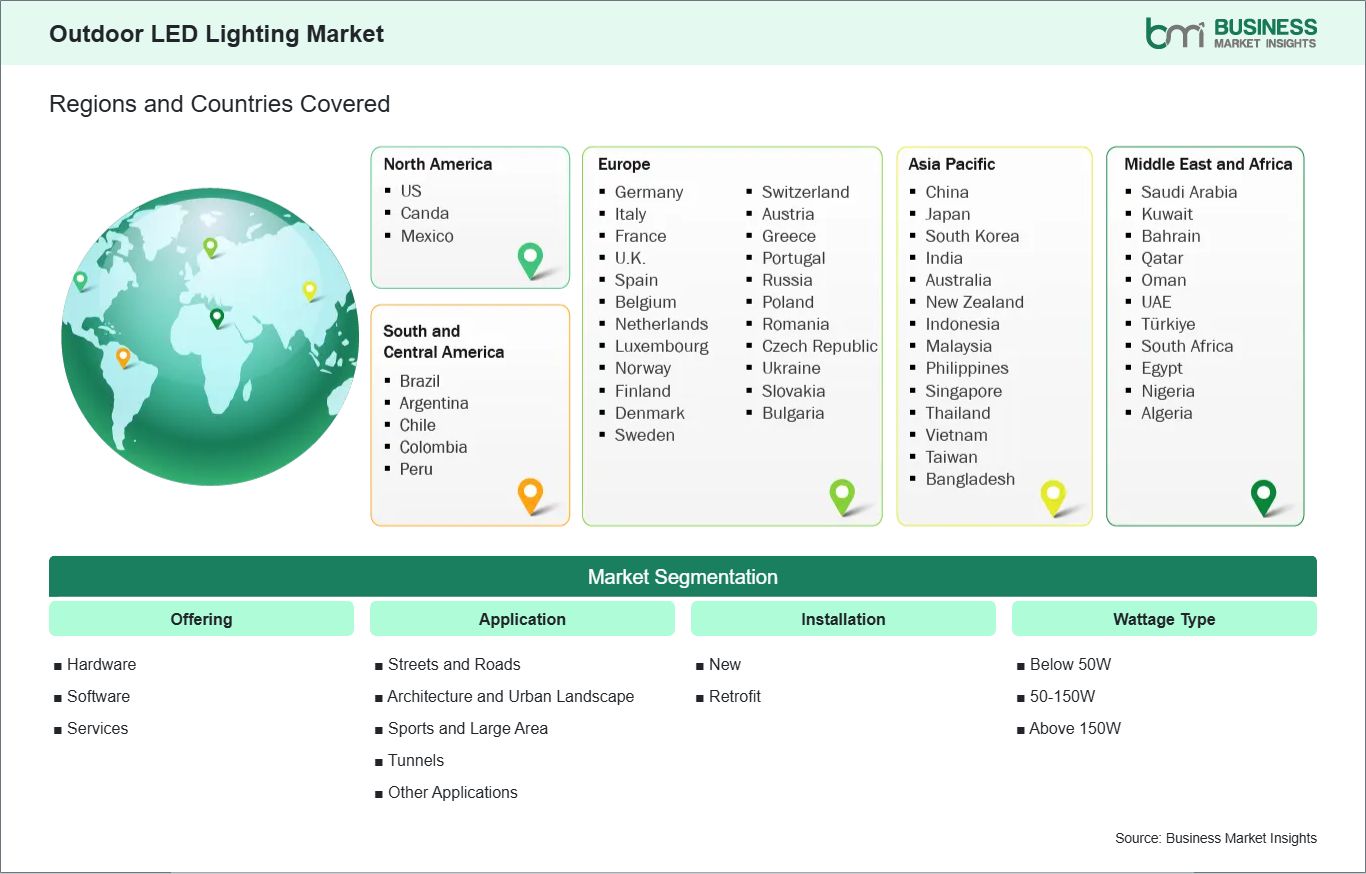
Key segments that contributed to the derivation of the outdoor LED lighting market analysis are material, application, installation, wattage type, communication, sales channel
The rising demand for energy-efficient outdoor lighting solutions is driving growth in the outdoor LED lighting market. Governments, municipalities, and commercial organizations are increasingly replacing conventional lighting systems with LEDs to reduce energy consumption, minimize maintenance costs, and support sustainability goals. Energy efficiency is a key factor, as LEDs consume significantly less electricity while providing better illumination compared with traditional technologies. Urban development projects, roadway expansions, and commercial outdoor lighting installations are major areas where LED adoption is accelerating. Street lighting, architectural projects, and sports facilities benefit from LEDs’ long lifespan, lower power requirements, and environmental advantages. As cities aim to reduce carbon emissions and optimize public infrastructure costs, energy-efficient LED lighting becomes an essential choice. Additionally, the trend toward smart cities and sustainable infrastructure supports broader adoption. Integration with controls, sensors, and adaptive systems allows more efficient operation and cost savings. These factors combined make energy efficiency a central driver for market growth, encouraging manufacturers and developers to expand LED lighting solutions across urban and commercial environments.
The expansion of smart lighting solutions with IoT integration is creating strong opportunities in the outdoor LED lighting market. Smart lighting allows control, monitoring, and automation of LED systems, enhancing energy efficiency, reducing operational costs, and providing adaptive illumination for urban and commercial spaces. IoT-enabled LED systems can be managed remotely, respond to environmental changes, and optimize lighting schedules according to real-time needs. Applications such as streets, tunnels, sports facilities, and architectural lighting benefit from connected systems that improve safety, operational efficiency, and user experience. Municipalities and commercial operators can leverage data collected from smart LEDs for predictive maintenance, energy optimization, and integration with broader smart city infrastructure.
In addition, the integration of IoT has spurred development of innovative, adaptive, and sensor-driven lighting solutions. As cities and commercial projects place more emphasis on sustainable, efficient, and connected infrastructure; there is a growing need for smart LED lighting systems. Manufacturers will continue to take advantage of this opportunity by providing manufacturers the opportunity to manufacture intelligent outdoor environments via new, innovative manufactured solutions.
The global outdoor LED lighting market is experiencing steady growth, with market size and share analysis reflecting evolving treatment preferences and competitive dynamics among key players. The report evaluates important subsegments categorized within material, application, installation, wattage type, communication, sales channel, highlighting their respective contributions to overall market performance.
By offering, the hardware subsegment dominated the market in 2025, due to its critical role in delivering high-efficiency, durable, and energy-saving lighting solutions that form the core of outdoor LED lighting installations.
By application, the streets and roads subsegment dominated the market in 2025, driven by widespread urban infrastructure development and government initiatives to replace conventional lighting with energy-efficient LED systems for public safety and cost savings.
By installation, the new installation subsegment dominated the market in 2025, as municipalities and commercial projects increasingly prefer installing LED systems during new construction for optimized energy efficiency and long-term cost benefits.
By wattage type, the 50 - 150W subsegment dominated the market in 2025, offering the ideal balance between illumination intensity, energy consumption, and cost for most urban and commercial outdoor applications.
By communication, the wired subsegment dominated the market in 2025, due to its reliability, stable performance, and ease of integration into existing municipal lighting networks.
By sales channel, the direct sales subsegment dominated the market in 2025, as project-based procurement by municipalities and commercial developers favors direct engagement with manufacturers for customized solutions.
| Report Attribute | Details |
|---|---|
| Market size in 2025 | US$ 38.4 Billion |
| Market Size by 2033 | US$ 115.2 Billion |
| Global CAGR (2026 - 2033) | 14.72% |
| Historical Data | 2022-2024 |
| Forecast period | 2026-2033 |
| Segments Covered | By Offering
|
|
Regions and Countries Covered
| |
| North America | US, Canada, Mexico |
| Europe | Belgium, Austria, Finland, Denmark, Greece, Poland, Romania, Russia, Ukraine, Czech Republic, Slovakia, Bulgaria, Italy, Luxembourg, Germany, Switzerland, France, Netherlands, Norway, Portugal, Spain, Sweden, United Kingdom |
| Asia-Pacific | Australia, China, India, Japan, South Korea, Indonesia, Malaysia, Philippines, Singapore, Thailand, Vietnam, Bangladesh, New Zealand, Taiwan |
| South and Central America | Brazil, Argentina, Peru, Chile, Colombia |
| Middle East and Africa | Bahrain, Kuwait, Oman, Qatar, Saudi Arabia, United Arab Emirates, Turkiye, South Africa, Egypt, Algeria, Nigeria |
| Market leaders and key company profiles |
|
The "Outdoor LED Lighting Market Size and Forecast (2022 - 2033)" report provides a detailed analysis of the market covering below areas:
The geographical scope of the outdoor LED lighting market report is divided into: North America, Asia Pacific, Europe, Middle East & Africa, and South & Central America. North America held the largest share in 2025.
North America holds a leading position in the outdoor LED lighting market due to strong adoption of energy-efficient infrastructure and smart city projects. Municipalities, commercial developers, and urban planners in the region are increasingly replacing traditional lighting systems with LED solutions to reduce energy costs, improve safety, and support sustainability goals. The presence of advanced research, well-established manufacturing capabilities, and supportive government policies also strengthens the region’s market position.
The region benefits from widespread deployment of smart lighting systems that integrate IoT, sensors, and adaptive controls for streets, tunnels, sports arenas, and urban landscapes. These technologies enable real-time monitoring, automated adjustments, and predictive maintenance, which further enhance operational efficiency. North America’s focus on sustainable, connected, and technologically advanced infrastructure encourages continuous investment in innovative LED lighting solutions. As cities and commercial spaces expand, the demand for high-performance, energy-saving, and adaptable outdoor lighting systems ensures that North America maintains its dominance in the global market.

The outdoor LED lighting market is evaluated by gathering qualitative and quantitative data post primary and secondary research, which includes important corporate publications, association data, and databases. A few of the key developments in the Outdoor LED Lighting market are:
The Outdoor LED Lighting Market is valued at US$ 38.4 Billion in 2025, it is projected to reach US$ 115.2 Billion by 2033.
As per our report Outdoor LED Lighting Market, the market size is valued at US$ 38.4 Billion in 2025, projecting it to reach US$ 115.2 Billion by 2033. This translates to a CAGR of approximately 14.72% during the forecast period.
The Outdoor LED Lighting Market report typically cover these key segments-
The historic period, base year, and forecast period can vary slightly depending on the specific market research report. However, for the Outdoor LED Lighting Market report:
The Outdoor LED Lighting Market is populated by several key players, each contributing to its growth and innovation. Some of the major players include:
The Outdoor LED Lighting Market report is valuable for diverse stakeholders, including:
Essentially, anyone involved in or considering involvement in the Outdoor LED Lighting Market value chain can benefit from the information contained in a comprehensive market report.
Please tell us your area of interest
(Market Segments/ Regions and Countries/ Companies)