
Nickel Alloy Market Outlook: Size, Share, Trends, Growth Analysis, Competitive Landscape & Forecast, 2026-2033

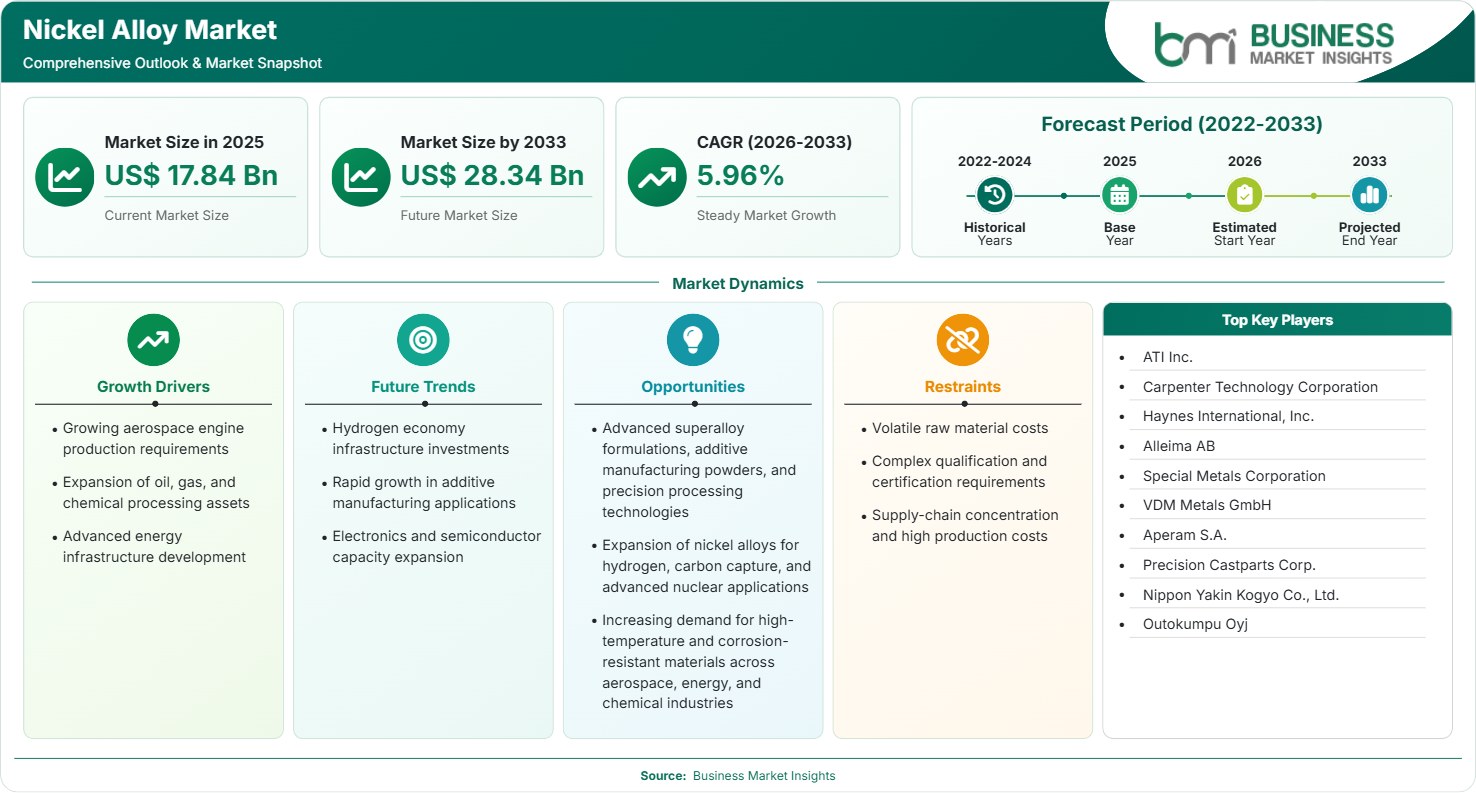
The Nickel Alloy Market size was valued at US$ 17.84 Billion in 2025 and is projected to reach US$ 28.34 Billion by 2033, growing at a CAGR of 5.96% during 2026–2033. Growth is supported by aerospace engine demand, energy infrastructure upgrades, offshore exploration activity, corrosion-resistant applications, additive manufacturing adoption, and emerging hydrogen processing investments.

Report Coverage
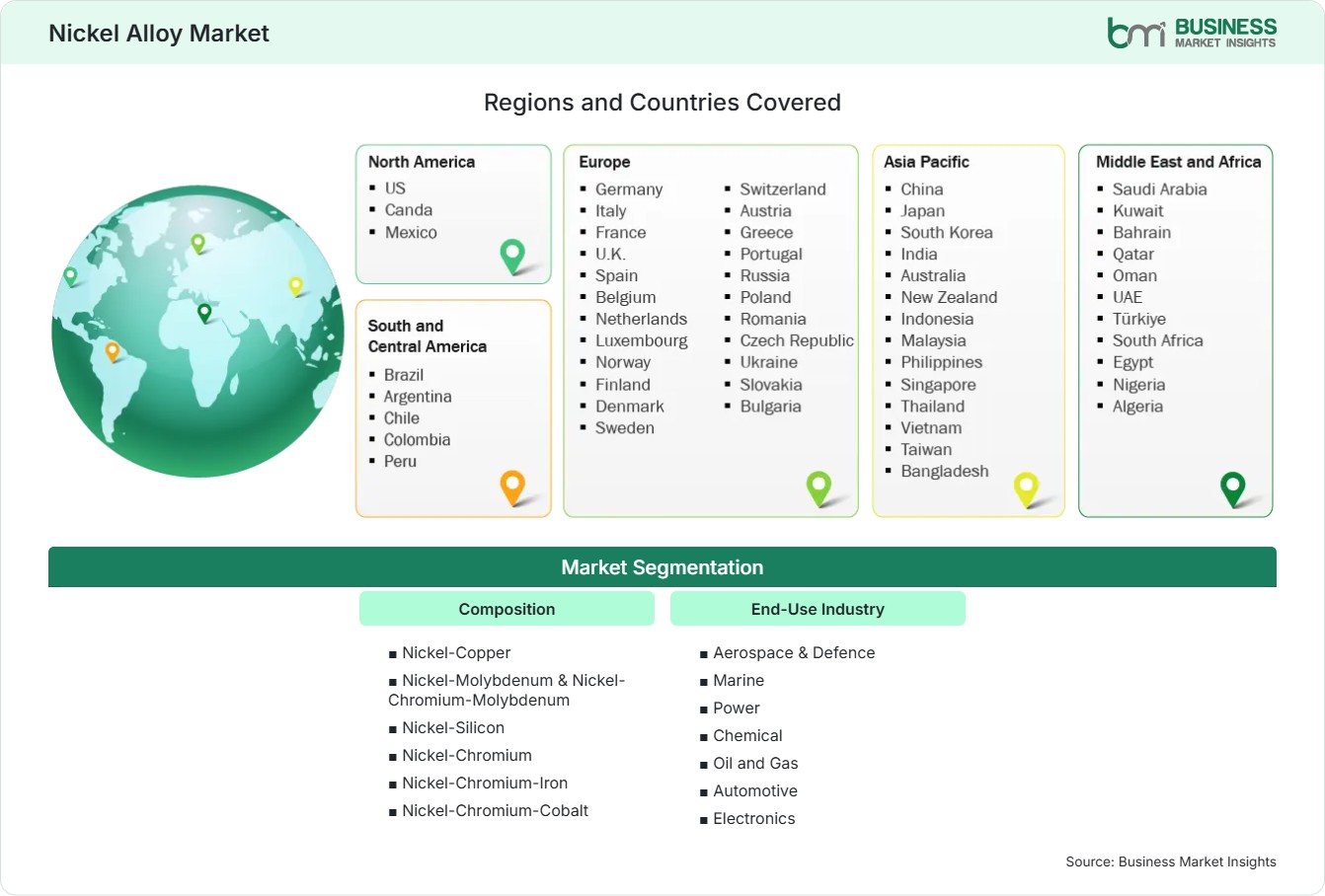
  • Composition: Nickel-Copper, Nickel-Molybdenum & Nickel-Chromium-Molybdenum, Nickel-Silicon, Nickel-Chromium, Nickel-Chromium-Iron, Nickel-Chromium-Cobalt
  • End-Use Industry: Aerospace & Defence, Marine, Power, Chemical, Oil and Gas, Automotive, Electronics
US$ 17.84 Bn Market size in 2025
US$ 28.34 Bn Market Size by 2033
5.96% CAGR, 2026 - 2033
2026-2033 Forecast Period

AI Overview

Nickel Alloy Market Summary

  • North America Region: North America holds a market share of 34%–37% in 2025, growing at a CAGR of 5.2%–5.6% through 2033. Demand is driven by aerospace turbine production, defense modernization, advanced energy assets, and petrochemical upgrades. Opportunities stem from hydrogen infrastructure and next-generation aircraft materials. U.S. demand remains supported by aerospace manufacturing and defense procurement, advancing at an estimated 5.3%–5.7% CAGR.
  • Fastest Growing Region: Asia Pacific holds 28%–31% share in 2025 and expands at 6.8%–7.4% CAGR. Industrialization, aircraft manufacturing expansion, power investments, naval modernization, electronics production, and chemical processing capacity additions continue supporting sustained consumption.
  • Leading Segment: Aerospace & Defence accounts for 24%–27% share in 2025 and grows at 6.2%–6.8% CAGR. High-temperature resistance requirements, turbine engine development, defense platforms, and lightweight performance materials create durable long-term demand opportunities.
  • High Growth Segment: Electronics accounts for 8%–11% share in 2025 and grows at 7.1%–7.8% CAGR. Rising semiconductor investments, battery technologies, precision components, and high-reliability electronic systems accelerate premium alloy adoption.
  • Key Market Opportunity: Energy transition investments, hydrogen production facilities, carbon capture systems, advanced nuclear reactors, and offshore renewable infrastructure are creating new demand channels for corrosion-resistant high-performance material solutions globally.
  • Major Market Players: ATI Inc., Carpenter Technology Corporation, Haynes International, Inc., Alleima AB, Special Metals Corporation, VDM Metals GmbH, Aperam S.A., Precision Castparts Corp., Nippon Yakin Kogyo Co., Ltd., Outokumpu Oyj.
Strategic Insights

Nickel Alloy Market: Strategic Insights

Nickel Alloy Market Strategic Framework
FREE PDF
Request your free sample
Request free sample
Stakeholder View

Key Takeaways

  • Supply chains remain concentrated among specialized melt shops, forging companies, and value-added processors, creating high entry barriers and reinforcing premium pricing dynamics.
  • Electronics, hydrogen infrastructure, and advanced chemical processing applications offer the strongest long-term volume expansion potential beyond traditional aerospace consumption.
  • Additive manufacturing is enabling customized geometries and reduced material waste, encouraging new product development strategies among alloy suppliers.
  • India and Southeast Asia present compelling investment cases due to industrial expansion, power generation projects, and growing aerospace manufacturing ecosystems.
  • Strategic acquisitions continue targeting specialty metallurgy capabilities, precision forging assets, and high-performance material technologies to strengthen market positioning.
  • Sustainability initiatives increasingly favor longer-life corrosion-resistant materials that reduce maintenance cycles and improve total lifecycle economics.
Geographic Outlook

Nickel Alloy Market Regional Highlights

North America Nickel Alloy Market

North America accounted for approximately 34%–37% of global demand in 2025 and is projected to expand at 5.2%–5.6% CAGR through 2033. The region benefits from large aerospace production programs, advanced defense procurement, petrochemical investments, and nuclear energy activity. The Nickel Alloy Market share remains highest in this region because manufacturers maintain strong technological capabilities and vertically integrated supply chains. Growth is supported by turbine engines, industrial gas turbines, and next-generation energy infrastructure.

  • Aerospace manufacturing continues supporting premium alloy consumption across engine, exhaust, and structural systems.
  • Defense modernization programs encourage procurement of advanced high-temperature materials.
  • Petrochemical and refining upgrades sustain demand for corrosion-resistant process equipment.
  • Hydrogen infrastructure projects create additional long-term consumption opportunities.
  • Advanced nuclear initiatives increasingly utilize specialty metallurgy solutions.

US Nickel Alloy Market

The United States represents roughly 76%–80% of regional demand and advances at 5.3%–5.7% CAGR. Strong aerospace exports, defense spending, industrial innovation, and specialty material manufacturing capabilities reinforce market leadership. Extensive R&D investments improve alloy performance and production economics. Domestic demand remains supported by commercial aviation recovery, gas turbine installations, and strategic industrial policies focused on critical materials and advanced manufacturing competitiveness.

  • Engine manufacturers continue emphasizing high-temperature superalloy utilization.
  • Defense aerospace programs maintain stable procurement requirements.
  • Energy infrastructure upgrades support industrial alloy applications.
  • Additive manufacturing adoption expands advanced material opportunities.

Europe Nickel Alloy Market

Europe holds 24%–27% share in 2025 and is expected to grow at 5.4%–5.9% CAGR. Aerospace, energy, automotive engineering, and chemical processing industries remain core demand sources. Germany leads regional consumption, while Eastern European manufacturing clusters are emerging as higher-growth locations. Sustainability targets and industrial decarbonization programs support investments in high-performance materials designed for efficiency improvements and operational durability.

  • Germany remains the leading country due to strong industrial manufacturing capabilities.
  • France benefits from aerospace production and defense industry investments.
  • The United Kingdom supports demand through energy and aerospace applications.
  • Poland shows comparatively faster industrial expansion rates.
  • Hydrogen and nuclear energy investments strengthen long-term fundamentals.

Asia Pacific Nickel Alloy Market

Asia Pacific accounts for 28%–31% share and records the fastest expansion at 6.8%–7.4% CAGR. China leads regional demand through heavy industrial activity and aerospace development. India represents the fastest-growing major economy due to manufacturing expansion and infrastructure investment. The Nickel Alloy Market growth trajectory in the region is supported by energy projects, electronics production, naval programs, and chemical processing capacity additions.

  • China remains the largest regional consumer across industrial applications.
  • India demonstrates the fastest growth supported by manufacturing investments.
  • Japan maintains demand through precision engineering sectors.
  • South Korea supports consumption through electronics and shipbuilding industries.
  • Southeast Asian economies increasingly attract industrial capital expenditure.

Rest of World Nickel Alloy Market

The Rest of World region holds 10%–13% share and expands at 5.8%–6.3% CAGR. Middle Eastern demand benefits from oil, gas, refining, and energy diversification projects. South and Central America continue investing in mining, power generation, and industrial processing facilities. Saudi Arabia leads Middle Eastern consumption while Brazil remains the largest Latin American market, supporting steady adoption of corrosion-resistant engineered materials.

  • GCC countries invest heavily in petrochemical and industrial diversification projects.
  • Saudi Arabia remains the leading regional market.
  • Brazil dominates Latin American consumption through industrial investments.
  • Offshore energy developments support specialty alloy utilization.
  • Mining and process industries contribute stable long-term demand.
Global Market Geography
FREE PDF
Request your free sample
Request free sample
Segment Analysis

Nickel Alloy Market Segmentation

Composition

This segment represents nearly 58%–62% share in 2025 and grows at 5.7%–6.1% CAGR. Nickel Alloy Market scope within composition categories is expanding as users select alloys based on corrosion resistance, strength retention, thermal stability, and lifecycle performance across demanding industrial environments.

  • Nickel-Copper: Widely used in marine environments where seawater corrosion resistance and reliability remain critical operational requirements.
  • Nickel-Molybdenum & Nickel-Chromium-Molybdenum: Preferred in aggressive chemical processing environments due to exceptional corrosion resistance and durability.
  • Nickel-Silicon: Applied in specialized high-temperature industrial equipment requiring oxidation resistance and processing efficiency.
  • Nickel-Chromium: Extensively utilized in heating elements, power systems, and thermal industrial applications.
  • Nickel-Chromium-Iron: Balances cost and performance across industrial, aerospace, and power-generation environments.
  • Nickel-Chromium-Cobalt: Selected for turbine engines and extreme-temperature aerospace applications requiring superior strength.

End-Use Industry

End-use industries account for the full revenue base, with Aerospace & Defence leading at 24%–27% share in 2025 and expanding at 6.2%–6.8% CAGR. Nickel Alloy Market trends indicate growing diversification toward electronics, energy transition infrastructure, and advanced industrial equipment.

  • Aerospace & Defence: Demand driven by aircraft engines, defense platforms, and extreme-temperature component requirements.
  • Marine: Corrosion resistance characteristics support use in naval vessels and offshore infrastructure.
  • Power: Advanced turbines, nuclear systems, and energy facilities require durable high-performance materials.
  • Chemical: Aggressive processing conditions encourage adoption of corrosion-resistant alloy solutions.
  • Oil and Gas: Subsea systems, pipelines, and refining operations remain significant consumption channels.
  • Automotive: Performance vehicles and emissions-related technologies support specialized alloy requirements.
  • Electronics: Semiconductor investments and precision components drive enhanced growth prospects.
Market Forces

Nickel Alloy Market Dynamics

Key Market Drivers

Growing Aerospace Engine Production Requirements

Commercial aviation fleets continue expanding while aircraft manufacturers prioritize fuel efficiency and higher operating temperatures. Super alloys made of nickel are critical for applications like blades, combustion chambers, and other hot sections since replacement materials cannot guarantee the same longevity. Improved visibility is ensured by global passenger traffic recovery and defense aviation orders. Engine manufacturers need to employ metallurgical solutions to improve thermal efficiency and reduce maintenance intervals. With the development of aerospace programs in the direction of future propulsion systems, alloy suppliers have good visibility and technological barriers to stay profitable.

Expansion of Oil, Gas, and Chemical Processing Assets

Refineries, petrochemical complexes, LNG infrastructure, and offshore production systems operate under highly corrosive conditions. Specific alloys enable extended life expectancy, reduced downtime, and improved reliability. The rising investments in energy-producing countries and developing countries will further boost the demand for alloys used in valves, heat exchangers, piping systems, and processing equipment. More attention is being paid to lower total costs during the lifecycle rather than the initial purchase cost, which encourages the use of high-quality materials. The tougher environmental regulations also foster investments in robust equipment platforms.

Advanced Energy Infrastructure Development

Hydrogen, carbon capture, advanced nuclear technologies, and high-efficiency gas turbines demand materials capable of operating in harsh thermal and chemical environments. With the increase in investments in low-carbon initiatives, governments and energy companies are channeling more capital into projects that utilize special metallurgical products. Transitioning into cleaner production methods has expanded the number of application areas outside traditional markets. Suppliers who can provide solutions for their applications gain an edge as project developers prioritize longevity and safety in their criteria.

Key Market Opportunities

Hydrogen Economy Infrastructure Investments

Hydrogen production, transportation, storage, and utilization systems frequently expose equipment to corrosive environments and elevated pressures. This creates attractive opportunities for advanced material providers. Nickel Alloy Market Forecasts are now focusing on the infrastructure of hydrogen as a promising area for growth due to the development of major electrolyzers, pipelines, and processing projects in North America, Europe, and Asia-Pacific. Companies that have certified products to suit hydrogen applications can earn good margins from their sales. Project life spans and high standards for performance could reinforce the demands arising from maintenance and replacements.

Rapid Growth in Additive Manufacturing Applications

Additive manufacturing enables the efficient production of complex geometries previously difficult or costly to fabricate. Metal printing is becoming more common among aerospace, defense, medical, and industrial users using high-performing alloys. This opens more possibilities for value addition for manufacturers who can ensure material consistency. Value addition comes through customization of components, reduction of waste in processing, and shorter times for prototype development. With certification frameworks in place, the need for specialized powders will continue to grow.

Electronics and Semiconductor Capacity Expansion

The semiconductor industry's continued investment cycle supports specialty material consumption in manufacturing equipment, thermal management systems, and precision components. Need for greater levels of reliability, smaller size, and superior performance leads to the use of better alloys. Construction of new factories in the Asia Pacific, North America, and Europe will provide additional demand growth avenues. Manufacturers who design their products with respect to semiconductor process needs can enter more profitable markets with high-quality standards and strong customer relationships.

Market Restraints and Challenges

Volatile Raw Material Costs

Factor: Nickel, molybdenum, cobalt, and chromium markets experience periodic supply disruptions, geopolitical uncertainties, and pricing volatility. Impact: Producers encounter pressure from slim margins, procurement problems, and fluctuating production economics. The fast-changing dynamics might make it hard for producers to negotiate contracts in the long run and hinder their visibility among consumers in procurement. High prices may force consumers to hold back on investment and look for alternative options. As such, producers need to have good procurement approaches.

Complex Qualification and Certification Requirements

Factor: Aerospace, defense, nuclear, and critical industrial sectors impose extensive qualification, testing, and regulatory requirements. Impact: Product commercialization timelines become longer, and development costs increase. New entrants face significant barriers when attempting to gain approvals and customer confidence. Certification demands also limit rapid substitution and delay revenue realization from innovative products. While such standards support quality and safety outcomes, they contribute to higher operating expenses and slower market penetration for emerging material solutions.

Company Analysis

Competitive Landscape

Nickel Alloy Market analysis indicates competition centers on metallurgical expertise, proprietary superalloy formulations, processing capabilities, certification credentials, and long-term customer relationships.

Company Name

Overview

Products and Services relevant to this market

ATI Inc.

Global specialty materials producer serving aerospace, defense, energy, and industrial customers.

Nickel-based superalloys, forged products, specialty materials, powder metals, engineered solutions.

Carpenter Technology Corporation

Producer of high-performance specialty alloys and engineered materials.

Nickel alloys, precision components, specialty metals, additive manufacturing materials.

Haynes International, Inc.

Recognized supplier of corrosion-resistant and high-temperature alloys.

HASTELLOY®, nickel alloys, process industry materials, aerospace applications.

Alleima AB

Advanced materials company operating across high-performance alloy markets.

Tubes, pipes, strip steel, advanced alloy products and engineered solutions.

Special Metals Corporation

Major inventor and producer of premium nickel alloy families.

INCONEL®, INCOLOY®, MONEL®, NIMONIC® and related alloy systems.

VDM Metals GmbH

Specialist supplier of nickel, cobalt, and corrosion-resistant materials.

Semi-finished products, alloy sheets, bars, wires, additive manufacturing powders.

Aperam S.A.

Global stainless and specialty alloy producer.

Specialty alloys, high-performance materials and industrial processing solutions.

Precision Castparts Corp.

Aerospace-focused manufacturer with advanced metallurgical capabilities.

Castings, forged components, aerospace alloy products.

Nippon Yakin Kogyo Co., Ltd.

Japanese producer specializing in specialty metallic materials.

Corrosion-resistant alloys, high-temperature materials, industrial solutions.

Outokumpu Oyj

International stainless and specialty alloy manufacturer.

Specialty metal products, industrial alloys, engineered material solutions.

Trust & Transparency

Research Methodology

The market analysis combines proprietary research with secondary data from government agencies, company disclosures, regulatory filings, industry databases and expert interviews. Market estimates are validated through data triangulation, cross-market benchmarking and analyst review.

View Full Research Methodology

Questions Answered

Frequently Asked Questions

What insights does a Nickel Alloy Market Report typically provide?

A Nickel Alloy Market Report generally evaluates industry size, competition, regional opportunities, end-use demand trends, technological developments, and long-term growth prospects.

How does additive manufacturing influence the industry?

Additive manufacturing increases demand for specialized alloy powders, enables complex component designs, reduces waste, and accelerates product development cycles.

Which region is expected to grow the fastest?

Asia Pacific is projected to record the strongest expansion due to manufacturing investments, aerospace development, electronics production, and power infrastructure growth.

What makes nickel alloys suitable for harsh industrial environments?

They provide strong resistance to corrosion, oxidation, pressure, and extreme temperatures, allowing longer service life and improved operational reliability in demanding conditions.

What factors are driving long-term demand for nickel alloys?

Demand is largely supported by aerospace engines, offshore infrastructure, power generation projects, chemical processing equipment, and emerging hydrogen applications requiring corrosion-resistant materials.

Access the Full Nickel Alloy Market Report

Get segment-level forecasts, regional estimates, competitive benchmarking, company profiles and downloadable Excel datasets.

Access the full Nickel Alloy Market Report
350 pages PDF & Excel | 2026-08-31