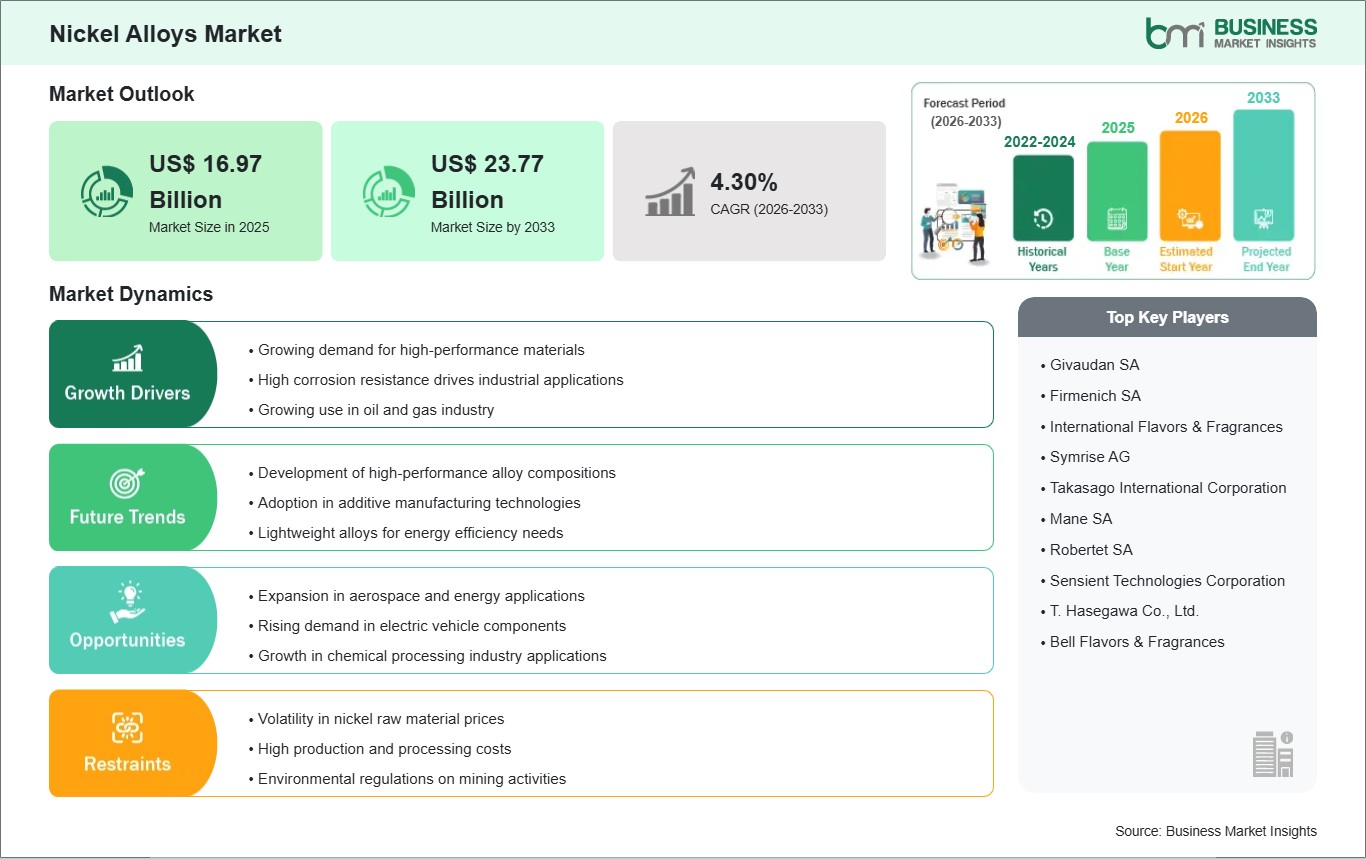
The Nickel Alloys Market size is expected to reach US$ 23.77 Billion by 2033 from US$ 16.97 Billion in 2025. The market is estimated to record a CAGR of 4.30% from 2026 to 2033.
The nickel alloy market is growing steadily, driven by increased demand from aerospace, automotive, energy, and chemical processing sectors. Nickel alloys, which possess superior corrosion resistance, high temperature properties, and mechanical strength, are very important for use in severe operating conditions. Aerospace and defense are major drivers for nickel alloys, as nickel super alloys are used in turbine engines, gas turbines, and structural components owing to their ability to perform in extreme temperature and stress conditions. Increased industrialization and the need for durable materials in chemical processing, oil and gas, and power generation also contribute to the nickel alloy market growth.
The market is influenced by technological advancements in metallurgical processes, which help produce superior alloys with enhanced composition for specific industry demands. Investments in research and development are targeted towards improving fatigue resistance, weldability, and thermal conductivity, along with reducing production costs. Competitive differentiation in the market is mostly achieved through the development of niche-specific materials, for example, materials with high resistance to corrosion in seawater or high-strength materials for aerospace applications. However, with issues related to the cost of raw materials, high production costs due to high energy consumption, and stringent environment protection regulations for metal production, the situation still poses a significant constraint for the market. Nevertheless, with growing emphasis on long-term production efficiency, longevity, and safety, the market for nickel alloys is expected to grow steadily in global industrial applications.

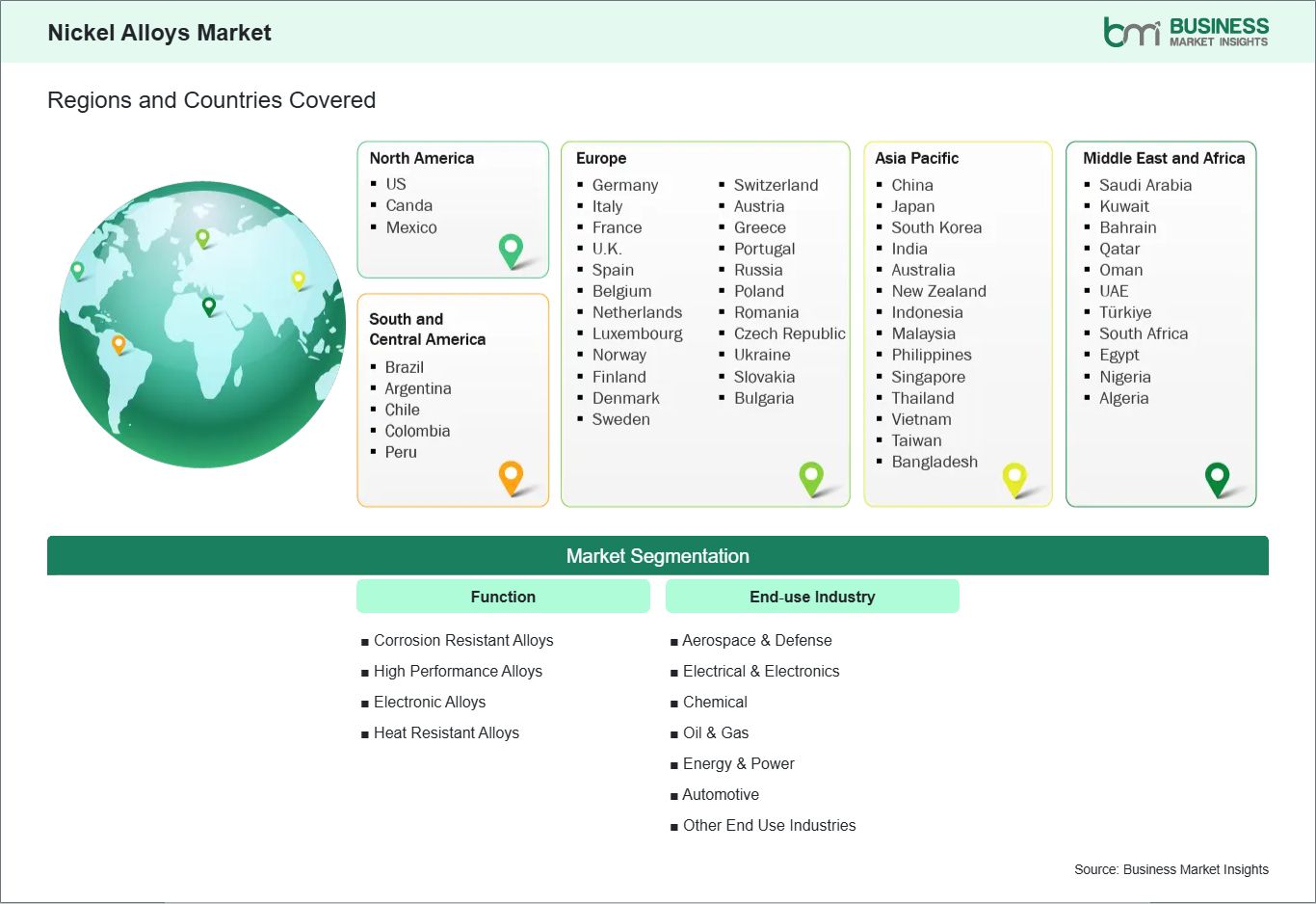
Key segments that contributed to the derivation of the nickel alloys market analysis are function and end‑use industry.
A significant factor in the nickel alloy market is the demand for high-performance materials. Modern industries are increasingly demanding materials that can operate in extreme conditions, such as high temperatures, corrosive environments, and mechanical stress. Nickel alloys are commonly used in industries such as aerospace, power generation, chemical processing, and oil and gas due to their high strength, durability, and ability to operate in harsh environments. These materials are also in high demand due to their ability to operate in extreme environments, making them a popular choice for industries that require high-performance materials.
Another factor contributing to the nickel alloy market growth is the demand for efficient and sustainable materials in industrial applications. Nickel alloys are commonly used in industries due to their ability to operate in high-temperature environments, which can help increase the efficiency of industrial operations while minimizing costs. These materials are also used in harsh environments, making them a popular choice for industries that require high-performance materials, thereby promoting industrialization efforts.
Additionally, continuous advancements in alloy design and manufacturing technologies have expanded their potential applications. Innovations in alloy composition, casting, and fabrication techniques improve both performance and manufacturability. As industries increasingly prioritize durability, safety, and operational efficiency, nickel alloys continue to see strong demand as a reliable solution for high-performance engineering and industrial applications.
The nickel alloy market is growing, driven by an increase in the use of nickel alloys in the aerospace industry and the energy sector. In the aerospace industry, nickel alloys are critical for components that are subjected to extreme temperature conditions and mechanical stresses, such as turbine blades, engine parts, and exhaust systems. Nickel alloys provide excellent resistance against heat, corrosion, and mechanical stresses, which enables aircraft manufacturers to produce lighter, efficient, and durable components, thus enhancing aircraft performance and fuel efficiency.
Nickel alloys are also used in the energy sector, particularly in power generation systems, including gas turbines, nuclear reactors, and renewable energy systems. Nickel alloys provide reliable service in extreme conditions, such as high pressure and temperature, which enables them to guarantee safety and reliability, thus enhancing operational efficiency and sustainability. Nickel alloys are used in critical equipment in the energy sector, which demonstrates their suitability for this industry.
Furthermore, ongoing research into advanced nickel-based superalloys and additive manufacturing techniques has expanded the possibilities for complex, high-performance components. These innovations allow industries to optimize designs, reduce weight, and enhance functionality while maintaining material integrity. As aerospace and energy sectors continue to advance, the demand for nickel alloys is expected to grow steadily, solidifying their role as a cornerstone material for high-performance applications.

The nickel alloys market demonstrates steady growth, with size and share analysis highlighting evolving trends and competitive dynamics among key players. The report examines subsegments categorized within function and end‑use industry, offering insights into their contribution to overall market performance.
By Function, the corrosion resistant alloys subsegment dominated the market in 2025, driven by superior resistance to harsh chemical environments and long-term durability.
Based on End‑use Industry, the aerospace & defense subsegment dominated the market in 2025, owing to increasing demand for lightweight, high-strength, and corrosion-resistant components in aircraft and defense applications.
| Report Attribute | Details |
|---|---|
| Market size in 2025 | US$ 16.97 Billion |
| Market Size by 2033 | US$ 23.77 Billion |
| Global CAGR (2026 - 2033) | 4.30% |
| Historical Data | 2022-2024 |
| Forecast period | 2026-2033 |
| Segments Covered | By Function
|
|
Regions and Countries Covered
| |
| North America | US, Canada, Mexico |
| Europe | Belgium, Austria, Finland, Denmark, Greece, Poland, Romania, Russia, Ukraine, Czech Republic, Slovakia, Bulgaria, Italy, Luxembourg, Germany, Switzerland, France, Netherlands, Norway, Portugal, Spain, Sweden, United Kingdom |
| Asia-Pacific | Australia, China, India, Japan, South Korea, Indonesia, Malaysia, Philippines, Singapore, Thailand, Vietnam, Bangladesh, New Zealand, Taiwan |
| South and Central America | Brazil, Argentina, Peru, Chile, Colombia |
| Middle East and Africa | Bahrain, Kuwait, Oman, Qatar, Saudi Arabia, United Arab Emirates, Turkiye, South Africa, Egypt, Algeria, Nigeria |
| Market leaders and key company profiles |
|
The "Nickel Alloys Market Size and Forecast (2022 - 2033)" report provides a detailed analysis of the market covering below areas:
The geographical scope of the Nickel Alloys Market report is divided into North America, Asia Pacific, Europe, Middle East & Africa, and South & Central America. North America held the largest share in 2025.
Nickel alloys have different growth rates, depending on industrialization, regulations, and sectoral requirements. The nickel alloy market is dominated by the North American region, given the well-established aerospace, defense, and chemical industries in the area. The U.S., being the largest consumer, utilizes the high metallurgical standards, industrialization, and supply chain advantages to meet the growing demand for nickel alloys, along with the stringent regulations that have increased the demand for corrosion-resistant materials in the industrial and aerospace industries.
Europe has also witnessed steady growth, particularly in the German, French, and U.K. markets, where the automotive and energy industries have created significant demand for specialty nickel alloys, given the high industrial standards, metallurgical research, and environmental regulations that have increased the adoption of high-grade materials.
Asia Pacific is the fastest-growing segment, with countries such as China, India, Japan, and South Korea contributing to the growing demand for nickel alloys. Rapid industrialization, urbanization, and expanding aerospace, power generation, and chemical industries are fueling demand, with increasing investment in high-performance alloy production facilities.
Middle East & Africa shows moderate growth, supported by oil & gas infrastructure projects in the Gulf region and mining-driven industrial activities in South Africa. The market is characterized by demand for corrosion-resistant alloys suited for extreme climatic and operational conditions.
South & Central America is witnessing gradual expansion, with Brazil and Chile leading due to investments in energy, mining, and industrial sectors. Demand is largely focused on nickel alloys for chemical processing, structural applications, and high-performance industrial equipment.

The Nickel Alloys Market is evaluated by gathering qualitative and quantitative data post primary and secondary research, which includes important corporate publications, association data, and databases. A few of the key developments in the nickel alloys market are:
The Nickel Alloys Market is valued at US$ 16.97 Billion in 2025, it is projected to reach US$ 23.77 Billion by 2033.
As per our report Nickel Alloys Market, the market size is valued at US$ 16.97 Billion in 2025, projecting it to reach US$ 23.77 Billion by 2033. This translates to a CAGR of approximately 4.30% during the forecast period.
The Nickel Alloys Market report typically cover these key segments-
The historic period, base year, and forecast period can vary slightly depending on the specific market research report. However, for the Nickel Alloys Market report:
The Nickel Alloys Market is populated by several key players, each contributing to its growth and innovation. Some of the major players include:
The Nickel Alloys Market report is valuable for diverse stakeholders, including:
Essentially, anyone involved in or considering involvement in the Nickel Alloys Market value chain can benefit from the information contained in a comprehensive market report.
Please tell us your area of interest
(Market Segments/ Regions and Countries/ Companies)