Market Summary
Executive Summary and Global Market Analysis
Mounted bearings are pre-assembled bearing units housed within support structures that stabilize rotating shafts under operational load. They simplify installation, maintain alignment, and protect internal rolling elements in equipment exposed to dust, vibration, and continuous motion.
Procurement interest is strengthening as industrial operators seek components that reduce installation complexity and shorten maintenance interventions. Mounted bearing units address these priorities by combining shaft support, sealing, and housing integrity in formats suited to conveyors, fans, material handling lines, and processing equipment.
Segment analysis shows clear differentiation across bearing architecture, housing configuration, and sales channel structure. Ball bearings serve applications requiring smooth operation and moderate load handling, while roller bearings fit heavier duty cycles. Housing choice reflects mounting constraints, and channel selection depends on replacement cycles and original equipment integration.
Product development is moving toward enhanced sealing performance, easier locking systems, corrosion-resistant materials, and condition-oriented design refinements. These changes help operators extend service intervals and improve reliability in applications where contamination, washdown exposure, or shaft misalignment can disrupt equipment performance.
Competitive conditions are shaped by engineering depth, housing versatility, aftermarket reach, and the ability to tailor units for specific industries. Suppliers differentiate through sealing technologies, mounting convenience, and portfolio breadth that supports both standardized machinery platforms and demanding operating environments.
Segment Analysis
Mounted Bearing Market Segmentation
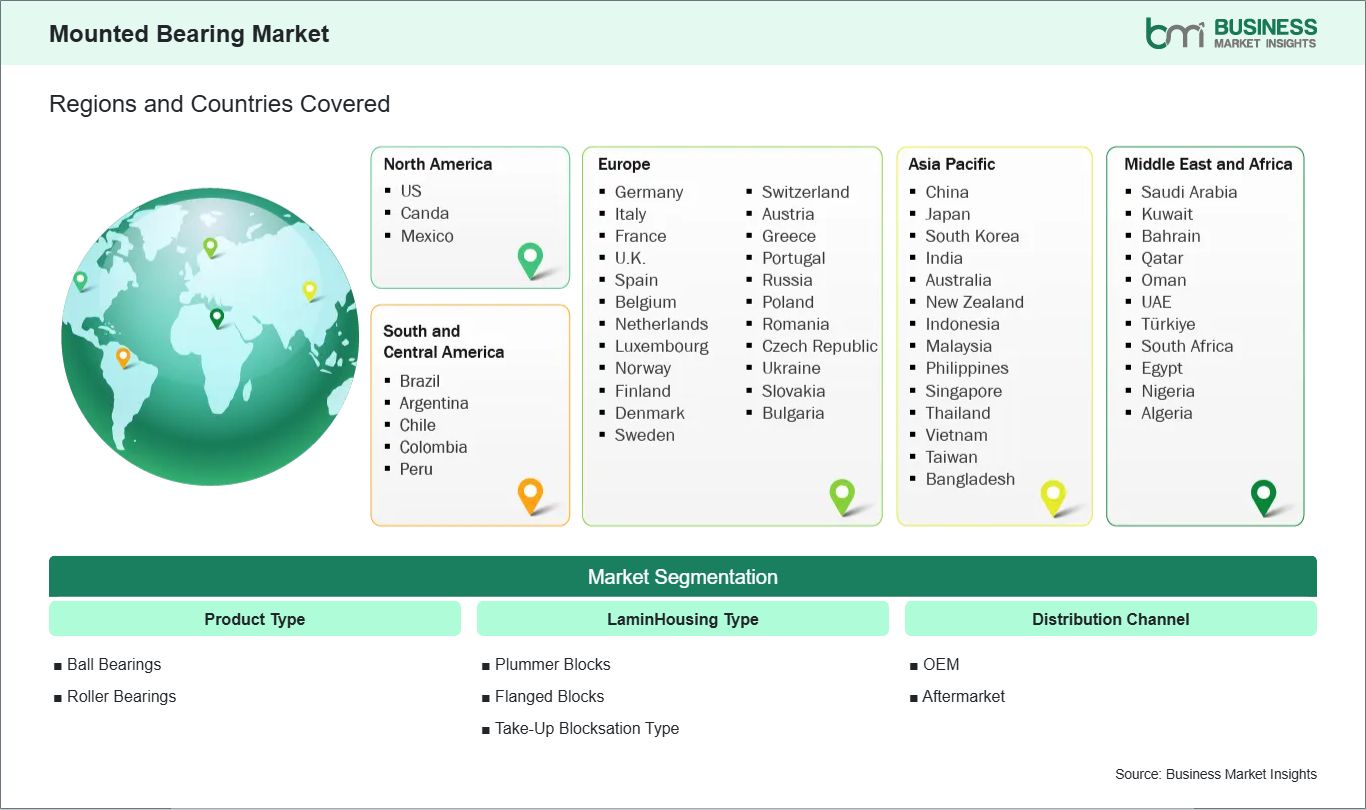
The mounted bearing market is segmented by product type, housing type, and distribution channel across industrial equipment requirements.
By Product Type
- Ball Bearings: Preferred for smoother rotation in moderate-load machinery layouts.
- Roller Bearings: Selected for stronger load support in demanding industrial assemblies.
By Housing Type
- Plummer Blocks: Used where shaft support and servicing access must remain straightforward.
- Flanged Blocks: Installed where face mounting supports compact equipment arrangements.
- Take-Up Blocks: Applied when belt or chain tension needs positional adjustment.
By Distribution Channel
- OEM: Supports integrated supply for new machinery production programs.
- Aftermarket: Captures replacement demand tied to maintenance and uptime priorities.
Market Forces
Mounted Bearing Market Drivers and Opportunities
Maintenance Efficiency Requirements Supporting Unitized Bearing Selection
Industrial equipment owners are under pressure to reduce service downtime without complicating installation practices. That requirement is pushing preference toward mounted bearings because they combine housing support, shaft alignment, and sealing within a single assembly. Maintenance teams adopt these units when replacement speed, interchangeability, and operational consistency matter across conveyors, processing lines, and rotating auxiliary equipment.
The effect reaches beyond maintenance convenience and influences equipment availability, service planning, and lifecycle cost control. In sectors where unplanned stoppages disrupt throughput, mounted bearings provide a practical route to steadier operation. Their relevance remains high in facilities seeking dependable shaft support solutions that fit established machinery layouts without extensive redesign or prolonged commissioning effort.
Advanced Sealing and Application-Specific Designs Creating Expansion Potential
An important opportunity is emerging through bearing units engineered for harsher environments, easier mounting, and stricter hygiene or contamination control requirements. Suppliers are refining sealing systems, housing materials, and locking mechanisms to support use cases in food processing, bulk handling, washdown zones, and abrasive industrial settings where standard units can face performance limitations.
Future scope is tied to broader customization across equipment classes and replacement cycles where operators value fit-for-purpose reliability. As machinery operators seek longer service intervals and simplified maintenance, mounted bearing suppliers can expand through specialized product lines and retrofit-friendly solutions. This direction can strengthen sector penetration while improving performance consistency across varied industrial operating conditions.
Size and Share Analysis
Mounted Bearing Market Size and Share Analysis
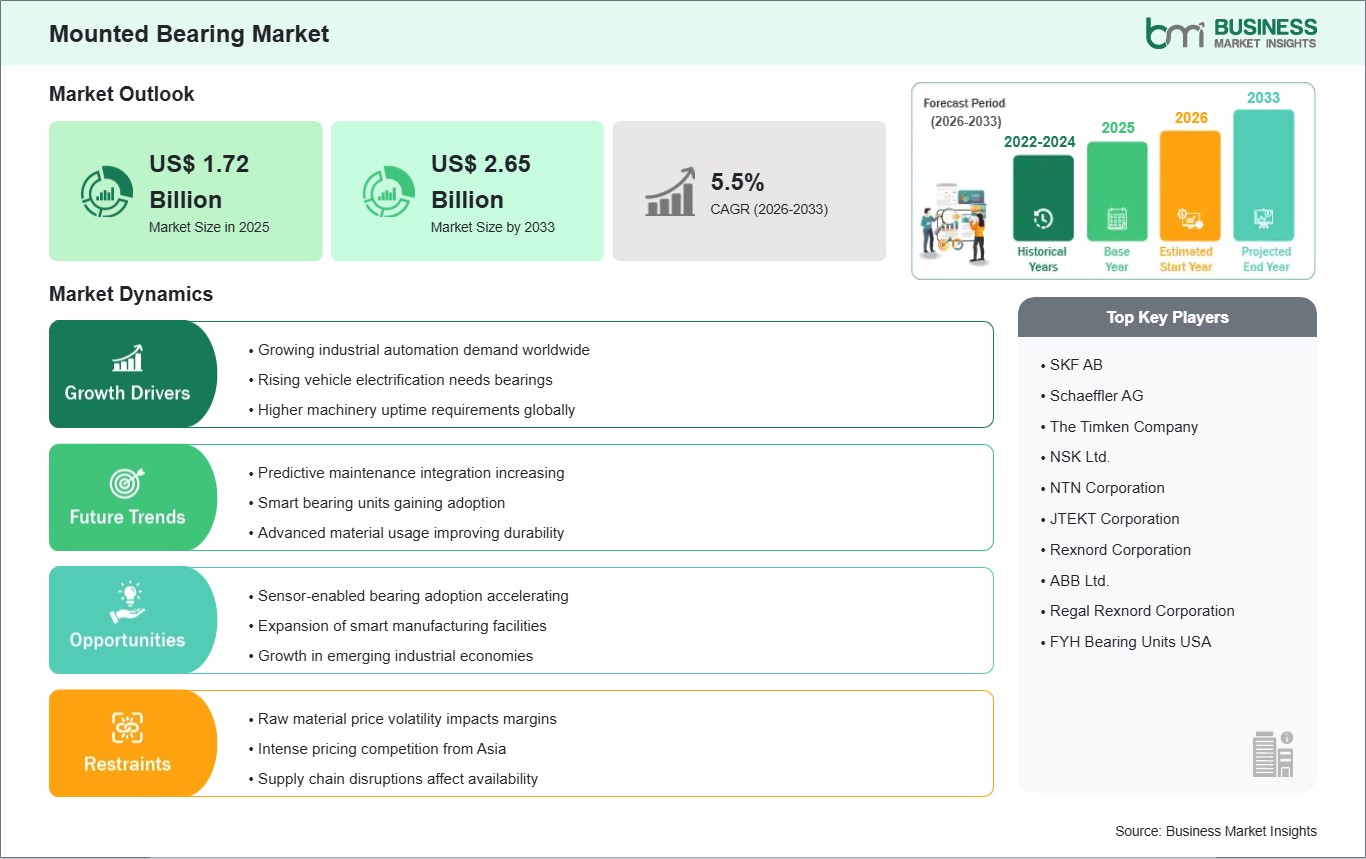
The Mounted Bearing market size is expected to reach US$ 2.65 Billion by 2033 from US$ 1.72 Billion in 2025. The market is estimated to record a CAGR of 5.5% from 2026 to 2033. This trajectory reflects steady replacement demand, ongoing equipment modernization, and the importance of reliable shaft support across industrial machinery categories.
By product type, ball bearings retain broad market visibility because they align with mainstream machinery needs requiring balanced cost, smooth motion, and installation flexibility. Within housing configurations, plummer blocks hold a strong position where service access and robust support structures are prioritized. OEM demand remains important, although aftermarket channels maintain strong relevance through routine replacement and maintenance activity.
Application leadership is centered on conveyor systems and material handling equipment, where mounted bearings are essential for stable shaft performance and service continuity. Processing machinery also represents a significant use area because contamination resistance and maintenance accessibility influence component selection. Agricultural and bulk movement equipment further support demand where durability and fast replacement remain operational priorities.
Report Coverage
Mounted Bearing Market Report Coverage and Deliverables
The " Mounted Bearing Market Size and Forecast (2022-2033)" report provides a detailed analysis of the market covering below areas:
- Market size and forecast at global, regional, and country levels for all the key market segments covered under the scope
- Market trends, as well as market dynamics such as drivers, restraints, and key opportunities
- Market analysis covering key market trends, global and regional framework, major players, regulations, and recent market developments
- Industry landscape and competition analysis covering market concentration, heat map analysis, prominent players, and recent developments for the market
- Detailed company profiles, including SWOT analysis
Geographic Insights
Mounted Bearing Market Geographic Insights
The Mounted Bearing market shows diverse regional adoption patterns influenced by industrial equipment age, maintenance culture, end-use specialization, and machinery operating intensity. At the global level, procurement behavior reflects the need for shaft support solutions that combine straightforward installation with dependable performance across material handling, food processing, agriculture, and general machinery platforms.
North America remains a mature market where replacement demand and engineered upgrades support consistent purchasing activity. Users across heavy industry, warehousing, and processing environments value bearing units that simplify maintenance and reduce downtime exposure. Demand also benefits from preference for durable housings and sealing systems suited to contaminated or high-cycle operating conditions.
Asia Pacific presents a broad manufacturing and equipment base that sustains strong usage across conveyors, fans, farm machinery, and industrial processing systems. The region benefits from continuing machinery deployment and an extensive installed base that supports both OEM and replacement demand. Buyers often prioritize product versatility, local availability, and reliable performance across varied industrial environments.
Europe is characterized by application-specific selection practices, with emphasis on precision fit, service life, and compliance-oriented engineering in industrial systems. Beyond Europe, emerging markets in the Middle East, Africa, and South and Central America are gradually broadening their use of mounted bearing units as processing capacity, logistics networks, and bulk material infrastructure continue to expand.
Industry Activity
Recent Developments
The mounted bearing market is evaluated by gathering qualitative and quantitative data post primary and secondary research, which includes important corporate publications, association data, and databases. Recent developments and news in the market include:
- February 2026: Dodge Industrial, Inc. announce the launch of its new 300-Series mounted ball bearing. Designed to deliver exceptional durability, quality, and reliability, the 300-Series excels in environments where heavy loads and high speeds are common. The bearing features larger ball-shaped rolling elements compared to a traditional 200-series mounted ball bearing, enabling it to handle heavy loads more effectively. Additionally, compared to mounted spherical roller bearings, the ball elements produce less surface contact with the raceway, providing an ideal balance of speed and load performance.
Trust & Transparency
Research Methodology
The market analysis combines proprietary research with secondary data from government agencies, company disclosures, regulatory filings, industry databases and expert interviews. Market estimates are validated through data triangulation, cross-market benchmarking and analyst
review.
View Full Research Methodology
Key Sources Referred:
International Organization for Standardization (ISO) World Bearing Association (WBA) American Bearing Manufacturers Association (ABMA) Federation of European Bearing Manufacturers’ Associations (FEBMA) Japan Bearing Industry Association (JBIA) Company filings Academic studies Trade association publications Technical standards and product literature