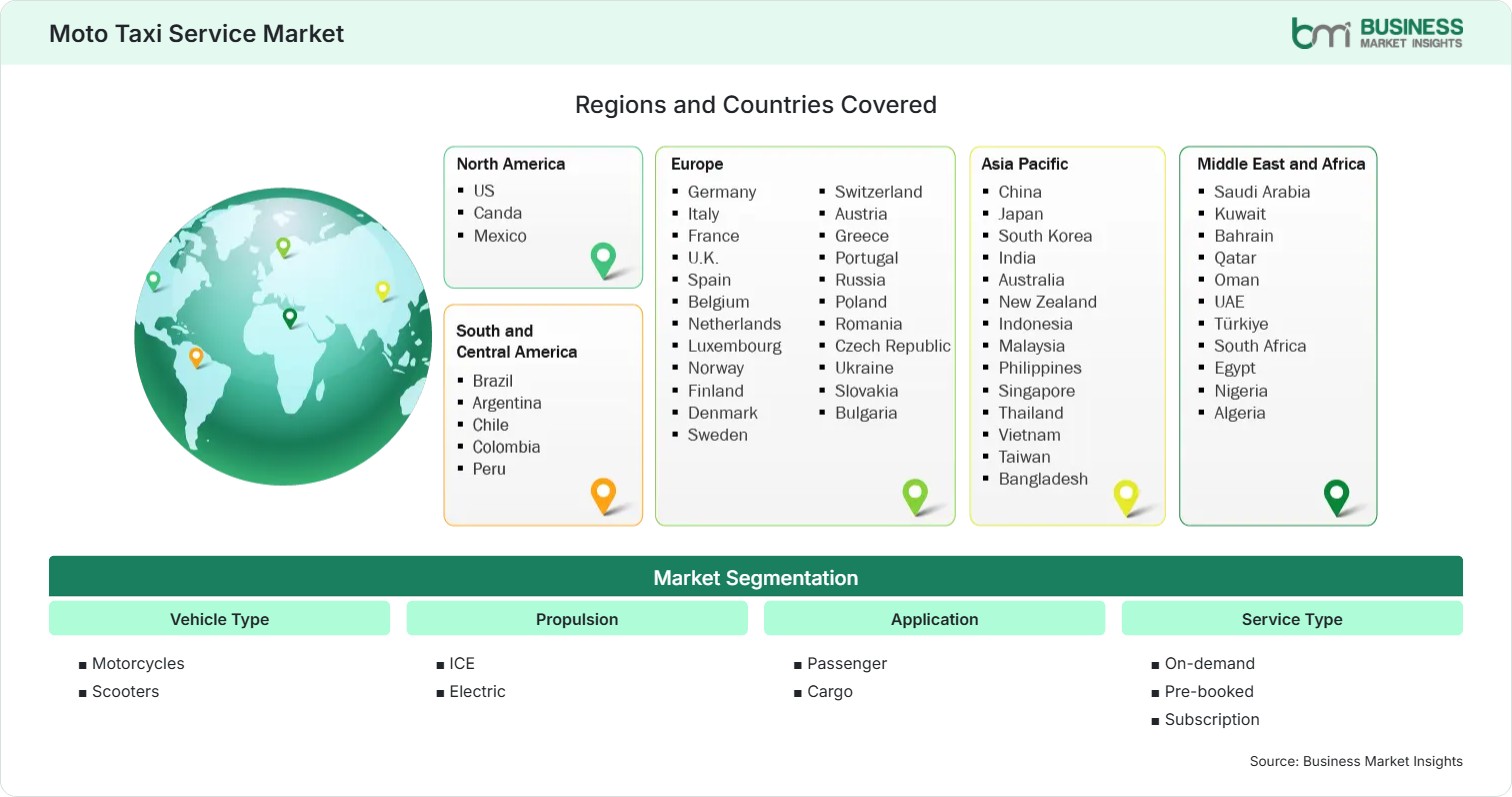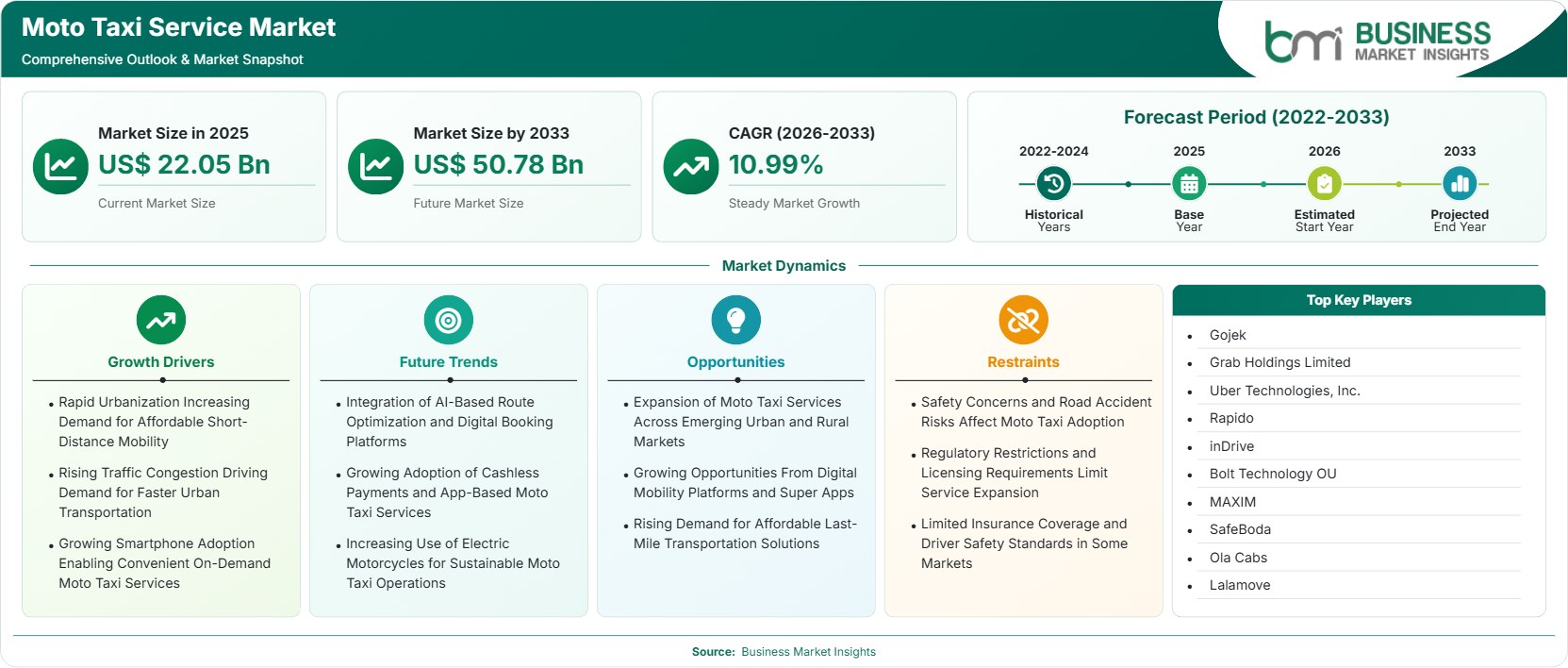
Moto Taxi Service Market Regional Highlights
North America Moto Taxi Service Market
North America held an estimated 8%–11% moto taxi service market share of the global market in 2025 and is projected to grow at a CAGR of 6.5%–7.2% during 2026–2033. The US acts as the key market for the region, whereas there are smaller markets in Canada. Growth is mainly seen in urbanized cities, tourism zones, and pre-booked transportation due to regulatory requirements and safety reasons for motorcycles.
- Dense metropolitan areas with severe congestion can support motorcycle-based commuting services where journey-time savings justify premium pricing and customers prioritize flexible point-to-point transportation.
- Regulatory approval remains a critical market-entry consideration, with operators requiring appropriate commercial licensing, insurance, safety compliance, and driver qualification standards before scaling.
- Tourist districts and business centers offer potential for pre-booked motorcycle transportation, particularly where conventional taxis face congestion and parking limitations during peak periods.
- Electric motorcycles could improve market acceptance by reducing noise and local emissions, particularly where cities introduce cleaner transportation policies and fleet electrification incentives.
US Moto Taxi Service Market
The US moto taxi service market held an estimated 6%–9% share of the global market in 2025 and is projected to expand at a CAGR of 6.3%–6.9% during 2026–2033. Demand is concentrated in major metropolitan areas where congestion and parking constraints support two-wheeler mobility. Adoption remains below Asian markets because of regulatory differences, motorcycle safety concerns, seasonal conditions, and strong private-vehicle ownership.
- New York, Los Angeles, Miami, and other dense metropolitan markets offer potential for specialized services where congestion creates measurable time savings for short-distance journeys.
- Pre-booked services may gain greater acceptance than fully on-demand operations because customers can select verified drivers and plan journeys around specific business or travel requirements.
- Safety technology, including GPS tracking, emergency assistance, driver identification, and helmet compliance, can improve customer confidence and help operators address regulatory concerns.
Europe Moto Taxi Service Market
Europe moto taxi service market accounted for an estimated 12%–15% share in 2025 and is projected to grow at a CAGR of 7.0%–7.8% during 2026–2033. Italy and France are leading markets, supported by established motorcycle usage and dense cities. Spain and Portugal offer attractive tourism-related opportunities. Italy is projected to grow at 6.5%–7.5%, France at 7.0%–8.0%, Spain at 7.0%–8.0%, and Portugal at 7.5%–8.5%.
- Italy benefits from widespread scooter usage and dense urban environments, creating favorable conditions for motorcycle-based mobility and pre-booked transportation services.
- France offers opportunities in Paris and other congested cities, where faster journey times and premium commuter services can complement conventional taxi and public transportation networks.
- Spain provides potential through tourism, airport transfers, and urban mobility services, particularly in Barcelona, Madrid, and major coastal destinations.
- Portugal can support high-growth niche applications through tourism and dense city centers, where motorcycle transportation can reduce journey times and parking constraints.
- European operators increasingly need to demonstrate compliance with local licensing, insurance, emissions, and safety requirements before establishing scalable commercial fleets.
Asia Pacific Moto Taxi Service Market
Asia Pacific moto taxi service market held an estimated 65%–70% share in 2025 and is projected to grow at a CAGR of 11.5%–12.5% during 2026–2033, making it the largest and fastest-growing regional market. India, Indonesia, Vietnam, and the Philippines are major growth centers. India is projected to grow at 12.0%–13.0%, Indonesia at 11.5%–12.5%, Vietnam at 11.0%–12.0%, and the Philippines at 10.5%–11.5%.
- India offers substantial potential as app-based motorcycle taxi services expand across major cities and secondary urban centers, supported by high two-wheeler ownership and digital payment adoption.
- Indonesia benefits from extensive motorcycle usage and strong digital mobility ecosystems, enabling passenger transportation, food delivery, courier services, and financial products within integrated platforms.
- Vietnam's dense urban environments and widespread scooter ownership provide a strong foundation for app-based transportation, while electric motorcycle adoption creates opportunities for cleaner fleet expansion.
- The Philippines offers growth potential as urban congestion and limited public transport connectivity increase demand for flexible, affordable motorcycle-based transportation services.
- Thailand provides an established motorcycle taxi ecosystem, creating opportunities for platforms to improve digital booking, payment, driver management, and customer safety through technology.
Rest of World Moto Taxi Service Market
Rest of World accounted for an estimated 10%–14% share in 2025 and is projected to grow at a CAGR of 9.0%–10.0% during 2026–2033. Brazil, Colombia, and Mexico are leading Latin American markets, while Nigeria, Kenya, and Uganda represent key African opportunities.
- Brazil offers strong potential due to large urban populations, extensive motorcycle usage, and demand for affordable transportation and delivery services.
- Colombia's motorcycle-heavy mobility ecosystem creates opportunities for digital platforms to formalize passenger and delivery services while improving driver management and payment infrastructure.
- Nigeria provides substantial potential because motorcycles serve as an important mobility option in congested cities and areas with limited conventional transportation access.
- Kenya and Uganda offer opportunities through established motorcycle taxi ecosystems, where digital platforms can improve safety, payments, driver verification, and customer convenience.
- Mexico benefits from urban congestion and expanding delivery demand, although regulatory requirements and safety considerations will influence the pace of platform-based motorcycle taxi adoption.