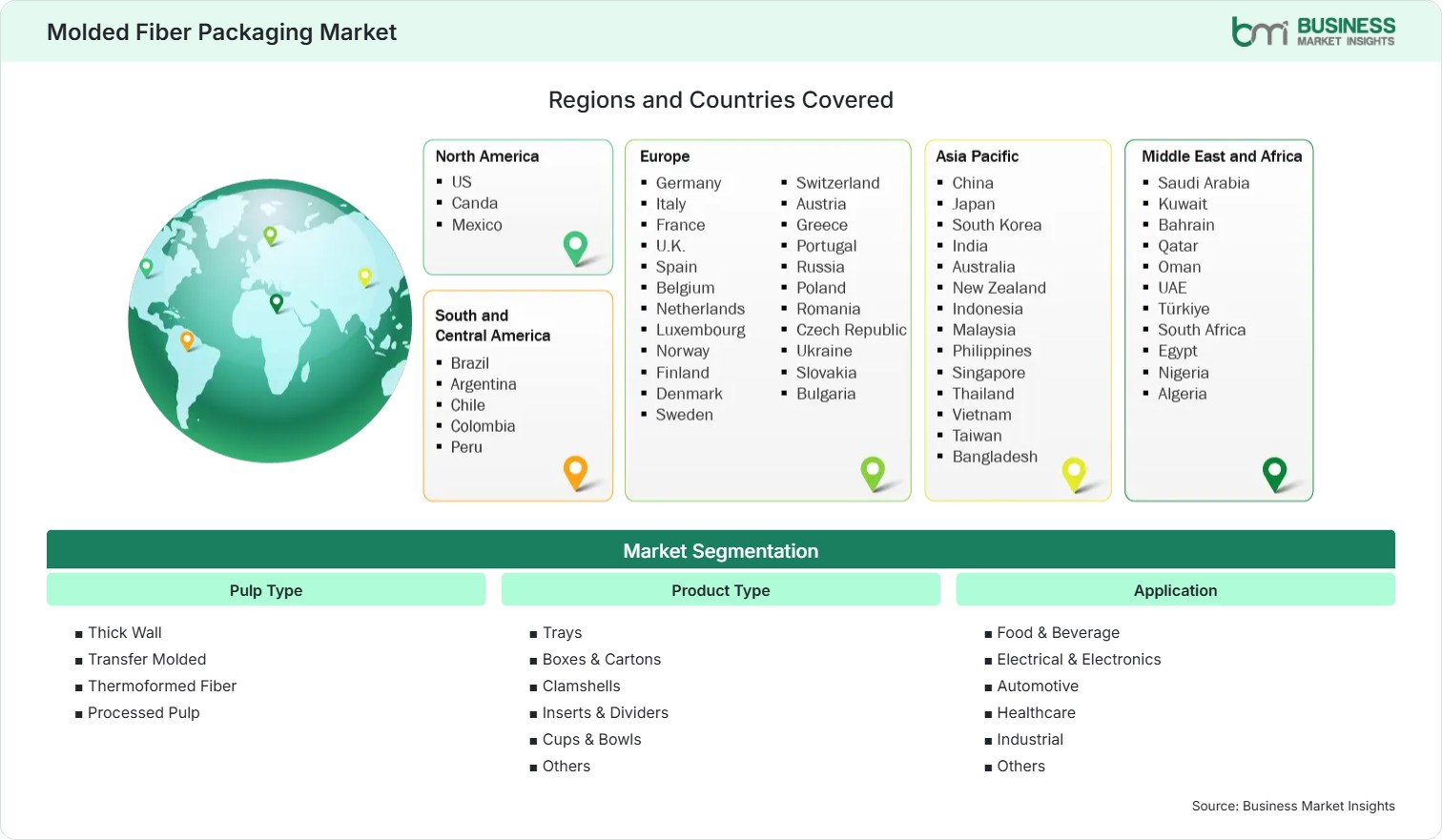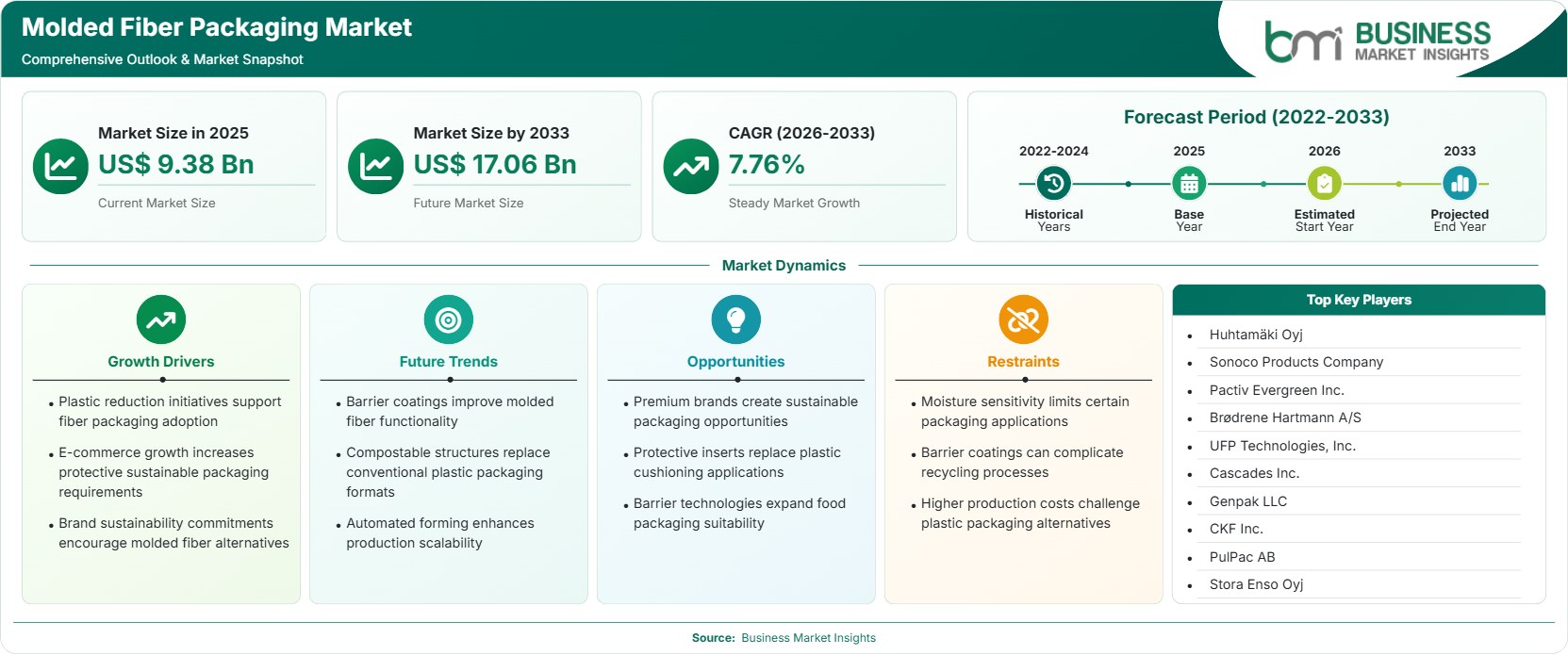
Molded Fiber Packaging Market Regional Highlights
North America Molded Fiber Packaging Market
North America Molded Fiber Packaging Market represents 23%–27% share in 2025 and is projected to grow at a 5.8%–6.4% CAGR through 2033. Demand centers on foodservice, eggs, produce, electronics, healthcare, and protective packaging. Plastic-reduction policies support conversion, while domestic recycled-fiber supply improves sourcing resilience. The U.S. remains the regional center, with Canada providing incremental opportunities. Automation is increasingly important because labor and energy costs influence delivered unit economics and manufacturing competitiveness.
- Foodservice operators are expanding fiber trays, bowls, clamshells, and carriers as plastic restrictions and corporate sustainability programs increase conversion volumes across takeaway channels.
- Electronics and industrial buyers favor molded fiber inserts where cushioning, stacking efficiency, and reduced plastic foams can simplify packaging without sacrificing transit protection.
- Recycled-fiber availability supports regional sourcing, although converters remain exposed to collection quality, recovered-paper pricing, energy costs, and feedstock competition.
- Automation improves consistency, labor productivity, throughput, and changeover performance, strengthening competitiveness for suppliers serving large standardized customer programs.
US Molded Fiber Packaging Market
The U.S. Molded Fiber Packaging Market represents 84%–88% of North American demand in 2025 and is projected to expand at a 5.5%–6.1% CAGR during 2026–2033. Foodservice remains the largest conversion engine, while healthcare, electronics, consumer products, and e-commerce provide higher-value applications. State-level restrictions encourage substitution, although adoption depends on recyclability, moisture performance, equipment compatibility, and delivered cost.
- Restaurant chains are standardizing fiber formats across networks, creating scalable contracts for suppliers capable of consistent specifications and multi-location fulfillment.
- Healthcare and electronics provide higher-value opportunities because precision geometry, cleanliness, cushioning, and application engineering support differentiated pricing.
- Domestic converters benefit from shorter lead times and established recovered-paper networks, while high operating costs increase the importance of automated production.
Europe Molded Fiber Packaging Market
Europe Molded Fiber Packaging Market is projected to be 17%–21% share in 2025 and is expected to register a CAGR of 6.0%–6.7% from 2026 to 2033. Germany, France, Italy, the UK, and the Nordic markets have mature demand, while Poland and Central Europe hold growth opportunities. Recyclability, efficient use of resources, food safety, and reduction of plastics drive market growth. R&D efforts for formed fiber are increasingly focused on circularity, barriers, and high-end applications that demand reliable geometry and aesthetics.
- Germany combines food manufacturing, industrial packaging, engineering capability, and retailer sustainability programs, supporting precision molded fiber adoption.
- France and the United Kingdom offer attractive foodservice and retail opportunities as brands redesign packaging around circularity and plastic reduction.
- Nordic producers leverage renewable forestry resources and advanced fiber technology to develop differentiated packaging and premium formed-fiber applications.
- Central Europe is gaining manufacturing importance because proximity to Western European customers can reduce logistics costs and accelerate customization.
Asia Pacific Molded Fiber Packaging Market
The Asia Pacific molded fiber packaging market will hold 36%-40% market share by 2025 and is estimated to grow at a CAGR of 6.6%-7.2% through 2033, making it the fastest-growing region. China dominates the volume sales, whereas India, Japan, South Korea, Thailand, Vietnam, and Malaysia drive diverse pockets of growth. Demand for the Asia Pacific molded fiber packaging market will be driven by electronics manufacturing, food delivery, export packaging, urban consumption, and packaging investments.
- China benefits from integrated pulp, paper, electronics, food, and packaging ecosystems supporting high-volume domestic and export production.
- India offers strong upside from foodservice, e-commerce, electronics production, packaging investment, and increasing adoption of molded fiber alternatives.
- Japan emphasizes precision, food safety, quality, and recycling compatibility, supporting premium applications where dimensional consistency commands value.
- Southeast Asia attracts capacity because competitive manufacturing costs coincide with proximity to multinational food, electronics, and consumer-goods supply chains.
Rest of World Molded Fiber Packaging Market
South & Central American Molded Fiber Packaging Market reflects new demand for molded fiber products driven by food processing, agriculture, retail modernization, and foodservice. Brazil is the dominant market, while Mexico is the manufacturing/export platform. Middle East & Africa continue to be smaller markets but are growing increasingly appealing owing to growth in foodservice, consumer goods, and logistics infrastructure. The Rest of World market accounts for 14%-18% of the market share in 2025 and is projected to grow at a 6.0%-6.8% CAGR until 2033.
- Brazil benefits from food processing, agricultural packaging, organized retail, and growing pressure to reduce problematic disposable plastics.
- Mexico offers a strong manufacturing base because proximity to North American supply chains supports regional production of protective and foodservice formats.
- Gulf markets are developing opportunities in premium foodservice, hospitality, imported consumer goods, and packaging localization, although feedstock economics remain important.
- South Africa and selected African markets offer longer-term potential through retail expansion, food distribution modernization, and improved collection infrastructure.