
Returnable Transport Packaging Market Outlook: Size, Share, Trends, Growth Analysis, Competitive Landscape & Forecast, 2026-2033

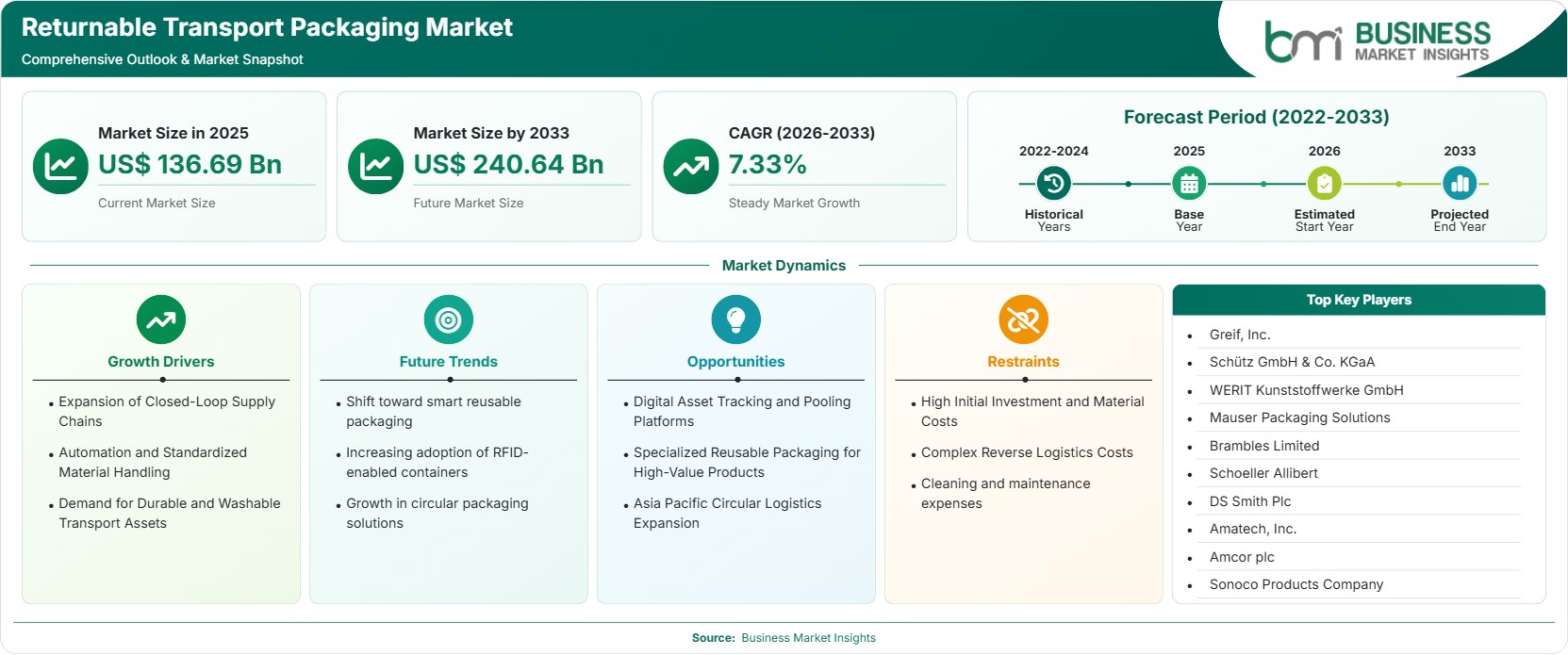
The Returnable Transport Packaging Market size was valued at US$ 136.69 Billion in 2025 and is projected to reach US$ 240.64 Billion by 2033, growing at a CAGR of 7.33% during 2026–2033, driven by circular supply chains, reusable assets, automation, sustainability mandates, and logistics efficiency investments.

Report Coverage
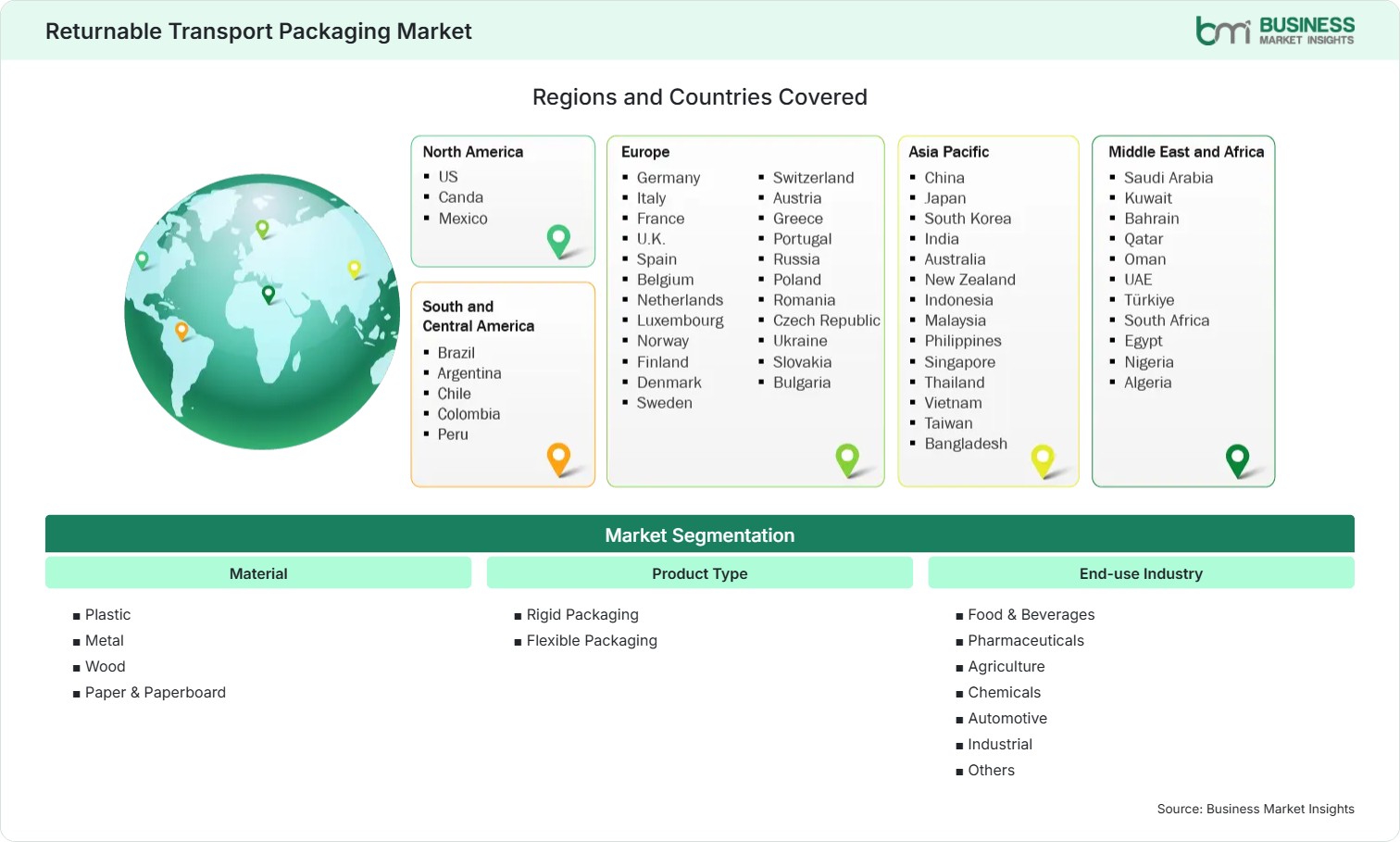
  • Material: Plastic, Metal, Wood, Paper & Paperboard
  • Product Type: Rigid Packaging, Flexible Packaging
  • End-use Industry: Food & Beverages, Pharmaceuticals, Agriculture, Chemicals, Automotive, Industrial, Others
US$ 136.69 Bn Market size in 2025
US$ 240.64 Bn Market Size by 2033
7.33% CAGR, 2026 - 2033
2026-2033 Forecast Period

AI Overview

Returnable Transport Packaging Market Summary

  • North America Region: North America holds a 34%–36% share in 2025, growing with a 6.8%–7.2% CAGR, influenced by mature pooling networks, automotive logistics, food distribution, pharmaceutical handling, and warehouse automation investments. The US market benefits from established reusable asset pools, retailer adoption, and automation, supporting approximately 6.9%–7.3% CAGR during 2026–2033.
  • Fastest Growing Region: Asia Pacific holds a 21%–24% share in 2025, growing with an 8.0%–8.5% CAGR, supported by manufacturing expansion, export-oriented supply chains, pharmaceutical production, organized retail, and rising investment in circular logistics infrastructure.
  • Leading Segment: Plastic holds a 51%–54% share in 2025, growing with a 7.5%–8.0% CAGR, supported by lightweight construction, corrosion resistance, washability, nesting, automated handling compatibility, recycled-content integration, and broad adoption across food, automotive, pharmaceutical, and industrial supply chains.
  • High Growth Segment: Flexible Packaging holds a 25%–29% share in 2025, growing with an 8.2%–8.8% CAGR, supported by collapsible formats, improved storage efficiency, lower empty-return volumes, lightweight construction, specialized industrial applications, and increasing demand for adaptable reusable logistics assets.
  • Key Market Opportunity: Closed-loop pooling, RFID-enabled asset visibility, automated handling, recycled polymers, collapsible formats, and sector-specific reusable designs can improve asset utilization while reducing packaging waste and reverse-logistics inefficiencies.
  • Major Market Players: Greif, Inc.; Schütz GmbH & Co. KGaA; WERIT Kunststoffwerke GmbH; Mauser Packaging Solutions; Brambles Limited; Schoeller Allibert; DS Smith Plc; Amatech, Inc.; Amcor plc; Sonoco Products Company
Strategic Insights

Returnable Transport Packaging Market: Strategic Insights

Returnable Transport Packaging Market Strategic Framework
FREE PDF
Request your free sample
Request free sample
Stakeholder View

Key Takeaways

  • The evolution of the value chain will move from packaging manufacturing to pool, clean, repair, track, transport, and manage assets. Firms with widespread service capabilities will be able to generate recurring revenue and utilization across several customer cycles.
  • Plastic will continue to lead the materials category as it provides the greatest combination of durability, sanitation, lightweighting, stackability, and compatibility with automation. Collapsible forms of flexible reuse are another opportunity due to lower return and warehousing needs.
  • Intelligent reusable resources will become integrated with RFID technology, barcodes, sensors, and digital platforms. These systems aid in cycle counting, theft prevention, maintenance scheduling, and improved visibility within the supply chain.
  • Asia Pacific offers an appealing investment thesis, as growth in manufacturing and trade requires the use of standardized reusable packaging including crates, pallets, bins, bulk containers, and industrial systems.
  • Capital is increasingly being invested in the areas of asset optimization, reuse specialization, circular economy, and network enablement. Brambles had 348 million units of assets in the form of pallets, crates, and containers at the end of fiscal year 2025, reflecting the possible results achieved through pooling.
  • The key competitive advantage lies in the economics of life cycle rather than cost of container ownership. The factors that impact economic performance of reuse schemes are design durability, cleaning infrastructure, reverse logistics, reparability, recyclability, and digitalization.
Geographic Outlook

Returnable Transport Packaging Market Regional Highlights

North America Returnable Transport Packaging Market

North America accounts for a 34%–36% share in 2025 and is projected to record a 6.8%–7.2% CAGR during 2026–2033. The region benefits from established pooling infrastructure, automotive manufacturing, food distribution, pharmaceutical logistics, and automated warehouses. Returnable assets are increasingly evaluated through total-cost-of-ownership models rather than purchase price. The region also benefits from large retailers and manufacturers that can support efficient reverse logistics. Available industry research identifies North America as the leading regional market, providing a validated directional benchmark for the 2025 adjusted range in Returnable Transport Packaging Market.

  • Automotive industry supply chain favors standardization in the design of racks, pallets, totes, and bulk containers due to repetitive movement to the supplier plant.
  • Food and beverages industry supply chain favors washable plastic packaging due to hygienic and protection requirements, coupled with repetitive delivery patterns.
  • Automation in warehouses is driving standardized container sizes and construction to be compatible with conveyors and robotics and automated storage.
  • The pooler companies benefit from service centers that are denser geographically as the cleaning and repair of the equipment and redistribution can be done within close range.

US Returnable Transport Packaging Market

The US represents approximately 82%–86% of North American demand in 2025, with a projected 6.9%–7.3% CAGR during 2026–2033. It is sustained by extensive distribution networks in automotive, food, pharmaceutical, retail, and industrial sectors. Higher adoption levels of automation in warehouses have led to standardization of reusable containers capable of handling mechanical cycles in Returnable Transport Packaging Market. Organizations are also increasingly adopting labor savings, package protection, inventory tracking, and reverse logistics efficiency as ways of evaluating packaging programs. Extensive distribution network at the national level also sustains pooling economies in reusable assets.

  • Reusable racks and crates are increasingly used by car manufacturers to safeguard parts during repeated transport from the supplier to the manufacturing facility.
  • In grocery and food processing, reusable plastic crates provide greater handling efficiency and are used for their washable, ventilated qualities.
  • The need for pharmaceutical logistics is driving demand for validated, sturdy, and cleanable containers to safeguard products during transport.

Europe Returnable Transport Packaging Market

Europe represents a 27%–29% share in 2025 and is projected to expand at a 7.0%–7.4% CAGR during 2026–2033 in Returnable Transport Packaging Market. Germany leads regional industrial demand, while the Netherlands, France, Italy, and the United Kingdom provide substantial opportunities across automotive, food, chemicals, retail, and logistics. Germany is estimated at approximately 7.5%–8.0% CAGR, supported by manufacturing intensity, while the Netherlands can reach approximately 7.8%–8.3% CAGR through logistics specialization. Circular-economy policy, packaging-waste reduction objectives, and supply-chain efficiency strengthen adoption across European industries.

  • European manufacturers have begun to favor reusable designs capable of showing a lifecycle advantage, especially when the packaging is reused through regional distribution networks.
  • The automobile manufacturing sector in Germany and Central Europe offers a strong repeat market for reusable packaging including boxes, racks, pallets, and even specialized component packaging.
  • Packaging in beverage and retail distribution logistics offer opportunities for returnable packaging because high-density collection, cleaning, and repeated delivery create favorable economics.
  • Pressure from regulations aimed at reducing waste has created an incentive for businesses to consider reusability along with reduced material usage and recycling programs.

Asia Pacific Returnable Transport Packaging Market

Asia Pacific accounts for a 21%–24% in Returnable Transport Packaging Market share in 2025 and represents the fastest-growing region, with an 8.0%–8.5% CAGR during 2026–2033. China remains a major industrial demand center, while Japan and South Korea benefit from advanced manufacturing systems. India offers strong expansion potential through organized retail, food processing, pharmaceuticals, automotive production, and logistics modernization. China is estimated at approximately 8.2%–8.7% CAGR, while India can reach approximately 8.6%–9.1% CAGR as reusable systems penetrate expanding manufacturing and distribution networks.

  • The relocation of manufacturing and the diversification of regional supply chains is driving the requirement for standard reusable containers capable of protecting their contents through multiple-step logistics chains.
  • Pharmaceutical and healthcare manufacturing has been increasing its reliance on robust logistics systems in which contamination prevention, traceability, and product protection play a role in packaging requirements.
  • Food processing and organized retailing are developing more robust closed-loop systems that can support re-circulation, cleaning, inspection, and redeployment of the containers.
  • Investments in digital logistics infrastructure enable RFID-based tracking and automation of handling processes.

Rest of World Returnable Transport Packaging Market

Rest of World represents approximately 14%–17% in 2025, with a projected 7.1%–7.6% CAGR during 2026–2033. South and Central America benefit from food exports, agriculture, beverage distribution, and automotive manufacturing, while Middle East and Africa demand is linked to industrialization, retail modernization, chemicals, and logistics infrastructure. Brazil and Mexico provide important manufacturing and agricultural opportunities. The Gulf states offer attractive logistics applications where durable containers can improve handling efficiency in expanding distribution networks and industrial corridors in Returnable Transport Packaging Market.

  • Brazil has an advantage in its agricultural and food-processing supply chains due to the use of reusable crates and bulk bins, which allow products to be shipped multiple times.
  • Mexico’s automotive manufacturing value chain favors reusable packaging for cross-border component shipping and for shipments from suppliers to assembly plants.
  • Gulf logistics centers offer opportunities for reusable containers in food distribution, industrial supply chains, chemical logistics, and regional warehousing.
  • Africa’s urbanization and retail developments offer longer-term prospects in reusable containers through developing collection and reverse logistics systems.
Global Market Geography
FREE PDF
Request your free sample
Request free sample
Segment Analysis

Returnable Transport Packaging Market Segmentation

Material

Plastic represents the leading material category, accounting for a 51%–54% share in 2025 and a 7.5%–8.0% CAGR during 2026–2033. Lightweight construction, durability, sanitation, nesting, recyclability, and automation compatibility support adoption. The Returnable Transport Packaging Market scope expands as manufacturers combine recycled polymers with engineered designs, while metal and wood remain important for heavy-duty applications and specialized industrial transportation.

  • Plastic: Durable reusable crates, pallets, totes, bins, and containers support food, pharmaceutical, automotive, and retail applications through washability, lightweighting, stacking efficiency, and long service life.
  • Metal: Steel and aluminum formats provide high load-bearing capacity for industrial, chemical, automotive, and heavy-component transportation where impact resistance and dimensional stability are essential.
  • Wood: Wooden pallets, crates, and engineered transport structures remain relevant for heavy loads, industrial logistics, export applications, and supply chains where repairability supports extended asset utilization.
  • Paper & Paperboard: Reusable or reinforced fiber-based formats address selected lightweight transport applications where lower mass, recoverability, and optimized material use support specialized logistics requirements.

Product Type

Rigid packaging represents the leading product category, accounting for an estimated 62%–66% share in 2025, supported by durability, stacking performance, product protection, and automation compatibility. Flexible packaging is expected to be the faster-growing format, with an estimated 7.5%–8.5% CAGR during 2026–2033, as collapsibility reduces empty-return volume and storage requirements. The Returnable Transport Packaging Market trends continues to favor configurable designs, while rigid formats remain dominant across industrial applications and flexible solutions gain traction where return efficiency and lower storage requirements are priorities.

  • Rigid Packaging: Rigid containers, crates, pallets, bins, drums, and bulk systems provide structural protection and stable stacking for repeated handling across manufacturing and distribution networks.
  • Flexible Packaging: Collapsible bulk bags, flexible containers, and adaptable transport formats reduce empty storage requirements while supporting applications requiring lower tare weight and improved return efficiency.

End-use Industry

Food & beverages, automotive, pharmaceuticals, agriculture, chemicals, and industrial users form the core end-use base, with food & beverages estimated to account for 25%–29% of demand in 2025, followed by automotive at 20%–24%. Pharmaceuticals and chemicals represent smaller but higher-value applications due to stringent handling and protection requirements. The Returnable Transport Packaging Market is expected to see 6.5%–7.5% CAGR during 2026–2033, supported by repeated distribution cycles, sustainability goals, and increasing adoption of reusable packaging across industrial supply chains.

  • Food & Beverages: Reusable crates and containers improve product protection, hygiene, stackability, ventilation, and delivery efficiency across repeated producer, distributor, retailer, and foodservice movements.
  • Pharmaceuticals: Durable transport packaging supports controlled handling, traceability, protection, and repeated distribution while addressing stringent quality expectations for sensitive healthcare products.
  • Agriculture: Reusable crates and bulk containers support produce harvesting, packing, storage, and distribution while reducing damage and enabling repeated seasonal logistics cycles.
  • Chemicals: Industrial containers and bulk packaging prioritize containment, chemical compatibility, durability, and safe handling across repeated transportation and processing activities.
  • Automotive: Specialized racks, totes, bins, and containers protect components while enabling synchronized supplier deliveries, line-side presentation, automation compatibility, and efficient return cycles.
  • Industrial: Heavy-duty reusable assets support machinery, engineered components, electronics, metals, and industrial consumables where durability and repeated movement justify lifecycle investment.
Market Forces

Returnable Transport Packaging Market Dynamics

Key Market Drivers

Expansion of Closed-Loop Supply Chains

The development of closed-loop supply chains will contribute to the adoption of returnable transport packaging, as companies will have the opportunity to recycle pallets, crates, containers, and other assets during their movement from suppliers to manufacturers, from manufacturers to distribution centers, and finally from distribution centers to customers. The repeated use of assets may help increase packaging efficiency, reduce reliance on one-off materials, and achieve better resource management. The development of pooling facilities and reverse logistics networks will also simplify the management of reusable packaging.

Automation and Standardized Material Handling

Automation in warehouses is increasing demand for returnable transport packaging that can work smoothly with conveyors, robotic systems, automated storage, and machine-readable inventory processes. Standardized container sizes and designs help reduce handling interruptions and improve compatibility with automated equipment. As warehouses adopt more advanced material-handling systems, reusable packaging is increasingly being designed as part of the overall logistics operation rather than simply as a transport container. This is creating opportunities for packaging suppliers to develop durable, standardized, and automation-ready solutions that support efficient warehouse operations.

Demand for Durable and Washable Transport Assets

Food, beverage, pharmaceutical, and industrial supply chains are increasing their use of transport packaging that can withstand repeated handling while maintaining cleanliness and product protection. Reusable plastic containers can be washed, inspected, repaired, and used again, making them suitable for operations with frequent product movement. Companies are also looking for packaging designed around specific handling and storage needs rather than standard containers. This is encouraging the use of durable, washable, and application-specific returnable transport packaging across industries where hygiene, protection, and long-term usability are important.

Key Market Opportunities

Digital Asset Tracking and Pooling Platforms

The Returnable Transport Packaging Market presents an opportunity to combine RFID, barcode, GPS, sensor technology, and cloud analytics with reusable assets. The digital identification system can also help determine the number of cycles, dwell times, loss patterns, maintenance needs, and geographic imbalance. This information can be used by pooling operators to reallocate their assets before any shortages occur, while manufacturers can optimize their fleet sizes. However, the business potential is not only in the hardware but also in the services as well since the tracking system creates the need for continuous revenue from software and services.

Specialized Reusable Packaging for High-Value Products

High-cost items present good opportunities for engineered, reusable packaging systems, as the prevention of damage justifies increased packaging investment. Electronic goods, pharmaceutical products, automotive parts, high-end food items, and industrial equipment all need custom protection, controlled handling, and dimensional stability. The ability to adjust dimensions to accommodate changes in product lines without re-engineering the entire packaging system is one advantage of flexible designs. Reusable systems may also include cushioning, venting, separators, RFID tagging, ergonomic design, and automated geometry. Investment in packaging engineering will thus differentiate these packaging systems from commodity packaging.

Asia Pacific Circular Logistics Expansion

The Returnable Transport Packaging Market Forecasts indicate strong investment potential in Asia Pacific because industrial production, organized retail, pharmaceuticals, food processing, and regional logistics networks are expanding simultaneously. New factories could build reusable packaging into their system design rather than converting existing single-use systems. Washing and re-distribution facilities for packaging materials can help leverage network effects and lower reverse logistics costs. There are specific opportunities for countries such as India, China, Japan, and South Korea, with varying strengths ranging from mass manufacturing to logistics expertise. Local suppliers that offer digitalized asset management can tap the market potential.

Market Restraints and Challenges

Complex Reverse Logistics Costs

Factor: Increasing complexity in collection routes, asset tracking, inspection, cleaning, repair, and redistribution will add to transportation, handling, maintenance, and inventory-management costs, particularly across geographically dispersed customer networks and third-party logistics providers. Impact: Reverse logistics costs and longer turnaround times will reduce the economic efficiency of reusing packaging and necessitate larger packaging fleets. Loss of assets and a fragmented recovery system will even lower utilization levels. Thus, repeatable packaging will become economically unfeasible in low-density areas and advantageous to firms with good routes, tracking, standardization, and service centers.

High Initial Investment and Material Costs

Factor: Higher upfront costs for durable materials, specialized tooling, engineering, and repeated-use requirements make returnable containers more expensive than single-use alternatives. Impact: The increased cost of purchasing can hinder smaller firms from using returnable packaging, particularly when capital expenditure is constrained. The unpredictable costs of raw materials like polymers and metals, together with rising energy and labor costs, can also add to acquisition costs. Financial considerations could result in delay in adoption, whereas pooling and leasing of containers can appear appealing.

Company Analysis

Competitive Landscape

The Returnable Transport Packaging Market analysis indicates a fragmented competitive environment spanning industrial packaging manufacturers, pooling operators, reusable plastic specialists, fiber and paper companies, and engineered logistics providers. Competitive advantage increasingly depends on product durability, geographic service coverage, customization, recycled-content capability, digital visibility, and lifecycle support.

Company Name

Overview

Products and Services relevant to this market

Greif, Inc.

Global industrial packaging provider with broad capabilities across durable packaging and lifecycle services.

Intermediate bulk containers, drums, reconditioned containers, industrial packaging, reusable and returnable packaging solutions.

Schütz GmbH & Co. KGaA

German packaging specialist recognized for industrial bulk packaging and container systems.

IBCs, drums, reusable industrial containers, container services, and packaging lifecycle solutions.

WERIT Kunststoffwerke GmbH

German plastics specialist focused on reusable industrial and logistics packaging.

Plastic containers, IBC systems, pallets, storage products, and reusable transport solutions.

Mauser Packaging Solutions

Global packaging company serving industrial customers with reusable and reconditioned packaging capabilities.

IBCs, drums, reconditioning, plastic and metal containers, and lifecycle packaging services.

Brambles Limited

Global pooling and logistics company operating large reusable pallet, crate, and container networks.

Pallets, crates, containers, pooling, asset management, digital visibility, and supply-chain services.

Schoeller Allibert

European reusable packaging specialist serving industrial, retail, food, and beverage supply chains.

Reusable crates, pallets, containers, bulk systems, and beverage packaging solutions.

DS Smith Plc

Packaging and fiber-based solutions provider with circular packaging and supply-chain expertise.

Fiber transport packaging, reusable concepts, industrial packaging, and circular packaging services.

Amatech, Inc.

US packaging specialist providing engineered transport protection and reusable packaging systems.

Reusable containers, protective packaging, custom transport systems, and industrial packaging solutions.

Amcor plc

Global packaging company with extensive materials, engineering, and sustainability capabilities.

Flexible packaging, rigid packaging, specialty formats, and reusable or recyclable transport-related solutions.

Sonoco Products Company

Diversified packaging manufacturer serving industrial and consumer supply chains globally.

Industrial containers, protective packaging, rigid formats, and engineered transport packaging solutions.

Trust & Transparency

Research Methodology

The market analysis combines proprietary research with secondary data from government agencies, company disclosures, regulatory filings, industry databases and expert interviews. Market estimates are validated through data triangulation, cross-market benchmarking and analyst review.

View Full Research Methodology

Questions Answered

Frequently Asked Questions

How can companies measure sustainability performance from reusable packaging?

Companies should track completed cycles, asset utilization, loss rates, return distance, cleaning energy, repair frequency, recycled content, packaging weight, and avoided single-use material.

What role does pooling play in reusable packaging adoption in Returnable Transport Packaging Market report?

Pooling reduces the capital and operational burden of owning a large packaging fleet. A third-party operator can manage asset distribution, collection, inspection, cleaning, repair, and redistribution.

Which industries can benefit most from specialized returnable packaging?

Automotive, food and beverages, pharmaceuticals, chemicals, agriculture, and industrial manufacturing can benefit strongly because they often involve repeated transportation, valuable products, defined handling requirements, or established supplier networks.

How does packaging design affect automated warehouse performance in market?

Dimensional consistency, structural rigidity, nesting behavior, weight, barcode or RFID compatibility, and smooth surfaces influence automated handling reliability.

What factors determine whether reusable transport packaging is economically viable?

Economic viability depends on cycle frequency, return distance, asset loss, cleaning requirements, repair costs, container durability, labor savings, and product-damage reduction.

Access the Full Returnable Transport Packaging Market Report

Get segment-level forecasts, regional estimates, competitive benchmarking, company profiles and downloadable Excel datasets.

Access the full Returnable Transport Packaging Market Report
350 pages PDF & Excel | 2026-09-03