
Polyvinyl Chloride Packaging Film Market Outlook: Size, Share, Trends, Growth Analysis, Competitive Landscape & Forecast, 2026-2033

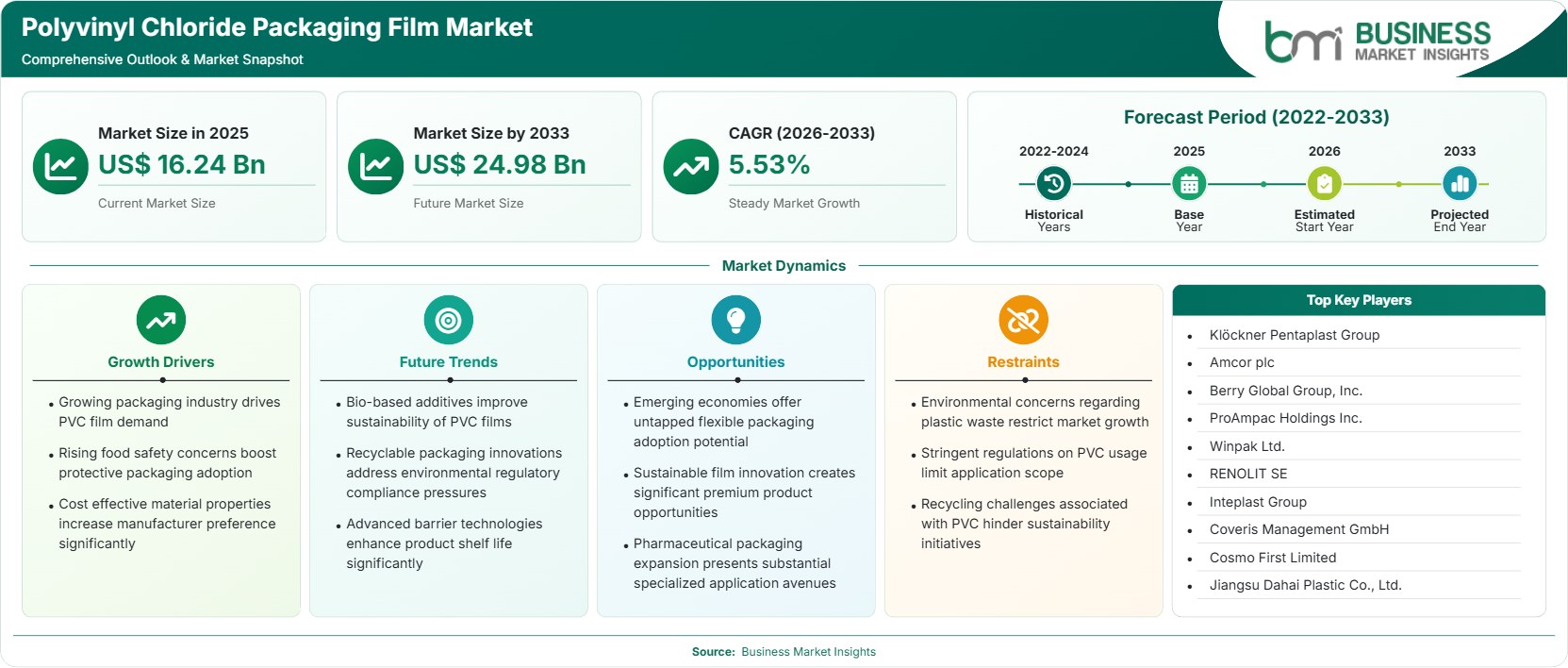
The Polyvinyl Chloride Packaging Film Market size was valued at US$ 16.24 Billion in 2025 and is projected to reach US$ 24.98 Billion by 2033, growing at a CAGR of 5.53% during 2026–2033, driven by packaged food demand, pharmaceutical protection, flexible formats, multilayer structures, and recycling-focused film innovation.

Report Coverage
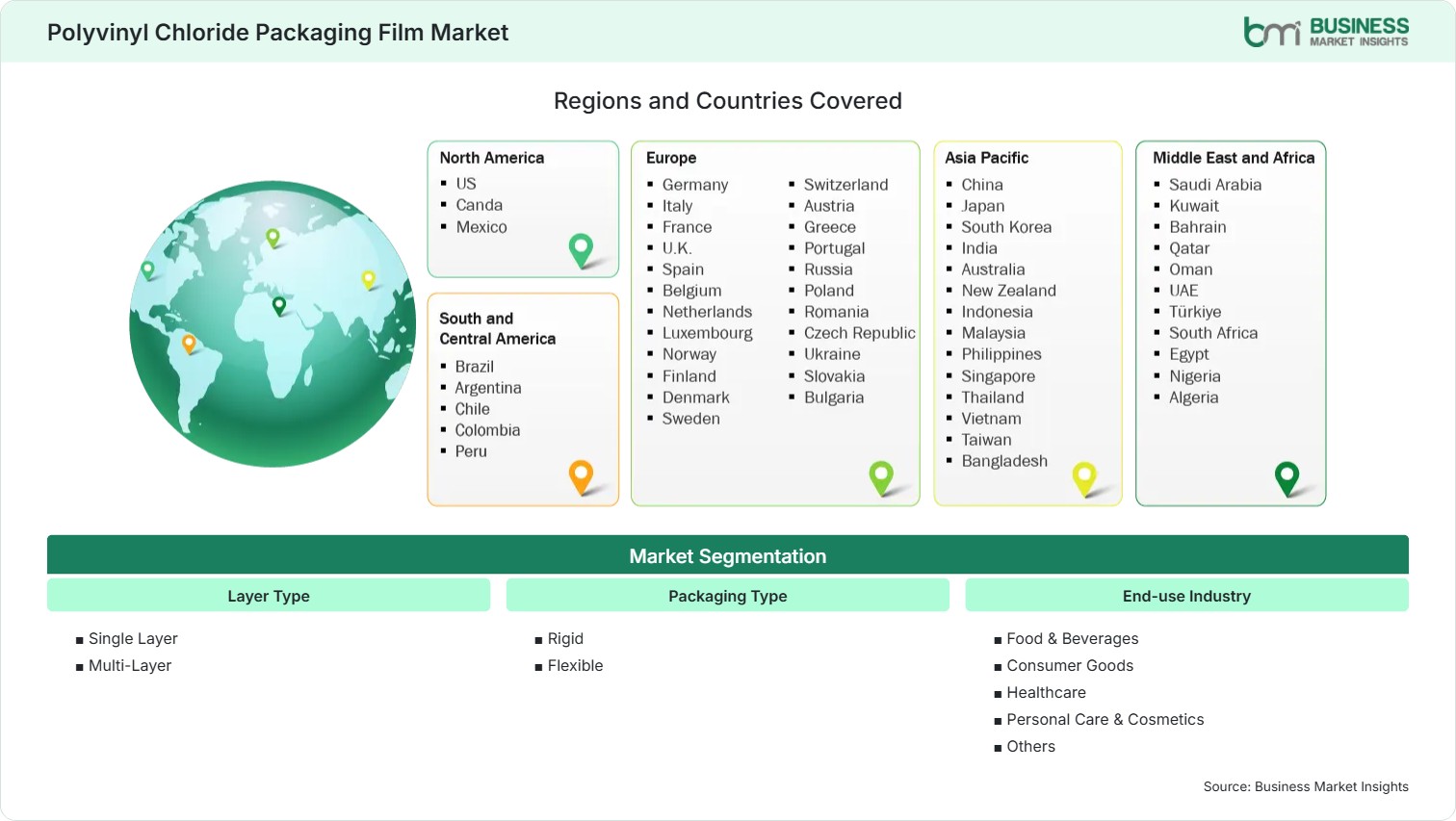
  • Layer Type: Single Layer, Multi-Layer
  • Packaging Type: Rigid, Flexible
  • End-use Industry: Food & Beverages, Consumer Goods, Healthcare, Personal Care & Cosmetics, Others
US$ 16.24 Bn Market size in 2025
US$ 24.98 Bn Market Size by 2033
5.53% CAGR, 2026 - 2033
2026-2033 Forecast Period

AI Overview

Polyvinyl Chloride Packaging Film Market Summary

  • North America Region: North America holds a Polyvinyl Chloride Packaging Film Market share of 22%–25% in 2025, growing at a CAGR of 4.6%–5.0%, influenced by food safety, pharmaceutical packaging, advanced films, recycling investments, and stringent material compliance requirements. The US represents the dominant regional market, with packaging converters investing in high-clarity, lightweight, and recyclable film structures for food, healthcare, and consumer applications at 4.4%–4.8% CAGR.
  • Fastest Growing Region: Asia Pacific holds a market share of 37%–40% in 2025, expanding at a CAGR of 6.0%–6.5%, supported by packaged food manufacturing, pharmaceutical exports, urbanization, flexible packaging conversion, expanding retail networks, and cost-efficient regional production capacity.
  • Leading Segment: Flexible packaging holds a 55%–59% share in 2025, expanding at a CAGR of 5.6%–6.1%, supported by lightweight formats, wrapability, strong seal performance, visibility, efficient material utilization, and expanding food and personal care applications.
  • High Growth Segment: Multi-layer films represent 31%–35% of 2025 demand and are expanding at a CAGR of 6.2%–6.8% of the Polyvinyl Chloride Packaging Film Market, supported by barrier enhancement, downgauging, improved sealability, product protection, and customized structures for demanding healthcare and food applications.
  • Key Market Opportunity: Converters can capture value through recyclable structures, phthalate-free formulations, high-barrier healthcare films, multilayer downgauging, digital printing, anti-fog coatings, and application-specific films that improve shelf life without excessive material consumption.
  • Major Market Players: Klöckner Pentaplast Group, Amcor plc, Berry Global Group, Inc., ProAmpac Holdings Inc., Winpak Ltd., RENOLIT SE, Inteplast Group, Coveris Management GmbH, Cosmo First Limited, and Jiangsu Dahai Plastic Co., Ltd.
Strategic Insights

Polyvinyl Chloride Packaging Film Market: Strategic Insights

Polyvinyl Chloride Packaging Film Market Strategic Framework
FREE PDF
Request your free sample
Request free sample
Stakeholder View

Key Takeaways

  • The value chain is becoming more integrated, with resin suppliers, film manufacturers, compounders, converters, packaging machinery providers, brand owners, and recyclers increasingly coordinating material specifications. Film producers with technical conversion support can reduce qualification cycles and improve customer retention.
  • Flexible packaging provides the broadest near-term commercial opportunity because it combines lightweight construction, strong product visibility, convenient handling, and efficient conversion. Multilayer films offer additional upside where barrier, sealability, and mechanical performance must coexist.
  • Film innovation is moving toward downgauging, high-clarity surfaces, anti-fog functionality, improved printability, recyclable structures, and formulations that reduce problematic additives. Healthcare packaging is also encouraging greater attention to extractables, sterilization resistance, and controlled material composition.
  • Asia Pacific offers the strongest expansion case because China and India combine large food and pharmaceutical manufacturing bases with growing domestic consumption. India is particularly attractive as flexible packaging adoption and pharmaceutical exports expand. External forecasts also identify India among the faster-growing country markets.
  • Investment activity is increasingly shaped by consolidation and portfolio expansion. The Amcor and Berry Global combination illustrates how scale across flexible films, containers, healthcare packaging, and consumer packaging can strengthen purchasing, manufacturing, and innovation capabilities.
  • Sustainability is becoming a competitive filter rather than a standalone product feature. Producers increasingly need to demonstrate recyclability, material efficiency, responsible additive selection, and measurable circularity while maintaining the performance advantages that drive PVC adoption.
Geographic Outlook

Polyvinyl Chloride Packaging Film Market Regional Highlights

North America Polyvinyl Chloride Packaging Film Market

North America accounted for a 22%–25% share in 2025 and is projected to expand at a 4.6%–5.0% CAGR through 2033. Demand is anchored by processed food, healthcare, pharmaceutical, and consumer-product packaging. Film buyers increasingly prioritize consistent thickness, high clarity, seal integrity, and compliance documentation. Domestic converting capacity supports shorter supply chains, while recycling initiatives are encouraging material optimization. The US Polyvinyl Chloride Packaging Film Market remains the dominant country market, followed by Canada, with growth concentrated in healthcare packaging, convenience foods, and specialty flexible applications. Regulatory scrutiny is also accelerating additive reformulation and traceability.

  • Food processors increasingly require films that preserve visibility and mechanical integrity while supporting automated wrapping and high-throughput packaging operations.
  • Healthcare packaging remains attractive because transparent PVC structures can support visual inspection, thermoforming, sealing, and sterilization requirements across selected applications.
  • Recyclability expectations are encouraging converters to evaluate downgauging, alternative structures, and improved collection pathways without compromising package functionality.
  • The US benefits from large-scale packaged-food and pharmaceutical production, while Canada provides additional demand through food processing and healthcare supply chains.

US Polyvinyl Chloride Packaging Film Market

The US represented approximately 72%–76% of North American demand in 2025 and is forecast to grow at a 4.4%–4.8% CAGR of the Polyvinyl Chloride Packaging Film Market. Demand is supported by established food manufacturing, pharmaceutical production, personal care consumption, and sophisticated packaging conversion. Buyers increasingly emphasize documented material performance, food-contact compliance, reliable supply, and downgauged film structures. Healthcare applications remain particularly valuable because transparent films facilitate product inspection and controlled packaging processes. Domestic converters are also investing in automation and sustainable alternatives, creating competitive pressure for PVC film suppliers to demonstrate measurable performance and lifecycle advantages.

  • Convenience food, bakery, meat, dairy, and fresh-product packaging support steady film consumption where clarity, sealing, and moisture resistance are commercially important.
  • Pharmaceutical packaging favors tightly controlled film specifications, particularly where thermoforming accuracy, barrier protection, sterilization compatibility, and package integrity determine qualification.
  • Consumer brands are encouraging suppliers to reduce material intensity while retaining visual appeal, print quality, and protection during distribution.

Europe Polyvinyl Chloride Packaging Film Market

Europe represented a 21%–24% share in 2025 and is expected to grow at a 4.8%–5.2% CAGR through 2033. Germany, France, Italy, and the United Kingdom remain important markets because of sophisticated packaging conversion and pharmaceutical manufacturing. Germany leads regional industrial capability, while Italy and France provide strong food and consumer packaging demand. The United Kingdom Polyvinyl Chloride Packaging Film Market benefits from established retail and convenience-food applications. Regulatory emphasis on packaging waste, recyclability, and material composition is accelerating investment in lightweight films, optimized structures, and circular-material systems across converters.

  • Germany combines advanced converting technology with strong food, healthcare, and industrial packaging demand, creating a high-value market for technically differentiated films.
  • France and Italy provide significant food and consumer-goods demand, particularly for films used in wrapping, trays, labels, and specialty packaging structures.
  • European suppliers are increasingly evaluating circularity, recycled content, and alternative formulations as packaging regulations tighten.
  • The region rewards suppliers capable of documenting material composition, food-contact compliance, recycling compatibility, and consistent production performance.

Asia Pacific Polyvinyl Chloride Packaging Film Market

Asia Pacific held a 37%–40% share in 2025 and is projected to record a 6.0%–6.5% CAGR through 2033, making it the fastest-growing regional market. China remains the largest manufacturing base, while India is emerging rapidly through food processing, pharmaceuticals, organized retail, and flexible packaging conversion. Japan and South Korea provide high-value demand for technically advanced packaging. Southeast Asian economies are adding capacity as consumer packaged goods manufacturing expands. Competitive production costs, expanding domestic consumption, and regional export activity support investment in film extrusion and converting.

  • China Polyvinyl Chloride Packaging Film Market benefits from extensive polymer processing infrastructure, large packaging-conversion capacity, and substantial domestic consumption across food, consumer goods, and healthcare.
  • India offers a strong growth opportunity as pharmaceutical exports, organized food retail, and flexible packaging adoption expand across urban and semi-urban markets.
  • Japan and South Korea emphasize high-performance films, precision converting, product safety, and advanced packaging applications requiring controlled material properties.
  • Southeast Asia is attracting packaging investment as multinational food, beverage, personal care, and consumer-goods manufacturers expand regional production networks.

Rest of World Polyvinyl Chloride Packaging Film Market

South and Central America together represent an important emerging demand base, led by Brazil and Mexico, where packaged food, consumer products, and retail modernization support film consumption. Middle Eastern markets are also expanding through food imports, pharmaceutical development, and modern retail infrastructure.

The broader Rest of World region represented an 18%–21% share in 2025 and is forecast to grow at a 5.3%–5.8% CAGR of the Polyvinyl Chloride Packaging Film Market. Brazil and Mexico lead Latin American demand, while Saudi Arabia and the UAE offer high-growth Middle Eastern opportunities.

  • Brazil benefits from large food-processing volumes and growing packaged-product consumption, supporting demand for transparent and flexible packaging materials.
  • Mexico combines food manufacturing, consumer-product production, and proximity to North American supply chains, strengthening demand for packaging films and converted products.
  • Saudi Arabia and the UAE are investing in food security, pharmaceutical capacity, and modern retail infrastructure, supporting specialized packaging applications.
  • South Africa provides an important African conversion hub, while broader African demand remains linked to urbanization, healthcare expansion, and formal retail penetration.
Global Market Geography
FREE PDF
Request your free sample
Request free sample
Segment Analysis

Polyvinyl Chloride Packaging Film Market Segmentation

Layer Type

Layer Type continues to play a crucial role in determining performance, costs, and suitability for application. This category is subdivided into Single Layer and Multi-Layer categories, with the latter preferred when packaging requirements demand improved barrier performance, sealing ability, puncture resistance, or custom-made material features. The Polyvinyl Chloride Packaging Film Market share is showing increasing signs of this trend, while the market trends are leaning towards functionality and material efficiency.

  • Single Layer: Single-layer films remain important for cost-sensitive wrapping and straightforward applications requiring transparency, flexibility, and adequate moisture protection without complex barrier requirements.
  • Multi-Layer: Multi-layer films combine PVC with complementary materials or coatings to improve barrier performance, mechanical strength, sealability, printability, and product protection across demanding packaging applications.

Packaging Type

Packaging Type segregates demand between Rigid and Flexible types based on variations in the forming process, protection needs, and environmental conditions. Flexible is the larger category since it offers opportunities for lightweight wrapping and greater production efficiency. Rigid type still has significance in thermoforming applications, where dimensional stability is required. Hence, the forecasted growth of the Polyvinyl Chloride Packaging Film market will be determined by the ratio between the two types.

  • Rigid: Rigid PVC films provide dimensional stability, clarity, thermoformability, and protection for applications such as blister packs, trays, and structured consumer packaging.
  • Flexible: Flexible films support wrapping, pouches, liners, labels, and protective applications where low material weight, conformability, visibility, and efficient sealing are essential.

End-use Industry

End-use industry demand comprises Food & Beverage, Consumer Goods, Healthcare, Personal Care & Cosmetics, and Others. Food and healthcare have solid, recurring demand because the quality of packaging materials directly influences product safety and handling. The consumer goods and personal care industry focuses on visual attractiveness and printability. The demand trends in the Polyvinyl Chloride Packaging Film Market are increasingly driven by industry requirements.

  • Food & Beverages: Food packaging uses PVC films for wrapping, trays, labels, and protective applications where clarity, moisture resistance, sealing, and product visibility support shelf presentation and preservation.
  • Consumer Goods: Consumer-goods packaging relies on PVC film for durable, transparent, printable structures that protect products while supporting retail presentation and efficient automated conversion.
  • Healthcare: Healthcare applications prioritize controlled material composition, transparency, barrier properties, thermoforming precision, sterilization compatibility, and reliable package integrity for pharmaceutical and medical products.
  • Personal Care & Cosmetics: Cosmetics and personal-care packaging emphasizes visual quality, printability, surface finish, product protection, and customized formats that reinforce premium shelf presentation.
  • Others: Other applications provide diversified demand across specialized packaging requirements where PVC films offer useful combinations of clarity, durability, processability, and chemical resistance.
Market Forces

Polyvinyl Chloride Packaging Film Market Dynamics

Key Market Drivers

Expansion of Packaged Food and Convenience Consumption

Food packaging requirements continue to be an integral driving force due to the properties exhibited by PVC films, such as transparency, moisture barrier, flexibility, sealability, and effective processability. Packaging requirements for ready-to-eat meals, meats, baked goods, dairy products, fresh foods, and convenience foods involve protecting packaged products while keeping them visible on shelves. There is also a growing reliance of global food chains on the performance of controlled packaging. Consequently, the Polyvinyl Chloride Packaging Film Market growth will be supported not only by the increased volume but also by functional improvements in packaging. Manufacturers are introducing new technologies to achieve thinner gauges, improved anti-fogging performance, stronger seals, and customized barrier structures. These innovations enable converters to effectively meet the needs of food waste management and product protection. Growth in organized retail and foodservice penetration in developing countries also contributes to the widening of applications.

Growth of Pharmaceutical and Medical Packaging Applications

Healthcare packaging requires films with transparency, dimensional stability, barrier properties, and good formability. PVC continues to be a choice in certain blister packaging, medical, and pharmaceutical applications due to efficient processing with existing converting facilities. There is an increasing need for pharmaceutical companies to use packaging materials that ensure the drug's integrity from production through distribution, storage, and transportation to the consumer. In addition, there is a need for visibility, as transparent packaging enables the easy inspection of the package and its contents. This is driven by the growth of pharmaceutical manufacturing in Asia, along with healthcare consumption in North America and Europe. Suppliers of films are thus responding to this trend by developing special grades of films, better extractables, better sealability, and film structures that thermoform at high speed.

Advancement of High-Performance Film Engineering

Innovations in film engineering are enhancing the economic viability of PVC by controlling thickness, multilayer construction, coating, and surface functionality. Film manufacturers can integrate properties such as mechanical strength, optical clarity, barrier performance, sealability, and printability into films designed for specific applications. This is especially critical because multilayer films enable the use of less expensive functional materials without sacrificing necessary performance. Digital process controls and automated inspection improve consistency by enabling manufacturers to detect variations in gauge, surface defects, and manufacturing process deviations early. All of these innovations make it possible to meet stringent customer specifications and avoid wasting material during the conversion process. Thus, the Polyvinyl Chloride Packaging Film Market trends reflect growing technological differentiation rather than pure volume growth.

Key Market Opportunities

Recyclability and Circular Material Development

Environmental pressure is creating an opportunity for suppliers that can demonstrate practical circularity without sacrificing PVC film performance. Development priorities will be compatible with collection systems, formulation optimization, incorporation of recycled content when technically feasible, and materials design that limits unnecessary complexity. For instance, RENOLIT produced a PVC film comprising 50% recycled content in 2025. This is an example of circular development that shows how materials innovation is taking place commercially. Producers can differentiate themselves through lifecycle proof, verifiable recycled content, and film designs that facilitate film recovery. Europe is the region with the greatest potential, as packaging regulation is increasing customer pressure, and this trend is spreading to other multinational brands. The more producers can claim their circularity with good film quality, the more likely they are to qualify.

High-Barrier Films for Healthcare and Sensitive Products

Packaging solutions for the healthcare, nutraceutical, and sensitive consumer product segments need to be moisture- and oxygen-transmission-resistant while maintaining properties such as clarity and formability. In doing so, there are opportunities for suppliers to design engineered PVC structures, including barrier layers and coatings, as well as effective sealing mechanisms. Film solutions from specialty pharmaceuticals provide a case in point of how these engineered PVC solutions have proven commercially viable. Thus, Future Polyvinyl Chloride Packaging Film Market Forecasts must account for value shifts from conventional films to those with greater qualification requirements. These opportunities lie in pharmaceutical blister packaging, liquid-dose applications, specialty medical packaging, and protective consumer goods packaging.

Digitalized and Application-Specific Film Conversion

Film manufacturers are now looking for ways to work with customers who require short development times, flexible design, efficient production processes, and specific functional properties of films. Digital printing, automatic inspection, smart process control, and precise slitting can help make production more responsive and minimize production losses. Small packaging runs for personal care, specialty food, healthcare, and premium consumer goods open the door to producing customized film constructions rather than standard commodity rolls. It is also possible to provide technical assistance to fine-tune sealing temperature, forming conditions, film thickness, and printing compatibility for each particular piece of equipment of the converting customer. Such an approach will make it easier to build customer relationships because the film's performance depends not only on its composition but also on the manufacturing process. Therefore, investment in application laboratories may serve as a competitive advantage, especially when customers have strict sustainability requirements.

Market Restraints and Challenges

Environmental and Regulatory Pressure on PVC Materials

Factor: PVC packaging undergoes a critical review linked to its chemistry, additives, waste management, and recycling. Impact: This pressure can lead to cost increases for formulation, compliance, testing, and documentation. In addition, it encourages brand owners to consider other materials. Europe’s packaging policy is highly significant because multinationals often adopt EU material standards worldwide. Suppliers must be able to prove that their products are food-contact compliant, that they use appropriate additives, that they have a recycling path, and that they have a consistent material composition. If companies cannot provide technical documentation, they will likely have qualification delays or risk substitution. The problem is not universal for different applications, as PVC performs exceptionally well in certain healthcare, rigid film, and specialty packaging applications. Nevertheless, further regulation makes manufacturers reconsider their material use.

Feedstock Volatility and Production Cost Pressure

Factor: The economic viability of PVC film production is subject to fluctuations in the prices of chlorine, ethylene, vinyl chloride monomer, additives, energy, and logistics, as well as oversupply in certain manufacturing locations, which could drive up competition and put downward pressure on prices. Impact: Margin squeeze would prevent companies from making further investments in specialized products and force customers to negotiate film prices. The industry publications of 2025 cited the emergence of additional PVC capacity and periods of low prices in China as examples of how supply expansion affects producers' financial positions. Small converters would be particularly susceptible because of their limited buying power and limited hedging opportunities through diversified investments. Producers can offset this disadvantage through long-term purchasing contracts, energy savings, process automation, product specialization, and geographical diversification. However, competition in commodity pricing remains an inherent challenge for manufacturers whose product portfolios predominantly include PVC films.

Company Analysis

Competitive Landscape

The Polyvinyl Chloride Packaging Film Market analysis indicates a competitive environment combining large multinational packaging groups, specialty film manufacturers, rigid-film specialists, flexible packaging producers, and vertically integrated converters. Competitive differentiation increasingly depends on film engineering, application support, regulatory compliance, manufacturing scale, sustainability credentials, and customer-specific development.

Company Name

Overview

Products and Services relevant to this market

Klöckner Pentaplast Group

Global packaging and specialty-film producer with extensive food, healthcare, and consumer packaging capabilities.

PVC thermoforming films, pharmaceutical films, specialty rigid films, multilayer structures, and packaging development services.

Amcor plc

Global packaging company serving food, healthcare, pharmaceutical, and consumer markets across multiple material platforms.

Flexible packaging films, healthcare packaging, thermoformable structures, barrier solutions, and recyclable packaging technologies.

Berry Global Group, Inc.

Large packaging manufacturer with extensive flexible films, healthcare, consumer, and industrial packaging operations.

Flexible films, healthcare packaging, consumer packaging, specialty films, and converted packaging structures.

ProAmpac Holdings Inc.

Flexible packaging and material-science company focused on food, consumer, healthcare, and industrial applications.

Flexible films, high-performance packaging, specialty film structures, sustainable packaging, and converting technologies.

Winpak Ltd.

North American packaging producer serving food, beverage, pharmaceutical, medical, and personal-care applications.

Medical films, thermoforming materials, lidding films, flexible structures, pouches, and high-performance packaging.

RENOLIT SE

Specialty polymer-film producer with established PVC expertise and packaging applications in healthcare and consumer markets.

Rigid PVC packaging films, thermoforming films, pharmaceutical blister films, liquid pouch films, and specialty PVC structures.

Inteplast Group

Diversified US film manufacturer with broad flexible-film and packaging capabilities across multiple end markets.

Packaging films, custom films, liners, bags, flexible structures, and converted film products.

Coveris Management GmbH

European packaging manufacturer focused on flexible and sustainable packaging for food, healthcare, and consumer applications.

Flexible films, high-barrier packaging, printed films, lidding solutions, and specialized packaging structures.

Cosmo First Limited

Indian specialty-film manufacturer with packaging and lamination expertise and expanding value-added film capabilities.

Packaging films, coated films, specialty films, laminates, lidding structures, and high-performance packaging materials.

Jiangsu Dahai Plastic Co., Ltd.

Chinese PVC film producer serving domestic and international packaging and specialty-film applications.

PVC films, medical packaging films, protective films, floor-covering films, and customized extrusion products.

Industry Activity

Recent Developments

What applications offer the strongest opportunity for PVC packaging films?

Healthcare, food, pharmaceuticals, personal care, and specialized consumer packaging offer attractive opportunities because they require transparency, sealing performance, barrier protection, thermoformability, and reliable package integrity.

How are manufacturers improving the sustainability profile of PVC packaging?

Manufacturers are pursuing downgauging, recycled content, improved recyclability, optimized additive systems, better collection pathways, and structures designed to reduce material consumption while retaining required packaging performance.

Why are multilayer films gaining importance in packaging?

Multilayer construction allows manufacturers to combine different functional properties within one structure. This can improve moisture and oxygen protection, puncture resistance, sealability, printability, and forming performance while controlling overall material usage.

What does the Polyvinyl Chloride Packaging Film Market Report help packaging buyers evaluate?

The report helps buyers evaluate regional demand, film structure trends, end-use opportunities, competitive positioning, growth drivers, regulatory pressures, and investment priorities across the global packaging-film value chain.

Which regional market provides the strongest long-term growth opportunity?

Asia Pacific provides the strongest growth opportunity because of its large food and pharmaceutical manufacturing base, expanding consumer markets, competitive production economics, and continued investment in packaging conversion capacity.

Trust & Transparency

Research Methodology

The market analysis combines proprietary research with secondary data from government agencies, company disclosures, regulatory filings, industry databases and expert interviews. Market estimates are validated through data triangulation, cross-market benchmarking and analyst review.

View Full Research Methodology

Access the Full Polyvinyl Chloride Packaging Film Market Report

Get segment-level forecasts, regional estimates, competitive benchmarking, company profiles and downloadable Excel datasets.

Access the full Polyvinyl Chloride Packaging Film Market Report
350 pages PDF & Excel | 2026-09-23
Similar Research

Related Market Reports