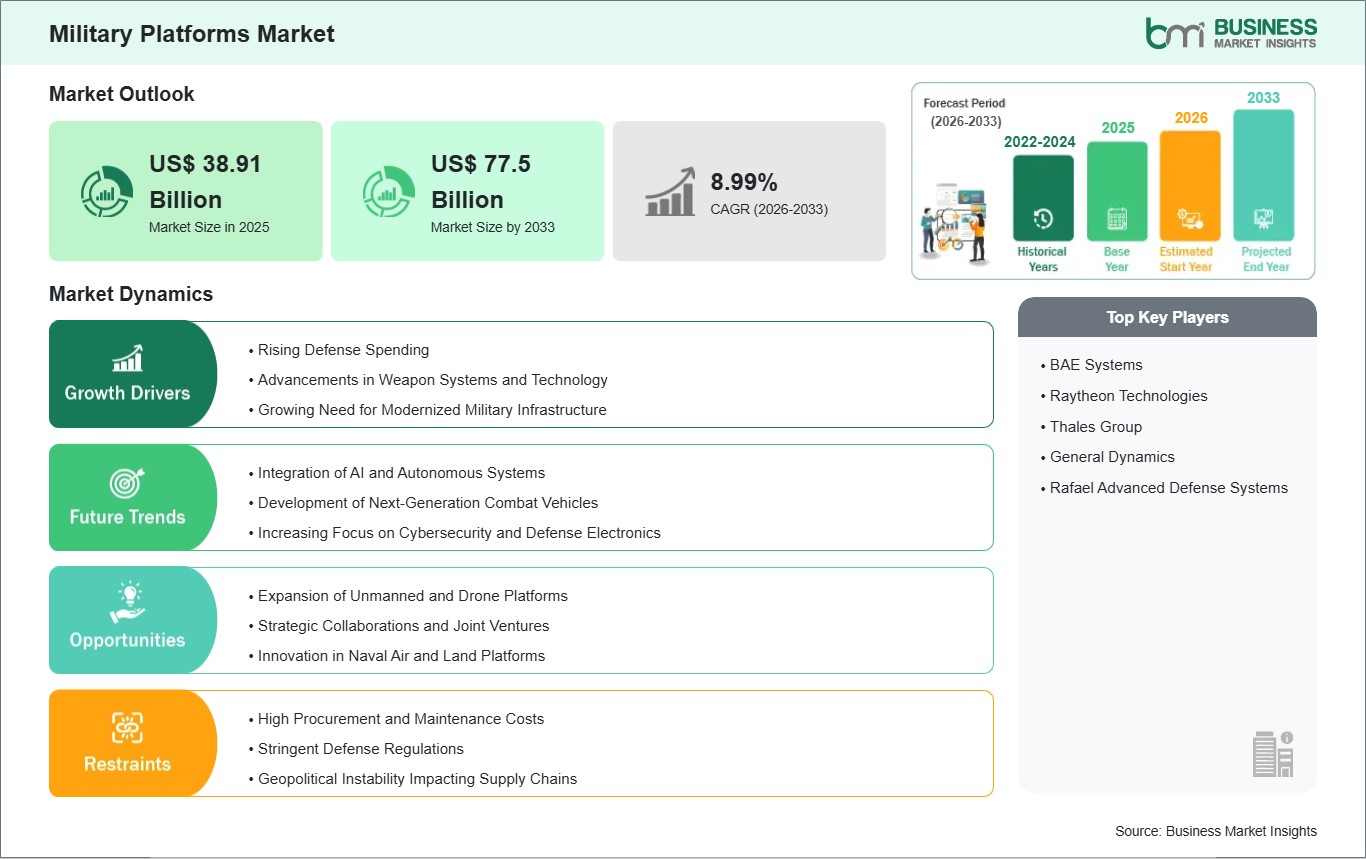
The Military Platforms Market size is expected to reach US$ 77.5 Billion by 2033 from US$ 38.91 Billion in 2025. The market is estimated to record a CAGR of 8.99% from 2026 to 2033.
The global military platforms market covers land, air, sea, and, more recently, unmanned systems that are essential to modern defense. These platforms include tanks, armored vehicles, fighter jets, helicopters, naval ships, and autonomous systems. Together, they enable countries to project power, defend their territory, and deter potential threats. The ongoing geopolitical situations mean that countries are focusing on modernizing their defenses, and this has seen continuous investment in new military technologies with enhanced mobility, protection, connectivity, and flexibility. New technologies, including digital systems, sensor fusion, artificial intelligence, and networked battlefields, are also changing the capabilities of these systems, enabling the armed forces to perform more effectively in challenging situations. The requirement for military systems is also influenced by new threats, including asymmetric threats, border issues, and the rivalry of major powers. However, the requirement for military systems also faces challenges, including the high costs of these systems, the long-term costs of maintaining these systems, and the limitations of the defense budget in terms of funding these systems.

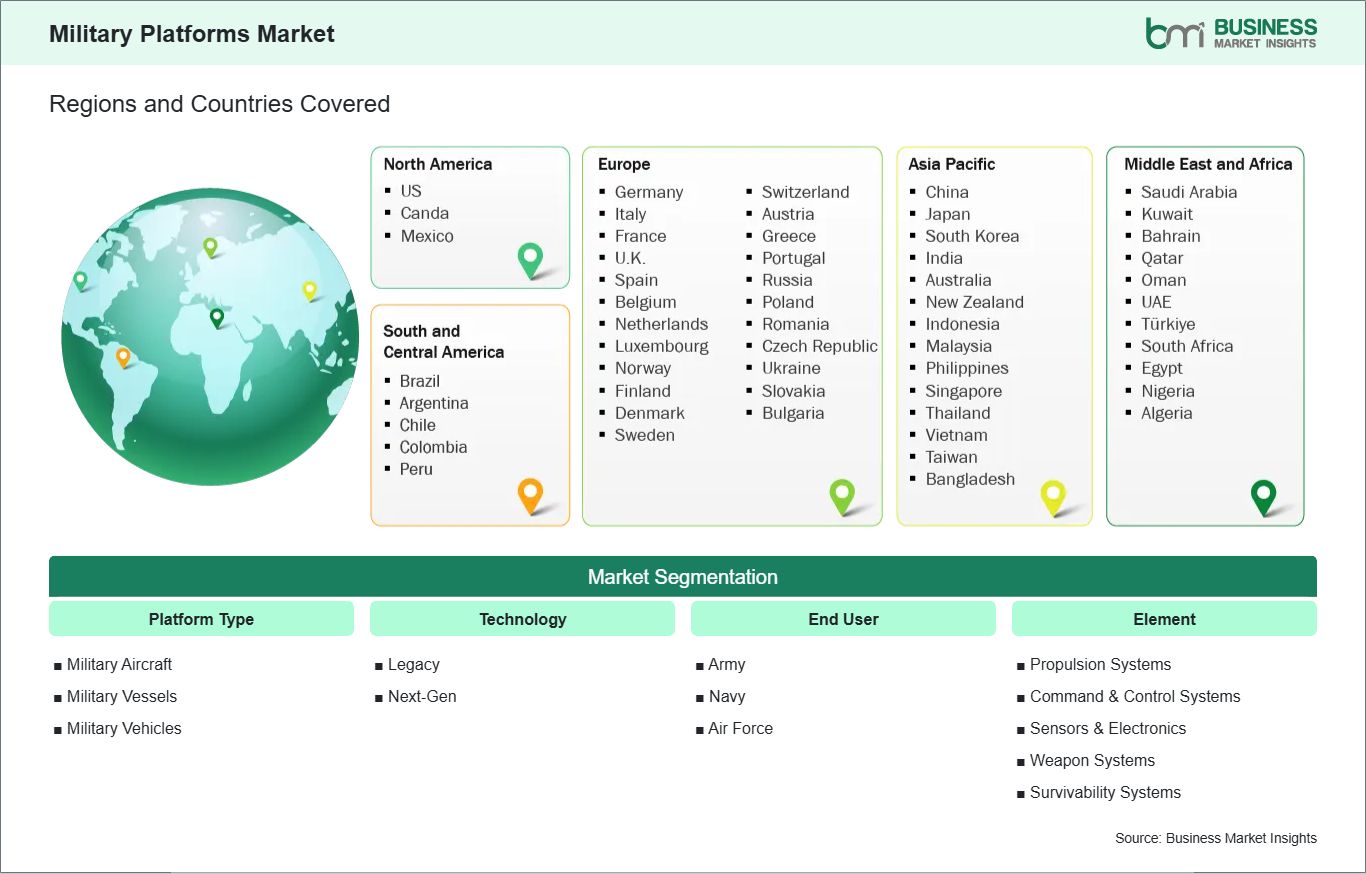
Key segments that contributed to the derivation of the military platforms market analysis are platform type, technology, end user, and element.
Global defense spending has been rising steadily as nations seek to modernize their defense capabilities. Advanced nations with strong defense sectors, such as the United States and Germany, are investing heavily in next-generation fighter planes, armored vehicles, and ships. This has led to increased demand for all sorts of military equipment, including that for conventional and network-centric warfare.
Newly emerging economies are also contributing to an increase in defense spending. In Asia and the Middle East, nations are modernizing their existing fleets and also investing in cutting-edge defense equipment for strategic deterrence and border security. For example, modernization of armored and naval fleets by nations such as India is an example of their intentions to enhance defense preparedness, and this has led to an increase in demand for new and existing defense equipment.
In addition, defense spending is increasingly focused on integrated systems that enhance situational awareness, interoperability, and survivability. Investments in platforms equipped with advanced sensors, communications, and command systems reflect the growing need for high-tech capabilities. This trend ensures that military platforms remain central to national defense strategies, encouraging continued global demand and innovation in design, production, and deployment.
The use of unmanned systems and drone technology is revolutionizing military operations globally, providing flexibility and ensuring the safety of military personnel. Drones and unmanned aircraft are providing military forces with an opportunity to conduct high-risk operations without exposing their personnel to danger. Modern drone technology is providing militaries with the ability to conduct operations in the air, on land, and at sea. Drones are providing militaries with an opportunity to conduct operations without exposing their personnel to danger. Therefore, the use of unmanned aircraft is revolutionizing military operations globally. In many parts of the world, there is an increased use of unmanned aircraft, especially in regions with active modernization programs. In East Asia, there are reports that many countries are acquiring long-endurance drones with intelligence and precision strike capabilities. This is an indication that many countries in the region are shifting their attention to rapid response operations. In Europe, many countries are using unmanned aircraft in their military forces.
Furthermore, technological innovations in the development of autonomous technology, artificial intelligence, and sensors are also contributing to the increased adoption of drone technology. This is due to the increased capacity of unmanned vehicles to operate collaboratively and make real-time decisions, which is improving the efficiency of the operations of the drones. Therefore, drones are also part of the modernization of the military sector, creating more opportunities in the market for innovative and flexible technology products.

The military platforms market is experiencing steady growth, with market size and share analysis reflecting evolving treatment preferences and competitive dynamics among key players. The report evaluates important subsegments categorized within platform type, technology, end user, and element, highlighting their respective contributions to overall market performance.
By platform type, the Military Aircraft subsegment dominated the Defense market in 2025. Military aircraft offer strategic mobility, advanced combat capabilities, and rapid response, driving their widespread adoption.
Based on technology, the Next‑Gen subsegment dominated the Defense market in 2025. Next‑generation technologies provide enhanced situational awareness, stealth, and precision, supporting strong demand across defense operations.
In terms of end user, the Air Force subsegment dominated the Defense market in 2025. Air force operations rely heavily on advanced aircraft and integrated systems for defense and strategic missions, reinforcing the leading position of this segment.
On the basis of element, the Weapon Systems subsegment dominated the Defense market in 2025. Advanced weapon systems are critical for operational effectiveness, precision targeting, and defense superiority, driving their widespread adoption in military platforms.
| Report Attribute | Details |
|---|---|
| Market size in 2025 | US$ 38.91 Billion |
| Market Size by 2033 | US$ 77.5 Billion |
| Global CAGR (2026 - 2033) | 8.99% |
| Historical Data | 2022-2024 |
| Forecast period | 2026-2033 |
| Segments Covered | By Platform Type
|
|
Regions and Countries Covered
| |
| North America | US, Canada, Mexico |
| Europe | Belgium, Austria, Finland, Denmark, Greece, Poland, Romania, Russia, Ukraine, Czech Republic, Slovakia, Bulgaria, Italy, Luxembourg, Germany, Switzerland, France, Netherlands, Norway, Portugal, Spain, Sweden, United Kingdom |
| Asia-Pacific | Australia, China, India, Japan, South Korea, Indonesia, Malaysia, Philippines, Singapore, Thailand, Vietnam, Bangladesh, New Zealand, Taiwan |
| South and Central America | Brazil, Argentina, Peru, Chile, Colombia |
| Middle East and Africa | Bahrain, Kuwait, Oman, Qatar, Saudi Arabia, United Arab Emirates, Turkiye, South Africa, Egypt, Algeria, Nigeria |
| Market leaders and key company profiles |
|
The "Military Platforms Market Size and Forecast (2022 - 2033)" report provides a detailed analysis of the market covering below areas:
The geographical scope of the Military Platforms market report is divided into five regions: North America, Asia Pacific, Europe, Middle East & Africa, and South & Central America. The Military Platforms market in North America is expected to grow during the forecast period.
The most prominent player in the global military platforms market is North America. The reason behind this is that this region has a robust defense industry with significant research and development activities, as well as clear defense strategies. The United States is leading in terms of designing, manufacturing, and utilizing various kinds of military platforms, whether it is in terms of air, land, sea, or drones. For example, advanced fighter jets, long-range strike platforms, new kinds of armored vehicles, or advanced naval platforms are all highlighting the importance given by this region to remain technologically advanced in this domain.
The defense industry in North America is heavily investing in new kinds of technologies, such as digital technologies, drones, etc., to enhance its capabilities in various domains. Partnership and defense agreements will also strengthen North America’s leadership role. This is because partnerships and defense agreements will require platforms that can work in coalition forces, thus creating demand for such platforms. Having a support system in place ensures that deployed equipment remains available for use.
However, North America has various challenges, such as budget constraints, the complexity of the acquisition system, and the need to modernize old systems as it develops new ones. Long development cycles and testing are also hurdles, as are politics in defense spending. Despite these challenges, North America remains at the forefront in terms of innovation and deployment of military platforms.

The military platforms market is evaluated by gathering qualitative and quantitative data post primary and secondary research, which includes important corporate publications, association data, and databases. A few of the key developments in the military platforms market are:
The Military Platforms Market is valued at US$ 38.91 Billion in 2025, it is projected to reach US$ 77.5 Billion by 2033.
As per our report Military Platforms Market, the market size is valued at US$ 38.91 Billion in 2025, projecting it to reach US$ 77.5 Billion by 2033. This translates to a CAGR of approximately 8.99% during the forecast period.
The Military Platforms Market report typically cover these key segments-
The historic period, base year, and forecast period can vary slightly depending on the specific market research report. However, for the Military Platforms Market report:
The Military Platforms Market is populated by several key players, each contributing to its growth and innovation. Some of the major players include:
The Military Platforms Market report is valuable for diverse stakeholders, including:
Essentially, anyone involved in or considering involvement in the Military Platforms Market value chain can benefit from the information contained in a comprehensive market report.
Please tell us your area of interest
(Market Segments/ Regions and Countries/ Companies)