Smart City Platforms Market Outlook (2022-2033)

Historic Data: 2022-2024   |   Base Year: 2025   |   Forecast Period: 2026-2033
Report Content: Market Scope, Market Segmentation, Market Dynamics, and Competitive Analysis

Report Coverage:
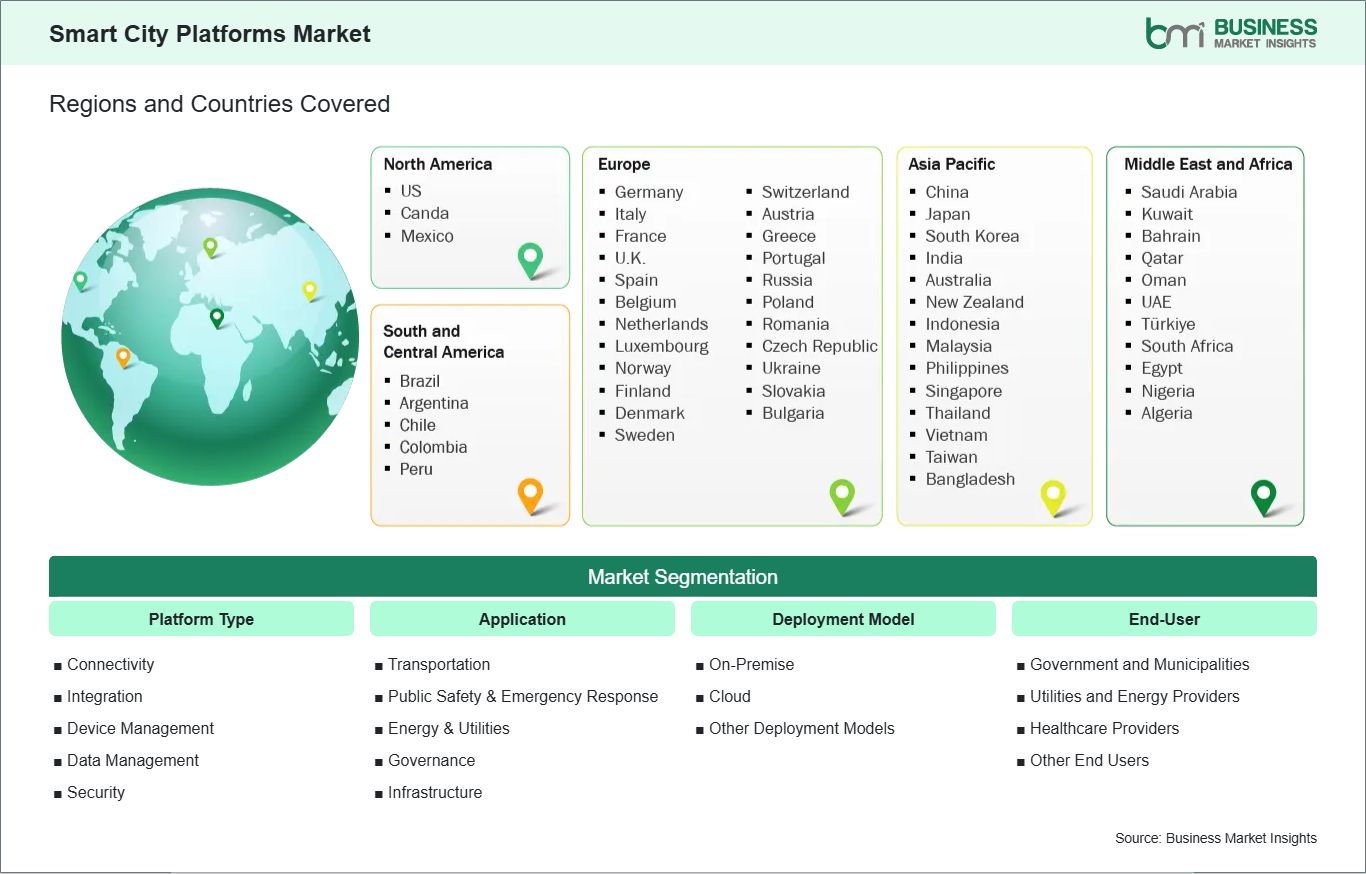
  • Platform Type (Connectivity, Integration, Device Management, Data Management, Security)
  • Application (Transportation, Public Safety & Emergency Response, Energy & Utilities, Governance, Infrastructure)
  • Deployment Model (On-Premise, Cloud, and Other Deployment Models)
  • End-User (Government and Municipalities, Utilities and Energy Providers, Healthcare Providers, and Other End Users)

No. of Pages: 423
Report Code: BMIPUB00034362
Category: Electronics and Semiconductor
Smart City Platforms Market

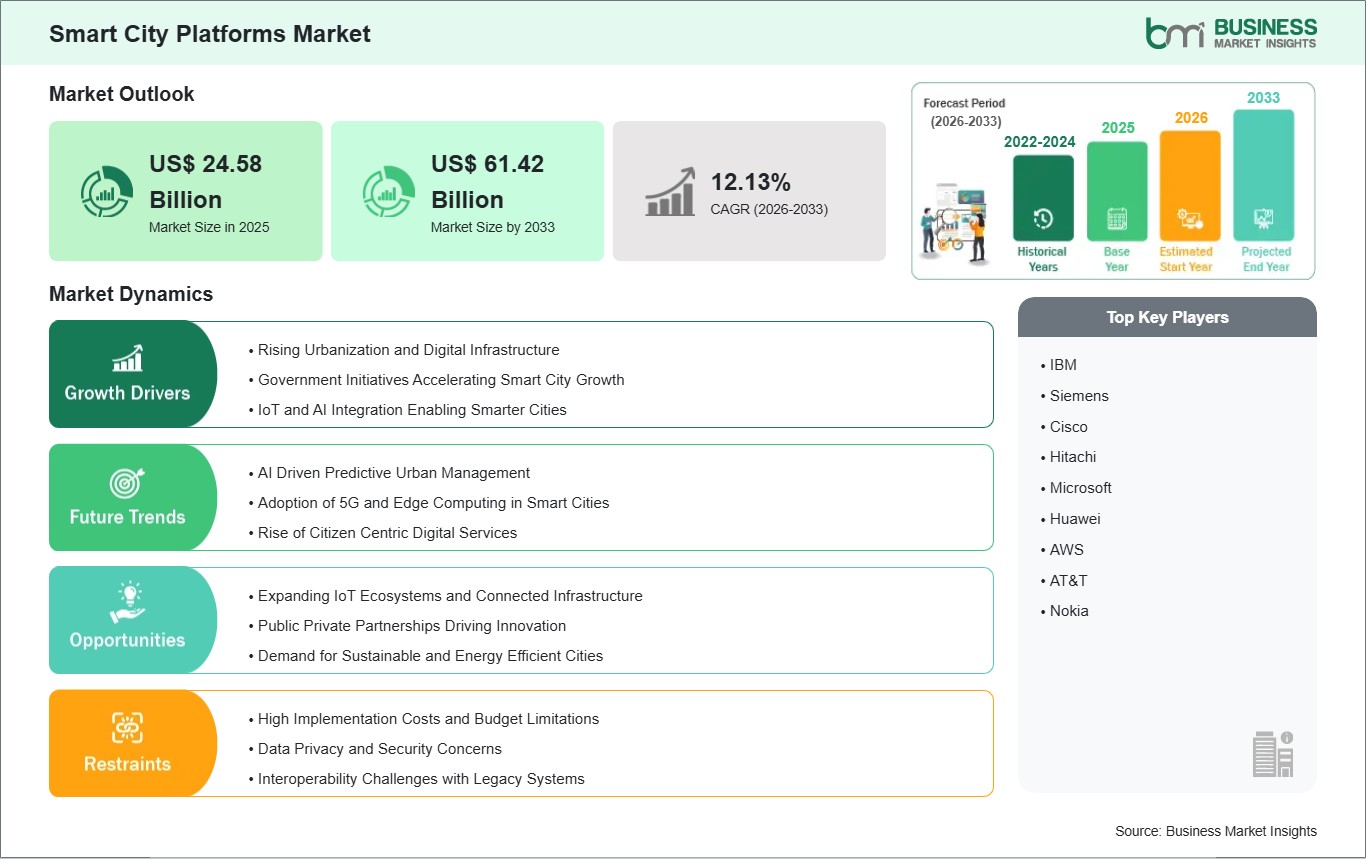
The Smart City Platforms Market size is expected to reach US$ 61.42 billion by 2033 from US$ 24.58 billion in 2025. The market is estimated to record a CAGR of 12.13% from 2026 to 2033.

Executive Summary and Global Market Analysis:

The global smart city platforms market brings together digital infrastructure, data analytics, and urban services to help cities become more efficient, sustainable, and focused on citizens’ needs. This market centers on using technologies like the Internet of Things (IoT), cloud computing, artificial intelligence (AI), and advanced data platforms to connect areas such as infrastructure, utilities, transportation, public safety, environmental monitoring, and citizen services. As cities grow rapidly, they face challenges with mobility, resource use, population density, and sustainability. These issues have led to more investment in technologies that provide real-time data and insights, helping city leaders make better decisions and improve daily operations. The market is growing because more cities want connected infrastructure, governments are encouraging digital transformation, and there is a strong need to address issues like air quality and energy use.

Smart platforms help city leaders see patterns and trends across different areas, making it easier to respond quickly and improve services. There is also a bigger focus on improving quality of life with digital tools and flexible public services, which makes smart city solutions even more important. Still, the market faces some challenges. It can be hard to connect older systems with new technology, and there are ongoing concerns about security and data privacy because so much sensitive information is involved. Also, not all cities and regions are equally prepared for digital changes, which can slow down adoption and make it harder to implement these solutions on a large scale.

Smart City Platforms Market - Strategic Insights:

global-market-strategic-framework
Get more information on this report

Smart City Platforms Market Segmentation Analysis:

Key segments that contributed to the derivation of the smart city platforms market analysis are platform type, application, deployment model, and end-user.

  • By platform type, the Smart City Platforms market is segmented into connectivity, integration, device management, data management, and security. The connectivity management platforms segment dominated the market in 2025.
  • Based on application, the Smart City Platforms market is classified into transportation, public safety & emergency response, energy & utilities, governance, and infrastructure. The transportation segment dominated the market in 2025.
  • In terms of deployment model, the Smart City Platforms market is categorized into on‑premise, cloud, and other deployment models. The on‑premise segment dominated the market in 2025.
  • On the basis of end user, the Smart City Platforms market is classified into overnment and municipalities, utilities and energy providers, healthcare providers, and other end users. The government and municipalities segment dominated the market in 2025.

Smart City Platforms Market Drivers and Opportunities:

Rising Demand for Operational Efficiency

Cities around the world are increasingly relying on smart city platforms to ensure operational efficiency in managing various urban systems as the population grows and becomes more complex in nature. It is important for a city to manage various systems, such as transportation systems, energy systems, water systems, and security systems at the same time. A smart city platform provides a solution to this by allowing various departments within a city to integrate various systems and efficiently manage them by centralizing various types of information within a single system. Therefore, governments are increasingly seeking smart city platforms that will help in efficiently managing various operations within a city.

Operational efficiency in various cities around the world is also being driven by the need to reduce resource wastage and efficiently manage public services within a particular city. A smart city platform allows a city to efficiently manage various operations, such as traffic control systems, street lighting systems, and garbage collection systems within a particular city by integrating Internet of Things (IoT) technologies and data analytics into a smart system. This allows a city to reduce energy consumption and efficiently manage various operations within a particular department within a city.

In addition, integrated smart city platforms help break down data silos that traditionally exist between different government agencies. Transportation departments, utilities, emergency services, and environmental monitoring systems can operate through a shared digital infrastructure, improving collaboration and decision-making. With access to unified dashboards and real-time insights, city administrators can quickly identify operational challenges and coordinate responses more effectively. This growing emphasis on integrated management systems is making smart city platforms an essential tool for improving the efficiency of urban governance worldwide.

Predictive Maintenance and Asset Optimization

Predictive maintenance is one of the significant benefits of smart cities, enabling cities to predict potential issues with their infrastructure assets before failures occur. This is done through data generated by various sensors installed in various pieces of infrastructure, such as roads, bridges, streetlights, water pipelines, etc. This data is then analyzed through a centralized platform, enabling cities to predict patterns that may result in failures, thus enabling them to carry out maintenance activities ahead of time.

Another area in which the smart city platforms may prove to be advantageous is in the optimization of the city’s assets. This is because the platforms offer in-depth information about the infrastructure. The data collected from the connected devices will enable the city to assess how the public assets are being utilized and whether it is time to upgrade, replace, or improve the infrastructure. For instance, the connected street lights may be able to change their intensity depending on the traffic and pedestrians, thus extending the lifespan of the lights.

Furthermore, predictive analytics integrated within smart city platforms enables long-term infrastructure planning and cost management. By analyzing historical data and environmental conditions, city administrators can forecast maintenance requirements and allocate budgets more effectively. This shift from reactive to predictive asset management not only improves service continuity but also helps reduce long-term maintenance costs. As urban infrastructure networks continue to expand, predictive maintenance capabilities are becoming an essential component of modern smart city platform deployments.

Smart City Platforms Market Size and Share Analysis:

The smart city platforms market is experiencing steady growth, with market size and share analysis reflecting evolving treatment preferences and competitive dynamics among key players. The report evaluates important subsegments categorized within platform type, application, deployment model, and end-user, highlighting their respective contributions to overall market performance.

By platform type, the connectivity management platforms segment dominated the Smart City Platforms market in 2025. This dominance is driven by the growing need to manage and integrate large numbers of connected devices and communication networks across urban infrastructure. Connectivity management platforms enable cities to efficiently control IoT devices used in smart lighting, utilities, surveillance, and transportation systems. By supporting reliable connectivity, real-time monitoring, and secure data exchange, these platforms help municipalities improve operational efficiency and support the scalable deployment of smart city solutions.

Based on application, the transportation segment dominated the market in 2025. The growth of this segment is mainly attributed to the increasing adoption of smart mobility solutions to address urban traffic congestion and improve road safety. Smart city platforms support intelligent traffic management, smart parking systems, and connected public transportation, enabling authorities to monitor traffic conditions and optimize mobility through real-time data and analytics.

In terms of deployment model, the on-premise segment dominated the market in 2025. This leadership is largely due to government agencies prioritizing data security, regulatory compliance, and greater control over critical urban infrastructure systems. On-premise platforms allow municipalities to manage sensitive data within their own IT environments while ensuring system reliability and integration with existing city infrastructure.

On the basis of end user, the government and municipalities segment dominated the market in 2025. This is driven by the key role of public sector organizations in planning and implementing smart city initiatives. Governments and municipal authorities use smart city platforms to manage urban services, integrate data from multiple infrastructure systems, and improve decision-making for efficient and sustainable city operations.

Smart City Platforms Market Report Highlights:

Report Attribute Details
Market size in 2025 US$ 24.58 Billion
Market Size by 2033 US$ 61.42 Billion
Global CAGR (2026 - 2033)12.13%
Historical Data 2022-2024
Forecast period 2026-2033
Segments Covered By Platform Type
  • Connectivity
  • Integration
  • Device Management
  • Data Management
  • Security
By Application
  • Transportation
  • Public Safety & Emergency Response
  • Energy & Utilities
  • Governance
  • Infrastructure
By Deployment Model
  • On-Premise
  • Cloud
  • Other Deployment Models
By End-User
  • Government and Municipalities
  • Utilities and Energy Providers
  • Healthcare Providers
  • Other End Users
Regions and Countries Covered
North America US, Canada, Mexico
Europe Belgium, Austria, Finland, Denmark, Greece, Poland, Romania, Russia, Ukraine, Czech Republic, Slovakia, Bulgaria, Italy, Luxembourg, Germany, Switzerland, France, Netherlands, Norway, Portugal, Spain, Sweden, United Kingdom
Asia-Pacific Australia, China, India, Japan, South Korea, Indonesia, Malaysia, Philippines, Singapore, Thailand, Vietnam, Bangladesh, New Zealand, Taiwan
South and Central America Brazil, Argentina, Peru, Chile, Colombia
Middle East and Africa Bahrain, Kuwait, Oman, Qatar, Saudi Arabia, United Arab Emirates, Turkiye, South Africa, Egypt, Algeria, Nigeria
Market leaders and key company profiles
  • IBM
  • Siemens
  • Cisco
  • Hitachi
  • Microsoft
  • Huawei
  • AWS
  • AT&T
  • Nokia
Get more information on this report

Smart City Platforms Market Report Coverage and Deliverables:

The "Smart City Platforms Market Size and Forecast (2022 - 2033)" report provides a detailed analysis of the market covering below areas:

  • Smart City Platforms market size and forecast at global, regional, and country levels for all the key market segments covered under the scope
  • Smart City Platforms market trends, as well as drivers, restraints, and opportunities
  • Smart City Platforms market analysis covering key trends, regional framework, major players, regulations, and recent developments
  • Industry landscape and competition analysis covering market concentration, heat map analysis, prominent players, and recent developments for the Smart City Platforms market
  • Detailed company profiles, including SWOT analysis

Smart City Platforms Market Geographic Insights:

The geographical scope of the Smart City Platforms market report is divided into five regions: North America, Asia Pacific, Europe, Middle East & Africa, and South & Central America. The Smart City Platforms market in North America is expected to grow during the forecast period.

North America leads the way in adopting smart city platforms, thanks to its strong infrastructure, robust technology sector, and forward-thinking policies. The region has invested heavily in digital projects that focus on interoperability, cloud-based systems, and open data. Many large cities in North America were among the first to use smart mobility solutions, integrated public safety networks, and utility management platforms that rely on predictive analytics to improve urban planning. One of North America’s main strengths is its strong partnerships between private companies, city governments, and universities. These collaborations have led to new ideas in real-time traffic management, environmental monitoring with sensors, and platforms that help residents give feedback to city officials. The region is also home to many large tech companies and startups, which makes it easier to test new smart city solutions and share successful models with other cities around the world. However, North America still faces challenges with data governance, cybersecurity, and making sure everyone can access smart services.

Even though digital change is happening quickly, it is still difficult to keep regulations up to date with new technologies. Despite these challenges, North America sets global trends by showing how to build smart city projects that are secure, scalable, and focused on citizens. Other regions watch and adapt these examples to fit their own needs.

global-market-geography
Get more information on this report

Smart City Platforms Market Research Report Guidance:

  • The report includes qualitative and quantitative data in the Smart City Platforms market across platform type, application, deployment model, end-user, and geography.
  • The report starts with the key takeaways (chapter 2), highlighting the key trends and outlook of the Smart City Platforms market.
  • Chapter 3 focuses on the research methodology of the study.
  • Chapter 4 includes ecosystem analysis.
  • Chapter 5 highlights the major industry dynamics in the Smart City Platforms market, including factors that are driving the market, prevailing deterrents, potential opportunities, as well as future trends. Impact analysis of these drivers and restraints is also covered in this section.
  • Chapter 6 discusses the Smart City Platforms market scenario, in terms of historical market revenues, and forecast till the year 2033.
  • Chapters 7 to 11 cover the Smart City Platforms market segments by platform type, application, deployment model, end-user, and geography across North America, Europe, Asia Pacific, Middle East and Africa, and South and Central America. They cover the market volume, revenue forecast, and factors driving the market.
  • Chapter 12 describes the competitive analysis with the heat map analysis for the key players operating in the market.
  • Chapter 13 describes the industry landscape analysis. It provides detailed descriptions of business activities such as market initiatives, new developments, mergers, and joint ventures globally, along with a competitive landscape.
  • Chapter 14 provides detailed profiles of the major companies operating in the Smart City Platforms market. Companies have been profiled on the basis of their key facts, business descriptions, products, financial overview, SWOT analysis, and key developments.
  • Chapter 15, i.e., the appendix, is inclusive of a brief overview of the company, list of abbreviations, and disclaimer.

Smart City Platforms Market News and Key Development:

The smart city platforms market is evaluated by gathering qualitative and quantitative data post primary and secondary research, which includes important corporate publications, association data, and databases. A few of the key developments in the smart city platforms market are:

  • In March 2025, Siemens announced a strategic collaboration with Amazon Web Services (AWS) to integrate the Building X digital building platform with AWS cloud and AI technologies, enabling cities and infrastructure operators to use real-time data analytics to improve energy efficiency and smart infrastructure management.
  • In April 2024, Siemens announced the launch of Depot360, a portfolio developed by Siemens Smart Infrastructure to support the electrification of bus and truck fleets with integrated software, charging infrastructure, and energy management capabilities, helping cities accelerate sustainable and smart transportation systems.

Key Sources Referred:

  • International Telecommunication Union (ITU)
  • World Bank
  • Organisation for Economic Co-operation and Development (OECD)
  • World Economic Forum (WEF)
  • S. Federal Communications Commission (FCC)
  • European Commission
  • Company Websites
  • Company Annual Reports
  • Company Investor Presentations
The List of Companies - Smart City Platforms Market
  • IBM
  • Siemens
  • Cisco
  • Hitachi
  • Microsoft
  • Huawei
  • AWS
  • AT&T
  • Nokia
Frequently Asked Questions
How big is the Smart City Platforms Market?

The Smart City Platforms Market is valued at US$ 24.58 Billion in 2025, it is projected to reach US$ 61.42 Billion by 2033.

What is the CAGR for Smart City Platforms Market by (2026 - 2033)?

As per our report Smart City Platforms Market, the market size is valued at US$ 24.58 Billion in 2025, projecting it to reach US$ 61.42 Billion by 2033. This translates to a CAGR of approximately 12.13% during the forecast period.

What segments are covered in this report?

The Smart City Platforms Market report typically cover these key segments-

  • Platform Type (Connectivity, Integration, Device Management, Data Management, Security)
  • Application (Transportation, Public Safety & Emergency Response, Energy & Utilities, Governance, Infrastructure)
  • Deployment Model (On-Premise, Cloud, and Other Deployment Models)
  • End-User (Government and Municipalities, Utilities and Energy Providers, Healthcare Providers, and Other End Users)

What is the historic period, base year, and forecast period taken for Smart City Platforms Market?

The historic period, base year, and forecast period can vary slightly depending on the specific market research report. However, for the Smart City Platforms Market report:

  • Historic Period : 2022-2024
  • Base Year : 2025
  • Forecast Period : 2026-2033
  • Who are the major players in Smart City Platforms Market?

    The Smart City Platforms Market is populated by several key players, each contributing to its growth and innovation. Some of the major players include:

  • IBM
  • Siemens
  • Cisco
  • Hitachi
  • Microsoft
  • Huawei
  • AWS
  • AT&T
  • Nokia
  • Who should buy this report?

    The Smart City Platforms Market report is valuable for diverse stakeholders, including:

    • Investors: Provides insights for investment decisions pertaining to market growth, companies, or industry insights. Helps assess market attractiveness and potential returns.
    • Industry Players: Offers competitive intelligence, market sizing, and trend analysis to inform strategic planning, product development, and sales strategies.
    • Suppliers and Manufacturers: Helps understand market demand for components, materials, and services related to concerned industry.
    • Researchers and Consultants: Provides data and analysis for academic research, consulting projects, and market studies.
    • Financial Institutions: Helps assess risks and opportunities associated with financing or investing in the concerned market.

    Essentially, anyone involved in or considering involvement in the Smart City Platforms Market value chain can benefit from the information contained in a comprehensive market report.

    Available Report Formats

    pdf-format excel-format pptx-format
    Buy Now
    Sales Assistance
    +1 646 791 7070 (US & UK)
    Customization Form

    Please tell us your area of interest
    (Market Segments/ Regions and Countries/ Companies)