Market Summary
Executive Summary and Global Market Analysis
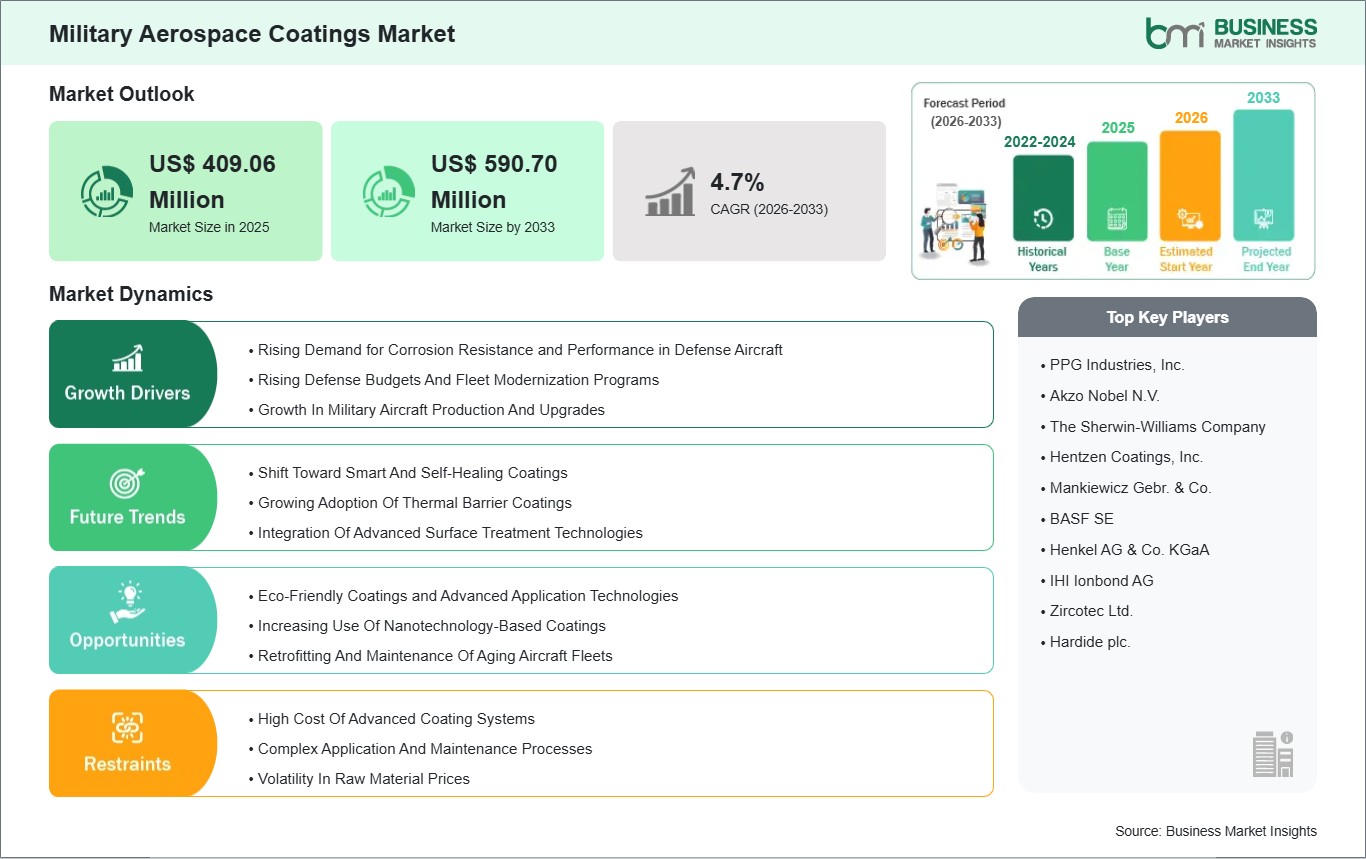
Military aerospace coatings refer to specialized surface treatments engineered to protect defense aircraft, missiles, and unmanned aerial vehicles from extreme operational environments and detection. Beyond conventional corrosion resistance, these coatings deliver advanced functionalities such as infrared camouflage, radar absorption, and thermal protection for high-speed components. The market encompasses a diverse range of chemistries, including polyurethane topcoats and epoxy primers, all of which must comply with rigorous military specifications to ensure survivability and mission readiness of high-value defense assets. Market expansion is being propelled by the global surge in defense spending and fleet modernization programs, which require advanced coatings for next-generation stealth platforms as well as the refurbishment of aging aircraft.
However, several factors may restrain market progression. Stringent environmental regulations, particularly those targeting hexavalent chromium and volatile organic compounds, necessitate the development of complex, compliant alternatives that maintain performance standards. The industry also faces high capital intensity, as the specialized application of radar-absorbing materials and stealth finishes requires advanced robotic facilities and highly controlled environments, resulting in significant upfront costs. Additionally, lengthy and demanding certification cycles for new coating chemistries can delay the integration of innovative materials into active service. These challenges increase the total cost of ownership and demand deep technical expertise and strategic resource allocation.
Despite these hurdles, the market outlook remains favorable. Opportunities are emerging through the integration of nanotechnology and smart materials, enabling the development of self-healing coatings and surfaces with enhanced electrical conductivity for lightning strike protection. The expansion of maintenance, repair, and overhaul (MRO) activities for global military fleets ensures recurring demand for coating applications to preserve structural integrity and low-observable characteristics. Furthermore, the growth of chrome-free and water-borne coating systems aligns with institutional sustainability mandates and reduces health risks associated with hazardous formulations. Advanced techniques such as ceramic-based thermal barriers and multi-spectral camouflage are also expanding capabilities, allowing defense forces to operate more effectively in contested environments. Collectively, these innovations position the military aerospace coatings industry for sustained long-term development and strategic importance.
Segment Analysis
Military Aerospace Coatings Market Segmentation
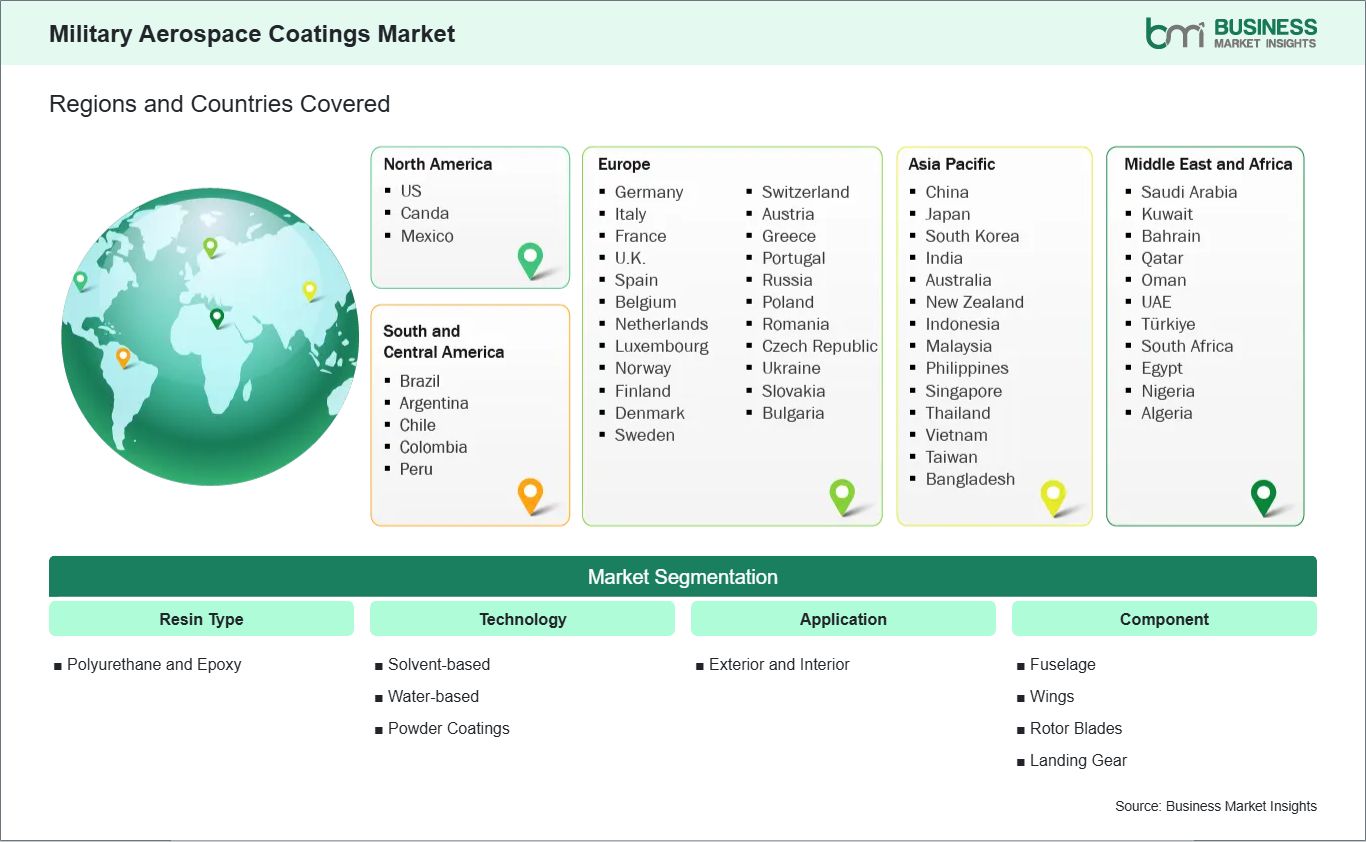
Key segments that contributed to the derivation of the Military Aerospace Coatings market analysis are resin type, technology, application, and component.
- By Resin Type, the market is segmented into Polyurethane and Epoxy.
- By Technology, the market is divided into Solvent-based, Water-based, and Powder Coatings.
- By Application, the market is categorized into Exterior and Interior.
- By Component, the market is segmented into Fuselage, Wings, Rotor Blades, and Landing Gear.
Market Forces
Military Aerospace Coatings Market Drivers and Opportunities
Rising Demand for Corrosion Resistance and Performance in Defense Aircraft
The military aerospace coatings market continues to expand as defense organizations seek advanced protective solutions that enhance durability, safety, and operational efficiency across a wide range of aircraft. Fighter jets, helicopters, and unmanned aerial vehicles are routinely exposed to extreme conditions, including rapid temperature shifts, mechanical stress, and corrosive environments. To address these challenges, polyurethane and epoxy coatings are widely applied, offering strong corrosion resistance, improved adhesion, and longer component lifespans. Beyond protection, coatings play a strategic role in stealth technology, with radar-absorbing materials helping reduce detection and strengthen mission effectiveness. Global modernization programs are accelerating adoption, supported by significant government investments in fleet upgrades and next-generation platforms. At the same time, strict military standards around performance, safety, and sustainability are driving continuous innovation in coating formulations. Taken together, the demand for corrosion resistance, stealth capabilities, and modernization initiatives is fueling steady, long-term growth in the global military aerospace coatings market.
Eco-Friendly Coatings and Advanced Application Technologies
A significant opportunity in the military aerospace coatings market lies in the development of eco-friendly formulations, advanced application methods, and expansion into emerging defense markets. With increasing regulatory pressure to reduce volatile organic compounds (VOCs) and environmental impact, manufacturers are focusing on water-based and powder coatings that deliver high performance while meeting sustainability goals. The adoption of nanotechnology and smart coatings is creating new pathways, enabling self-healing surfaces, enhanced thermal resistance, and improved camouflage capabilities. Advanced application technologies, including automated spraying and robotic systems, are improving efficiency, reducing waste, and ensuring uniform quality across complex aircraft structures. Beyond technological innovation, emerging regions such as Asia-Pacific and the Middle East present lucrative prospects due to rising defense budgets, modernization initiatives, and growing demand for indigenous aerospace capabilities. Vendors who prioritize eco-friendly solutions, advanced technologies, and regional partnerships are well-positioned to capture new market segments. The convergence of sustainability, innovation, and geographic expansion underscores a transformative growth trajectory for the global military aerospace coatings market.
Size and Share Analysis
Military Aerospace Coatings Market Size and Share Analysis
Based on resin type, the Polyurethane subsegment holds the primary market presence. These resins are indispensable due to their exceptional UV stability, gloss retention, and flexibility, making them critical for applications exposed to varied thermal cycles such as high-altitude flight. Their durability and performance under extreme conditions have positioned polyurethane as a foundational material in advanced coatings and aerospace systems. Alongside this, the Epoxy subsegment is registering steady growth, becoming essential for Base-Layer Corrosion Inhibition. With superior adhesion and chemical resistance, epoxy resins play a strategic role in protecting structural substrates from harsh maritime and desert environments. Together, these resin technologies highlight the evolving balance between surface protection, environmental resilience, and structural integrity, reinforcing their importance in industries where reliability and long-term performance are paramount.
Report Coverage
Military Aerospace Coatings Market Report Coverage and Deliverables
The "Military Aerospace Coatings Market Size and Forecast (2022 - 2033)" report provides a detailed analysis of the market covering below areas:
- Market size and forecast at global, regional, and country levels for all market segments covered under the scope
- Market trends, as well as drivers, restraints, and opportunities
- Market analysis covering key trends, global and regional framework, major players, and recent developments
- Market concentration, heat map analysis, prominent players, and recent developments
- Detailed company profiles, including SWOT analysis
Geographic Insights
Military Aerospace Coatings Market Geographic Insights
The geographical scope of the Military Aerospace Coatings market report is divided into five regions: North America, Asia Pacific, Europe, Middle East & Africa, and South & Central America.
North America maintains the most substantial market share, driven by its expansive defense budget and the presence of dominant aerospace manufacturers. Asia Pacific is identified as the most rapidly expanding region, propelled by aggressive military modernization programs and a shift toward domestic production in major emerging economies. Europe serves as a strategic center for high-performance and environmentally compliant coatings, while the Middle East & Africa and South & Central America are witnessing growth through the acquisition of advanced aircraft fleets and the expansion of regional maintenance and repair capabilities.
The Asia-Pacific Military Aerospace Coatings Market is the primary driver of global industry expansion, anchored by significant defense expenditures in China, India, and Japan. These nations are prioritizing the development of Next-Generation Combat Aircraft and Unmanned Aerial Vehicles (UAVs), which require specialized coatings for stealth, thermal protection, and radar absorbency. China remains a dominant force, supported by a robust internal supply chain and a focus on self-reliance in military technology. India is witnessing a notable transition, marked by the "Make in India" initiative, which encourages global coating manufacturers to establish local production facilities to support the domestic assembly of fighter jets and helicopters.
Industry Activity
Recent Developments
The Military Aerospace Coatings market is evaluated by gathering qualitative and quantitative data post primary and secondary research, which includes important corporate publications, association data, and databases. A few of the key developments in the Military Aerospace Coatings market are:
- In November 2025, Valence Surface Technologies announced the acquisition of Foresight Finishing to strengthen its aerospace and defense surface treatment capabilities. Foresight specializes in high-precision precious metal plating and surface finishing for mission-critical defense and aerospace electronics. The acquisition enhances Valence`s regional presence and reinforces consolidation and capacity expansion within the military aerospace coatings market.
- In October 2025, Allnex launched its European Defense Materials Program to accelerate innovation in high-performance resin and coating solutions for defense applications. The initiative focuses on high-speed curing technologies and advanced resin systems designed for stealth, corrosion protection, and extreme-environment resistance. The program strengthens Europe`s defense materials ecosystem and supports growing demand for advanced military aerospace coatings.
Trust & Transparency
Research Methodology
The market analysis combines proprietary research with secondary data from government agencies, company disclosures, regulatory filings, industry databases and expert interviews. Market estimates are validated through data triangulation, cross-market benchmarking and analyst
review.
View Full Research Methodology
Key Sources Referred:
World Bank & Global Trade IndicatorsWorld Trade Organization (WTO)(International Monetary Fund )IMFInternational Trade Administration (ITA)Company websiteCompany annual reportsCompany investor presentations