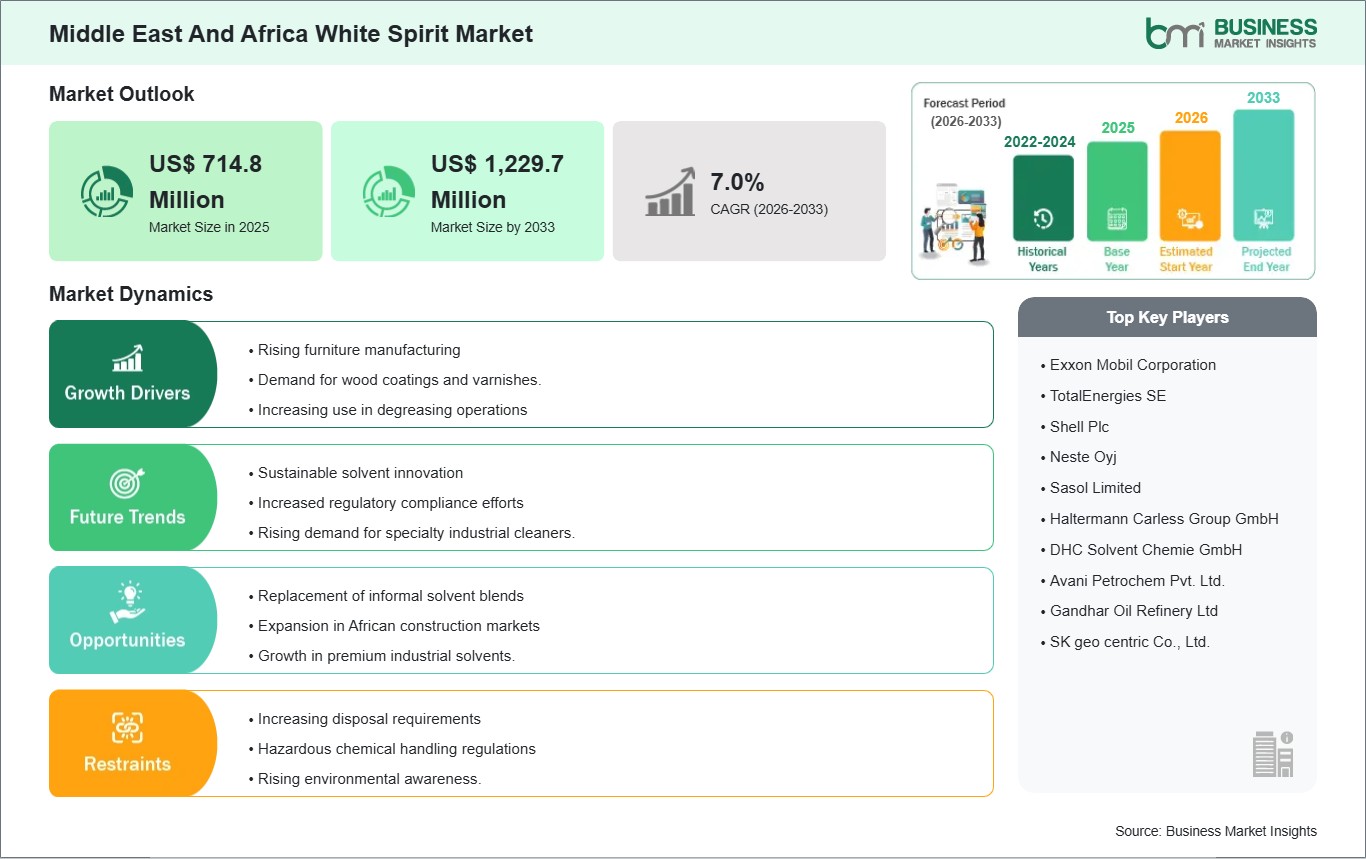
The Middle East and Africa white spirit market size is expected to reach US$ 1,229.7 million by 2033 from US$ 714.8 million in 2025. The market is estimated to record a CAGR of 7.0% from 2026 to 2033.
The Middle East and Africa white spirit market is influenced by a combination of oil-driven industrial economies, expanding construction activity, and growing downstream manufacturing sectors. White spirit remains an important industrial solvent across paints and coatings, petrochemical processing support activities, metal surface treatment, construction maintenance, and equipment cleaning applications. The region exhibits a dual structure: highly developed Gulf economies with advanced industrial and infrastructure ecosystems, and emerging African markets where demand is closely tied to urban development, basic manufacturing growth, and infrastructure expansion.
A key driver of the market is large-scale construction and infrastructure development, particularly in the Gulf Cooperation Council countries, where continuous investment in commercial real estate, transportation infrastructure, hospitality, and urban megaprojects supports strong consumption of coatings and maintenance chemicals. Additionally, the region's oil and gas sector contributes to solvent demand through equipment cleaning, refinery maintenance, and corrosion protection applications. Industrial diversification strategies across several economies are also expanding the use of white spirit in manufacturing and chemical processing activities.
However, the market is constrained by increasing regulatory attention toward volatile organic compounds and a gradual shift toward alternative low-emission solvents in more environmentally regulated segments. In parts of Africa, inconsistent supply chains and limited local production capacity also impact availability and pricing stability. Despite these constraints, white spirit continues to be widely used due to its strong solvency properties, cost efficiency, and compatibility with established industrial maintenance systems across diverse operating environments.

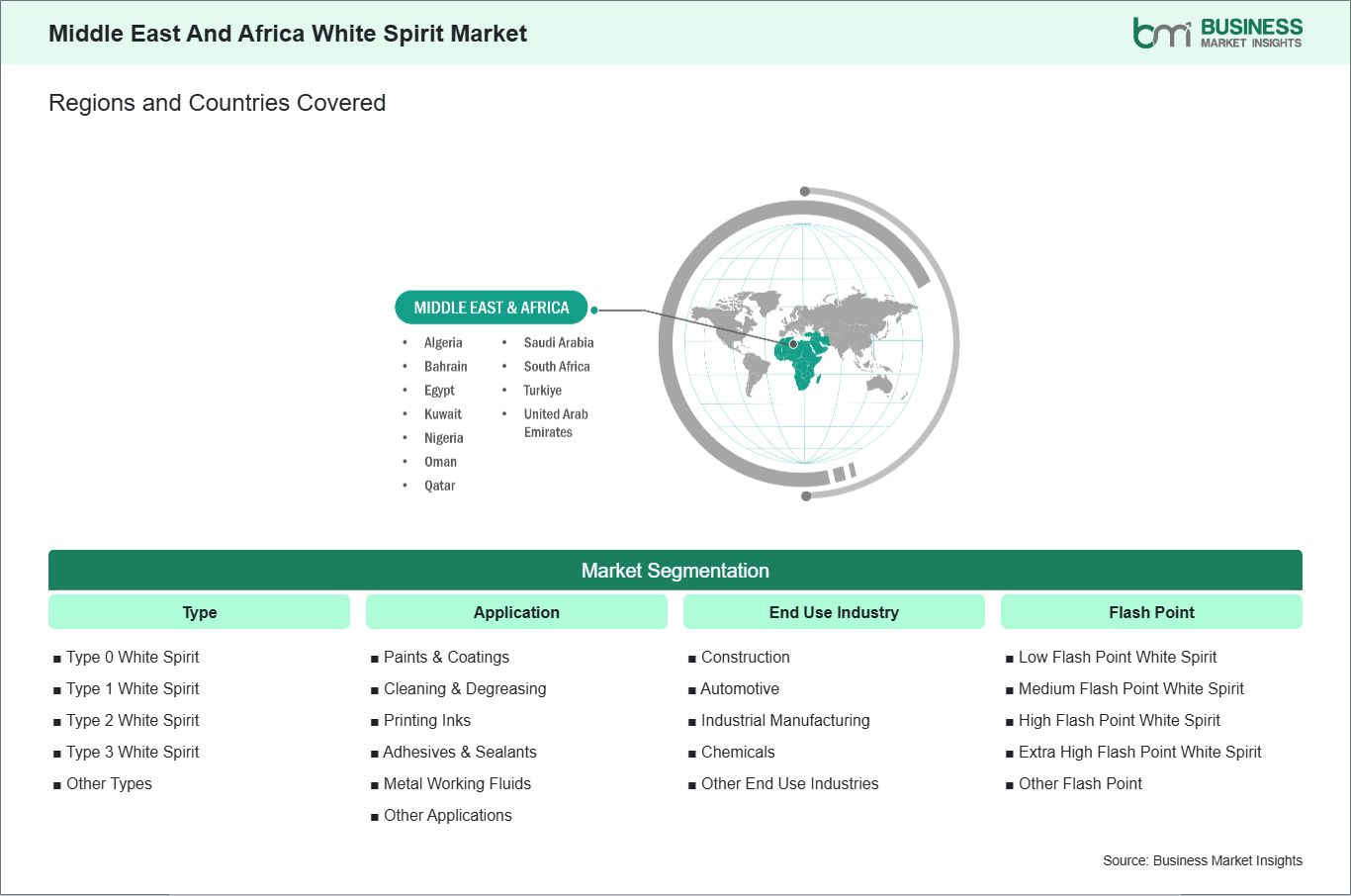
Key segments that contributed to the derivation of the Middle East and Africa white spirit market analysis are type, application, end use industry, and flashpoint.
Rising furniture manufacturing activity is a key driver supporting the white spirit market in the Middle East and Africa. Solvent is extensively used in processes such as wood finishing, surface coating, dilution of varnishes, and cleaning operations in furniture production. With an increase in the need for interior decorating goods in residential and commercial areas, there has been a steady rise in furniture manufacturing.
In Turkey, Egypt, and the United Arab Emirates, furniture production has become more organized and export-oriented, with manufacturers supplying both domestic and international markets. White spirit has extensive use in wood staining and polishing for attaining smooth finishing and improving product durability. In North African countries like Morocco and Egypt, there has been an increase in residential constructions, along with hospitality industry growth, which has resulted in increased furniture manufacturing.
In Sub-Saharan Africa, countries like Nigeria and Kenya are witnessing gradual growth in small and medium-scale furniture workshops that cater to rising urban housing demand. Workshops depend a lot on solvent-based paints because they are cost-effective and easy to apply. The white spirit is often employed when preparing surfaces and cleaning the wooden products before the final application of paint. Due to an increasing production of furniture on different scales of manufacture, there is a direct relationship between the consumption of white spirit and wood finishing.
The replacement of informal solvent blends with standardized white spirit formulations presents a strong opportunity in the Middle East and Africa. In several countries within the region, unregulated or blended solvents continue to be used for painting, cleaning, and maintenance purposes. But there is an increasing emphasis on product safety and quality control that is gradually shifting focus toward more refined white spirits.
In South Africa, stricter industrial safety standards are encouraging manufacturers and contractors to move away from low-quality solvent mixtures toward certified white spirit grades that offer predictable performance and reduced health risks. Similarly, the construction and maintenance industry in GCC countries like Saudi Arabia and UAE is being driven towards using standard chemical ingredients due to industrial modernization and regulation enforcement.
In East African markets such as Kenya and Tanzania, infrastructure development and growth in formal construction services are increasing demand for reliable and safe chemical products. Contractors and painters are shifting towards the use of branded white spirit solutions in place of locally manufactured solutions due to better finishing capabilities and improved safety conditions. The change from unorganized solvent use to organized one is likely to drive growth for major players in the white spirit market in the Middle East and Africa.
The Middle East and Africa white spirit market is experiencing steady growth, with market size and share analysis reflecting evolving treatment preferences and competitive dynamics among key players. The report evaluates important subsegments categorized within market type, application, end use industry, and flashpoint, highlighting their respective contributions to overall market performance.
By the type, the type 2 white spirit subsegment dominated the market in 2025, owing to its balanced solvency characteristics, moderate evaporation rate, and broad compatibility with industrial coatings and cleaning applications. Its ability to deliver effective thinning performance while complying with quality and safety requirements makes it the preferred choice among manufacturers.
Based on applications, the paint & coating subsegment dominated the market in 2025 due to the critical role of white spirit as a solvent in the formulation and application of paints, enamels, primers, and protective coatings. Its ability to improve coating consistency, facilitate smooth application, and assist in equipment cleaning has made it an essential component in the coatings industry.
On the basis of end use industry, the construction subsegment dominated the market in 2025, driven by increasing residential, commercial, and infrastructure development projects worldwide. White spirit is widely used in construction-related paints, varnishes, coatings, and maintenance products, supporting surface preparation and finishing activities.
In terms of flash points, the medium flash points white spirit subsegment dominated the market in 2025, due to its optimal balance between safety, performance, and evaporation characteristics. It offers effective solvency power for paints, coatings, and industrial cleaning applications while providing lower handling risks compared to low flash point grades.
| Report Attribute | Details |
|---|---|
| Market size in 2025 | US$ 714.8 Million |
| Market Size by 2033 | US$ 1,229.7 Million |
| CAGR (2026 - 2033) | 7.0% |
| Historical Data | 2022-2024 |
| Forecast period | 2026-2033 |
| Segments Covered | By Type
|
|
Regions and Countries Covered
| |
| Middle East and Africa | Saudi Arabia, United Arab Emirates, Kuwait, Bahrain, Qatar, Oman, Turkiye, South Africa, Egypt, Nigeria, Algeria |
| Market leaders and key company profiles |
|
The "Middle East and Africa White Spirit Market Size and Forecast (2022-2033)" report provides a detailed analysis of the market covering below areas:
The geographical scope of the Middle East and Africa White spirit market report is divided into: Saudi Arabia, the United Arab Emirates, Kuwait, Bahrain, Qatar, Oman, Turkey, South Africa, Egypt, Nigeria, Algeria, and the Rest of MEA. Turkiye held the largest share in 2025.
Turkiye plays a strategically distinct role within the Middle East and Africa white spirit market due to its hybrid positioning between Europe and Asia, as well as its diversified industrial base. Unlike many regional peers, Turkiye has a well-developed manufacturing ecosystem that includes automotive assembly, white goods production, textiles, construction materials, and industrial machinery. This diversified structure creates consistent and multi-sectoral demand for white spirit, particularly in cleaning, degreasing, surface preparation, and coating-related applications. A significant portion of industrial production is integrated into European supply chains, which drives compliance-driven usage of solvents aligned with international quality and environmental standards. This has encouraged a gradual shift toward more refined white spirit grades and improved handling practices, especially within automotive and appliance manufacturing clusters. Additionally, Turkiye's robust construction sector, driven by urban development and infrastructure modernization, sustains steady demand for architectural coatings and maintenance chemicals. Turkiye further is its relatively mature distribution and chemical supply chain infrastructure compared to neighboring regions. This enables more stable product availability and better integration with international suppliers. As environmental regulations tighten across export markets, Turkiye is increasingly positioned as a compliance-sensitive manufacturing hub, influencing solvent selection trends more strongly than many other Middle Eastern and African economies.

The Middle East and Africa white spirit market is evaluated by gathering qualitative and quantitative data post primary and secondary research, which includes important corporate publications, association data, and databases. A few of the key developments in the Middle East and Africa white spirit market are:
The Middle East And Africa White Spirit Market is valued at US$ 714.8 Million in 2025, it is projected to reach US$ 1,229.7 Million by 2033.
As per our report Middle East And Africa White Spirit Market, the market size is valued at US$ 714.8 Million in 2025, projecting it to reach US$ 1,229.7 Million by 2033. This translates to a CAGR of approximately 7.0% during the forecast period.
The Middle East And Africa White Spirit Market report typically cover these key segments-
The historic period, base year, and forecast period can vary slightly depending on the specific market research report. However, for the Middle East And Africa White Spirit Market report:
The Middle East And Africa White Spirit Market is populated by several key players, each contributing to its growth and innovation. Some of the major players include:
The Middle East And Africa White Spirit Market report is valuable for diverse stakeholders, including:
Essentially, anyone involved in or considering involvement in the Middle East And Africa White Spirit Market value chain can benefit from the information contained in a comprehensive market report.
Please tell us your area of interest
(Market Segments/ Regions and Countries/ Companies)