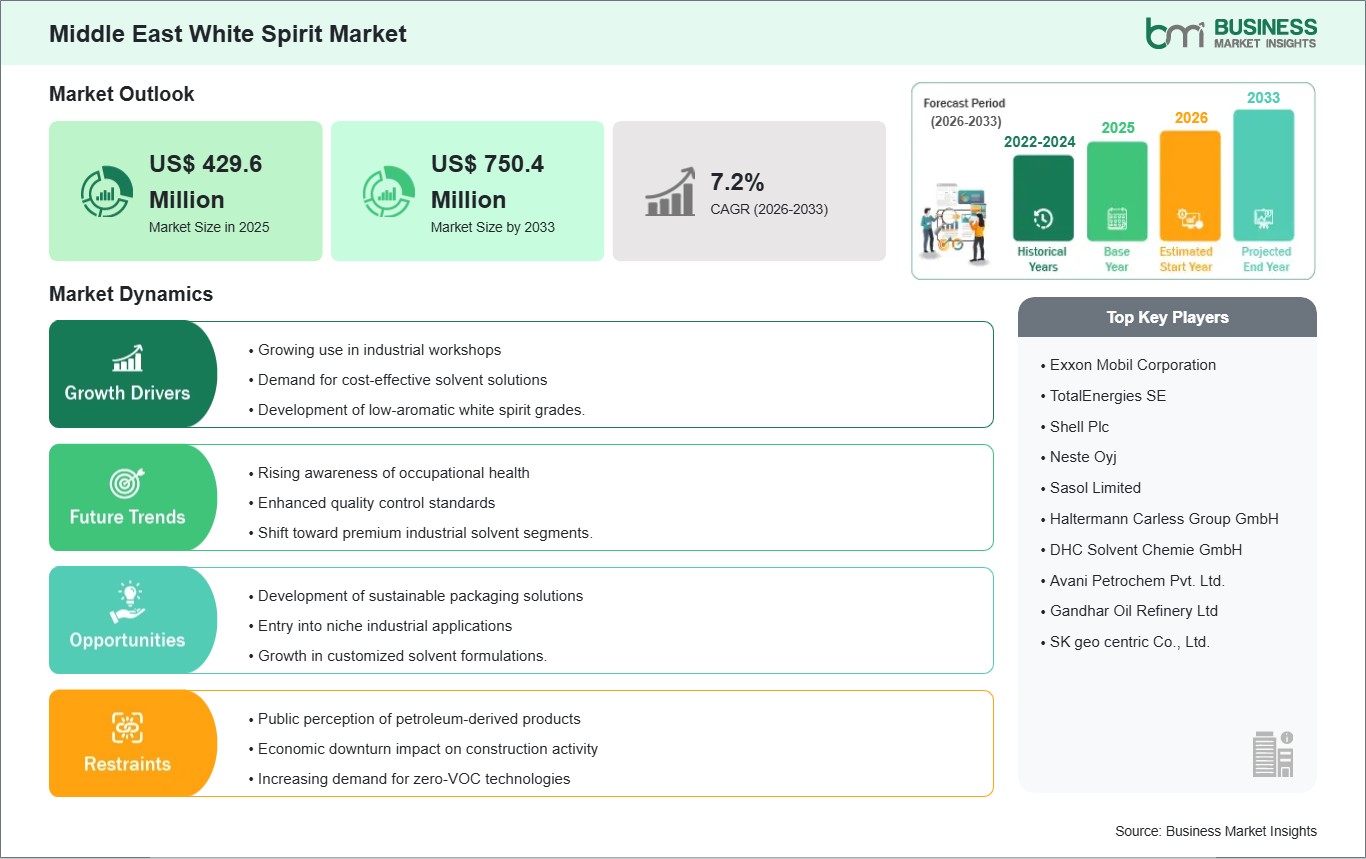
The Middle East white spirit market size is expected to reach US$ 750.4 million by 2033 from US$ 429.6 million in 2025. The market is estimated to record a CAGR of 7.2% from 2026 to 2033.
The Middle East white spirit market is shaped by the region's strong reliance on construction activity, industrial maintenance cycles, and the steady expansion of downstream petrochemical applications. White spirit continues to play a critical role as a solvent in paints, coatings, adhesives, and metal cleaning formulations, particularly in infrastructure development and refurbishment projects that are common across both urbanizing Gulf economies and industrial corridors in non-GCC countries. Demand is closely tied to construction coatings consumption, where architectural paints and protective coatings for steel structures remain key end-use areas.
One of the primary drivers in the region is the sustained investment in infrastructure diversification projects, including residential expansion, commercial real estate development, and transport-linked industrial zones. Additionally, the growing automotive refinishing sector and equipment maintenance requirements in oil & gas facilities support consistent solvent consumption. The availability of feedstock from regional refining and petrochemical complexes also strengthens supply-side stability, enabling manufacturers to serve both domestic and export-oriented solvent markets.
However, the market faces restraint from increasing environmental scrutiny and a gradual shift toward low-VOC and alternative bio-based solvents. Regulatory alignment with global sustainability standards is slowly influencing formulation changes in coatings and industrial cleaning products. In addition, volatility in downstream construction cycles can temporarily affect solvent demand patterns. Despite these constraints, white spirit remains widely used due to its cost efficiency, compatibility with traditional formulations, and entrenched use across legacy industrial systems in the region.

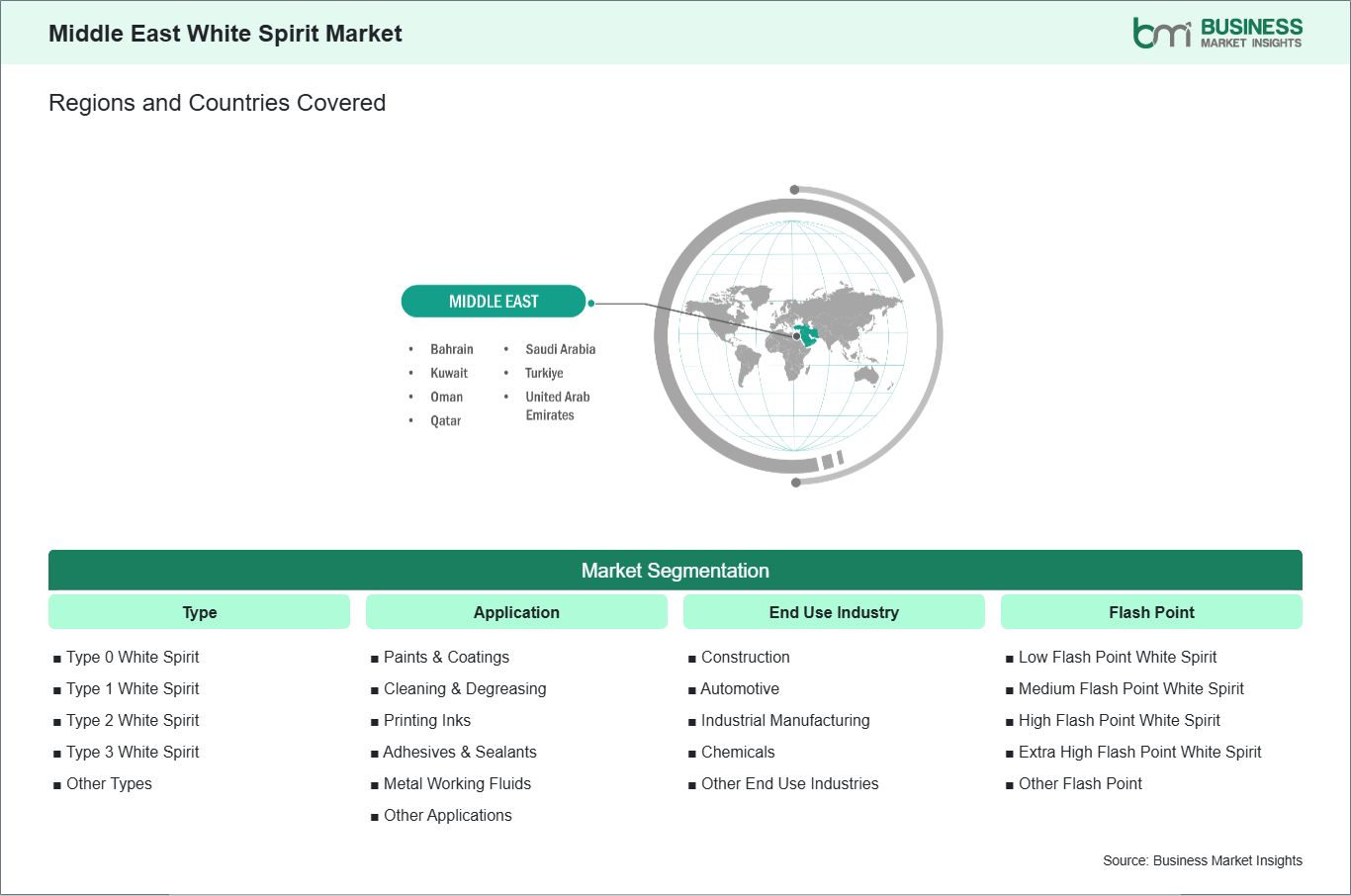
Key segments that contributed to the derivation of the Middle East white spirit market analysis are type, application, end use industry, and flashpoint.
The Middle East white spirit market is being positively influenced by the expanding use of industrial workshops across construction, automotive repair, metal fabrication, and equipment maintenance activities. As urban development and infrastructure projects continue across the region, there is a parallel increase in small and medium-scale workshops that support fabrication, finishing, and maintenance services. White spirit is widely used in these settings for degreasing metal parts, cleaning tools, and preparing surfaces prior to painting or coating applications.
In countries such as Saudi Arabia and the United Arab Emirates, the growth of construction-related services has led to a rise in contractor workshops that handle steel structures, pipelines, and mechanical components. These workshops use solvents in order to guarantee the quality of surfaces prior to the application of any coating. White spirit is used in preference to others because of its efficiency in the removal of any oil and other substances from the surface.
Additionally, the automotive repair and maintenance sector contributes significantly to white spirit consumption in the region. The workshops carrying out the services of vehicle maintenance, repair, and cleaning of components use solvent-based products for maintenance purposes. With the rising number of vehicles and commercial fleets, demand for work-shop supplies like white spirit will be stable, driving the growth of the market in the Middle East region.
The development of sustainable packaging solutions presents an emerging opportunity within the Middle East white spirit market, as environmental awareness and regulatory focus on waste reduction continue to grow. Industrial users and distributors are increasingly seeking packaging formats that reduce environmental impact, improve safety, and enhance efficiency in handling and transportation of chemical products such as white spirit.
Manufacturers are exploring alternatives to traditional packaging materials by adopting recyclable, reusable, and lightweight container designs. These innovations will be helpful in reducing wastage and improving logistics efficiency, especially in industrial supply chains where there is extensive use of solvents. Besides, advancements in packaging technology have made it easier and safe to store solvents, while also preventing any risks of leakage, evaporation, or contamination.
Government-led sustainability initiatives across the Middle East are also encouraging industries to adopt environmentally responsible practices, including improvements in chemical packaging and waste management systems. As industrial sectors continue to diversify and modernize, demand for sustainable packaging solutions is expected to grow, creating opportunities for packaging innovation providers and white spirit suppliers to align with evolving environmental and operational standards in the region.

The Middle East white spirit market is experiencing steady growth, with market size and share analysis reflecting evolving treatment preferences and competitive dynamics among key players. The report evaluates important subsegments categorized within are type, application, end use industry, and flashpoint, highlighting their respective contributions to overall market performance.
By the type, the type 2 white spirit subsegment dominated the market in 2025, owing to its balanced solvency characteristics, moderate evaporation rate, and broad compatibility with industrial coatings and cleaning applications. Its ability to deliver effective thinning performance while complying with quality and safety requirements makes it the preferred choice among manufacturers.
Based on applications, the paint & coating subsegment dominated the market in 2025 due to the critical role of white spirit as a solvent in the formulation and application of paints, enamels, primers, and protective coatings. Its ability to improve coating consistency, facilitate smooth application, and assist in equipment cleaning has made it an essential component in the coatings industry.
On the basis of end use industry, the construction subsegment dominated the market in 2025, driven by increasing residential, commercial, and infrastructure development projects worldwide. White spirit is widely used in construction-related paints, varnishes, coatings, and maintenance products, supporting surface preparation and finishing activities.
In terms of flash points, the medium flash points white spirit subsegment dominated the market in 2025, due to its optimal balance between safety, performance, and evaporation characteristics. It offers effective solvency power for paints, coatings, and industrial cleaning applications while providing lower handling risks compared to low flash point grades.
| Report Attribute | Details |
|---|---|
| Market size in 2025 | US$ 429.6 Million |
| Market Size by 2033 | US$ 750.4 Million |
| CAGR (2026 - 2033) | 7.2% |
| Historical Data | 2022-2024 |
| Forecast period | 2026-2033 |
| Segments Covered | By Type
|
|
Regions and Countries Covered
| |
| Middle East | UAE, Saudi Arabia, Bahrain, Oman, Kuwait, Qatar, Turkiye |
| Market leaders and key company profiles |
|
The "Middle East White Spirit Market Size and Forecast (2022-2033)" report provides a detailed analysis of the market covering below areas:
The geographical scope of the Middle East white spirit market report is divided into: the UAE, Saudi Arabia, Bahrain, Oman, Kuwait, Qatar, and Turkiye. Turkiye held the largest share in 2025.
Turkiye emerges as the dominant market for white spirit consumption due to its diversified industrial base and strong coatings manufacturing ecosystem. The country's strategic position bridging Europe, the Middle East, and Central Asia allows it to function as both a production hub and a distribution gateway for solvent-based products. The domestic demand is strongly influenced by construction activity, particularly residential renovation, urban redevelopment initiatives, and large-scale infrastructure upgrades across major metropolitan areas. Turkiye's paint and coatings industry plays a central role in sustaining white spirit consumption, with solvent-based formulations still widely used in industrial coatings, protective paints, and decorative applications. The metalworking and machinery sectors further reinforce demand, as white spirit is commonly used in degreasing and surface preparation processes. Additionally, the automotive repair and refinishing segment contributes steady consumption due to the extensive vehicle parc and established aftermarket service network. Compared to neighboring Middle Eastern markets, Turkiye exhibits a more mature industrial ecosystem with higher formulation diversity, which supports consistent solvent utilization across multiple sectors. The presence of integrated petrochemical and refining capacity also ensures a relatively stable supply environment for solvent production and distribution. While environmental regulations are gradually tightening, the transition toward alternative solvents is progressing at a moderate pace, allowing white spirit to retain its relevance across industrial and construction-linked applications in the foreseeable future.

The Middle East White spirit market is evaluated by gathering qualitative and quantitative data post primary and secondary research, which includes important corporate publications, association data, and databases. A few of the key developments in the Middle East White spirit market are:
The Middle East White Spirit Market is valued at US$ 429.6 Million in 2025, it is projected to reach US$ 750.4 Million by 2033.
As per our report Middle East White Spirit Market, the market size is valued at US$ 429.6 Million in 2025, projecting it to reach US$ 750.4 Million by 2033. This translates to a CAGR of approximately 7.2% during the forecast period.
The Middle East White Spirit Market report typically cover these key segments-
The historic period, base year, and forecast period can vary slightly depending on the specific market research report. However, for the Middle East White Spirit Market report:
The Middle East White Spirit Market is populated by several key players, each contributing to its growth and innovation. Some of the major players include:
The Middle East White Spirit Market report is valuable for diverse stakeholders, including:
Essentially, anyone involved in or considering involvement in the Middle East White Spirit Market value chain can benefit from the information contained in a comprehensive market report.
Please tell us your area of interest
(Market Segments/ Regions and Countries/ Companies)