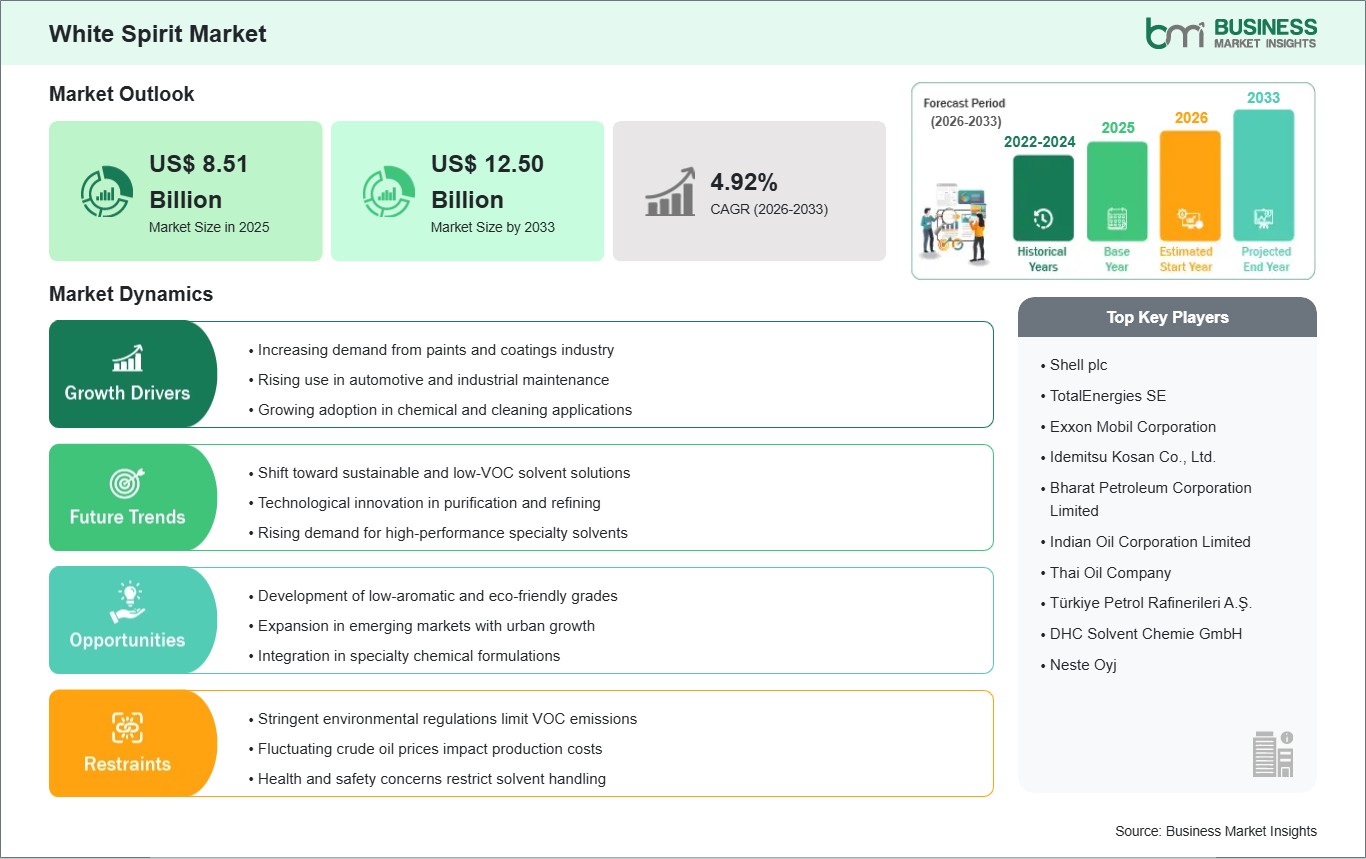
The White Spirit Market size is expected to reach US$ 12.5 billion by 2033 from US$ 8.51 billion in 2025. The market is estimated to record a CAGR of 4.92% from 2026 to 2033.
The global market for White Spirit exists because a highly adaptable petroleum-based solvent serves both industrial and commercial needs. White spirit, which exists as a transparent and combustible hydrocarbon solvent, serves its main purpose as a paint thinner, as a degreasing agent and as a solvent carrier that researchers use for coatings, adhesives and chemical products. Its global significance stems from its balance of solvent power, evaporation rate, and compatibility with various resins and oils, which makes it essential in the paints and coatings industry, the automotive sector and construction industry and the industrial maintenance field. The global market experiences its primary growth drivers through ongoing construction and infrastructure development, which creates an ongoing need for solvent-based paints and coatings in urbanizing areas. White spirit maintains its position as the primary cleaning, degreasing and chemical processing solvent used by industrial maintenance and manufacturing operations. The chemical industry uses it as a carrier in chemical formulations because it serves as a preferred solvent in producing adhesives, varnishes and specialty chemicals.
The market experiences significant restrictions because of its current limitations. The development of regulatory controls in developed countries has occurred because of environmental and occupational safety issues that arise from volatile organic compound (VOC) emissions. The market for white spirit now experiences a gradual change because users adopt low-VOC and water-based solvents as alternatives to traditional white spirit products. The availability and pricing of crude oil directly impact production expenses while establishing supply chain difficulties that manufacturers must navigate. The industrial sector continues to depend on white spirit as a core solvent because it provides reliable performance and multiple applications, and has a complete system for production and distribution.

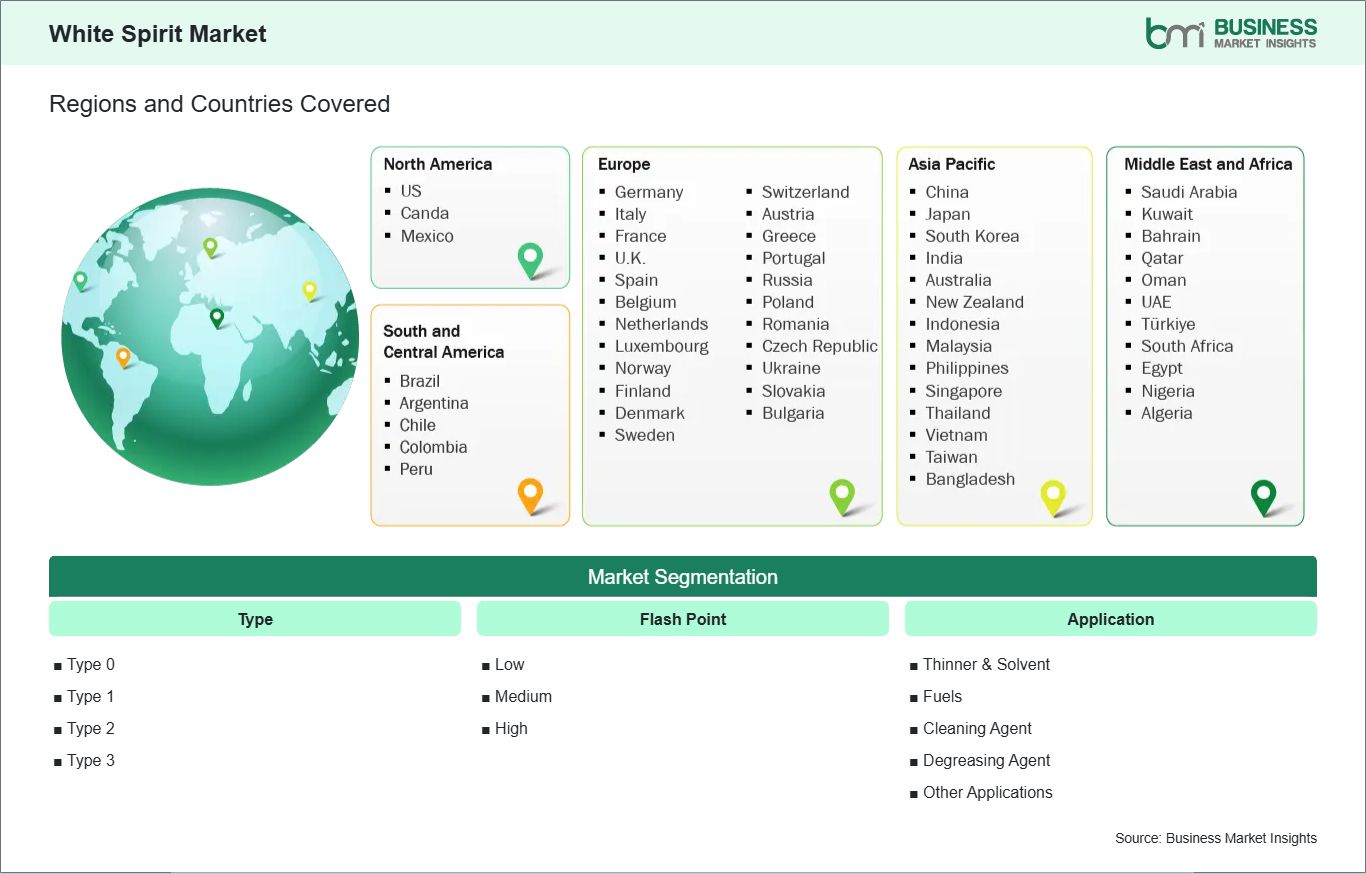
Key segments that contributed to the derivation of the white spirit market analysis are type, flash point and application.
The global White Spirit market exists because the paints and coatings industry requires White Spirit for its operations. The industrial and decorative coatings use White spirit as their main solvent and thinner, which maintains constant viscosity while enabling easy application and proper material drying. The product has become the preferred option because it meets the finishing requirements that all developed and emerging markets demand for construction work, automotive production and furniture manufacturing. The North American and European regions have developed construction and renovation markets that still use traditional solvent-based paints that create constant demand for white spirit.
The Asia Pacific region has experienced increased demand for solvent-based coatings because of its growing urban areas and industrial development, especially in China, India and Southeast Asia. The growing residential and commercial infrastructure has driven paint and varnish and coating consumption which has created a strong demand for white spirit. The industrial coatings market in Latin America, the Middle East and Africa has grown to support manufacturing plant operations, machine maintenance and facility construction activities.
The demand exists because consumers want high-performance finishes and professional-grade paints, which become impossible to achieve with water-based alternatives in specific situations. The market share of traditional white spirit remains strong because it provides effective solutions and safe operations, and maintains an established supply chain network despite the rising popularity of environmentally friendly products. The paints and coatings sector serves as the primary market for white spirit usage throughout the world.
A key global opportunity in the White Spirit market lies in the development and adoption of low-aromatic and eco-friendly grades. Rising environmental awareness, stricter occupational safety standards, and VOC emission regulations have prompted manufacturers to refine production processes and offer products that reduce harmful exposure. Low-aromatic white spirit minimizes health risks while maintaining performance, enabling its continued use in paints, coatings, and industrial cleaning applications across regulated markets such as Europe and North America.
Emerging economies present additional opportunities for eco-friendly grades. In Asia Pacific, Latin America, and parts of the Middle East, rapid industrialization and construction growth are paired with increasing adoption of environmentally responsible practices. Manufacturers introducing low-aromatic and bio-based solvent alternatives can capture new segments, particularly among industrial clients seeking compliance with evolving regulations and sustainability goals.
Furthermore, innovation in purification technology allows the creation of high-purity white spirit grades suitable for specialty chemicals and adhesive formulations, expanding its applicability. By aligning product development with environmental and health-conscious trends, the global white spirit market can simultaneously address regulatory demands, attract sustainability-focused customers, and maintain its relevance in both mature and emerging markets worldwide.
The white spirit market demonstrates steady growth, with size and share analysis highlighting evolving trends and competitive dynamics among key players. The report examines subsegments categorized within type, flash point and application, offering insights into their contribution to overall market performance.
By type, the type 2 subsegment dominated the market in 2025, driven by its balanced solvency power, moderate evaporation rate, and wide usage in paints and coatings.
Based on flash point, the high subsegment dominated the market in 2025, driven by increasing preference for safer solvents with lower volatility and reduced fire hazards.
In terms of application, the thinner & solvent subsegment dominated the market in 2025, driven by extensive demand from the paints and coatings industry for dilution and viscosity control.
| Report Attribute | Details |
|---|---|
| Market size in 2025 | US$ 8.51 Billion |
| Market Size by 2033 | US$ 12.50 Billion |
| Global CAGR (2026 - 2033) | 4.92% |
| Historical Data | 2022-2024 |
| Forecast period | 2026-2033 |
| Segments Covered | By Type
|
|
Regions and Countries Covered
| |
| North America | US, Canada, Mexico |
| Europe | Belgium, Austria, Finland, Denmark, Greece, Poland, Romania, Russia, Ukraine, Czech Republic, Slovakia, Bulgaria, Italy, Luxembourg, Germany, Switzerland, France, Netherlands, Norway, Portugal, Spain, Sweden, United Kingdom |
| Asia-Pacific | Australia, China, India, Japan, South Korea, Indonesia, Malaysia, Philippines, Singapore, Thailand, Vietnam, Bangladesh, New Zealand, Taiwan |
| South and Central America | Brazil, Argentina, Peru, Chile, Colombia |
| Middle East and Africa | Bahrain, Kuwait, Oman, Qatar, Saudi Arabia, United Arab Emirates, Turkiye, South Africa, Egypt, Algeria, Nigeria |
| Market leaders and key company profiles |
|
The "White Spirit Market Size and Forecast (2022 - 2033)" report provides a detailed analysis of the market covering below areas:
The geographical scope of the White Spirit Market report is divided into North America, Asia Pacific, Europe, Middle East & Africa, and South & Central America. North America held the largest share in 2025.
North America stands as the leading region in the global white spirit market because of its established industrial infrastructure, together with its technological construction and automotive industries and its strict regulations, which require high-quality low-aromatic solvent products.
The United States and Canada depend on white spirit to meet their needs for paints and coatings, industrial cleaning and degreasing because these applications require dependable, consistent and safe performance. The manufacturers in this area focus on achieving product purity while following the required regulations, which leads to the development of new solvent products that meet both occupational safety requirements and environmental protection standards, which allows North America to shape worldwide consumption patterns.
Europe represents a sophisticated market characterized by stringent environmental regulations and a focus on sustainability, pushing the industry toward low-VOC and environmentally friendly white spirit alternatives. Germany, France and the U.K. continue to use industrial solvents for their traditional applications in paints and coatings and chemical processing, but they now mix these applications with the growing use of water-based and bio-based solutions.
The Asia Pacific market experiences rapid growth because of urbanization, industrialization and construction development in China, India and Southeast Asian nations. The region requires white spirit primarily for residential and commercial construction and industrial maintenance purposes, while its regulatory system still develops at a slower pace than in North America and Europe. The market here offers both inexpensive and specialized product lines, which serve various industrial requirements in both developing and established business sectors.
The Middle East & Africa region primarily consumes white spirit in industrial cleaning, oilfield operations, and construction activities, with markets in the UAE, Saudi Arabia, and South Africa showing consistent demand. The assessment of supply chain operations, energy sector developments and infrastructure construction activities establishes their critical importance, while environmental regulations exhibit lower importance. South & Central America use white spirit mainly for construction work, automotive repair and industrial activities, with Brazil and Mexico serving as the main markets.
The regional market expands through urbanization efforts, industrial upgrades and stricter regulatory measures, even though companies still select traditional solvents. North America maintains its position as the leading region for product development and manufacturing excellence and compliance with regulations, while other regions showcase different patterns of technology adoption, which result from their industrial growth and construction market needs and environmental needs, which collectively determine the international white spirit market trends.

The White Spirit Market is evaluated by gathering qualitative and quantitative data post primary and secondary research, which includes important corporate publications, association data, and databases. A few of the key developments in the white spirit market are:
The White Spirit Market is valued at US$ 8.51 Billion in 2025, it is projected to reach US$ 12.50 Billion by 2033.
As per our report White Spirit Market, the market size is valued at US$ 8.51 Billion in 2025, projecting it to reach US$ 12.50 Billion by 2033. This translates to a CAGR of approximately 4.92% during the forecast period.
The White Spirit Market report typically cover these key segments-
The historic period, base year, and forecast period can vary slightly depending on the specific market research report. However, for the White Spirit Market report:
The White Spirit Market is populated by several key players, each contributing to its growth and innovation. Some of the major players include:
The White Spirit Market report is valuable for diverse stakeholders, including:
Essentially, anyone involved in or considering involvement in the White Spirit Market value chain can benefit from the information contained in a comprehensive market report.
Please tell us your area of interest
(Market Segments/ Regions and Countries/ Companies)