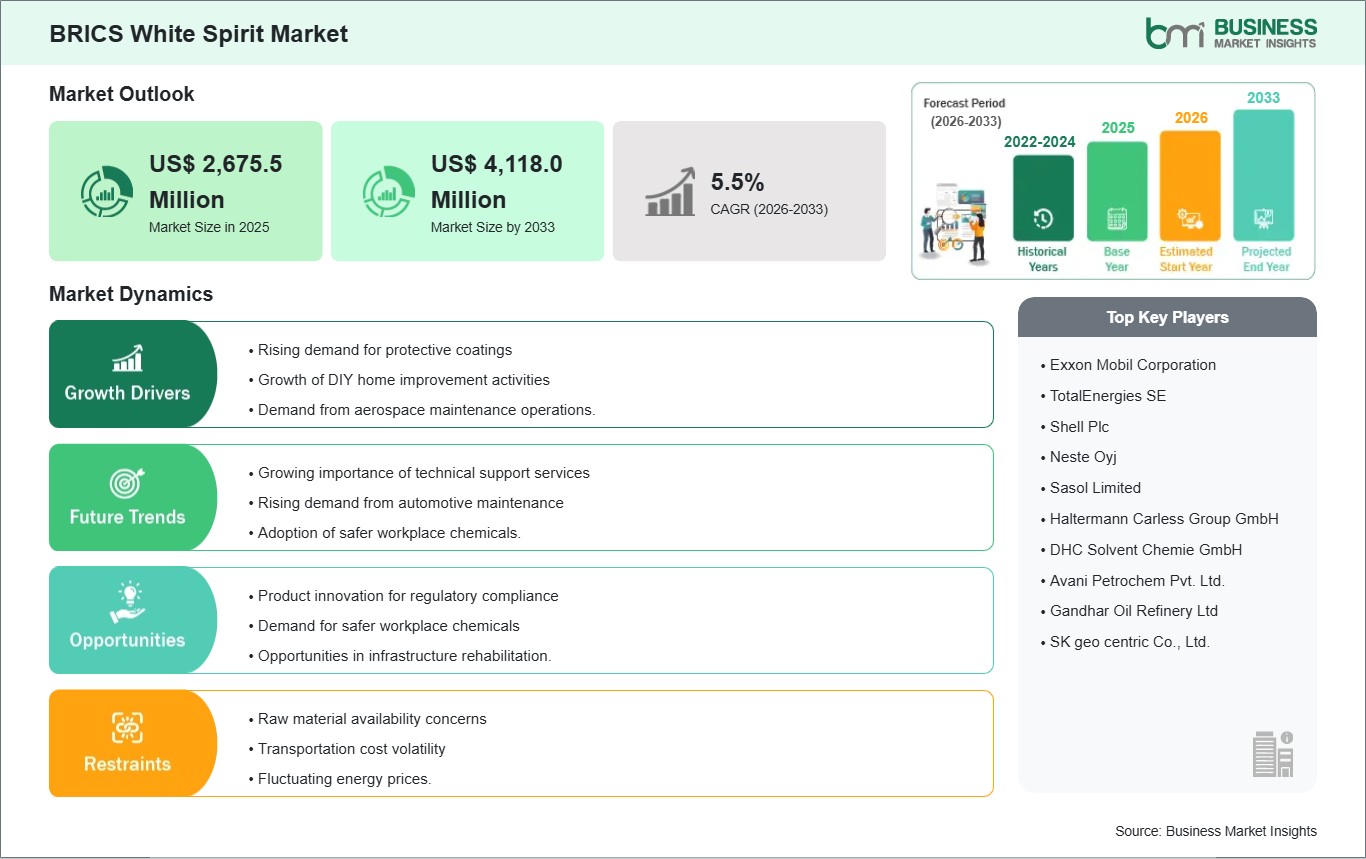
The BRICS white spirit market size is expected to reach US$ 4,118.0 million by 2033 from US$ 2,675.5 million in 2025. The market is estimated to record a CAGR of 5.5% from 2026 to 2033.
The white spirit market across the BRICS grouping is strongly shaped by large-scale industrialization, expanding infrastructure development, and the continued dominance of solvent-based applications in manufacturing and maintenance activities. White spirit remains a widely used hydrocarbon solvent across paints and coatings, metal processing, construction chemicals, machinery cleaning, and general industrial degreasing. Its continued relevance in BRICS economies is driven by its cost efficiency, broad functional applicability, and deep integration into legacy industrial systems that still rely heavily on solvent-based formulations.
Across the grouping, demand is primarily anchored in heavy industries, construction activity, automotive production, and large manufacturing ecosystems. Rapid urbanization and ongoing infrastructure expansion in key BRICS economies continue to generate consistent requirements for protective coatings and surface treatment applications, where white spirit plays a critical role. Additionally, industrial maintenance cycles in sectors such as oil and gas equipment servicing, shipbuilding, and metal fabrication further reinforce steady solvent consumption.
Within the BRICS framework, China represents the most influential market due to its extensive industrial base, highly developed chemical production infrastructure, and broad downstream application network. The country's scale of manufacturing activity and integrated supply chains make it a central hub for both consumption and distribution of white spirit. Other BRICS members, including India, Brazil, Russia, and South Africa, contribute through localized industrial activity, construction growth, and maintenance-driven demand, though at comparatively smaller scales and with more regionally concentrated usage patterns.

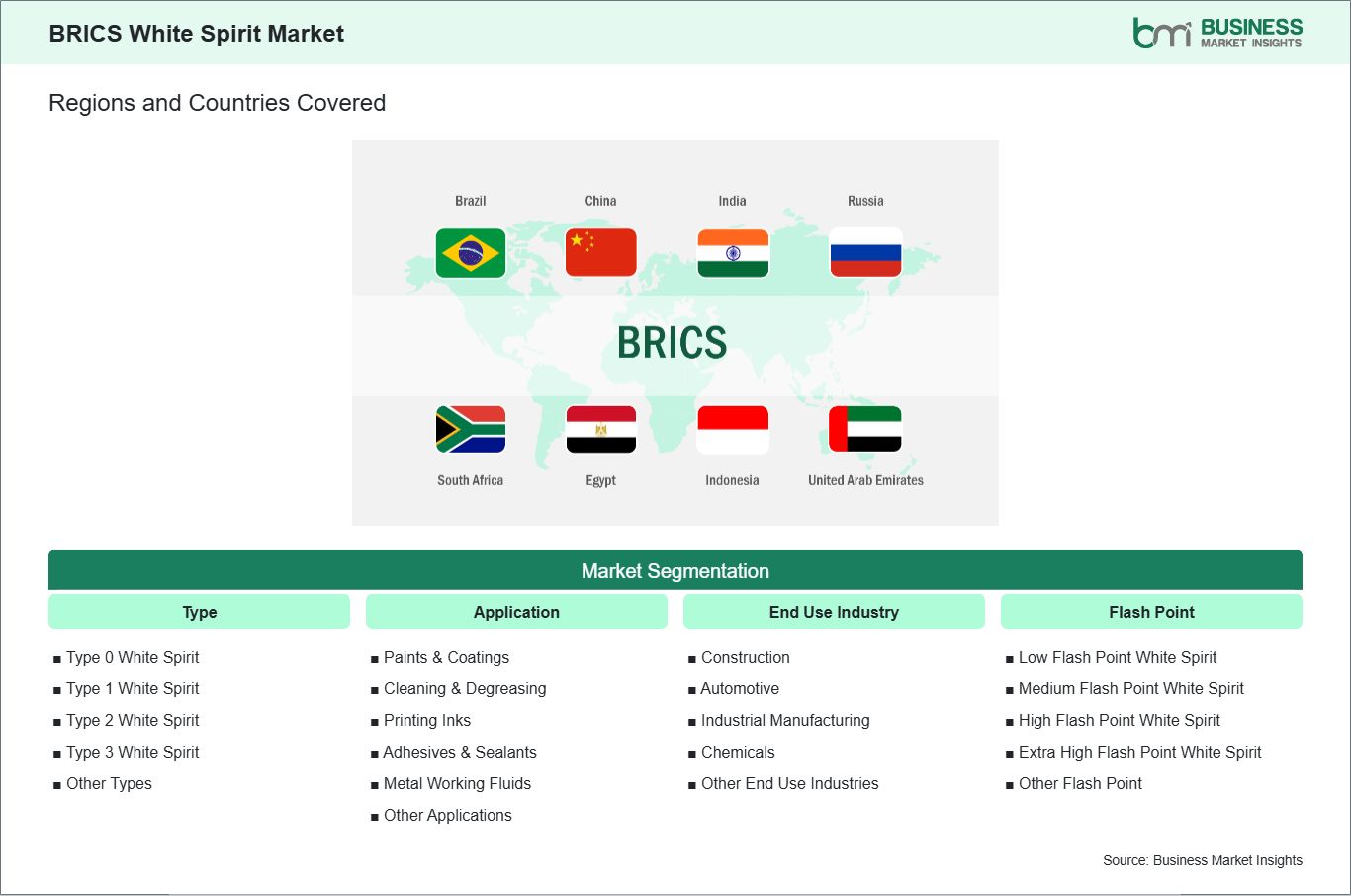
Key segments that contributed to the derivation of the BRICS white spirit market analysis are type, application, end use industry, and flashpoint.
The BRICS white spirit market is benefiting from increasing demand for protective coatings across industrial, infrastructure, energy, and transportation sectors. With fast-paced industrialization and construction taking place in countries like China and India, there is a huge demand for coatings to safeguard metal structures, machines, pipes, and industrial machinery from corrosion and any other form of environmental damage. White spirit remains an important solvent in many protective coating formulations, supporting application performance and surface preparation processes.
Infrastructure modernization programs across BRICS economies are further strengthening demand for protective coatings. Infrastructure projects involving significant investments in transport systems, industrial plants, ports, power plants, and city infrastructures need coating materials that can resist tough environmental conditions. The industries in Brazil and South Africa make extensive use of protective coatings to prolong the lifespan of assets and to minimize maintenance needs. These sectors continue to utilize solvent-based formulations where durability and resistance to moisture, chemicals, and abrasion are critical.
The expansion of manufacturing activities throughout the BRICS region also contributes to growing white spirit consumption. Coatings play a significant role in car manufacture, metal fabrication, heavy machinery manufacture, and shipbuilding industries. However, while environmental regulations have prompted a switch to new coating technology, many industries still opt to use solvent-based coatings for specific applications. As industrial assets become more sophisticated and maintenance standards increase, demand for protective coatings is expected to remain a significant growth driver for the BRICS white spirit market.
Product innovation presents a major opportunity for white spirit manufacturers operating in the BRICS region as environmental regulations continue to evolve. Government efforts are also leaning towards decreasing emissions, ensuring workplace safety, and promoting sustainable use of chemicals. This is driving manufacturers to come up with high-quality grades of white spirit that are environmentally friendly yet satisfy the requirements of the industries.
Manufacturers are investing in cleaner refining technologies, low-aromatic formulations, and products designed to support reduced emissions during application and handling. In China, tightening environmental standards are encouraging solvent producers to introduce products that align with stricter industrial requirements. Similar trends are emerging in India, Brazil, and other BRICS economies as policymakers seek to balance industrial growth with environmental responsibility. Companies that successfully adapt their product portfolios to these changing expectations are likely to strengthen their market position.
Innovation is also extending to renewable and circular feedstock integration, allowing producers to address sustainability goals without compromising product functionality. Customers across coatings, adhesives, cleaning chemicals, and industrial maintenance sectors increasingly seek solutions that support compliance with environmental standards while delivering consistent performance. As regulatory frameworks continue to develop throughout the BRICS region, product innovation will provide manufacturers with opportunities to differentiate their offerings, expand customer relationships, and access emerging high-value application segments.

The BRICS white spirit market is experiencing steady growth, with market size and share analysis reflecting evolving treatment preferences and competitive dynamics among key players. The report evaluates important subsegments categorized type, application, end use industry, and flashpoint, highlighting their respective contributions to overall market performance.
By the type, the type 2 white spirit subsegment dominated the market in 2025, owing to its balanced solvency characteristics, moderate evaporation rate, and broad compatibility with industrial coatings and cleaning applications. Its ability to deliver effective thinning performance while complying with quality and safety requirements makes it the preferred choice among manufacturers.
Based on applications, the paint & coating subsegment dominated the market in 2025 due to the critical role of white spirit as a solvent in the formulation and application of paints, enamels, primers, and protective coatings. Its ability to improve coating consistency, facilitate smooth application, and assist in equipment cleaning has made it an essential component in the coatings industry.
On the basis of end use industry, the construction subsegment dominated the market in 2025, driven by increasing residential, commercial, and infrastructure development projects worldwide. White spirit is widely used in construction-related paints, varnishes, coatings, and maintenance products, supporting surface preparation and finishing activities.
In terms of flash points, the medium flash points white spirit subsegment dominated the market in 2025, due to its optimal balance between safety, performance, and evaporation characteristics. It offers effective solvency power for paints, coatings, and industrial cleaning applications while providing lower handling risks compared to low flash point grades.
| Report Attribute | Details |
|---|---|
| Market size in 2025 | US$ 2,675.5 Million |
| Market Size by 2033 | US$ 4,118.0 Million |
| CAGR (2026 - 2033) | 5.5% |
| Historical Data | 2022-2024 |
| Forecast period | 2026-2033 |
| Segments Covered | By Type
|
|
Regions and Countries Covered
| |
| BRICS | Russia, Brazil, South Africa, India, China, Egypt, Indonesia, Saudi Arabia, United Arab Emirates |
| Market leaders and key company profiles |
|
The "BRICS White Spirit Market Size and Forecast (2022-2033)" report provides a detailed analysis of the market covering below areas:
The geographical scope of the BRICS white spirit market report is divided into: Russia, Brazil, South Africa, India, China, Egypt, Indonesia, Saudi Arabia, and the UAE. China held the largest share in 2025.
China's white spirit market is driven by the country's extensive industrial ecosystem, where the solvent continues to play a critical role in coatings, industrial cleaning, metal treatment, wood finishing, and manufacturing operations. As one of the world's largest producers of chemicals and industrial products, China maintains substantial demand for white spirit across a diverse range of end-use sectors. The solvent is widely utilized in industrial formulations due to its strong solvency characteristics, compatibility with traditional coating systems, and cost-effectiveness in large-scale applications. The market benefits from ongoing investments in infrastructure development, industrial modernization, transportation equipment manufacturing, and facility maintenance activities. Demand from protective coatings manufacturers remains particularly important, as industrial assets, machinery, steel structures, and commercial buildings require durable coating systems that often incorporate solvent-based formulations. Furthermore, the expansion of manufacturing clusters across coastal and inland provinces continues to support consumption in cleaning and degreasing applications. Despite these growth drivers, the market faces increasing pressure from environmental regulations focused on reducing emissions and promoting greener chemical usage. Authorities are encouraging industries to adopt cleaner production processes and lower-emission products, which has accelerated the adoption of water-based coatings and alternative solvents in certain applications. Rising sustainability expectations among industrial customers also present a long-term challenge for conventional white spirit products. Nevertheless, the solvent remains deeply integrated into China's industrial value chain, ensuring continued relevance in sectors where performance, reliability, and operational efficiency remain key purchasing considerations.

The BRICS white spirit market is evaluated by gathering qualitative and quantitative data post primary and secondary research, which includes important corporate publications, association data, and databases. A few of the key developments in the BRICS white spirit market are:
The BRICS White Spirit Market is valued at US$ 2,675.5 Million in 2025, it is projected to reach US$ 4,118.0 Million by 2033.
As per our report BRICS White Spirit Market, the market size is valued at US$ 2,675.5 Million in 2025, projecting it to reach US$ 4,118.0 Million by 2033. This translates to a CAGR of approximately 5.5% during the forecast period.
The BRICS White Spirit Market report typically cover these key segments-
The historic period, base year, and forecast period can vary slightly depending on the specific market research report. However, for the BRICS White Spirit Market report:
The BRICS White Spirit Market is populated by several key players, each contributing to its growth and innovation. Some of the major players include:
The BRICS White Spirit Market report is valuable for diverse stakeholders, including:
Essentially, anyone involved in or considering involvement in the BRICS White Spirit Market value chain can benefit from the information contained in a comprehensive market report.
Please tell us your area of interest
(Market Segments/ Regions and Countries/ Companies)