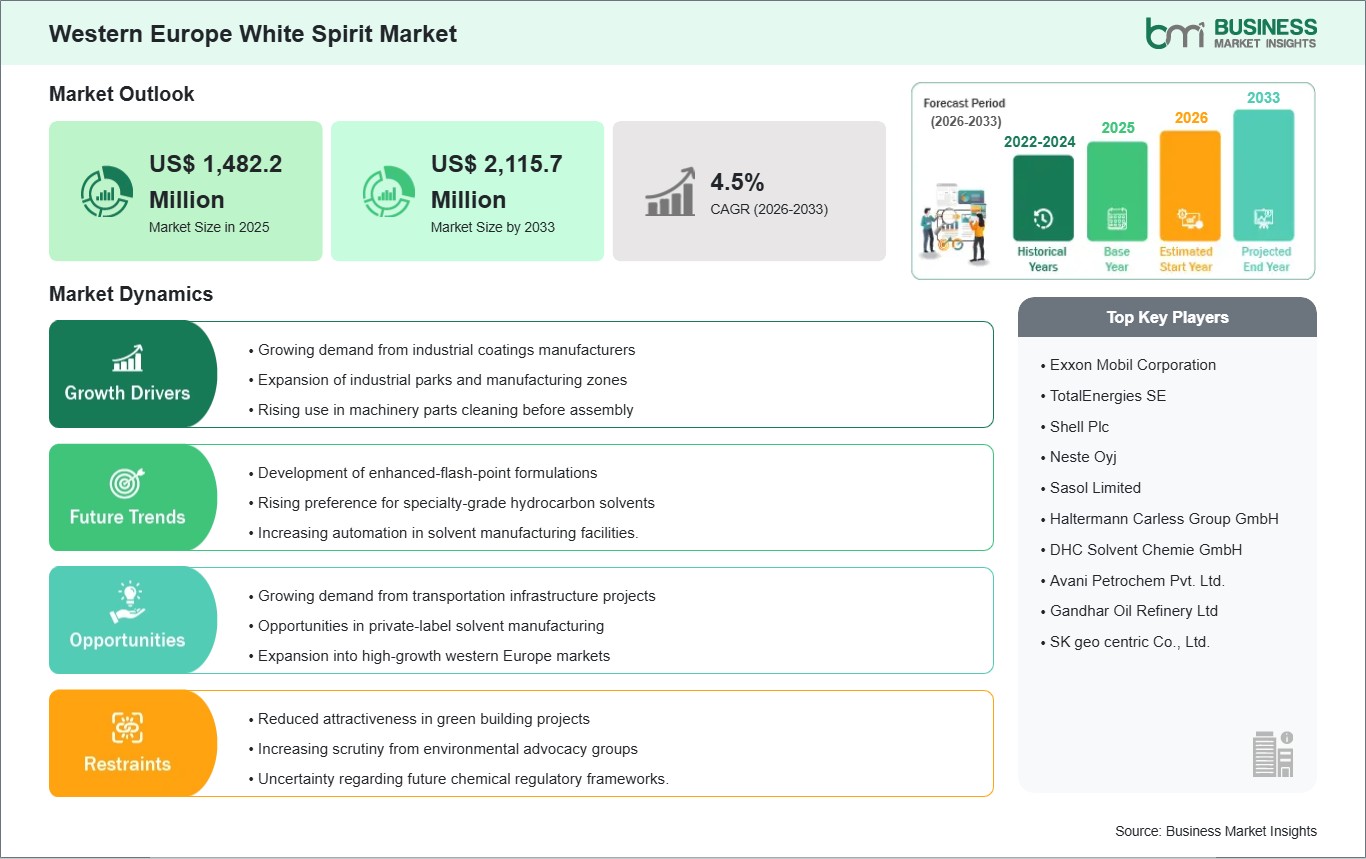
The Western Europe white spirit market size is expected to reach US$ 2,115.7 million by 2033 from US$ 1,482.2 million in 2025. The market is estimated to register a CAGR of 4.5% from 2026 to 2033.
Western Europe is a mature and regulated segment of the regional industrial solvents industry, shaped by strong environmental governance, advanced manufacturing standards, and an ongoing transition toward lower-emission chemical solutions. White spirit is extensively used as a petroleum-based solvent for paints, varnishes, adhesives, and cleaning applications in industries. The demands in the area do not depend so much on the development of new buildings, but instead depend on how renovations, refurbishments, and restorations of residential and commercial properties take place. There are changes in the industry that have seen an increase in demand for more sophisticated products, including those without odors and aromatics.
A key driver of the Western Europe market is the consistent need for building maintenance and refurbishment, supported by the region's extensive stock of aging infrastructure. Regular repainting, surface preparation, and protective coating applications sustain steady solvent consumption. Automotive aftermarket services and industrial maintenance operations contribute to stable demand, particularly in applications requiring effective degreasing and surface cleaning. High-precision sectors such as marine engineering, aerospace maintenance, and industrial equipment servicing support niche but reliable usage of white spirit across the region.
The market faces restraint from strict regulatory controls aimed at reducing volatile organic compound emissions and minimizing occupational exposure risks. These policies have accelerated the substitution of traditional white spirit with water-based, low-VOC, and bio-based alternatives in many applications. Environmental sustainability initiatives across Western Europe are influencing manufacturers to reformulate products and reduce reliance on petroleum-derived solvents. Despite these challenges, white spirit continues to retain relevance in specialized industrial applications where its solvency strength, evaporation characteristics, and cost efficiency remain difficult to replace fully.

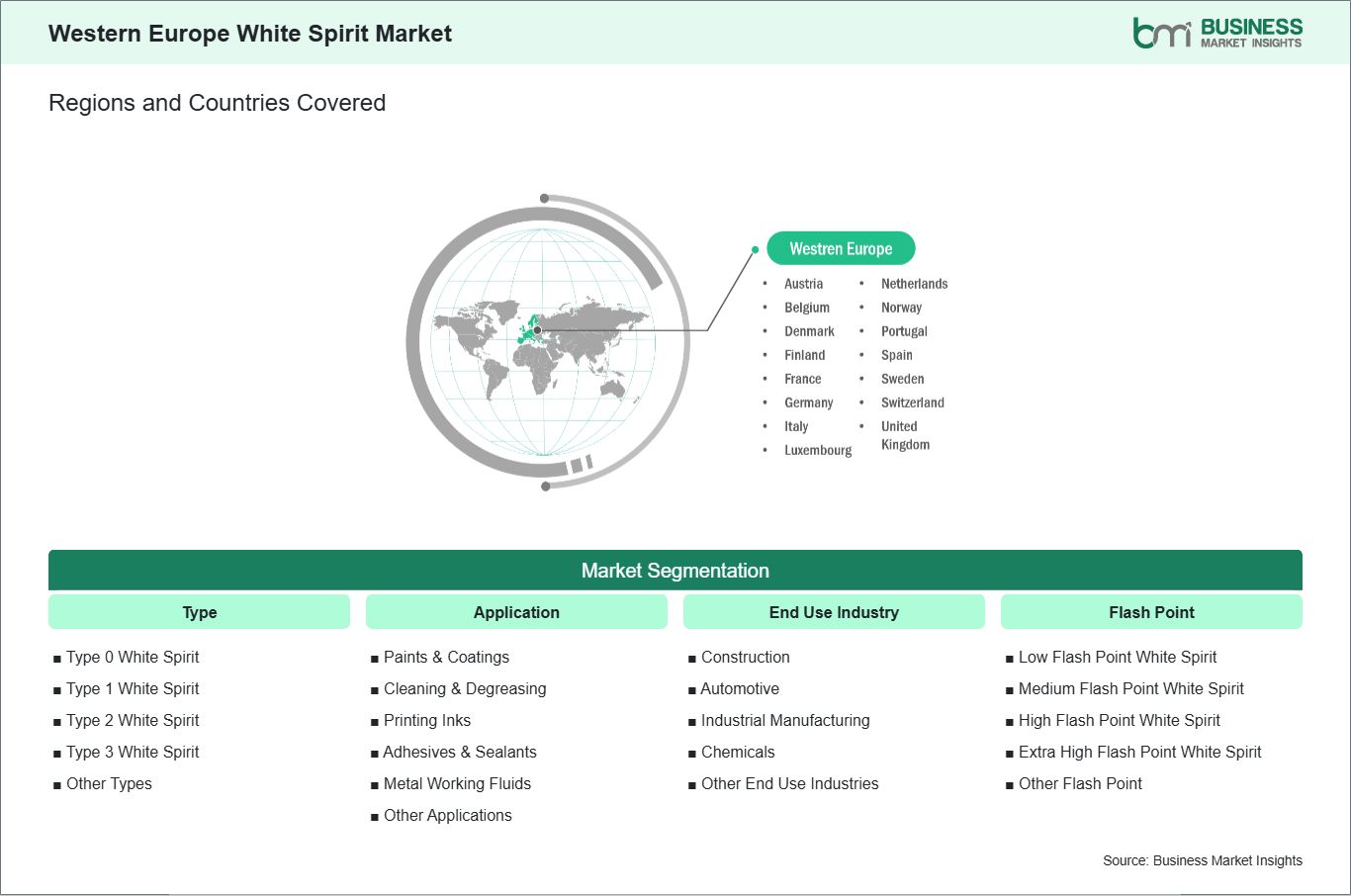
Key segments that contributed to the derivation of the Western Europe white spirit market analysis are type, application, end use industry, and flashpoint.
Coating manufacturers in the region are maintaining a stable demand for white spirit owing to its significance in coating compositions of a high-performance variety utilized in maintenance-heavy industries. In spite of the positive impact that policies have had on promoting the use of low VOC and water-based paints, solvent paint is an essential component where durability and resistance are key. White spirit is widely used as a formulation solvent and thinning agent in alkyd-based systems, supporting application efficiency, film formation, and surface finishing quality. It ensures its ongoing integration within industrial coating production, particularly for maintenance and protective coating lines serving heavy-duty applications.
Demand is supported by the region's established industrial ecosystem, where machinery, transportation infrastructure, energy facilities, and manufacturing equipment require frequent recoating and refurbishment. Industrial coatings producers operate within a mature but maintenance-driven market, supplying domestic end-users and export markets. It ensures continued demand for solvent-based systems that are utilized for corrosion protection, maintenance, and preservation of structures. White spirit continues to be significant in such systems as a result of its proven properties and cost-effectiveness during mass production.
Demand from industrial coatings manufacturers in Western Europe is expected to remain stable but gradually transition in line with tightening environmental regulations. While waterborne and alternative chemistries will gain share, solvent-based coatings will persist in specialized and high-performance segments where functional requirements limit substitution. It will result in a balanced outlook, with white spirit consumption stabilizing through efficiency improvements and targeted usage rather than broad-based growth.
Major investments in highways, rail corridors, bridges, tunnels, and urban transit systems are increasing the demand for industrial coatings used to protect infrastructure assets from corrosion, moisture, and environmental degradation. White spirit is used as a solvent in such coating mixes because of its capability to enhance fluidity, ease of use, and quality of finish achieved. With governments concerned about prolonging the life of assets and improving their reliability, there has been a growing demand for coatings materials.
The opportunity is strengthened by the region's emphasis on maintaining and upgrading aging transportation infrastructure. Rehabilitation procedures include surface preparation, cleaning, painting, and other treatments, which necessitate the use of solvent products to function efficiently. Electrification of the railway, increasing high-speed railway operations, and upgrading the transportation system have been creating constant demand for coating products along with their solvents. The requirement of ensuring structural strength and keeping the maintenance expenses low is prompting the infrastructure managers to go for premium coatings, which will increase the demand for white spirit among new constructions and renovations.
The transportation infrastructure investment is expected to remain a strategic priority across Western Europe, providing a stable foundation for market growth. Continued development of sustainable mobility networks and cross-border connectivity projects will support long-term coating demand. Suppliers offering compliant, high-performance white spirit grades will be well-positioned to capitalize on expanding infrastructure activity and evolving technical requirements throughout the region.

The Western Europe white spirit market is experiencing steady growth, with market size and share analysis reflecting evolving treatment preferences and competitive dynamics among key players. The report evaluates important subsegments categorized within type, application, end use industry, and flashpoint, highlighting their respective contributions to overall market performance.
By type, the type 2 white spirit subsegment dominated the market in 2025, owing to its balanced solvency characteristics, moderate evaporation rate, and broad compatibility with industrial coatings and cleaning applications. Its ability to deliver effective thinning performance while complying with quality and safety requirements makes it the preferred choice among manufacturers.
Based on applications, the paint & coating subsegment dominated the market in 2025 due to the critical role of white spirit as a solvent in the formulation and application of paints, enamels, primers, and protective coatings. Its ability to improve coating consistency, facilitate smooth application, and assist in equipment cleaning has made it an essential component in the coatings industry.
On the basis of end use industry, the construction subsegment dominated the market in 2025, driven by increasing residential, commercial, and infrastructure development projects worldwide. White spirit is widely used in construction-related paints, varnishes, coatings, and maintenance products, supporting surface preparation and finishing activities.
In terms of flash points, the medium flash points white spirit subsegment dominated the market in 2025, due to its optimal balance between safety, performance, and evaporation characteristics. It offers effective solvency power for paints, coatings, and industrial cleaning applications while providing lower handling risks compared to low flash point grades.
| Report Attribute | Details |
|---|---|
| Market size in 2025 | US$ 1,482.2 Million |
| Market Size by 2033 | US$ 2,115.7 Million |
| CAGR (2026 - 2033) | 4.5% |
| Historical Data | 2022-2024 |
| Forecast period | 2026-2033 |
| Segments Covered | By Type
|
|
Regions and Countries Covered
| |
| Western Europe | Belgium, Netherlands, Luxembourg, Germany, France, Italy, Spain, Switzerland, Sweden, Austria, United Kingdom, Denmark, Portugal, Norway, Finland |
| Market leaders and key company profiles |
|
The "Western Europe White Spirit Market Size and Forecast (2022-2033)" report provides a detailed analysis of the market covering below areas:
The geographical scope of the Western Europe white spirit market report is divided into: Belgium, the Netherlands, Luxembourg, Germany, France, Italy, Spain, Switzerland, Sweden, Austria, the UK, Denmark, Portugal, Norway, and Finland. Germany held the largest share in 2025.
Western Europe represents a significant market for white spirit, with Germany emerging as the dominant country due to its strong industrial foundation, advanced manufacturing sector, and large paints and coatings industry. The demand for white spirit is attributed to its use in industrial paints, automotive repainting, metallurgical processes, and maintenance operations. In Germany, the construction industry and the high consumption of protective and decorative paints will ensure consistent use of white spirit in the country.
The country's leadership is strengthened by its robust chemical industry and sophisticated distribution network, which facilitates the production, import, and supply of high-quality solvent products. In Germany, there are coatings, specialty chemicals, and manufacturing industries that make use of white spirit in their products. The export-driven industrial economy of Germany increases the consumption of industrial solvents in the region.
Stringent environmental regulations and sustainability goals influence market dynamics in Western Europe. As a result, manufacturers are investing in low-aromatic and high-purity white spirit grades that comply with evolving VOC and workplace safety standards. As the use of alternative solvents is being embraced in the region, white spirit remains significant in industries that require high-performance capabilities. Germany, owing to its technological advancements and innovative products, is the leading consumer of white spirit in Western Europe.

The Western Europe white spirit market is evaluated by gathering qualitative and quantitative data post primary and secondary research, which includes important corporate publications, association data, and databases. A few of the key developments in the Western Europe white spirit market are:
The Western Europe White Spirit Market is valued at US$ 1,482.2 Million in 2025, it is projected to reach US$ 2,115.7 Million by 2033.
As per our report Western Europe White Spirit Market, the market size is valued at US$ 1,482.2 Million in 2025, projecting it to reach US$ 2,115.7 Million by 2033. This translates to a CAGR of approximately 4.5% during the forecast period.
The Western Europe White Spirit Market report typically cover these key segments-
The historic period, base year, and forecast period can vary slightly depending on the specific market research report. However, for the Western Europe White Spirit Market report:
The Western Europe White Spirit Market is populated by several key players, each contributing to its growth and innovation. Some of the major players include:
The Western Europe White Spirit Market report is valuable for diverse stakeholders, including:
Essentially, anyone involved in or considering involvement in the Western Europe White Spirit Market value chain can benefit from the information contained in a comprehensive market report.
Please tell us your area of interest
(Market Segments/ Regions and Countries/ Companies)