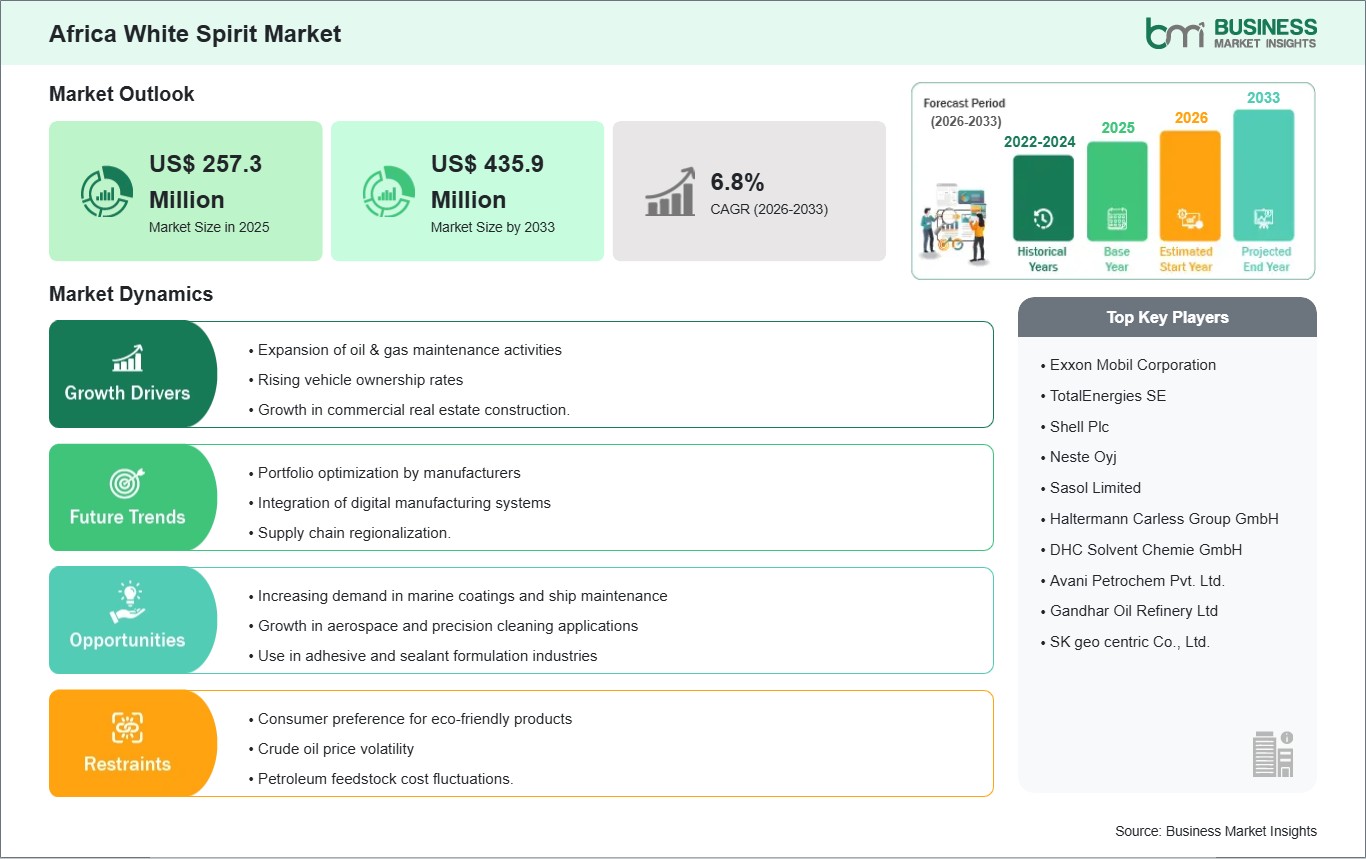
The Africa white spirit market size is expected to reach US$ 435.9 million by 2033 from US$ 257.3 million in 2025. The market is estimated to register a CAGR of 6.8% from 2026 to 2033.
White spirit is mainly used as a solvent obtained from petroleum products in paint, coating, cleansing operations, and industrial degreasing operations, whose consumption depends significantly on constructions taking place within an area, maintenance of infrastructures, and low-scale manufacturing activities. Across Africa, the market is shaped by a dual structure: relatively mature industrial demand centers in countries such as South Africa and Egypt, and rapidly expanding construction-driven consumption in West and East African economies. The market reflects a strong dependency on imported refined solvents in sub-regions. Localized refining and blending capacities are gradually expanding in selected hubs, particularly in North and Southern Africa.
There is sustained expansion of infrastructure development, including residential housing, commercial construction, transportation networks, and public utilities. These initiatives will drive up the consumption of paints, coatings, and surface preparatory products, which use white spirits as part of their formulations due to their cost-effectiveness and wide acceptance. Growth in the provision of automotive repairs and unorganized industrial maintenance drives demand at a baseline level. Industrial cleaning and oil-related maintenance activities in resource-rich countries provide supplementary demand streams.
However, the market faces notable restraints, primarily linked to supply chain volatility and dependency on imported petroleum-based inputs, which expose pricing and availability to global crude oil fluctuations and logistical constraints. There are environmental and occupational considerations coming up as constraints, especially in South Africa, which is more regulated and has developed an increasing awareness of VOC-related health impacts. Despite these constraints, white spirit continues to maintain relevance due to its affordability, strong solvency performance, and limited availability of scalable low-cost substitutes across the continent.

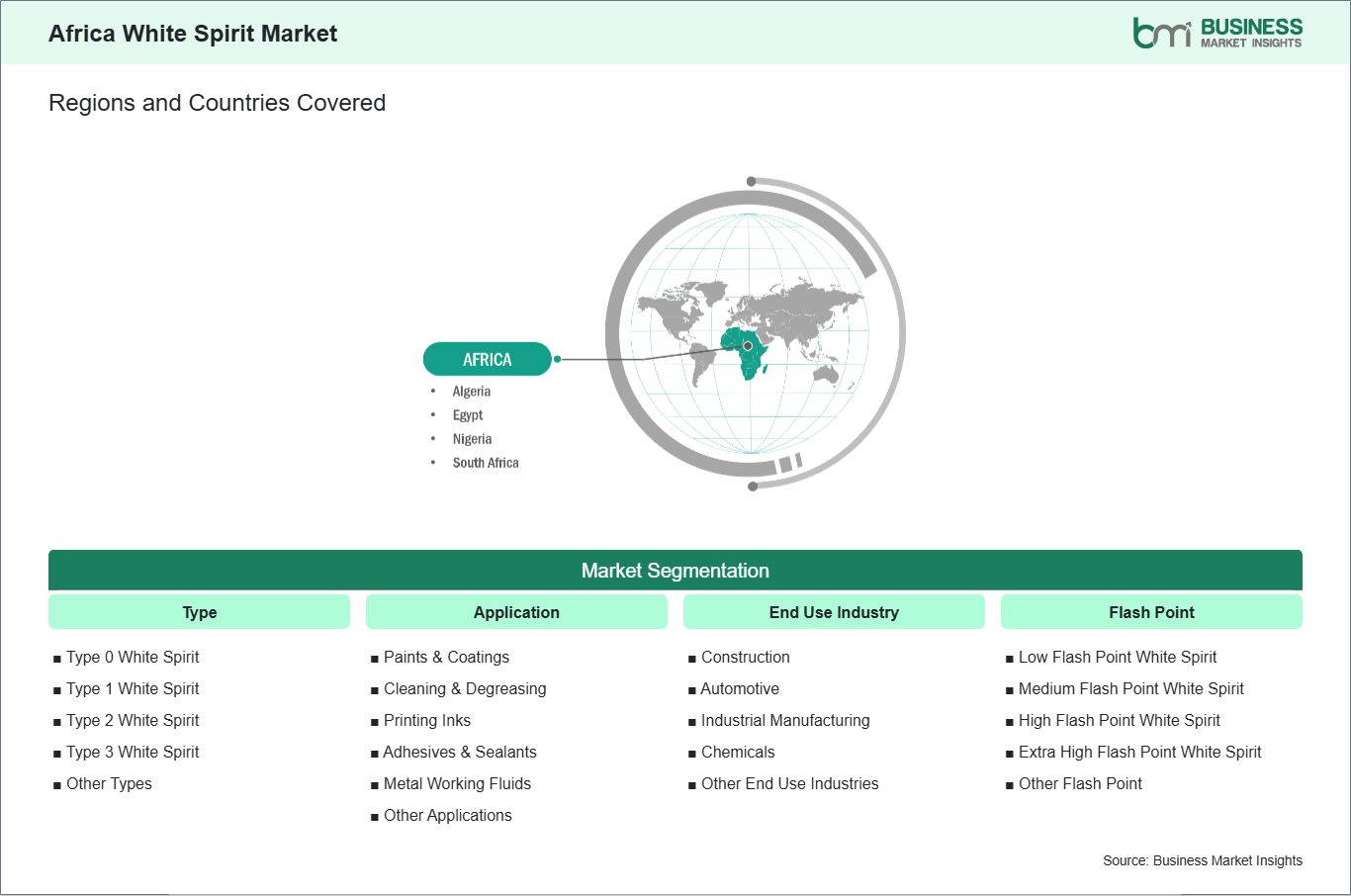
Key segments that contributed to the derivation of the Africa white spirit market analysis are type, application, end use industry, and flashpoint.
Expansion of oil and gas maintenance activities in Africa is driving white spirit demand, due to the sector's increasing focus on preserving and extending the life of existing upstream and downstream assets. Aging pipelines, refineries, storage facilities, and offshore facilities across the continent need constant maintenance for optimal performance and safety. White spirit is critical in the entire chain as a solvent for coating paints and degreasing, especially where resistant paints are required for the protection of steel structures. Its effectiveness in dissolving resins and improving coating application properties supports its widespread use in maintenance cycles.
The reliance on maintenance rather than large-scale new project development amplifies solvent consumption. In African oil-producing regions, operators prioritize refurbishment and integrity management programs due to capital constraints and the need to maximize output from mature fields. It leads to recurring repainting, equipment cleaning, and shutdown maintenance activities, all of which sustain demand for solvent-based coating systems. White spirit remains relevant in these applications because it performs reliably under harsh environmental conditions, including high humidity, salt exposure, and temperature fluctuations commonly found in coastal and offshore operations.
The continued emphasis on asset life extension and operational efficiency is expected to support stable white spirit demand within Africa's oil and gas sector. While environmental regulations may gradually encourage lower-VOC alternatives, the technical requirements and cost considerations of maintenance activities are likely to sustain solvent-based usage in the medium term. This positions white spirit as a persistent input in industrial maintenance workflows across the region.
Rising maritime activity and the growing need for vessel upkeep across coastal economies are strengthening the role of marine coatings as a consistent demand driver for white spirit in the region. Ship maintenance processes are characterized by the need for regular painting to prevent corrosion on ships operating under harsh conditions of high saline, humidity, and extensive use. White spirits are one of the most common solvents used in such paints because of their ability to reduce the viscosity of the paint. As commercial shipping, fishing fleets, and offshore operations expand, the frequency of maintenance cycles increases, creating a stable consumption base for solvent usage.
This trend is supported by the structural dependence of African economies on maritime trade routes and port infrastructure for import-export activity. As the number of vessels increases in the port, it becomes necessary for them to be repaired, painted, and dry-docked frequently. The focus on efficiency and extending the life span of ships has resulted in more investment in preventative maintenance, thus boosting the need for solvents used in marine coatings.
The continuous development of the ecosystem around shipping and ship repairs in Africa would continue to enhance stable growth possibilities for the white spirit industry in the maritime segment. The demand is likely to be connected to the degree of maintenance, although emerging environmental demands would continue to favor the adoption of increasingly refined solvents.

The white spirit market in Africa is experiencing steady growth, with market size and share analysis reflecting evolving treatment preferences and competitive dynamics among key players. The report evaluates important subsegments categorized within the type, application, end use industry, and flashpoint, highlighting their respective contributions to market performance.
By type, the type 2 white spirit subsegment dominated the market in 2025, owing to its balanced solvency characteristics, moderate evaporation rate, and broad compatibility with industrial coatings and cleaning applications. Its ability to deliver effective thinning performance while complying with quality and safety requirements makes it the preferred choice among manufacturers.
Based on applications, the paint & coating subsegment dominated the market in 2025 due to the critical role of white spirit as a solvent in the formulation and application of paints, enamels, primers, and protective coatings. Its ability to improve coating consistency, facilitate smooth application, and assist in equipment cleaning has made it an essential component in the coatings industry.
On the basis of end use industry, the construction subsegment dominated the market in 2025, driven by increasing residential, commercial, and infrastructure development projects worldwide. White spirit is widely used in construction-related paints, varnishes, coatings, and maintenance products, supporting surface preparation and finishing activities.
In terms of flash point, the medium flash points white spirit subsegment dominated the market in 2025, due to its optimal balance between safety, performance, and evaporation characteristics. It offers effective solvency power for paints, coatings, and industrial cleaning applications while providing lower handling risks compared to low flash point grades.
| Report Attribute | Details |
|---|---|
| Market size in 2025 | US$ 257.3 Million |
| Market Size by 2033 | US$ 435.9 Million |
| CAGR (2026 - 2033) | 6.8% |
| Historical Data | 2022-2024 |
| Forecast period | 2026-2033 |
| Segments Covered | By Type
|
|
Regions and Countries Covered
| |
| Africa | Egypt, South Africa, Nigeria, Algeria |
| Market leaders and key company profiles |
|
The "Africa White Spirit Market Size and Forecast (2022-2033)" report provides a detailed analysis of the market covering below areas:
The geographical scope of the Africa white spirit market report is divided into Nigeria, Egypt, South Africa, and Algeria. South Africa held the largest share in 2025.
In the region, the white spirit market is steadily growing, with South Africa emerging as the dominant hub due to its relatively advanced industrial base and well-established manufacturing sector. The country's strong construction activity, automotive maintenance industry, and expanding infrastructure projects drive consistent demand for white spirit, particularly in paints, coatings, and industrial cleaning applications. Urban development and ongoing renovation activities across major cities support the consumption of solvent-based products.
South Africa's comparatively developed chemical and petrochemical distribution network enables more reliable access to industrial solvents than other African countries. The presence of mining, metal processing, and machinery maintenance industries contributes significantly to demand, as white spirit is widely used for degreasing, equipment cleaning, and surface preparation. Imports play a key role in ensuring a steady supply, as local production capacity for refined solvents remains limited.
Across the region, growth is supported by gradual infrastructure expansion, increasing industrialization, and rising demand for construction materials. However, market development remains uneven due to economic constraints and limited refining infrastructure in several countries. Environmental awareness and regulatory frameworks are evolving, allowing continued reliance on traditional solvent-based products.

The Africa White spirit market is evaluated by gathering qualitative and quantitative data post primary and secondary research, which includes important corporate publications, association data, and databases. A few of the key developments in the Africa White spirit market are:
The Africa White Spirit Market is valued at US$ 257.3 Million in 2025, it is projected to reach US$ 435.9 Million by 2033.
As per our report Africa White Spirit Market, the market size is valued at US$ 257.3 Million in 2025, projecting it to reach US$ 435.9 Million by 2033. This translates to a CAGR of approximately 6.8% during the forecast period.
The Africa White Spirit Market report typically cover these key segments-
The historic period, base year, and forecast period can vary slightly depending on the specific market research report. However, for the Africa White Spirit Market report:
The Africa White Spirit Market is populated by several key players, each contributing to its growth and innovation. Some of the major players include:
The Africa White Spirit Market report is valuable for diverse stakeholders, including:
Essentially, anyone involved in or considering involvement in the Africa White Spirit Market value chain can benefit from the information contained in a comprehensive market report.
Please tell us your area of interest
(Market Segments/ Regions and Countries/ Companies)