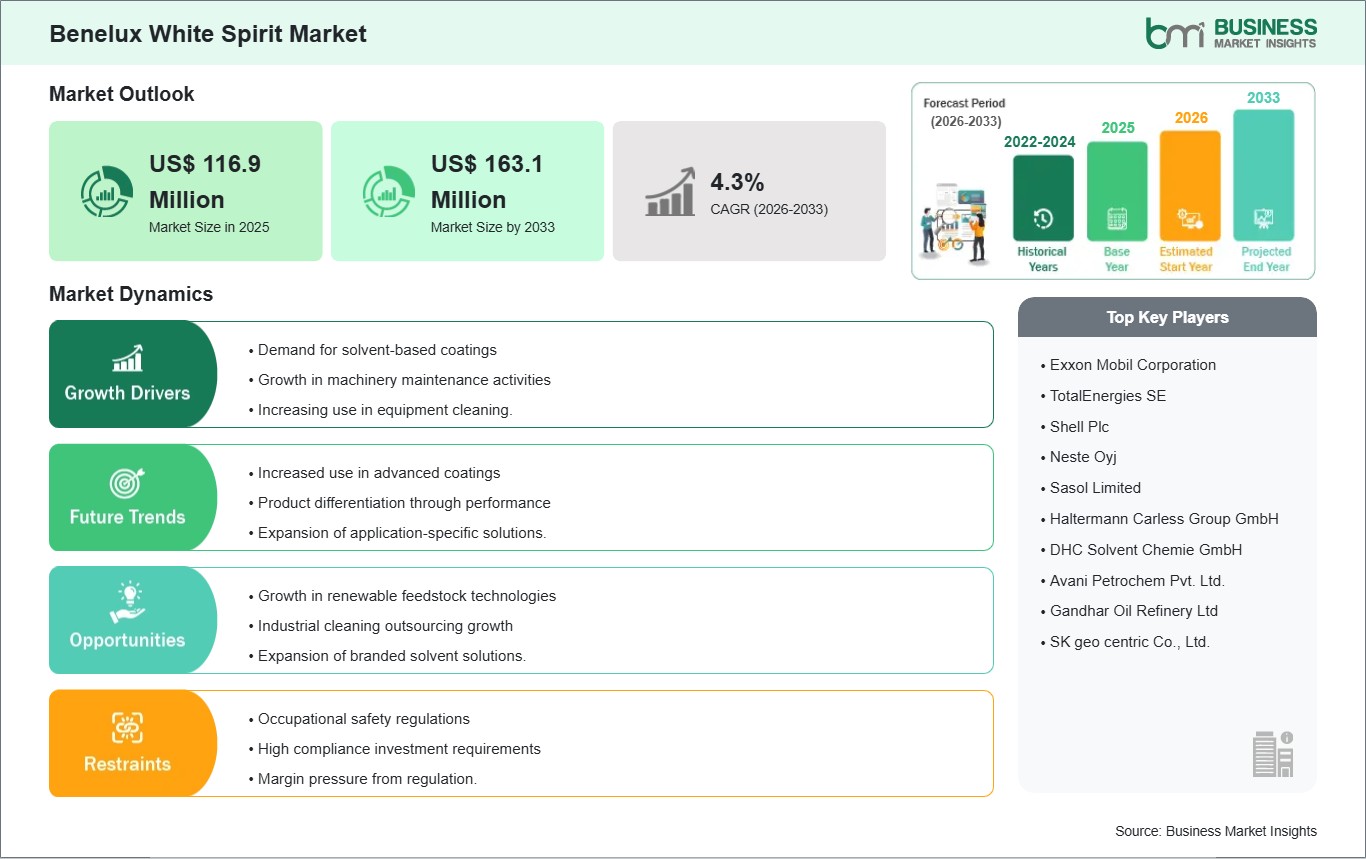
The Benelux white spirit market size is expected to reach US$ 163.1 million by 2033 from US$ 116.9 million in 2025. The market is estimated to record a CAGR of 4.3% from 2026 to 2033.
The Benelux white spirit market is characterized by a mature industrial base, stringent environmental regulations, and a strong presence of coatings, construction materials, industrial maintenance products, and chemical processing activities. Demand for white spirit across the region is primarily supported by its continued use as a solvent in paints, varnishes, wood treatments, metal cleaning applications, and industrial degreasing formulations. Although sustainability initiatives are gradually reshaping solvent consumption patterns, white spirit remains an important raw material due to its effectiveness, cost efficiency, and compatibility with a wide range of industrial and commercial formulations.
Within Benelux, the Netherlands serves as the principal market hub owing to its highly developed petrochemical infrastructure, extensive logistics network, and strong trade connectivity with the broader European market. The country's role as a distribution and manufacturing center enables consistent availability of white spirit for downstream industries. Belgium also contributes significantly through its chemical manufacturing ecosystem, where solvent-based formulations continue to be utilized in specialized industrial applications. Luxembourg represents a comparatively smaller market, with demand largely linked to construction maintenance and commercial usage.
Market growth is supported by ongoing renovation activities, industrial asset maintenance requirements, and demand from protective coatings manufacturers. However, the market faces challenges from increasingly stringent environmental regulations targeting volatile organic compound emissions and the growing adoption of low-VOC, water-based alternatives. Furthermore, sustainability commitments across industrial sectors are encouraging end users to evaluate substitute solvents, creating competitive pressure for conventional white spirit products. Despite these restraints, established industrial demand and the region's robust manufacturing foundation continue to support market stability.

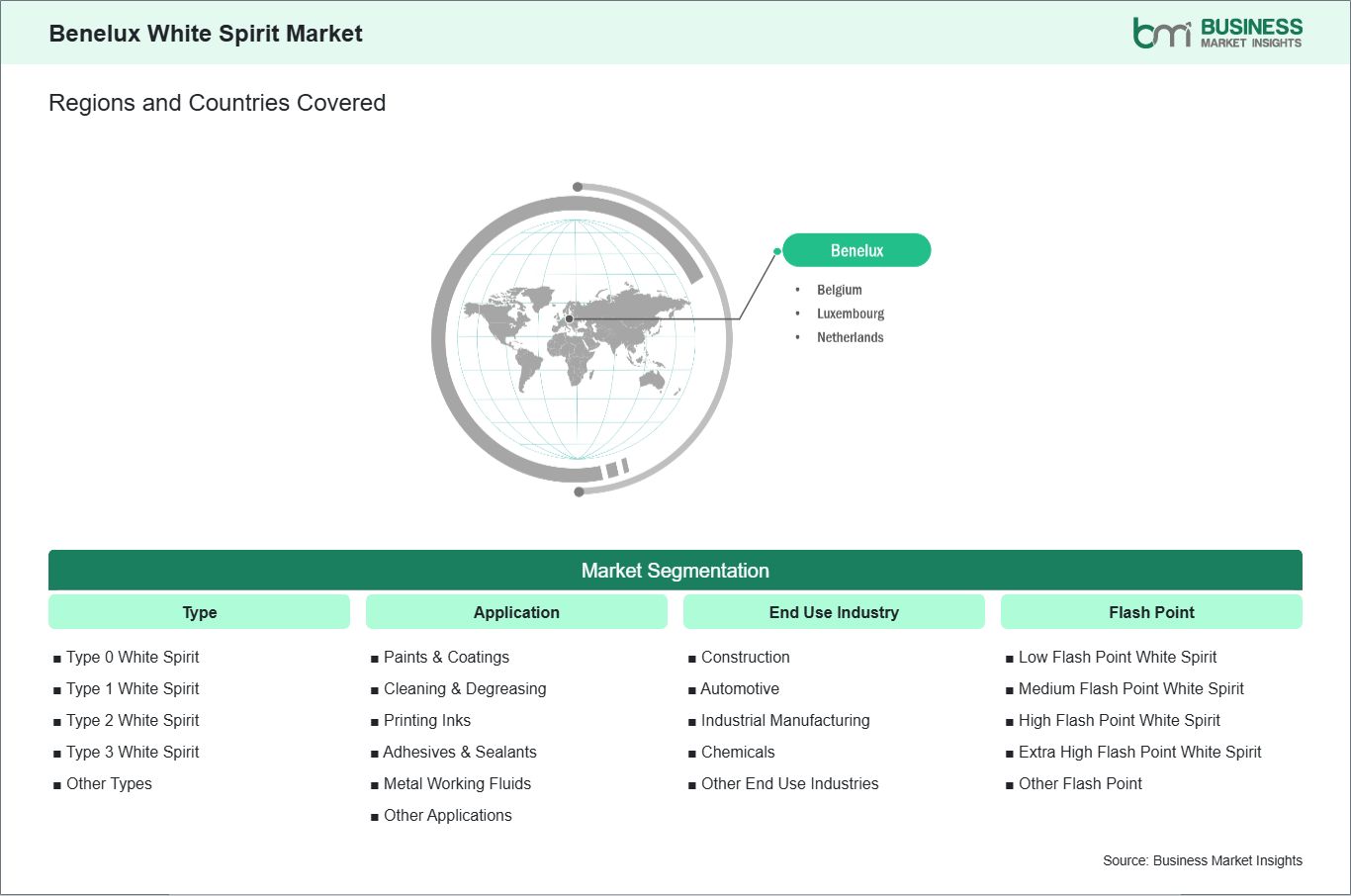
Key segments that contributed to the derivation of the Benelux white spirit market analysis are type, application, end use industry, and flashpoint.
The Benelux white spirit market continues to be significantly influenced by demand from solvent-based coatings, particularly across industrial maintenance, marine applications, metal fabrication, and protective coating sectors. Although environmental policies have prompted the use of water-based paints, solvent-based paints continue to be favored in applications that demand strong adhesion, robust performance in tough operating environments, and high levels of durability. White spirit continues to play a critical role in the application of paint coatings and the cleaning of equipment.
Belgium's industrial base plays an important role in sustaining demand for solvent-based coatings used in machinery, transportation equipment, and metal structures. Continuous maintenance operations carried out at factories, logistics centers, and ports lead to continuous needs for paint products that use white spirit as a key ingredient. This has been seen in the Netherlands, where the maritime industry of the nation creates demand for protective coatings due to its wide use in the industry. These sectors continue to favor solvent-based systems because of their performance under challenging environmental conditions.
Renovation and refurbishment activities across commercial buildings, industrial facilities, and public infrastructure further contribute to white spirit consumption. However, solvent-based coatings still remain popular among many construction companies when working on special constructions, where weather resistance and compatibility with surfaces are highly important. Even though various sustainable trends have an effect on formulating paints, there is still industrial demand which helps white spirit sales in the Benelux area.
Renewable feedstock technologies are gaining prominence within the Benelux white spirit market as sustainability objectives become increasingly important throughout the chemicals industry. Manufacturers are considering raw material options that utilize sources which are renewable and circular in order to decrease their reliance on traditional fossil fuels. The Netherlands has become a key center for renewable chemistry because of its sophisticated refinery facilities as well as its investments in sustainable industrial development. These initiatives are creating opportunities for the production of lower-carbon solvent products that align with evolving environmental expectations.
Across the region, chemical producers are evaluating renewable feedstock integration as part of broader decarbonization strategies. Belgium's well-established petrochemical sector is actively exploring pathways to incorporate renewable raw materials while maintaining product quality and performance standards. Growing interest from coatings manufacturers, industrial users, and consumer product companies is encouraging the commercialization of renewable solvent solutions that can meet both environmental and technical requirements.
The adoption of mass-balance certification approaches is further supporting the transition toward renewable white spirit products. These systems allow manufacturers to demonstrate the use of renewable inputs while maintaining compatibility with existing production processes and supply chains. As sustainability becomes a greater priority for both producers and end users, renewable feedstock technologies are expected to play an increasingly important role in shaping the future development of the Benelux white spirit market.
The Benelux white spirit marketis experiencing steady growth, with market size and share analysis reflecting evolving treatment preferences and competitive dynamics among key players. The report evaluates important subsegments categorized within type, application, end use industry, and flashpoint, highlighting their respective contributions to overall market performance.
By the type, the type 2 white spirit subsegment dominated the market in 2025, owing to its balanced solvency characteristics, moderate evaporation rate, and broad compatibility with industrial coatings and cleaning applications. Its ability to deliver effective thinning performance while complying with quality and safety requirements makes it the preferred choice among manufacturers.
Based on applications, the paint & coating subsegment dominated the market in 2025 due to the critical role of white spirit as a solvent in the formulation and application of paints, enamels, primers, and protective coatings. Its ability to improve coating consistency, facilitate smooth application, and assist in equipment cleaning has made it an essential component in the coatings industry.
On the basis of end use industry, the construction subsegment dominated the market in 2025, driven by increasing residential, commercial, and infrastructure development projects worldwide. White spirit is widely used in construction-related paints, varnishes, coatings, and maintenance products, supporting surface preparation and finishing activities.
In terms of flash points, the medium flash points white spirit subsegment dominated the market in 2025, due to its optimal balance between safety, performance, and evaporation characteristics. It offers effective solvency power for paints, coatings, and industrial cleaning applications while providing lower handling risks compared to low flash point grades.
| Report Attribute | Details |
|---|---|
| Market size in 2025 | US$ 116.9 Million |
| Market Size by 2033 | US$ 163.1 Million |
| CAGR (2026 - 2033) | 4.3% |
| Historical Data | 2022-2024 |
| Forecast period | 2026-2033 |
| Segments Covered | By Type
|
|
Regions and Countries Covered
| |
| Benelux | Belgium, Netherlands, Luxembourg |
| Market leaders and key company profiles |
|
The "Benelux White Spirit Market Size and Forecast (2022-2033)" report provides a detailed analysis of the market covering below areas:
The geographical scope of the Benelux White spirit market report is divided into: Belgium, the Netherlands, and Luxembourg. The Netherlands held the largest share in 2025.
The Netherlands dominates the Benelux white spirit market due to its strategic position as one of Europe's most important chemical production and distribution centers. The country benefits from a highly integrated petrochemical value chain, advanced storage infrastructure, and access to major maritime trade routes, making it a key supply and redistribution point for solvents across Northwestern Europe. This logistical advantage strengthens the availability of white spirit for domestic consumption as well as regional exports. Demand in the Netherlands is closely linked to the paints and coatings industry, where white spirit continues to be utilized in solvent-based decorative and industrial formulations. The country's active construction renovation sector also supports consumption through applications in surface preparation, equipment cleaning, and wood treatment products. In addition, industrial maintenance activities across manufacturing facilities, logistics hubs, marine operations, and infrastructure projects create sustained requirements for solvent-based cleaning and degreasing products. A distinctive feature of the Dutch market is the coexistence of strong industrial demand with some of Europe's most ambitious sustainability objectives. Manufacturers are increasingly focusing on higher-purity and lower-odor white spirit grades to align with environmental expectations while maintaining performance requirements. Market participants are also investing in product innovation aimed at reducing environmental impact without sacrificing operational efficiency.

The Benelux white spirit market is evaluated by gathering qualitative and quantitative data post primary and secondary research, which includes important corporate publications, association data, and databases. A few of the key developments in the Benelux white spirit market are:
The Benelux White Spirit Market is valued at US$ 116.9 Million in 2025, it is projected to reach US$ 163.1 Million by 2033.
As per our report Benelux White Spirit Market, the market size is valued at US$ 116.9 Million in 2025, projecting it to reach US$ 163.1 Million by 2033. This translates to a CAGR of approximately 4.3% during the forecast period.
The Benelux White Spirit Market report typically cover these key segments-
The historic period, base year, and forecast period can vary slightly depending on the specific market research report. However, for the Benelux White Spirit Market report:
The Benelux White Spirit Market is populated by several key players, each contributing to its growth and innovation. Some of the major players include:
The Benelux White Spirit Market report is valuable for diverse stakeholders, including:
Essentially, anyone involved in or considering involvement in the Benelux White Spirit Market value chain can benefit from the information contained in a comprehensive market report.
Please tell us your area of interest
(Market Segments/ Regions and Countries/ Companies)