
Micro Irrigation System Market Outlook: Size, Share, Trends, Growth Analysis, Competitive Landscape & Forecast, 2026-2033

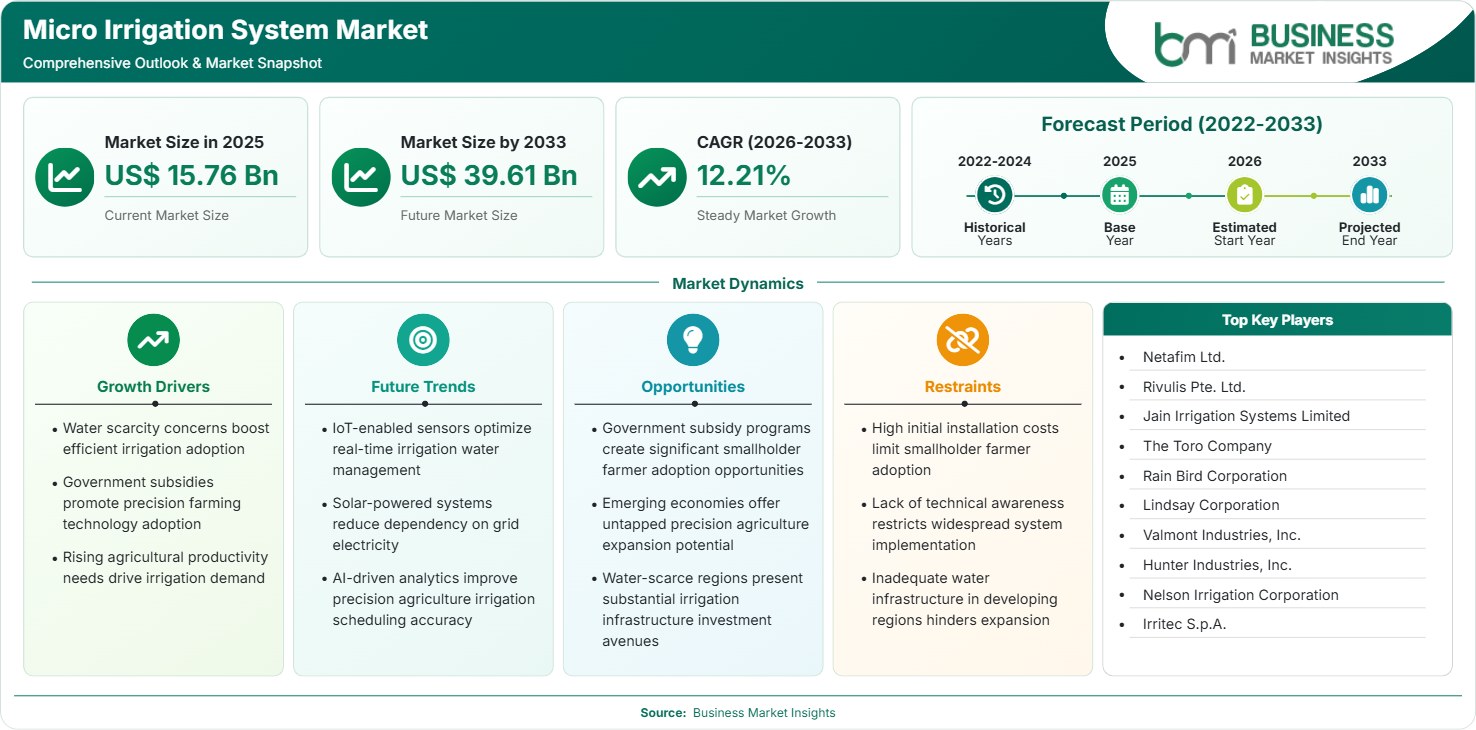
The Micro Irrigation System Market size was valued at US$ 15.76 Billion in 2025 and is projected to reach US$ 39.61 Billion by 2033, growing at a CAGR of 12.21% during 2026–2033, driven by water scarcity, precision farming adoption, government subsidies, digital irrigation technologies, and expanding cultivation of high-value crops across emerging agricultural economies.

Report Coverage
  • Type: Drip Irrigation, Sprinkler Irrigation
  • Crop Type: Field Crops, Orchard Crops, Landscape & Turf, Others
  • Application: Agriculture, Industrial
US$ 15.76 Bn Market size in 2025
US$ 39.61 Bn Market Size by 2033
12.21% CAGR, 2026 - 2033
2026-2033 Forecast Period

AI Overview

Micro Irrigation System Market Summary

  • North America Region: North America holds a market share of 30%–33% in 2025, growing at a CAGR of 10.5%–11.5% during 2026–2033. Growth is supported by precision agriculture investments, labor optimization strategies, climate-resilient farming systems, water productivity mandates, digital irrigation integration, specialty crop expansion, sustainable resource management programs, and advanced irrigation infrastructure development. The U.S. market benefits from large-scale commercial farming and irrigation automation, advancing at approximately 10.8%–11.8% CAGR.
  • Fastest Growing Region: Asia Pacific accounts for 28%–31% share in 2025 and expands at 13.5%–14.5% CAGR through 2033. Growth is fueled by subsidy-supported adoption, increasing horticulture cultivation, agricultural modernization programs, water conservation initiatives, smart irrigation deployment, rising food demand, rural infrastructure investments, and productivity-focused farming transformation strategies.
  • Leading Segment: Drip Irrigation commands 58%–62% market share in 2025 and grows at 12.5%–13.5% CAGR. Adoption is encouraged by superior water-use efficiency, fertigation compatibility, higher yields, reduced evaporation losses, regulatory encouragement, orchard deployment, vineyard expansion, sustainability commitments, and increasing acceptance among commercial growers globally.
  • High Growth Segment: Agriculture represents 82%–85% share in 2025 and advances with 12.8%–13.8% CAGR. Expansion is supported by crop productivity requirements, irrigation modernization, climate adaptation strategies, government funding initiatives, digital farm management systems, nutrient optimization practices, demand for water savings, and commercial farm mechanization.
  • Key Market Opportunity: Precision irrigation platforms combining sensors, AI analytics, satellite monitoring, fertigation management, and automated flow control offer scalable opportunities to increase productivity while reducing water, fertilizer, and energy consumption globally.
  • Major Market Players: Netafim Ltd., Rivulis Pte. Ltd., Jain Irrigation Systems Limited, The Toro Company, Rain Bird Corporation, Lindsay Corporation, Valmont Industries, Inc., Hunter Industries, Inc., Nelson Irrigation Corporation, Irritec S.p.A.
Strategic Insights

Micro Irrigation System Market: Strategic Insights

Micro Irrigation System Market Strategic Framework
FREE PDF
Request your free sample
Request free sample
Stakeholder View

Key Takeaways

  • Irrigation equipment manufacturers, automation suppliers, sensor developers, agri-tech software companies, distributors, and farm service providers are increasingly brought together into a connected ecosystem.
  • The cultivation of high-value crops, especially that of orchards and horticultural farms, provides the best chance of increasing revenue since it yields a higher return on investments in irrigation.
  • Innovation in products is now focusing on AI-powered scheduling, remote control systems, fertigation automation, and predictive water management systems.
  • India, China and the countries of Southeast Asia offer very attractive investment opportunities because of their supportive subsidy schemes and their growing efforts to modernise agriculture.
  • The strategic acquisitions and investments in manufacturing are aiding suppliers in extending their geographic reach and at the same time improving the resilience of their supply chains and their production capacity.
  • The number of commercial farming enterprises and agribusiness operators adopting sustainability reporting requirements and water stewardship targets is rising.
Geographic Outlook

Micro Irrigation System Market Regional Highlights

North America Micro Irrigation System Market

North America accounts for 30%–33% share in 2025 and is projected to grow at 10.5%–11.5% CAGR through 2033. Large commercial farms, severe drought exposure in western regions, and extensive precision agriculture adoption continue supporting expansion. The Micro Irrigation System Market share remains strong due to advanced equipment penetration and water-management regulations. Specialty crop production and high labor costs encourage automated irrigation investments. Growers increasingly integrate sensors, analytics, and fertigation systems to improve operational efficiency while reducing water consumption.

  • Commercial farming companies are still substituting traditional irrigation methods with data-enabled systems which enhance the accuracy of applications and operating efficiency.
  • California, Arizona, and Texas are still important centres of demand because of the ongoing drought conditions and the intensive cultivation of specialty crops.
  • IoT connectivity and the ability to monitor irrigation remotely are increasing the accuracy of scheduling and cutting down on the waste of resources in large farming operations.
  • Sustainability goals are promoting investments in water-saving technologies which are supported by agricultural extension programmes.

US Micro Irrigation System Market

The United States represents 78%–82% of the regional Micro Irrigation System Market revenue and expands at 10.8%–11.8% CAGR. Demand is concentrated in orchard crops, vegetables, vineyards, and nursery applications. Irrigation modernization programs and water-use restrictions support continued technology adoption. Growers increasingly prioritize integrated automation and precision nutrient delivery systems to maximize productivity.

  • Smart controllers and cloud-based irrigation systems are increasingly being used by larger farming operations.
  • Investment in efficient drip irrigation systems is still being made in vineyard and fruit-producing areas.
  • The shortage of labour is causing companies to speed up their adoption of automation in the area of irrigation management.
  • More and more, upgrades to equipment are stressing sustainability, compliance, and operational visibility.

Europe Micro Irrigation System Market

Europe holds 20%–23% Micro Irrigation System Market share during 2025 and is expected to grow at 10.8%–11.8% CAGR. Water conservation regulations, climate variability, and sustainable farming policies support adoption. Spain leads regional demand, while Eastern European markets represent higher-growth opportunities approaching 12%–13% CAGR. Farmers increasingly deploy efficient irrigation technologies for vineyards, orchards, and greenhouse agriculture. The region benefits from agricultural sustainability programs and precision farming initiatives.

  • The Mediterranean countries are still the main ones to adopt it because of the problem of water scarcity and the fact that horticultural production there is intensive.
  • The implementation of irrigation systems with a focus on vineyards is still spreading throughout southern Europe.
  • The EU's sustainability goals promote investments in efficient water management systems.
  • The integration of smart farming helps to optimise irrigation and provides operational transparency.

Asia Pacific Micro Irrigation System Market

Asia Pacific captures 28%–31% share in 2025 and delivers the fastest growth at 13.5%–14.5% CAGR. Government subsidy programs, expanding food demand, and increasing awareness of water conservation drive adoption. India represents the leading market, while Southeast Asian countries are among the fastest-growing. The Micro Irrigation System Market growth is reinforced by agricultural modernization, rural infrastructure development, and rising cultivation of water-intensive high-value crops.

  • National irrigation schemes are still promoting a shift from flood irrigation to micro-irrigation systems.
  • The expansion of horticulture leads to a continuous need for efficient water distribution technologies.
  • The capacity for domestic manufacturing is making things more affordable and increasing access to the market.
  • The uptake of precision agriculture is speeding up among commercial and progressive farming businesses.
  • Digital advisory platforms are now increasingly used to complement the deployment of irrigation hardware.

Rest of World Micro Irrigation System Market

Rest of World accounts for 16%–19% Micro Irrigation System Market share and advances at 11.8%–12.8% CAGR through 2033. South and Central America benefit from expanding export-oriented agriculture and increasing precision farming investments. Middle East and Africa adoption is linked to extreme water scarcity, food security objectives, and government-supported irrigation infrastructure programs. Brazil leads Latin American demand, while Gulf countries and South Africa show attractive growth potential.

  • The problem of water scarcity is promoting its use in agricultural areas that are dry.
  • The amount invested in advanced irrigation technologies is increasing because of export crops.
  • Public-private partnerships are helping to modernise irrigation infrastructure.
  • Initiatives aimed at ensuring food security promote efficient use of resources in key agricultural areas.
  • Increasing emphasis is now being placed on precision water application systems within climate resilience strategies.
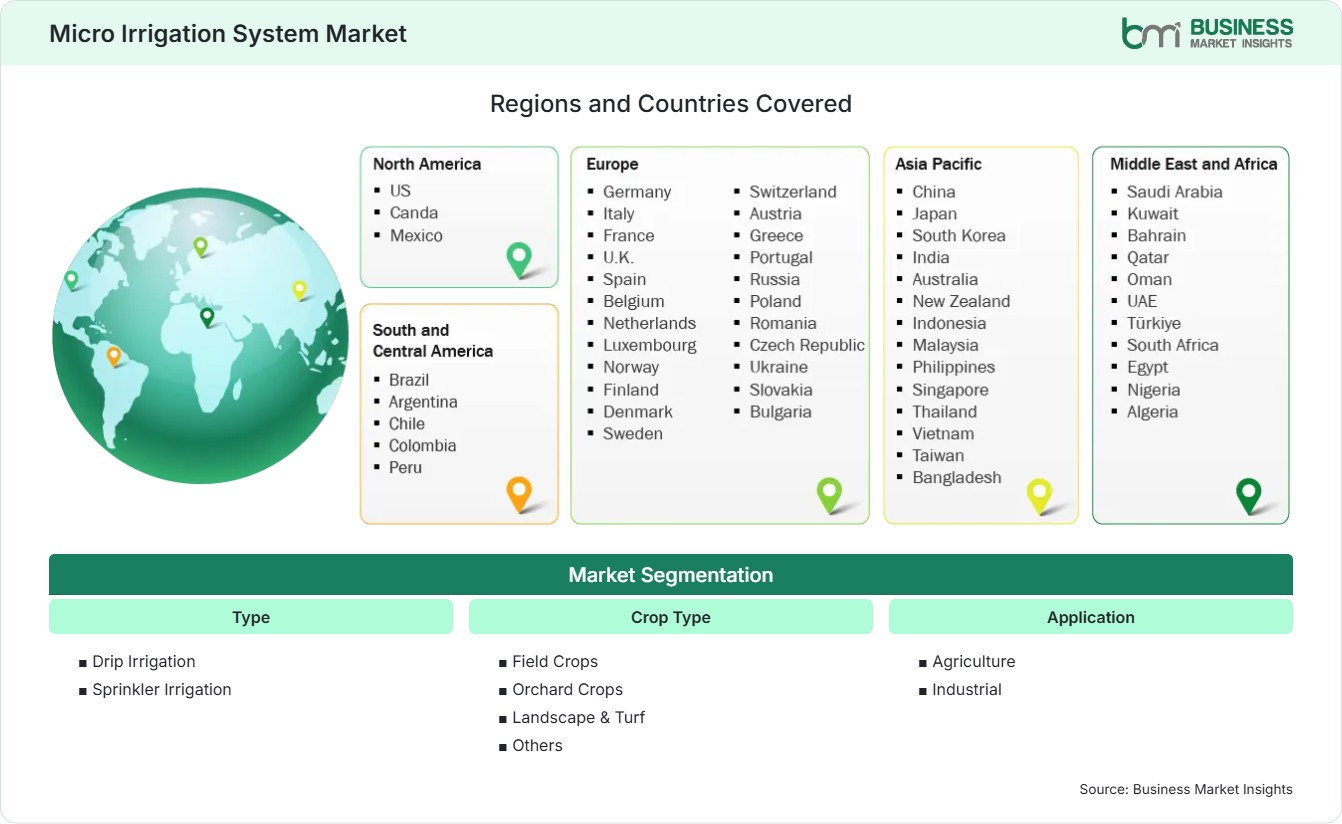
Global Market Geography
FREE PDF
Request your free sample
Request free sample
Segment Analysis

Micro Irrigation System Market Segmentation

Type

Type segment demand is shaped by water-use efficiency requirements, crop suitability, and automation compatibility. This segment held a significant Micro Irrigation System Market scope, with Drip Irrigation representing 58%–62% share in 2025 and expanding at 12.5%–13.5% CAGR, supported by water savings and productivity improvements.

  • Drip Irrigation: Delivers precise root-zone watering, supports fertigation, minimizes evaporation losses, and remains widely adopted across orchards, vineyards, vegetables, and commercial agriculture requiring efficient resource utilization.
  • Sprinkler Irrigation: Maintains broad suitability for field crops and landscape applications where uniform water distribution, operational flexibility, and large-area coverage remain essential adoption factors.

Crop Type

Crop-specific requirements strongly influence technology deployment patterns. Orchard and high-value crop cultivation increasingly relies on micro-irrigation systems because efficient water management directly impacts yield quality, productivity, and farm profitability. This segment remains central to evolving Micro Irrigation System Market trends.

  • Field Crops: Adoption increases where growers seek productivity gains, input optimization, and sustainable water management without extensive infrastructure expansion.
  • Orchard Crops: Strong demand stems from precise watering requirements, fertigation compatibility, and long-term productivity improvements in perennial crop cultivation.
  • Landscape & Turf: Utilized in commercial facilities, sports grounds, public infrastructure, and urban landscaping projects emphasizing efficient irrigation management.

Application

Application demand is dominated by farming activities, with Agriculture accounting for 82%–85% Micro Irrigation System Market share and achieving 12.8%–13.8% CAGR. Water conservation targets, increasing food demand, and modernization programs continue reinforcing adoption across diverse cultivation systems.

  • Agriculture: Benefits from productivity enhancement, efficient water utilization, fertigation integration, and improved resilience against climate-driven irrigation challenges.
  • Industrial: Used in green belts, industrial landscaping, environmental management applications, and facilities requiring controlled irrigation performance with sustainability objectives.
Market Forces

Micro Irrigation System Market Dynamics

Key Market Drivers

Escalating Water Scarcity and Conservation Mandates

Water stress is having a significant impact on major agricultural areas all over the world, which is making it more urgent to have efficient irrigation systems. Both the FAO and national water authorities continue to stress the need for improvements in agricultural water productivity. Compared to traditional methods, micro-irrigation technologies generally result in lower losses of water due to runoff and evaporation. This factor is helping to ensure that the systems are adopted in the long term in both developed and developing markets. Government incentives and subsidy schemes also promote the uptake of these systems among small as well as large farms. Since climate variability is becoming more severe, reliable irrigation infrastructure is becoming all the more important for ensuring crop productivity, profitability, and the mitigation of risk, thus maintaining demand in horticulture, in orchards, in vineyards and in large-scale agricultural operations.

Expansion of Precision Agriculture Technologies

Precision farming practices are transforming irrigation management through sensors, satellite analytics, remote monitoring, and automated scheduling. Farmers seek measurable efficiency gains from integrated platforms that connect irrigation infrastructure with agronomic decision-making tools. The Micro Irrigation System Market growth increasingly reflects adoption of digital agriculture solutions capable of optimizing water application and nutrient management. Technology providers are integrating artificial intelligence, weather forecasting systems, and field-level monitoring to improve irrigation precision. These capabilities support higher crop yields while reducing resource consumption. As digital agriculture investment expands globally, demand for intelligent irrigation systems continues strengthening throughout the forecast period.

Growth in High-Value Crop Cultivation

The need for efficient irrigation systems is being supported by the growth in the production of fruits, vegetables, nuts, vines, and plantation crops. In order to achieve the best possible quality and profitability, high-value crops usually demand that watering be carefully controlled. Farmers who grow crops for export are becoming more and more likely to spend money on technologies that can provide accurate irrigation and fertigation. The growing demand from consumers for fresh produce is also reinforcing the business argument for more resource-efficient methods of production. Commercial growers understand that better water management not only improves the consistency of their products but also reduces operational risks. As a result, these factors are leading to wider acceptance in both well-established agricultural areas and in farming economies that are rapidly modernising.

Key Market Opportunities

AI-Enabled Irrigation Decision Platforms

Irrigation systems increasingly generate operational data that can be transformed into actionable recommendations using artificial intelligence and predictive analytics. Companies developing integrated hardware-software ecosystems are positioned to capture value from this transition. Real-time recommendations regarding watering schedules, nutrient application, and weather adaptation improve farm management outcomes. Investment in digital solutions is expected to accelerate as connectivity improves across rural regions. These capabilities create recurring revenue opportunities through monitoring subscriptions and agronomic services. Micro Irrigation System Market Forecasts indicate growing interest in intelligent irrigation platforms capable of improving productivity while reducing water and energy consumption.

Emerging Market Agricultural Modernization

Modernisation programmes aimed at improving productivity and conserving resources are still being carried out in large agricultural economies in Asia, Africa and Latin America. The growing use of farm machinery, together with government-sponsored irrigation schemes, provides favourable conditions for the uptake of new technology. Increasing concern about the scarcity of water also strengthens the case for making investments. Companies that are expanding their local production and distribution capacities will be able to improve affordability and reach neglected markets. Because of the solid long-term prospects, demand can be expected from both small-scale farmers and commercial farms which are looking for sustainable increases in productivity. The above trends therefore provide great opportunities for both existing firms and regional specialists.

Integration of Renewable Energy and Irrigation

Solar-powered pumping systems and energy-efficient irrigation systems are becoming ever more appealing, especially in rural agricultural regions. By combining renewable energy with automated irrigation, operating costs are reduced and resilience is improved in areas where the reliability of the power grid is still a problem. This opportunity is in line with the sustainability goals set by governments and agribusiness organisations. Cooperation between suppliers of irrigation equipment, providers of renewable energy, and financing institutions can help speed up the implementation of such systems. Since energy efficiency is becoming an increasingly important factor when making purchases, integrated solutions are likely to be accepted more widely in all kinds of agricultural settings.

Market Restraints and Challenges

High Initial Capital Requirements

The cost of installing drip lines, filtration systems, controllers, pumps, and automation equipment can be very high, especially for small and financially limited farmers. As a result, uptake will probably continue to be slow in areas that do not have sufficient subsidies, financing assistance, or technical support. Although the long-term water savings and increases in productivity generally make the investment worthwhile, the initial outlay remains a major obstacle. This problem is especially clear in the case of fragmented farms, where the return on investment is carefully watched. Additionally, since access to agricultural credit is limited, the decision to modernise may be postponed even though there is increasing awareness of the benefits of efficient irrigation.

Maintenance Complexity and Technical Skill Gaps

The system has to be properly filtered, closely monitored, well maintained and have its components replaced from time to time in order to avoid clogging and keep its performance stable. If technicians do not have sufficient technical knowledge, the system's effectiveness will be reduced, which in turn will discourage broader use and lead to lower levels of user satisfaction. Farmers who are not familiar with precision irrigation methods may encounter difficulties when putting the system into operation. In areas where the service network is limited, maintenance costs and the amount of downtime will rise. Training schemes, support from dealers, and user-friendly technologies are needed in order to make system management easier while at the same time ensuring reliable long-term performance.

Company Analysis

Competitive Landscape

The competitive environment is characterized by product innovation, manufacturing expansion, and digital agriculture integration. Current Micro Irrigation System Market analysis indicates firms are focusing on automation, precision irrigation, monitoring solutions, and water-efficiency technologies.

Company Name

Overview

Products and Services relevant to this market

Netafim Ltd.

Global precision irrigation leader with extensive manufacturing and digital agriculture capabilities.

Drip irrigation systems, fertigation solutions, automation platforms, digital farming tools.

Rivulis Pte. Ltd.

International irrigation specialist serving growers across major agricultural regions.

Drip lines, sprinklers, filtration systems, automation and irrigation intelligence solutions.

Jain Irrigation Systems Limited

Leading agricultural solutions provider with strong micro-irrigation expertise.

Drip systems, sprinkler systems, pipes, agri-input and irrigation services.

The Toro Company

Diversified irrigation equipment manufacturer with global distribution presence.

Agricultural irrigation equipment, controllers, sprinklers, precision water management systems.

Rain Bird Corporation

Recognized irrigation technology provider serving agricultural and landscape markets.

Drip irrigation, valves, controllers, filtration and water management solutions.

Lindsay Corporation

Agricultural technology company focused on efficient irrigation operations.

Irrigation equipment, automation solutions, precision agriculture technologies.

Valmont Industries, Inc.

Infrastructure and irrigation company with broad agricultural offerings.

Irrigation technologies, monitoring solutions, water application systems.

Hunter Industries, Inc.

Irrigation equipment provider serving agricultural and landscape applications.

Controllers, drip systems, sprinklers, sensors and irrigation accessories.

Nelson Irrigation Corporation

Specialized irrigation manufacturer known for efficient watering technologies.

Sprinklers, pressure regulators, irrigation systems and related components.

Irritec S.p.A.

Precision irrigation specialist with strong international market presence.

Drip irrigation products, filtration, connectors, automation and fertigation solutions.

Trust & Transparency

Research Methodology

The market analysis combines proprietary research with secondary data from government agencies, company disclosures, regulatory filings, industry databases and expert interviews. Market estimates are validated through data triangulation, cross-market benchmarking and analyst review.

View Full Research Methodology

Questions Answered

Frequently Asked Questions

Which technologies are shaping future industry development?

Artificial intelligence, sensor networks, satellite imagery, remote monitoring platforms, automated fertigation systems, cloud-based irrigation management tools, and renewable-energy-powered irrigation infrastructure are shaping future adoption patterns.

How does a Micro Irrigation System Market Report help stakeholders?

It provides insights into demand drivers, regional opportunities, competitive positioning, technology trends, investment potential, regulatory influences, and future market outlook supporting strategic decision-making.

What factors influence purchasing decisions among growers?

Water-use efficiency, system reliability, maintenance requirements, automation capabilities, technical support availability, crop suitability, financing access, and total cost of ownership strongly influence procurement decisions.

Why is Asia Pacific the fastest-growing regional market?

Government subsidies, expanding food demand, agricultural modernization programs, increasing water stress, and rapid adoption of precision farming technologies accelerate market expansion across regional economies.

Which crop categories generate the strongest demand for micro-irrigation systems?

Orchard crops, vineyards, fruits, vegetables, nuts, and other high-value crop categories generate the strongest demand because irrigation precision directly influences yield quality, productivity, and farm profitability.

Access the Full Micro Irrigation System Market Report

Get segment-level forecasts, regional estimates, competitive benchmarking, company profiles and downloadable Excel datasets.

Access the full Micro Irrigation System Market Report
350 pages PDF & Excel | 2026-09-23
Similar Research

Related Market Reports