
Interior Design Market Outlook: Size, Share, Trends, Growth Analysis, Competitive Landscape & Forecast, 2026-2033

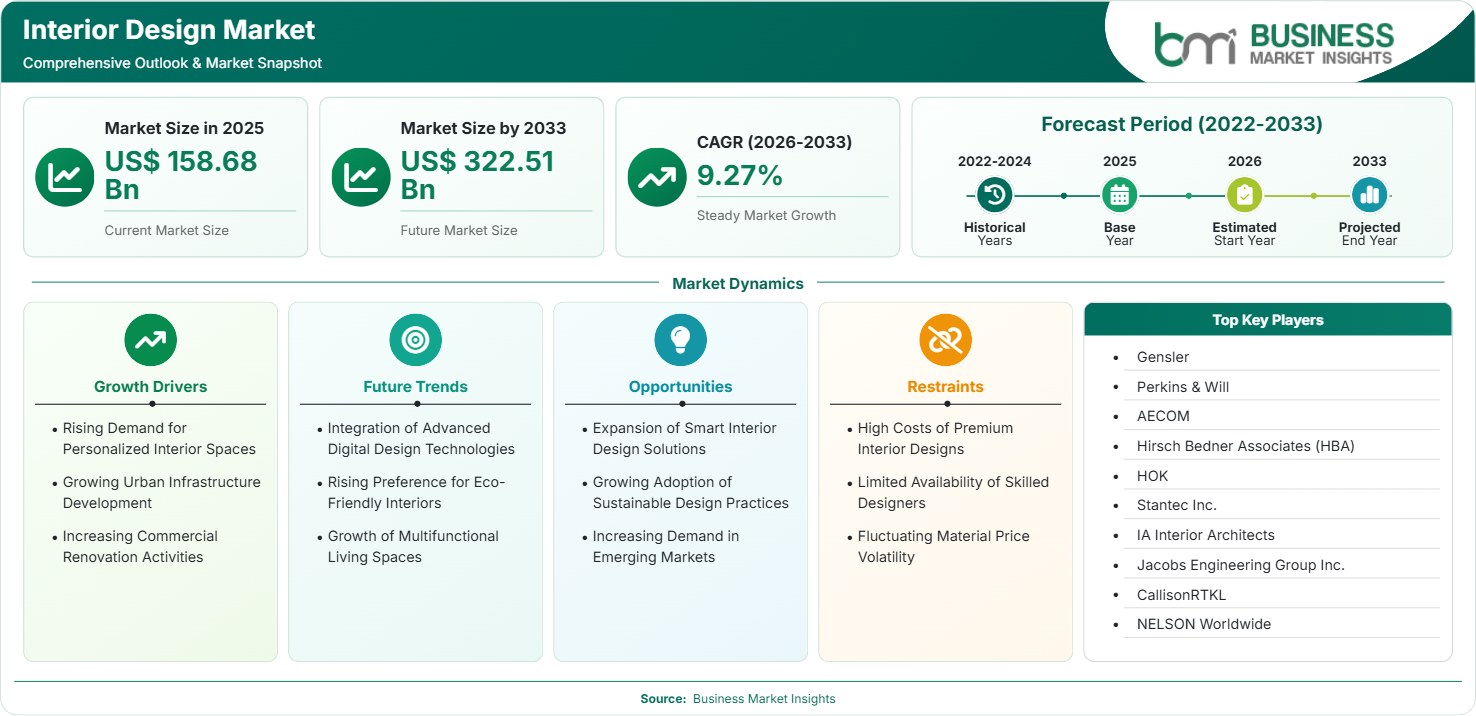
The Interior Design Market size was valued at USD 158.68 Billion in 2025 and is projected to reach USD 322.51 Billion by 2033, growing at a CAGR of 9.27% during 2026–2033, driven by personalized spaces, sustainable materials, smart design integration, urban development, and rising remodeling investments across residential, commercial, and hospitality sectors.

Report Coverage
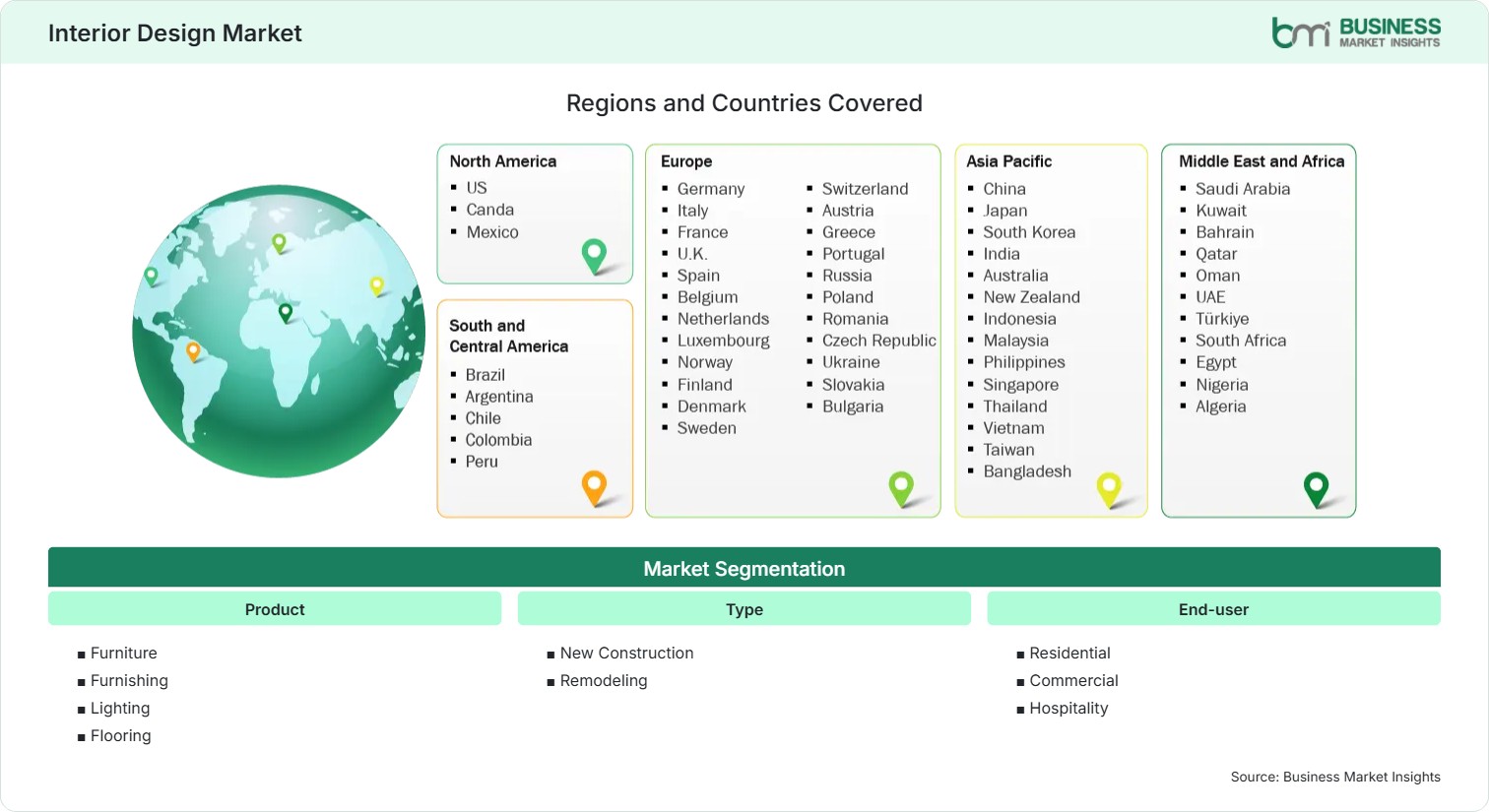
  • Product: Furniture, Furnishing, Lighting, Flooring
  • Type: New Construction, Remodeling
  • End-user: Residential, Commercial, Hospitality
US$ 158.68 Bn Market size in 2025
US$ 322.51 Bn Market Size by 2033
9.27% CAGR, 2026 - 2033
2026-2033 Forecast Period

01 AI Overview

Interior Design Market Summary

  • North America Region: North America holds a market share of 34%–37% in 2025, growing with a CAGR of 8.5%–10.0% based on high-end residential projects, workplace remodeling, sustainability of interiors, and technological developments. The US market has a high demand for custom-made interiors, with a CAGR of 8.8% to 10.2% during 2026–2033.
  • Fastest Growing Region: Asia Pacific holds a market share of 27%–30% in 2025, expanding with a CAGR of 10.5%–12.0% growing at a CAGR of 10.5% to 12.0% due to urbanization, rising disposable income, developments in hospitality and housing infrastructure, and increasing investments in interior solutions.
  • Leading Segment: Residential End-User Segment Market Share is estimated to be at 42%–45% in 2025, expanding at a CAGR of 9.0%–10.5%, which is propelled by home improvement needs, personalization in lifestyle, high-quality furniture, and digital design services
  • High Growth Segment: Commercial applications with smart interior designs command a market share of 18%–21% by 2025 and grow at a CAGR of 11.0%–13.0% due to automation, energy efficiency, office transformation, and intelligent buildings.
  • Key Market Opportunity: Increased use of sustainable material solutions, AI-driven design software tools, and investments in new markets will create opportunities for designers and manufacturers to deliver efficient, eco-friendly interior solutions worldwide.
  • Major Market Players: Gensler, Perkins & Will, AECOM, Hirsch Bedner Associates (HBA), HOK, Stantec Inc., IA Interior Architects, Jacobs Engineering Group Inc., CallisonRTKL, and NELSON Worldwide.
02 Strategic Insights

Interior Design Market: Strategic Insights

Interior Design Market Strategic Framework
FREE PDF
Request your free sample
Request free sample
03 Stakeholder View

Key Takeaways

  • Interior design value chains are becoming more integrated, connecting architects, designers, material suppliers, furniture manufacturers, technology providers, and construction companies through collaborative digital platforms and project management systems.
  • Home renovation and commercial area transformation are high-potential fields, as end-users and businesses prioritize practical designs, aesthetics, wellness environments, and dynamic interiors.
  • Advanced technologies like virtual reality visualization, artificial intelligence-driven design processes, and other digital technologies are revolutionizing how projects are carried out by enhancing accuracy, shortening design cycles, and improving customer involvement.
  • Asia-Pacific offers a compelling investment case owing to its rapid urbanization, growing middle-class spending, hotel development, and the need for modern residential and commercial interiors.
  • Strategic partnerships and mergers among interior design firms globally, architecture firms, and technology providers have been on the rise as companies seek to expand their geographic footprint and offer comprehensive service offerings.
  • Sustainability is emerging as a differentiator as people choose recyclable materials, efficient design, and sustainable design practices to comply with changing regulations and customer demands.
04 Geographic Outlook

Interior Design Market Regional Highlights

North America Interior Design Market

North America accounted for a 34%–37% share in 2025 and is projected to grow at a CAGR of 8.5%–10.0% during 2026–2033. This region also offers top-notch remodeling services for both residential and commercial settings, as well as hospitality and sustainable design. The Interior Design Market is enjoying high demand in the United States and Canada due to the use of technology, luxury interiors, and investment in adaptive reuse.

  • Growing workplace redesign initiatives are accelerating demand for flexible office interiors, collaborative spaces, and employee-centric environments across major corporate hubs and urban business districts.
  • Sustainable materials and green building certifications are influencing interior projects as developers prioritize energy efficiency, recycled products, and environmentally responsible design strategies.
  • Luxury residential renovations are increasing due to higher consumer spending on customized furniture, premium finishes, smart home integration, and personalized living environments.
  • Digital visualization technologies, including virtual reality and 3D modeling, are improving client engagement, reducing design revisions, and enhancing project planning efficiency across professional studios.

US Interior Design Market

The US represented a 29%–32% share in 2025 and is expected to expand at a CAGR of 8.8%–10.2% from 2026–2033. The country remains a leading contributor due to commercial renovation, residential remodeling, hospitality expansion, and demand for technology-enabled interiors. The Interior Design Market growth in the US is influenced by changing workplace models, premium housing developments, and increasing focus on wellness-oriented spaces.

  • Commercial renovation projects are increasing as companies redesign offices with hybrid work layouts, collaboration zones, ergonomic furniture, and employee wellness-focused interiors.
  • Residential consumers are investing in customized interiors, smart home features, and premium furnishings to improve comfort, functionality, and property value.
  • Hospitality operators are upgrading hotels and resorts with experiential designs, sustainable materials, and personalized guest environments to strengthen competitive positioning.

Europe Interior Design Market

Europe held a 24%–27% share in 2025 and is estimated to register a CAGR of 7.5%–9.0% during 2026–2033. Germany, the United Kingdom, France, and Italy remain important markets, while Poland shows increasing design activity. The region emphasizes sustainable architecture, heritage renovation, energy-efficient interiors, and regulatory-driven adoption of environmentally responsible materials across residential and commercial projects.

  • Germany demonstrates steady growth through sustainable building practices, industrial design expertise, and demand for energy-efficient interior solutions in commercial developments.
  • The United Kingdom is adopting flexible workplace interiors, hospitality redesign projects, and technology-supported design approaches to enhance modern commercial environments.
  • France and Italy maintain strong demand for premium furniture, luxury interiors, and design-led residential projects supported by established creative industries.
  • Poland is experiencing rising interior investment due to urban development, residential construction growth, and increasing consumer preference for contemporary living spaces.

Asia Pacific Interior Design Market

Asia Pacific captured a 27%–30% share in 2025 and is forecast to expand at a CAGR of 10.5%–12.0% through 2026–2033. China, India, Japan, and Southeast Asian countries drive regional demand through urbanization, infrastructure development, hospitality expansion, and rising household expenditure. The Interior Design Market share is increasing as developers adopt modern layouts, sustainable solutions, and technology-integrated interiors.

  • China continues supporting market expansion through residential construction, commercial developments, smart buildings, and increasing demand for contemporary interior solutions.
  • India is experiencing strong growth from urban housing projects, commercial infrastructure expansion, hospitality investments, and rising consumer spending on customized interiors.
  • Japan focuses on compact living solutions, multifunctional furniture, aging-friendly designs, and technology-enabled interiors suited for changing demographic needs.
  • Southeast Asian markets are attracting investments through tourism development, residential projects, and growing demand for premium hospitality interiors.

Rest of World Interior Design Market

Rest of World accounted for a 9%–11% share in 2025 and is projected to grow at a CAGR of 8.0%–10.0% during 2026–2033. South and Central America, along with Middle East and Africa markets, are expanding through hospitality projects, urban development, commercial investments, and luxury residential construction. Brazil, Mexico, UAE, and Saudi Arabia are emerging contributors.

  • Brazil and Mexico are witnessing increased demand for residential remodeling, commercial spaces, and modern interior concepts driven by urban population growth.
  • Middle Eastern countries are investing in luxury hotels, mixed-use developments, and premium residential projects requiring advanced interior design services.
  • UAE benefits from tourism expansion, real estate development, and high-end hospitality projects supporting demand for innovative interior solutions.
  • Saudi Arabia is creating opportunities through large-scale urban transformation initiatives, commercial developments, and hospitality infrastructure investments.
  • African markets are gradually adopting contemporary interiors due to increasing urbanization, commercial construction, and rising investment in modern residential spaces.
Global Market Geography
FREE PDF
Request your free sample
Request free sample
05 Segment Analysis

Interior Design Market Segmentation

Product

The product segment represents a core component of the market, with furniture accounting for a leading 38%–41% share in 2025 and expanding at a CAGR of 8.5%–10.0% between 2026–2034. Demand is supported by customization, premium materials, modular solutions, and changing lifestyle preferences. The Interior Design Market scope continues expanding through integrated product ecosystems combining aesthetics, functionality, and sustainability.

  • Furniture: Furniture remains a dominant product category, supported by residential upgrades, commercial workspace redesign, modular solutions, ergonomic requirements, and increasing consumer preference for customized interior arrangements.
  • Furnishing: Furnishing products gain traction through demand for decorative elements, textiles, curtains, accessories, and personalized styling solutions that enhance comfort, aesthetics, and overall interior experiences.
  • Lighting: Lighting solutions are evolving through smart controls, energy-efficient technologies, and architectural applications that improve ambiance, functionality, and sustainability across residential and commercial interior projects.
  • Flooring: Flooring demand is supported by durable materials, aesthetic variety, renovation activities, and growing adoption of sustainable flooring options for modern residential and commercial environments.

Type

The type segment is influenced by construction cycles, renovation activity, and changing consumer preferences. Remodeling accounted for a 54%–57% share in 2025, while the segment is expected to grow at a CAGR of 9.5%–11.0% between 2026–2034. Increasing property upgrades, adaptive reuse projects, and demand for modern spaces are strengthening opportunities across residential and commercial applications.

  • New Construction: New construction projects drive demand through residential developments, commercial buildings, hospitality facilities, and integrated interior planning during initial architectural design phases.
  • Remodeling: Remodeling activities are expanding due to aging infrastructure, lifestyle changes, property value enhancement, sustainability upgrades, and increasing demand for personalized living and working environments.

End User

The end-user segment demonstrates diverse adoption patterns, with residential applications representing a leading 42%–45% share in 2025 and growing at a CAGR of 9.0%–10.5% through 2026–2034. Rising personalization demand, urban housing development, and lifestyle transformation continue influencing design investments. Commercial and hospitality sectors provide additional growth opportunities through workplace modernization and experience-focused environments.

  • Residential: Residential interiors are expanding through home renovation, customized layouts, smart home integration, premium furnishings, and consumer interest in comfortable, functional, and personalized spaces.
  • Commercial: Commercial applications are increasing through office redesign, retail transformation, corporate branding initiatives, and demand for productive environments supporting hybrid workplace models.
  • Hospitality: Hospitality interiors are growing through hotel renovations, luxury accommodation projects, tourism development, and demand for immersive guest experiences using distinctive design concepts.
06 Market Forces

Interior Design Market Dynamics

Key Market Drivers

Rising Demand for Personalized Interior Spaces

Increasing consumer preference for customized living and working environments is accelerating demand for personalized interior solutions across residential, commercial, and hospitality sectors. Customers are increasingly seeking unique layouts, premium finishes, multifunctional furniture, and design concepts that reflect individual lifestyles and brand identities. Market growth is supported by rising disposable incomes, evolving housing preferences, and increased spending on home improvement projects. Designers are adopting digital visualization tools, 3D modeling, and virtual reality platforms to provide customized experiences before project execution. The Interior Design Market trends are also influenced by wellness-focused interiors, ergonomic solutions, and flexible space planning approaches that enhance comfort, functionality, and user engagement across modern environments.

Growing Urban Infrastructure Development

Expansion of urban infrastructure is creating sustained demand for interior design services across residential complexes, commercial buildings, healthcare facilities, educational institutions, and public spaces. Rapid urbanization is increasing the need for efficient space utilization, modern architectural concepts, and functional interiors in newly developed cities. According to the United Nations, urban populations are projected to continue expanding toward 2050, supporting long-term construction and renovation requirements globally. Developers are increasingly integrating sustainable materials, energy-efficient systems, and smart design elements into new projects to meet environmental standards and consumer expectations. Growing infrastructure investments across Asia Pacific, the Middle East, and Latin America are generating opportunities for interior designers, product manufacturers, and technology providers.

Increasing Commercial Renovation Activities

Rising commercial renovation activities are strengthening demand for advanced interior design solutions as businesses transform offices, retail spaces, and hospitality environments. Companies are redesigning workplaces to support hybrid working models, employee wellness, collaboration, and productivity enhancement. Retail operators are investing in experience-driven environments to improve customer engagement, while hospitality providers are upgrading interiors to deliver premium guest experiences. The shift toward adaptive reuse of existing commercial buildings is also increasing demand for modern layouts, sustainable materials, and efficient space management solutions. Interior firms are leveraging digital planning technologies and innovative product portfolios to manage complex renovation projects. This trend is creating opportunities for designers and suppliers offering integrated design, consulting, and execution capabilities.

Key Market Opportunities

Expansion of Smart Interior Design Solutions

The expansion of smart interior design solutions is creating new opportunities through integration of connected technologies, automated systems, and intelligent building features. Smart lighting, automated climate control, voice-enabled systems, and sensor-based solutions are becoming important elements of modern interiors across residential and commercial applications. Businesses and homeowners are increasingly adopting technology-enabled spaces to improve convenience, energy efficiency, and user experience. The Interior Design Market Forecasts indicate increasing investment opportunities as smart buildings and digital infrastructure become more widespread globally. Interior design companies are collaborating with technology providers to develop integrated solutions combining aesthetics with functionality. This shift is encouraging innovation in product development, service models, and customized design experiences.

Growing Adoption of Sustainable Design Practices

Growing adoption of sustainable design practices is opening opportunities for manufacturers and designers focused on environmentally responsible solutions. Increasing awareness regarding climate impact is encouraging the use of recycled materials, energy-efficient lighting, low-emission products, and sustainable furniture options. Green building certifications and environmental regulations are influencing project decisions across residential, commercial, and hospitality developments. Developers are prioritizing designs that reduce resource consumption while maintaining aesthetic appeal and operational efficiency. Interior design firms are expanding their capabilities by incorporating circular design principles, renewable materials, and responsible sourcing strategies. This opportunity is strengthened by growing consumer demand for healthier indoor environments and increasing corporate commitments toward sustainability targets.

Increasing Demand in Emerging Markets

Emerging markets are providing significant growth opportunities due to rapid urbanization, rising household incomes, infrastructure development, and expanding hospitality sectors. Countries across Asia Pacific, the Middle East, and Latin America are witnessing increased demand for modern residential interiors, commercial spaces, and luxury hospitality projects. Growing middle-class populations are driving interest in premium furnishings, customized designs, and contemporary living concepts. Governments investing in urban development and tourism infrastructure are creating additional opportunities for international design firms and suppliers. Interior Design Market participants are expanding regional presence through partnerships, localized services, and technology-enabled design platforms. These markets offer long-term potential due to evolving consumer preferences and increasing adoption of global interior design standards.

Market Restraints and Challenges

High Costs of Premium Interior Designs

Factor: Premium interior design projects often involve expensive materials, specialized craftsmanship, advanced technologies, and customized solutions, creating affordability challenges for many customers. Factor: Increasing costs of luxury furnishings, imported materials, and skilled design services raise overall project expenditure. Impact: Higher budgets can limit adoption among price-sensitive consumers and small businesses, slowing demand in certain market segments. Additionally, fluctuations in material availability and supply chain disruptions can further increase project costs and extend completion timelines. Interior design companies are addressing this challenge by introducing modular solutions, cost-efficient alternatives, and scalable design packages. However, maintaining quality standards while controlling expenses remains a key challenge for Interior Design market participants targeting broader customer segments.

Limited Availability of Skilled Designers

Factor: The shortage of experienced interior designers with expertise in advanced technologies, sustainable practices, and complex project management is restricting industry scalability. Factor: Growing demand for specialized design capabilities exceeds the availability of professionals trained in digital tools, smart solutions, and environmentally responsible design methods. Impact: Limited skilled workforce availability can increase project timelines, raise service costs, and constrain firms managing multiple large-scale projects simultaneously. The challenge is particularly relevant in emerging markets where professional design education and industry training infrastructure are still developing. Companies are responding through digital collaboration platforms, training programs, and technology-assisted design workflows to improve efficiency and expand service capabilities.

07 Company Analysis

Competitive Landscape

The Interior Design Market analysis highlights a competitive environment driven by global architecture firms, workplace design specialists, engineering consultancies, and hospitality-focused interior design companies. Leading participants are expanding capabilities through sustainable design expertise, digital visualization technologies, integrated architecture services, and global project execution networks. Companies are focusing on customized solutions, strategic collaborations, and technology adoption to address evolving requirements across residential, commercial, and hospitality applications.

Company Name

Overview

Products and Services relevant to this market

Gensler

Gensler is a global architecture and design firm specializing in workplace, hospitality, residential, and commercial interior environments with worldwide project expertise.

Interior architecture, workplace strategy, hospitality design, retail environments, experiential design, consulting services, and sustainable design solutions.

Perkins & Will

Perkins & Will is an international architecture and design firm focused on human-centered, sustainable, and innovative built environments.

Interior design, architecture services, healthcare interiors, workplace solutions, educational spaces, research-driven sustainable design, and planning services.

AECOM

AECOM provides infrastructure consulting and design services supporting complex commercial, urban, and institutional development projects globally.

Interior planning, architecture consulting, workplace design, project management, infrastructure design, and integrated development solutions.

Hirsch Bedner Associates (HBA)

Hirsch Bedner Associates (HBA) is a leading hospitality design firm specializing in luxury hotels, resorts, and branded guest experiences worldwide.

Hospitality interiors, hotel design, luxury residential projects, branding concepts, guest experience design, and interior consulting services.

HOK

HOK is a global design, architecture, and engineering firm delivering innovative solutions for commercial and institutional environments.

Workplace interiors, healthcare design, hospitality environments, sustainable architecture, space planning, and integrated design services.

Stantec Inc.

Stantec Inc. provides architecture, engineering, and design services focused on sustainable and community-oriented projects across global markets.

Interior architecture, commercial design, healthcare interiors, workplace solutions, environmental design, and project consulting services.

IA Interior Architects

IA Interior Architects specializes in workplace design and corporate environments, helping organizations create functional and engaging spaces.

Workplace interiors, corporate strategy, space planning, design consulting, technology integration, and employee experience solutions.

Jacobs Engineering Group Inc.

Jacobs Engineering Group Inc. delivers professional services for complex infrastructure, technology, and building development projects worldwide.

Interior planning, facility design, engineering services, workplace solutions, project management, and architectural consulting.

CallisonRTKL

CallisonRTKL is a global design consultancy focused on retail, hospitality, residential, and mixed-use environments.

Retail interiors, hospitality design, residential planning, mixed-use developments, customer experience design, and architectural services.

NELSON Worldwide

NELSON Worldwide provides workplace, retail, and experiential design solutions focused on transforming business environments.

Workplace design, retail interiors, brand environments, space planning, architecture services, and design strategy consulting.

08 Industry Activity

Recent Developments

December 2025

HNI Corporation announced the completion of its acquisition of Steelcase Inc., to meet the dynamic challenges and evolving needs of the workplace amid accelerating in-office work trends.

December 2024

Gensler published its Design Forecast 2025, highlighting emerging trends in workplace transformation, adaptive reuse, wellness-focused interiors, sustainable materials, and AI-enabled design, providing strategic insights for the future of interior environments.

October, 2025: MillerKnoll, Inc. continues to build on its research-driven approach to workplace planning to help organizations support employee well-being. MillerKnoll’s approach addresses mobility, sensory processing, hormonal health, neurodiversity, and more, reflecting its commitment to designing spaces that adapt to people.

August, 2025: Stantec Inc completed the acquisition of Page, significantly expanding its architecture, interior design, engineering, and planning capabilities across North America, strengthening its portfolio in commercial, healthcare, education, and civic building projects.

10 Trust & Transparency

Research Methodology

The market analysis combines proprietary research with secondary data from government agencies, company disclosures, regulatory filings, industry databases and expert interviews. Market estimates are validated through data triangulation, cross-market benchmarking and analyst review.

View Full Research Methodology

11 Questions Answered

Frequently Asked Questions

What insights are provided in the Interior Design Market Report?

The Interior Design Report evaluates industry dynamics, competitive positioning, segmentation trends, regional opportunities, application areas, growth drivers, challenges, and strategic developments influencing market expansion through 2033. It supports stakeholders in understanding investment opportunities and evolving market requirements.

What role does sustainability play in interior design projects?

Sustainability is becoming a key decision factor as customers and developers prioritize recycled materials, energy-efficient systems, low-impact products, and environmentally responsible design practices. Green building requirements are encouraging interior firms to adopt circular design approaches and sustainable sourcing strategies.

How are technology advancements impacting interior design services?

Technology is improving design accuracy through virtual reality, 3D visualization, artificial intelligence-assisted planning, and digital collaboration platforms. These tools enable designers to create realistic concepts, reduce project revisions, and improve communication between clients, architects, and contractors.

Which segment holds strong growth potential in interior design applications?

The commercial segment demonstrates strong potential due to workplace modernization, retail experience enhancement, hospitality expansion, and renovation activities. Businesses are increasingly investing in interiors that improve productivity, customer engagement, operational efficiency, and brand identity.

What factors are influencing the future direction of the Interior Design Market?

The market direction is being shaped by personalized spaces, sustainable materials, digital design technologies, smart interiors, and increasing demand for flexible residential and commercial environments. Changing consumer preferences and evolving workplace concepts are encouraging firms to develop more customized and technology-enabled solutions.

Access the Full Interior Design Market Report

Get segment-level forecasts, regional estimates, competitive benchmarking, company profiles and downloadable Excel datasets.

Access the full Interior Design Market Report
350 pages PDF & Excel | 2026-07-27