
Rotary Lobe Pump Market Outlook: Size, Share, Trends, Growth Analysis, Competitive Landscape & Forecast, 2026-2033

The Rotary Lobe Pump Market size was valued at USD 1.56 Billion in 2025 and is projected to reach USD 2.97 Billion by 2033, growing at a CAGR of 8.4% during 2026–2033. Increasing demand for hygienic fluid transfer applications within the food processing and pharmaceutical industries, along with the investments being made in waste water treatment systems, are contributing towards the growth of the market. Industrial automation and efficient pumping technology offer growth potential to pump manufacturers.

Report Coverage
  • Flow Rate: Up to 1000L/h, 1000-50,000 L/h, 50,001-200,000 L/h, 200,001-600,000 L/h and Above 600,000 L/h
  • Application: Food & Beverage, Pharmaceutical, Wastewater Management, Pulp & Paper, Chemical, Petroleum, Others
US$ 1.56 Bn Market size in 2025
US$ 2.97 Bn Market Size by 2033
8.4% CAGR, 2026 - 2033
2026-2033 Forecast Period

01 AI Overview

Rotary Lobe Pump Market Summary

  • North America Region: North America holds a market share of 33%–36% in 2025 and is projected to expand at a CAGR of 7.8%–8.3% during 2026–2033. Demand is supported by modernization of food processing facilities, pharmaceutical production, and municipal wastewater infrastructure. The US remains the leading contributor, advancing at a CAGR of 7.9%–8.4% through sustained industrial investments and process automation.
  • Fastest Growing Region: Asia Pacific accounts for 28%–31% of the market in 2025 while registering the fastest CAGR of 9.2%–9.8% during the forecast period. Expanding food manufacturing, pharmaceutical production, industrial wastewater treatment, and chemical processing continue creating attractive opportunities for rotary lobe pump manufacturers.
  • Leading Segment: Application – Food & Beverage represents 30%–33% of the market in 2025 and is expected to grow at a CAGR of 8.0%–8.5% through 2033. Strict hygiene standards, increasing processed food production, and demand for gentle product handling continue supporting segment leadership.
  • High Growth Segment: Application – Pharmaceutical accounts for 17%–20% of the market in 2025 and is projected to expand at a CAGR of 9.5%–10.1%. Rising biologics manufacturing, hygienic processing requirements, and pharmaceutical capacity expansion continue accelerating demand for precision pumping solutions.
  • Key Market Opportunity: Increasing investment in advanced wastewater treatment facilities and hygienic industrial processing is creating sustained opportunities for high-efficiency rotary lobe pumps with digital monitoring, low maintenance requirements, and superior operational reliability.
  • Major Market Players: Börger GmbH, Alfa Laval AB, NETZSCH Group, GEA Group AG, Vogelsang GmbH & Co. KG, SPX FLOW, Inc., LobePro, Verder Liquids B.V., INOXPA Group, Wright Flow Technologies.
03 Stakeholder View

Key Takeaways

  • The industry value chain is becoming increasingly integrated as manufacturers strengthen partnerships with component suppliers, automation providers, distributors, and aftermarket service companies to deliver complete fluid handling solutions with improved lifecycle support.
  • Food processing, pharmaceutical manufacturing, and wastewater treatment applications present the strongest commercial opportunities as regulatory compliance, hygienic production requirements, and infrastructure investments continue increasing equipment demand.
  • Product innovation is centered on energy-efficient motors, wear-resistant rotor designs, digital condition monitoring, hygienic certifications, and predictive maintenance technologies that improve operational reliability while reducing lifecycle operating costs.
  • Asia Pacific represents the most attractive regional investment destination owing to expanding industrial production, growing pharmaceutical manufacturing, increasing processed food demand, and large-scale investments in municipal wastewater treatment infrastructure.
  • Strategic acquisitions, regional manufacturing expansion, and distributor partnerships remain key competitive strategies as companies strengthen Rotary Lobe Pump market presence, improve supply chain resilience, and expand customer support capabilities across emerging industrial markets.
  • Growing demand for customized pumping solutions capable of handling high-viscosity, shear-sensitive, and abrasive fluids is encouraging manufacturers to invest in advanced engineering capabilities, application-specific product development, and value-added aftermarket services.
04 Geographic Outlook

Rotary Lobe Pump Market Regional Highlights

North America Rotary Lobe Pump Market

North America accounts for 33%–36% of the global market in 2025 and is projected to expand at a CAGR of 7.8%–8.3% during 2026–2033. The Rotary Lobe Pump Market share in the region is supported by strong demand from food processing, pharmaceutical manufacturing, and municipal wastewater treatment. Increasing investments in industrial automation and hygienic fluid handling systems continue strengthening equipment replacement and new installations across diverse process industries.

  • Stringent food safety regulations encourage manufacturers to adopt hygienic rotary lobe pumps that ensure contamination-free fluid transfer, easy cleaning, and compliance with sanitary processing standards across food and beverage production facilities.
  • Pharmaceutical manufacturers continue upgrading production lines with precision pumping systems capable of handling sensitive formulations while meeting stringent quality, sterility, and regulatory compliance requirements for modern drug manufacturing.
  • Municipal wastewater treatment upgrades are increasing demand for durable positive displacement pumps capable of handling sludge, viscous fluids, and abrasive media while maintaining reliable operational performance.
  • Adoption of digital monitoring, predictive maintenance, and energy-efficient pumping technologies enables industrial operators to improve process reliability, reduce maintenance costs, and optimize overall plant productivity.
  • Growing investments in industrial modernization and sustainable manufacturing practices continue supporting demand for advanced pumping equipment across chemical, food, and environmental applications.

US Rotary Lobe Pump Market

The United States represents 26%–29% of the global Rotary Lobe Pump market in 2025 and is expected to register a CAGR of 7.9%–8.4% through 2033. Expansion of pharmaceutical production, increasing processed food demand, and modernization of municipal infrastructure continue driving equipment adoption. Industrial facilities are increasingly investing in efficient fluid handling technologies to improve productivity, reduce operating costs, and comply with stringent environmental and hygiene regulations.

  • Food manufacturers continue investing in hygienic production equipment to support higher processing efficiency while complying with evolving food safety regulations and consumer quality expectations.
  • Expanding pharmaceutical manufacturing facilities require reliable positive displacement pumps capable of accurately transferring high-value and shear-sensitive pharmaceutical formulations.
  • Municipal utilities continue replacing aging pumping infrastructure with energy-efficient equipment supporting improved wastewater management and lower lifecycle operating costs.
  • Smart manufacturing initiatives encourage adoption of digitally connected pumping systems that improve equipment monitoring, maintenance planning, and operational efficiency across industrial facilities.

Europe Rotary Lobe Pump Market

Europe holds 27%–30% of the market in 2025 and is projected to grow at a CAGR of 8.0%–8.5% during the forecast period. Strong environmental regulations, advanced food processing industries, and established pharmaceutical manufacturing continue supporting Rotary Lobe Pump market growth. Germany leads regional demand through its extensive industrial base, while Poland records the fastest growth owing to expanding manufacturing investments and wastewater infrastructure development.

  • Germany maintains market leadership through advanced industrial automation, strong food processing capacity, and continuous investments in high-performance hygienic pumping technologies.
  • Poland demonstrates the highest regional growth as manufacturing expansion and municipal infrastructure investments increase demand for reliable industrial fluid handling systems.
  • Sustainability initiatives encourage industries to replace conventional pumping equipment with energy-efficient technologies capable of reducing electricity consumption and maintenance requirements.
  • Pharmaceutical and biotechnology companies continue investing in hygienic production systems supporting contamination-free processing and regulatory compliance.
  • Digital process control and predictive maintenance technologies continue improving equipment utilization across food, beverage, and chemical manufacturing facilities.

Asia Pacific Rotary Lobe Pump Market

Asia Pacific captures 28%–31% of the global market in 2025 while recording the fastest CAGR of 9.2%–9.8% through 2033. Rapid industrialization, urbanization, and expansion of food processing, pharmaceutical manufacturing, and wastewater treatment infrastructure continue driving demand. China dominates regional revenue, while India registers the fastest growth due to increasing industrial investments and expanding process manufacturing activities.

  • China continues strengthening domestic manufacturing capabilities while increasing investments in food processing, chemicals, and wastewater treatment facilities requiring advanced rotary lobe pumping systems.
  • India records the strongest regional growth as pharmaceutical manufacturing, dairy processing, and municipal wastewater treatment projects continue expanding nationwide.
  • Southeast Asian economies are witnessing increasing investments in food processing and industrial manufacturing, creating new opportunities for hygienic positive displacement pump suppliers.
  • Government initiatives supporting environmental protection and wastewater treatment continue accelerating replacement of outdated pumping infrastructure across major industrial sectors.
  • Rising adoption of Industry 4.0 technologies encourages manufacturers to integrate intelligent pumping systems with automated production environments.

Rest of World Rotary Lobe Pump Market

The Rest of World accounts for 8%–11% of the global market in 2025 and is expected to expand at a CAGR of 8.1%–8.7% during 2026–2033.

South & Central America is witnessing increasing investments in food processing, mining, and municipal wastewater treatment. Brazil leads regional demand through its expanding industrial sector, while Chile demonstrates the fastest growth supported by modernization of food and beverage manufacturing.

The Middle East & Africa continues investing in industrial diversification, water treatment infrastructure, and food production capacity. Saudi Arabia remains the largest regional market, whereas the United Arab Emirates records the highest growth through industrial automation and infrastructure development.

  • Brazil continues strengthening food processing and wastewater treatment infrastructure, increasing demand for durable positive displacement pumping systems across municipal and industrial applications.
  • Chile is experiencing rapid adoption of hygienic pumping equipment as food exports, beverage production, and industrial modernization projects continue expanding.
  • Saudi Arabia supports regional demand through investments in industrial manufacturing, desalination, and wastewater management under long-term economic diversification initiatives.
  • The United Arab Emirates continues adopting advanced industrial processing technologies and automated manufacturing systems that require reliable, high-efficiency fluid handling equipment.
  • Growing environmental compliance requirements and industrial sustainability initiatives continue encouraging replacement of conventional pumping systems with energy-efficient rotary lobe pump technologies.
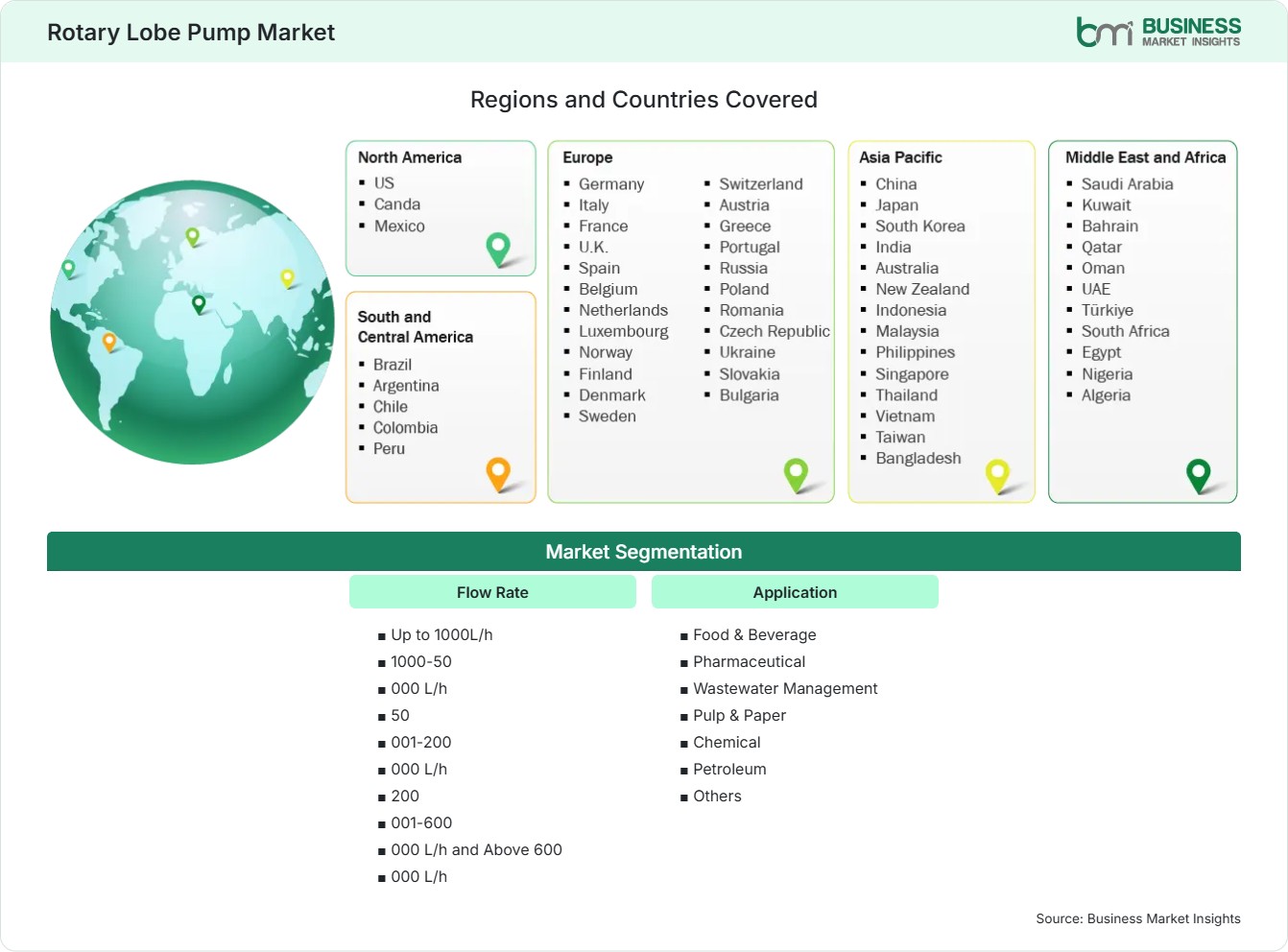
Global Market Geography
FREE PDF
Request your free sample
Request free sample
05 Segment Analysis

Rotary Lobe Pump Market Segmentation

Flow Rate

Flow Rate remains a key purchasing parameter influencing pump selection across industrial applications based on throughput requirements, fluid characteristics, and operational efficiency. The 1000–50,000 L/h segment accounts for 36%–39% of the market in 2025 and the overall segment is projected to grow at a CAGR of 8.3%–8.8% during 2026–2033. The Rotary Lobe Pump Market scope continues to expand as industries increasingly adopt application-specific pumping solutions for improved process performance.

  • Up to 1000L/h: These pumps are widely used in laboratories, pilot plants, pharmaceutical production, and specialty food processing where accurate flow control and gentle handling of sensitive fluids remain essential.
  • 1000–50,000 L/h: This segment dominates owing to widespread deployment across food processing, dairy, chemical manufacturing, and wastewater treatment where balanced flow capacity and operational efficiency are critical.
  • 50,001–200,000 L/h: Growing industrial production and expanding municipal wastewater treatment facilities continue increasing demand for medium-to-high-capacity rotary lobe pumps capable of handling viscous and abrasive fluids.
  • 200,001–600,000 L/h: High-capacity pumps support continuous processing operations in pulp and paper, mining, wastewater management, and large chemical facilities requiring reliable, uninterrupted fluid transfer.
  • Above 600,000 L/h: These pumps serve large infrastructure projects and heavy industrial operations where maximum throughput, robust construction, and high operational reliability remain primary purchasing considerations.

Application

Application continues to define product innovation and market demand according to industry-specific processing requirements. Food & Beverage accounts for 30%–33% of the market in 2025 while the segment is expected to expand at a CAGR of 8.0%–8.5% during the forecast period. Increasing hygiene requirements and process automation continue shaping Rotary Lobe Pump Market trends across multiple end-use industries.

  • Food & Beverage: Hygienic rotary lobe pumps remain extensively used for dairy products, beverages, sauces, confectionery, and other food applications requiring contamination-free processing and gentle product handling.
  • Pharmaceutical: Pharmaceutical manufacturers increasingly deploy sanitary pumping systems for sterile formulations, biologics, vaccines, and other high-value products requiring precise and contamination-free fluid transfer.
  • Wastewater Management: Municipal and industrial wastewater facilities utilize rotary lobe pumps for sludge transfer, chemical dosing, and handling abrasive fluids while maintaining consistent operational performance.
  • Pulp & Paper: Paper manufacturers employ rotary lobe pumps for transferring pulp stock, coatings, additives, and process chemicals while minimizing maintenance and ensuring continuous production efficiency.
  • Chemical: Chemical processing plants rely on rotary lobe pumps to handle corrosive, viscous, shear-sensitive, and hazardous fluids under demanding operating conditions with high reliability.
  • Petroleum: Petroleum facilities utilize these pumps for transferring lubricants, heavy oils, additives, and specialty fluids where consistent flow rates and durability are essential.
  • Others: Additional applications include cosmetics, personal care products, biotechnology, agriculture, paints, adhesives, and other industrial processes requiring efficient positive displacement fluid handling.
06 Market Forces

Rotary Lobe Pump Market Dynamics

Key Market Drivers

Rising Demand from Food and Beverage Processing Industries

The expansion of processed food, dairy, beverage, and ready-to-eat product manufacturing continues to increase demand for hygienic pumping equipment. The rotary lobe pumps are highly desirable due to their capability of transferring shear sensitive materials while retaining product integrity and ensuring compliance with food safety requirements. The Rotary Lobe Pump Market growth has been aided by rising automation of food processing units, hygiene rules, and high investments made into the installation of advanced production lines. It is seen that manufacturers are increasingly implementing sanitary fluid handling equipment systems.

Increasing Adoption in Wastewater Treatment Applications

The growing demand for investments in wastewater treatment facilities in both municipalities and industries has led to an increase in the use of rotary lobe pumps for sludge transportation, chemical dosing, and handling of viscous media. With their capability to handle solid-laden liquids with uniform flow and minimal maintenance needs, they have proved ideal for tough treatment conditions. Rising urbanization, tightening environmental regulations, and modernization of infrastructure projects have kept up the trend of installation of rotary lobe pumps in wastewater treatment plants.

Growing Need for Hygienic and Gentle Fluid Handling

The industries dealing with delicate, viscous, and valuable materials need pumping solutions which do not harm the product and ensure contamination free processing. The rotary lobe pump technology has been designed to offer low shear transfer of fluids, accurate flow regulation, and easy cleanability, and can be used in food industry, pharmaceutical industry, cosmetics industry, and biotechnology industry. The rising production of biologicals, premium food items, milk-based products, and personal care products is driving the growth of hygienic pumps market.

Key Market Opportunities

Expansion of Pharmaceutical and Bioprocessing Facilities

The production capacities for biologics, vaccines, injections, and advanced therapeutics are being expanded by pharmaceutical producers, and this provides many chances for hygienic pumps. Rotary Lobe Pump Market Forecasts indicate sustained demand for sanitary equipment capable of handling sterile and shear-sensitive formulations. Growth in biotechnology manufacturing, contract development and manufacturing organizations, and continuous processing technologies further supports equipment demand. Manufacturers offering FDA-compliant designs, precision flow control, and clean-in-place capabilities are expected to benefit from long-term industry investments.

Growing Demand from Emerging Industrial Markets

Rapid industrialization in Asia-Pacific, Latin America, the Middle East, and Africa remains to be opening up business chances for manufacturers of rotary lobe pumps. Growing food processing, chemical manufacturing, pharmaceuticals, and infrastructure projects need dependable positive displacement pumps. Governments' efforts to develop industries and local manufacture drive companies to invest in efficient production plants. Companies that enhance their capacities in manufacturing, engineering services, and logistics are ready to benefit from increasing demand for machinery.

Rising Investments in Water and Wastewater Infrastructure

Governments worldwide continue making big investments in water supply systems, sewage treatment plants, and environmental protection initiatives. Rotating lobe pumps have become preferred equipment when it comes to sludge processing, chemical transfer, and water treatment because of their ruggedness and the capability to handle abrasive and viscous substances. Increasing emphasis on sustainable water management will likely create more business prospects for the makers of such pumping equipment.

Market Restraints and Challenges

High Initial Cost Compared to Conventional Pumps

Factor: Rotary lobe pumps utilize precision-engineered rotors, high-quality sealing systems, and sanitary materials that increase manufacturing and acquisition costs compared with conventional centrifugal pumps. Impact: High initial cost may deter adoption by smaller industrial plants which have relatively tight budgets to work with. While rotary lobe pumps tend to be more economical due to their superior efficiency and durability, higher costs may delay decisions regarding equipment purchases.

Performance Limitations in High-Pressure Applications

Factor: Rotary lobe pumps are primarily designed for low-to-medium pressure fluid transfer and are not optimized for applications requiring extremely high discharge pressures. Impact: High-pressure industries usually require positive displacement pumps that have higher pressure capacity. This makes the use of rotary lobe pumps in some industries less suitable and makes manufacturers concentrate on the development of products that have specific uses. These include hygiene-friendly pumping and reliable performance.

07 Company Analysis

Competitive Landscape

The Rotary Lobe Pump Market analysis is characterized by competition among established fluid handling equipment manufacturers focusing on hygienic pump technologies, product innovation, and global distribution expansion. Companies are strengthening their positions through investments in energy-efficient designs, digital monitoring capabilities, sanitary certifications, and application-specific pumping solutions. Strategic partnerships, regional manufacturing expansion, and aftermarket service offerings continue to enhance competitiveness across food processing, pharmaceutical, wastewater treatment, chemical, and industrial fluid handling applications.

Company Name

Overview

Products and Services Relevant to this Market

Börger GmbH

German manufacturer specializing in rotary lobe pumps and fluid handling solutions for industrial and municipal applications.

Rotary lobe pumps, macerators, separators, service solutions, and customized pumping systems for wastewater and industrial processing.

Alfa Laval AB

Global provider of fluid handling, heat transfer, and separation technologies serving hygienic and industrial processing industries.

Hygienic rotary lobe pumps, sanitary pumps, valves, fluid handling equipment, and processing system solutions.

NETZSCH Group

International engineering company offering advanced positive displacement pumping technologies for industrial processing applications.

Rotary lobe pumps, progressing cavity pumps, dosing systems, grinding equipment, and industrial fluid handling solutions.

GEA Group AG

Global engineering company delivering processing equipment and automation solutions for food, beverage, and pharmaceutical industries.

Hygienic rotary lobe pumps, processing systems, separators, valves, automation solutions, and plant engineering services.

Vogelsang GmbH & Co. KG

Manufacturer of pumping, shredding, and distribution technologies for agriculture, wastewater, and industrial applications.

Rotary lobe pumps, macerators, sludge pumping systems, wastewater equipment, and industrial pumping solutions.

SPX FLOW, Inc.

Supplier of process technologies and fluid handling equipment serving food, beverage, pharmaceutical, and industrial sectors.

Rotary lobe pumps, sanitary pumps, mixing equipment, valves, homogenizers, and process engineering services.

LobePro

Manufacturer focused on positive displacement rotary lobe pumps for industrial and hygienic processing applications.

Rotary lobe pumps, replacement parts, maintenance services, and customized industrial pumping solutions.

Verder Liquids B.V.

Global supplier of pumping technologies serving industrial, hygienic, laboratory, and environmental applications.

Rotary lobe pumps, hygienic pumps, dosing pumps, industrial pumping systems, and fluid transfer solutions.

INOXPA Group

International manufacturer specializing in stainless steel processing equipment for hygienic industries.

Rotary lobe pumps, sanitary pumps, mixers, valves, processing equipment, and complete fluid handling systems.

Wright Flow Technologies

Manufacturer of hygienic pumping equipment serving food, beverage, dairy, and pharmaceutical industries worldwide.

Rotary lobe pumps, circumferential piston pumps, sanitary processing equipment, and hygienic fluid transfer solutions.

08 Industry Activity

Recent Developments

September 2025

INOXPA announced the launch of the UltiLobe hygienic rotary lobe pump, a new generation of positive displacement pumps designed for the food, beverage, dairy, cosmetics, pharmaceutical, and fine chemicals industries, offering improved hygienic design, higher pressure capabilities, and a wider range of models.

June 2025

PSG announced that it acquired ipp Pump Products GmbH, a manufacturer of hygienic rotary lobe pumps, progressive cavity pumps, and processing equipment, to expand its portfolio of sanitary pump technologies.

June 2025

Netzsch Pumpen & Systeme GmbH expanded its positive displacement product portfolio by launching the high-capacity Tornado® T1 XXLB-F rotary lobe pump size. The new model features a flow-optimized housing and advanced lobe geometry engineered to achieve larger flow rates up to 1,400 m³/h and higher pressure outputs while handling highly viscous, shear-sensitive, or solids-laden media.

February 2025

Vogelsang USA launched its EP series rotary lobe pump line, featuring a heavy-duty gearbox for uniform high-pressure performance up to 260 psi and an AirGap system that atmospherically separates the gearbox and pump chamber to protect against leaks and extreme temperatures in industrial pulp and paper manufacturing applications.

10 Trust & Transparency

Research Methodology

The market analysis combines proprietary research with secondary data from government agencies, company disclosures, regulatory filings, industry databases and expert interviews. Market estimates are validated through data triangulation, cross-market benchmarking and analyst review.

View Full Research Methodology

11 Questions Answered

Frequently Asked Questions

What are the emerging opportunities for manufacturers?

Manufacturers can benefit from expanding pharmaceutical and bioprocessing facilities, increasing investments in water infrastructure, rising demand from emerging industrial markets, and adoption of smart pumping technologies with predictive maintenance capabilities.

Who are the leading companies operating in the market?

Key market participants include Börger GmbH, Alfa Laval AB, NETZSCH Group, GEA Group AG, Vogelsang GmbH & Co. KG, SPX FLOW, Inc., LobePro, Verder Liquids B.V., INOXPA Group, and Wright Flow Technologies.

Which region is expected to witness the fastest growth?

Asia Pacific is projected to register the fastest growth during the forecast period due to rapid industrialization, expanding pharmaceutical manufacturing, increasing food processing activities, and growing investments in municipal water and wastewater infrastructure.

Which application segment dominates the Rotary Lobe Pump Market Report?

The Food & Beverage segment leads the market owing to stringent hygiene standards, increasing processed food production, and the need for sanitary pumping systems capable of handling sensitive products without compromising quality.

What is driving the Rotary Lobe Pump Market?

The market is driven by increasing demand for hygienic fluid handling in food and beverage processing, expanding wastewater treatment infrastructure, and growing adoption across pharmaceutical, chemical, and industrial manufacturing applications requiring gentle product transfer.

Access the Full Rotary Lobe Pump Market Report

Get segment-level forecasts, regional estimates, competitive benchmarking, company profiles and downloadable Excel datasets.

Access the full Rotary Lobe Pump Market Report
350 pages PDF & Excel | 2026-07-28