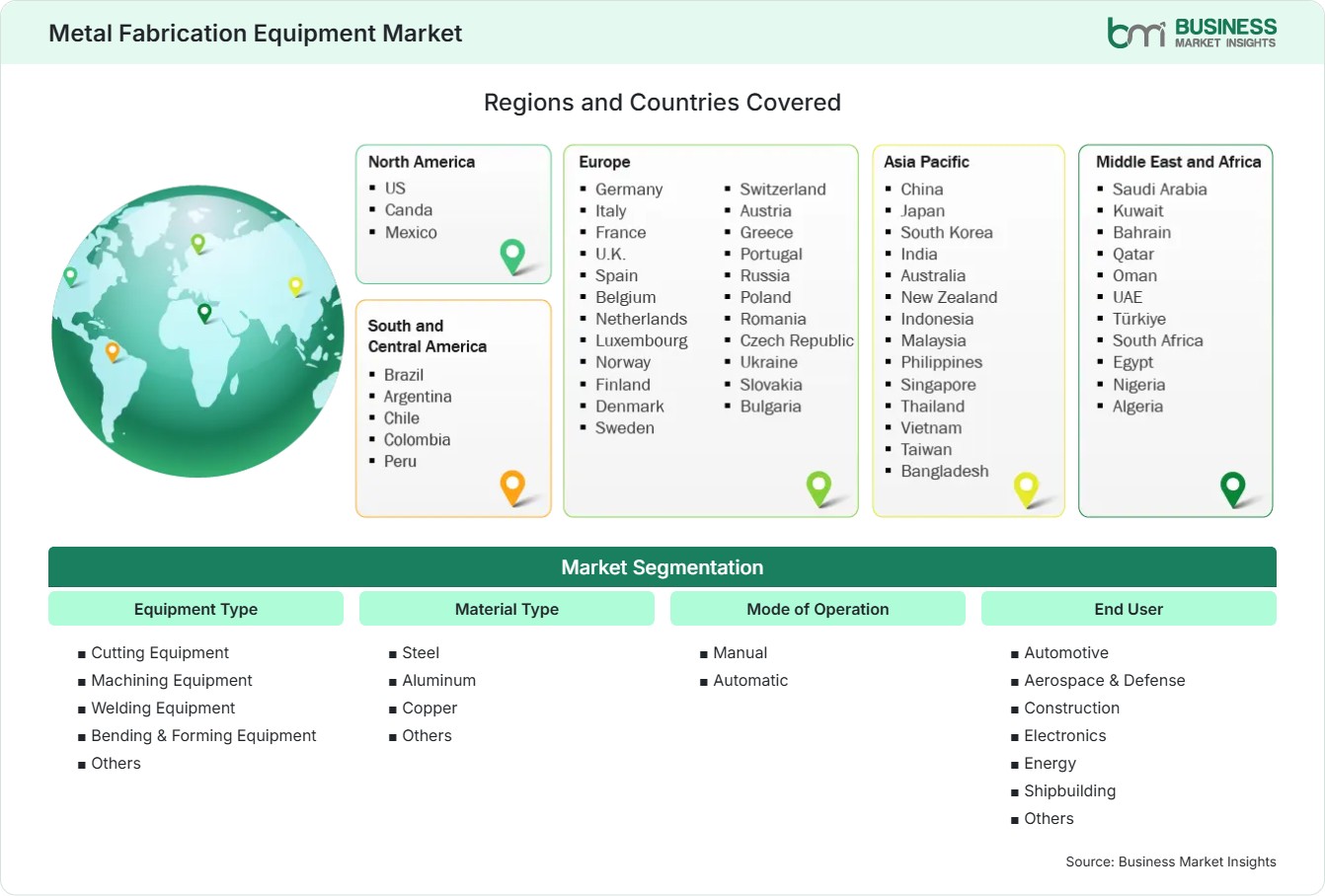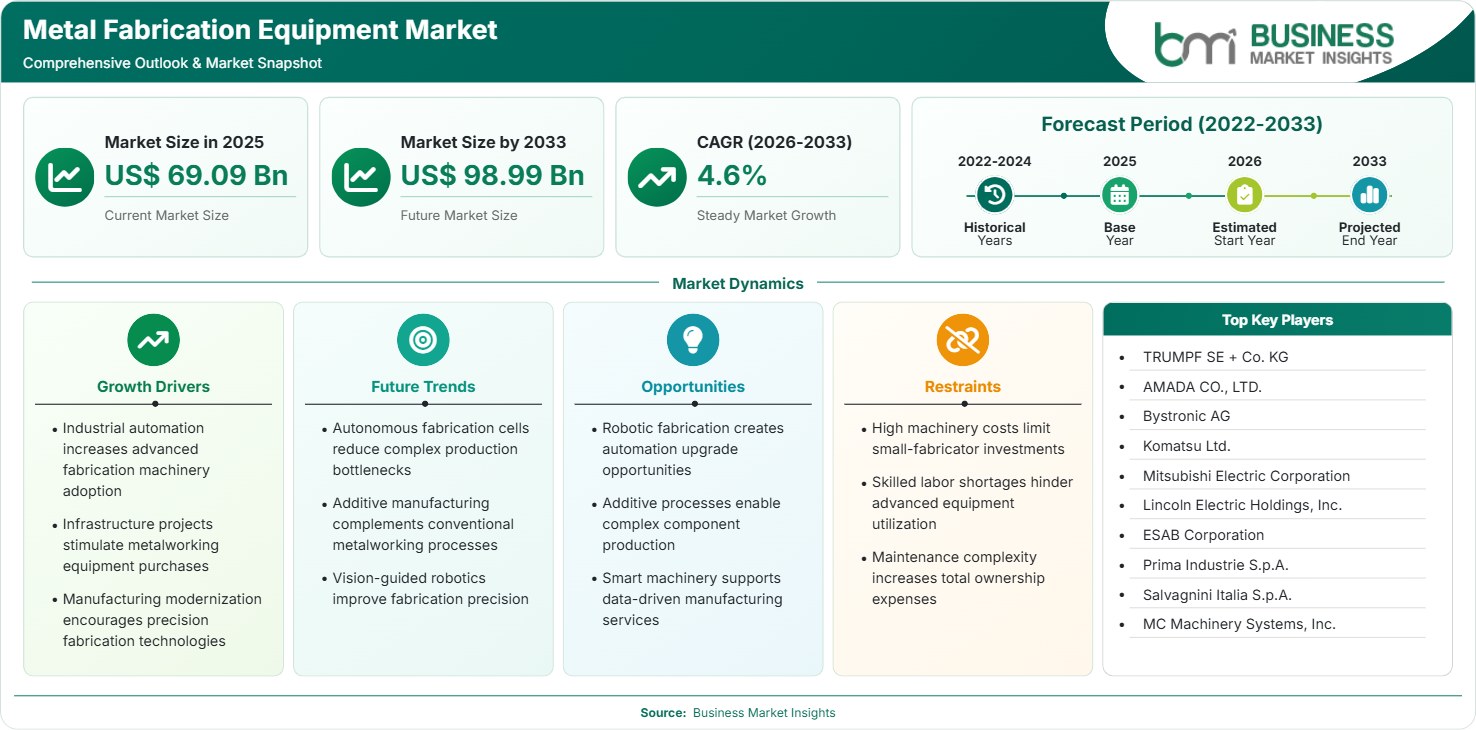
Metal Fabrication Equipment Market Regional Highlights
North America Metal Fabrication Equipment Market
North America accounted for 31%-34% of the Metal Fabrication Equipment Market share in 2025 and is expected to exhibit a CAGR of 4.1%-4.5% between 2026 and 2033. North America derives its growth from reshoring initiatives, investments in aerospace, modernization of automotive, construction, and energy infrastructure. While the United States continues to lead as the primary consumer, both Canada and Mexico are contributing significantly to enhancing the region's supply chain. The growing scarcity of labor has led companies to invest in machines capable of producing repetitive outputs.
- US manufacturers are increasing automation investment as reshoring strategies require competitive domestic production. Fabrication equipment suppliers can benefit from demand for integrated cutting, bending, welding, handling, and production-monitoring solutions.
- Aerospace and defense manufacturing supports demand for precision equipment capable of processing specialized alloys and complex geometries. Qualification requirements favor established suppliers with strong application engineering, traceability, and service capabilities.
- Mexico offers a strategic manufacturing base for automotive, appliances, and industrial components. Equipment demand benefits from supplier localization, cross-border production, and manufacturers seeking proximity to North American customers.
- Energy infrastructure creates opportunities for heavy fabrication equipment, particularly systems supporting structural components, electrical equipment, pipelines, and industrial projects. Suppliers offering high-duty-cycle machinery can capture replacement and capacity-expansion investments.
US Metal Fabrication Equipment Market
The US market accounted for 74%-77% of North American revenue in 2025 and is forecast to grow at a 4.0%-4.4% CAGR through 2033 in the Metal Fabrication Equipment Market. Strategies involving industrial reshoring, defense manufacturing, transportation equipment manufacturing, energy infrastructure development, and commercial construction are key drivers of equipment demand. Fabricators have begun opting for automation cells due to labor shortage problems. Manufacturing within the country has become a trend, leading to greater use of flexible CNC machines, laser equipment, robotized welding equipment, and connectivity-enabled machines.
- Automotive and electric-vehicle supply chains support demand for equipment capable of processing lightweight materials, structural components, battery-related assemblies, and high-strength steels with controlled heat input.
- Defense manufacturing requires precision, repeatability, and traceable production. Equipment suppliers with application expertise and robust service networks can gain from modernization programs involving specialized fabrication and machining operations.
- Infrastructure investment supports demand from structural steel, electrical equipment, and construction-component manufacturers. Higher utilization rates encourage buyers to evaluate automation, rapid setup, and material-handling capabilities.
Europe Metal Fabrication Equipment Market
Europe represented a 27%–30% share in 2025 and is projected to record a 4.0%–4.4% CAGR during 2026–2033. Germany remains the leading market because of its advanced machinery, automotive, engineering, and industrial ecosystem. Italy, France, and the UK contribute substantial fabrication demand, while Poland is positioned among the faster-growing manufacturing locations at a 4.7%–5.1% CAGR in the Metal Fabrication Equipment Market[kk I,jl2. Energy-efficiency requirements, industrial digitalization, skilled-labor constraints, and demand for high-precision manufacturing encourage European fabricators to replace legacy machinery with connected, automated systems.
- Germany maintains strong equipment demand because automotive, machinery, industrial automation, and engineering companies require advanced cutting, forming, machining, and welding capabilities for high-value production.
- Italy benefits from a large base of machinery manufacturers and specialized fabricators. Flexible equipment, compact automation, and integrated software can address the requirements of small and medium-sized industrial producers.
- France and the UK provide opportunities across aerospace, defense, transportation, construction, and energy applications. Precision fabrication and compliance requirements favor sophisticated equipment and reliable lifecycle support.
- Poland is developing as an important manufacturing hub, supporting faster equipment adoption through automotive suppliers, industrial production, construction activity, and increasing integration into European supply chains.
Asia Pacific Metal Fabrication Equipment Market
The Asia Pacific region is expected to account for 25%-28% in 2025 and grow at a CAGR of 5.2%-5.7% through 2033. The Asia Pacific region will emerge as the fastest-growing regional market. China is the biggest demand generator in the region, and India, Japan, and South Korea offer significant prospects. India is one of the fastest-growing markets in the Metal Fabrication Equipment Market, with a CAGR of 6.0%-6.5 %, driven by growth in manufacturing activities, infrastructure, automotive localization, electronics investments, and industrial automation.
- China remains a major fabrication equipment market because of extensive automotive, construction, machinery, electronics, shipbuilding, and energy manufacturing capacity. Local automation development is also strengthening competitive intensity.
- India offers strong opportunities as industrial policies encourage domestic manufacturing and supply-chain localization. Automotive, railways, construction equipment, renewable energy, and electronics manufacturing can expand demand for automated fabrication systems.
- Japan and South Korea emphasize precision, productivity, and advanced automation. Manufacturers serving automotive, electronics, shipbuilding, and industrial equipment customers require sophisticated CNC controls, robotics, inspection, and process-management technologies.
- Southeast Asia is attracting manufacturing capacity in electronics, automotive components, machinery, and consumer products. Vietnam, Thailand, and Indonesia can generate incremental equipment demand as regional supply chains diversify.
Rest of World Metal Fabrication Equipment Market
Rest of World represented a 12%–15% share in 2025 and is projected to expand at a 4.4%–4.9% CAGR in the Metal Fabrication Equipment Market through 2033. South and Central America benefit from automotive, mining, construction, energy, and industrial investment, with Brazil remaining the principal market. The Middle East and Africa offer opportunities through infrastructure, oil and gas, renewable energy, shipbuilding, and industrial diversification. Saudi Arabia and the UAE are among the more attractive growth markets as industrial localization initiatives increase fabrication capacity and technology investment.
- Brazil leads South American demand because automotive production, infrastructure projects, mining equipment, energy development, and general manufacturing require cutting, welding, forming, and machining capacity.
- Mexico's broader North American manufacturing integration supports demand across automotive and industrial fabrication. Local production strategies can encourage investment in modern equipment with automation and efficient material utilization.
- Saudi Arabia is developing fabrication opportunities through industrial diversification, infrastructure, energy, and localization programs. Equipment suppliers can address demand for structural steel, energy components, and industrial manufacturing.
- The UAE provides opportunities through construction, aerospace, maritime, energy, and advanced manufacturing initiatives. High-value projects favor precision equipment, automated handling, and digital production-management capabilities.