Market Summary
Executive Summary and Global Market Analysis
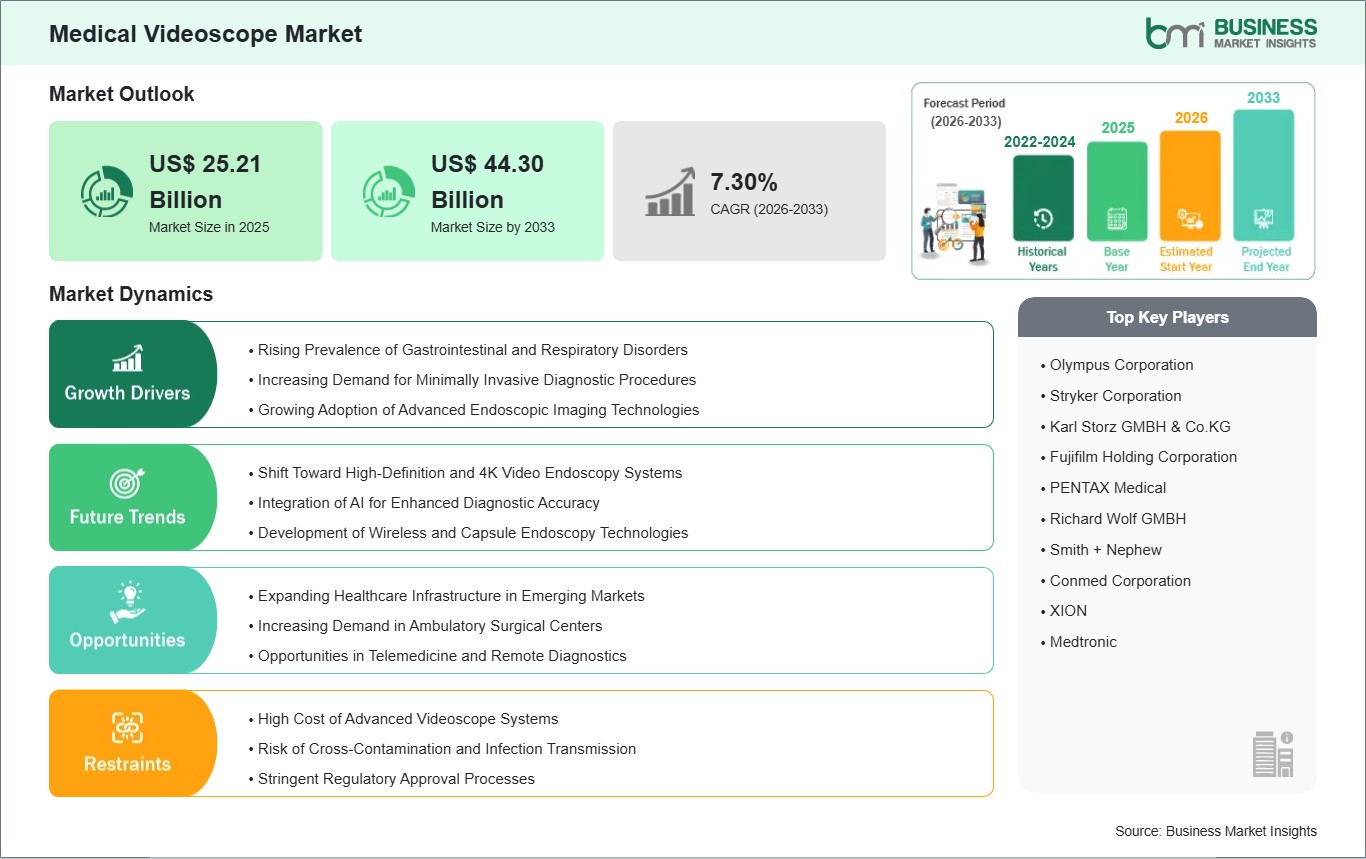
A medical videoscope is an advanced electronic endoscope equipped with a built-in imaging sensor, typically a Charge-Coupled Device (CCD) or Complementary Metal-Oxide-Semiconductor (CMOS), at its distal tip. Projected market expansion is primarily driven by the global increase in chronic gastrointestinal and respiratory disorders, the rapid integration of robot-assisted surgery, and the transition from reusable to single-use (disposable) videoscopes to mitigate cross-contamination risks. Additionally, the implementation of artificial intelligence (AI)-driven diagnostic software, which autonomously identifies polyps or abnormal vascular patterns during procedures, is significantly enhancing diagnostic accuracy and standardizing outcomes across practitioners with varying skill levels.
However, several challenges can restrain market growth: high capital and maintenance costs for advanced 4K/3D imaging stacks often limit adoption in rural or budget-constrained clinics. The steep learning curve and a global shortage of highly skilled endoscopists can lead to equipment underutilization. Additionally, the industry faces constraints due to stringent sterilization protocols for reusable scopes, which are time-consuming and carry the risk of device damage if not performed with specialized automated reprocessors.
Despite these challenges, significant opportunities exist in the expansion of Ambulatory Surgical Centers (ASCs), which prefer the cost predictability offered by disposable videoscopes. The advancement of wireless, ultra-miniaturized capsule cameras for small-bowel imaging and the growth of tele-endoscopy platforms for remote specialist consultation are anticipated to drive long-term market growth.
Segment Analysis
Medical Videoscope Market Segmentation
Key segments that contributed to the derivation of the Medical Videoscope market analysis are product and application.
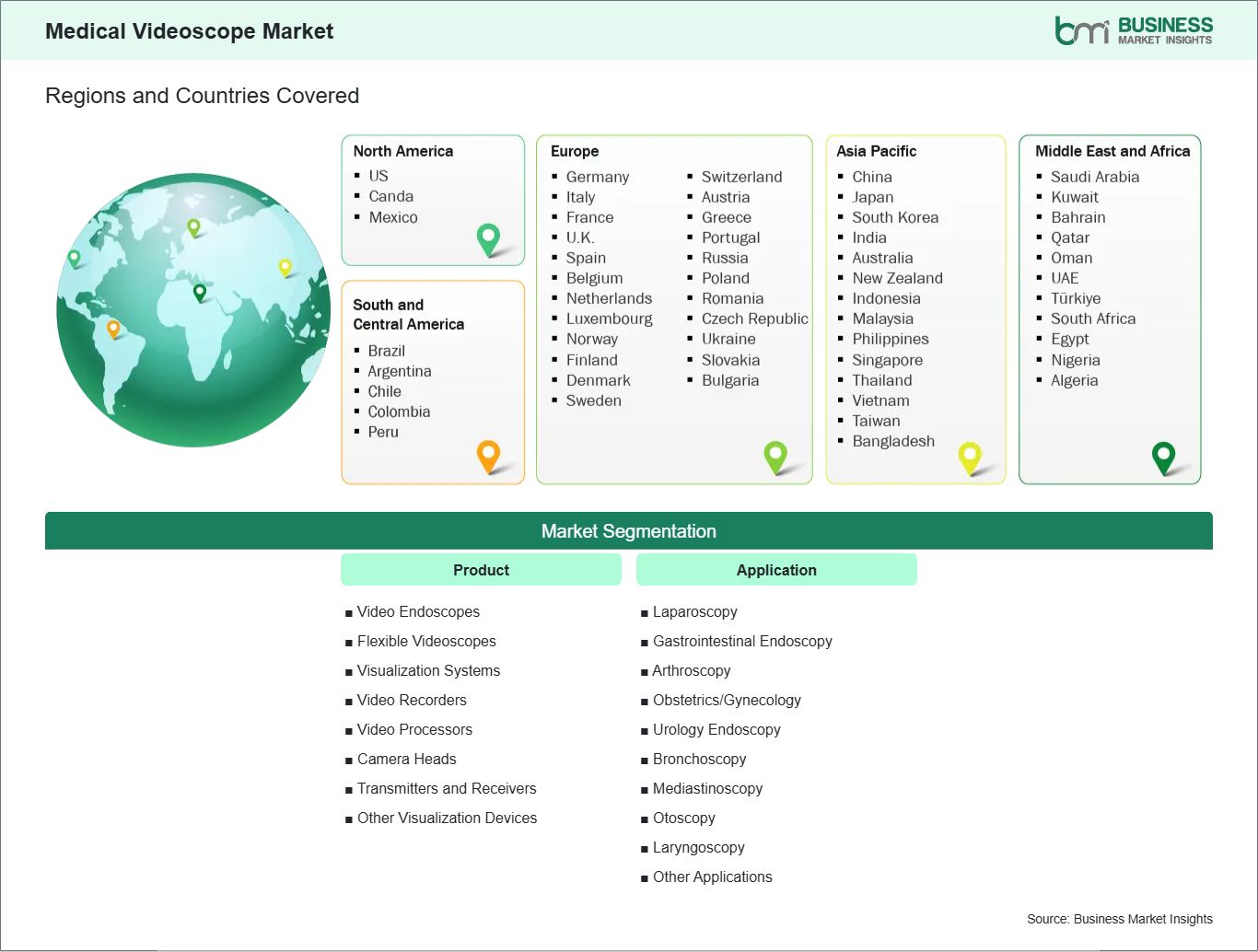
- By Product, the market is segmented into Video Endoscopes, Flexible Videoscopes, Visualization Systems, Video Recorders, Video Processors, Camera Heads, Transmitters and Receivers, and Others Visualization Devices.
- By Application, the market is divided into Laparoscopy, Gastrointestinal Endoscopy, Arthroscopy, Obstetrics/Gynecology, Urology Endoscopy, Bronchoscopy, Mediastinoscopy, Otoscopy, Laryngoscopy, and Other Applications.
Market Forces
Medical Videoscope Market Drivers and Opportunities
Advancing Clinical Safety and the Integration of AI-Aided Navigation
A key driver of the Medical Videoscope Market is the global transition toward Minimally Invasive Procedures (MIS), which depend on high-fidelity video feedback as an alternative to open surgery. The increasing prevalence of gastrointestinal and respiratory disorders, particularly among aging populations, necessitates frequent screenings for conditions such as colorectal cancer and inflammatory bowel disease. This trend is further accelerated by the integration of Artificial Intelligence (AI) and Machine Learning, as contemporary videoscope processors incorporate Computer-Aided Detection (CADe) to highlight suspicious lesions or polyps in real time, thereby reducing the likelihood of clinical oversight.
In addition, heightened infection control standards have shifted hospital procurement preferences toward single-use (disposable) videoscopes, aiming to eliminate cross-contamination risks and reduce the costs associated with reprocessing. Furthermore, the Favorable Reimbursement Environment for outpatient endoscopic procedures acts as a major catalyst, encouraging ambulatory surgical centers (ASCs) to invest in high-definition video towers. Together, these factors, the demand for MIS, AI-driven precision, and a focus on sterile safety, ensure that medical videoscopes remain a high-growth pillar of the surgical landscape.
Single-Use Modular Scopes and 5G-Enabled Remote Surgery
A significant high-value opportunity lies in the convergence of Medical Videoscopes with Single-Use (Disposable) Architecture. As healthcare facilities seek to bypass complex sterilization cycles, manufacturers have a major opportunity to develop chip-on-tip disposable videoscopes that offer 4K resolution at a price suitable for high-volume procedures. There is also strong growth potential in developing 5G-Enabled Wireless Videoscopes and Tele-Endoscopy Platforms. These systems let specialists provide real-time guidance and consultation to rural or remote clinics, effectively decentralizing expert surgical knowledge.
The expansion of Multimodal Imaging presents a lucrative opportunity as manufacturers integrate fluorescence and ultrasonic capabilities into a single scope, allowing surgeons to see blood flow and subsurface tissue layers at the same time. Beyond traditional hardware, the rise of Cloud-Based Video Management and Analytics gives hospitals a significant opportunity to store, analyze, and share surgical footage for training and legal documentation. Manufacturers focusing on Ergonomic, Lightweight Handle Designs and those pioneering Robotic-Assisted Integrated Videoscope are positioned to lead the global medical videoscope market.
Size and Share Analysis
Medical Videoscope Market Size and Share Analysis
The Medical Videoscope market demonstrates steady growth, with size and share analysis revealing evolving trends and competitive positioning among key players. The report further examines subsegments categorized within product and application, offering insights into their contribution to overall market performance.
Based on product, the Video Endoscopes, Visualization Systems, and Video Processors subsegments hold a significant market share, serving as the industry benchmark for the modern digital operating room. Video Endoscopes, particularly Flexible Videoscopes, are indispensable for Gastrointestinal Endoscopy and Bronchoscopy, where maneuverability and image stability are critical for navigating complex luminal structures. A notable trend is the surge in the Visualization Systems and Camera Heads subsegments, which are registering higher interest due to the adoption of Chip-on-the-Tip technology. These advancements are becoming essential for Laparoscopy, as they eliminate the need for cumbersome fiber-optic bundles, allowing for lighter, more ergonomic tools that provide 3D and 4K resolution directly from the surgical site.
Report Coverage
Medical Videoscope Market Report Coverage and Deliverables
The "Medical Videoscope Market Size and Forecast (2022–2033)" report provides a detailed analysis of the market covering below areas:
- Medical Videoscope market size and forecast at global, regional, and country levels for all the key market segments covered under the scope
- Medical Videoscope market trends, as well as market dynamics such as drivers, restraints, and key opportunities
- Medical Videoscope market analysis covering key market trends, global and regional framework, major players, regulations, and recent market developments
- Industry landscape and competition analysis covering market concentration, heat map analysis, prominent players, and recent developments for the Medical Videoscope market
- Detailed company profiles, including SWOT analysis
Geographic Insights
Medical Videoscope Market Geographic Insights
The geographical scope of the Medical Videoscope market report is divided into five regions: North America, Asia Pacific, Europe, Middle East & Africa, and South & Central America.
North America remains the leading region, driven by a well-established healthcare infrastructure, widespread adoption of robotic-assisted surgery, and favorable reimbursement policies for endoscopic procedures. Europe also occupies a significant position, distinguished by rigorous regulatory frameworks and a strong clinical emphasis on early diagnostic accuracy, particularly in countries such as Germany and France. The Asia Pacific region represents the fastest-growing market, fueled by rapid urbanization, substantial investments in hospital digitization, and the expansion of the medical tourism sector in emerging economies.
The Asia-Pacific Medical Videoscope Market is segmented into China, Japan, South Korea, India, Australia, and the Rest of Asia Pacific. China leads the regional market, driven by government initiatives to modernize medical facilities and increased domestic production of high-definition imaging sensors. India is experiencing rising demand, attributed to the growth of private specialty hospitals and a preference for minimally invasive diagnostic procedures. In Japan, the market is technologically advanced, with an emphasis on integrating artificial intelligence (AI) and 8K visualization into gastrointestinal and pulmonary videoscopes to address the needs of an aging population.
Industry Activity
Recent Developments
The Medical Videoscope market is evaluated by gathering qualitative and quantitative data post primary and secondary research, which includes important corporate publications, association data, and databases. A few of the key developments in the Medical Videoscope market are:
- In Nov 2025, Evident launched the IPLEX One, a next-generation videoscope with software-driven scalability, 3D measurement, and advanced optics. Designed for medical device inspections, it enhances precision, workflow efficiency, and traceability, supporting stringent quality and compliance requirements.
- In September 2025, Olympus Corporation launched its third-generation EBUS bronchoscope (BF-UCP190F) across the EMEA region. The advanced videoscope features a slimmer 5.9mm outer diameter, enhanced angulation, and improved maneuverability, enabling greater diagnostic reach and precision in lung cancer staging. The launch strengthens Olympus’ medical videoscope portfolio and reinforces technological advancements in bronchoscopic imaging solutions.
Trust & Transparency
Research Methodology
The market analysis combines proprietary research with secondary data from government agencies, company disclosures, regulatory filings, industry databases and expert interviews. Market estimates are validated through data triangulation, cross-market benchmarking and analyst
review.
View Full Research Methodology
Key Sources Referred:
World Bank – Global Trade IndicatorsWorld Trade Organization (WTO)(International Monetary Fund )IMFInternational Trade Administration (ITA)Company websiteCompany annual reportsCompany investor presentations