Market Summary
Executive Summary and Global Market Analysis
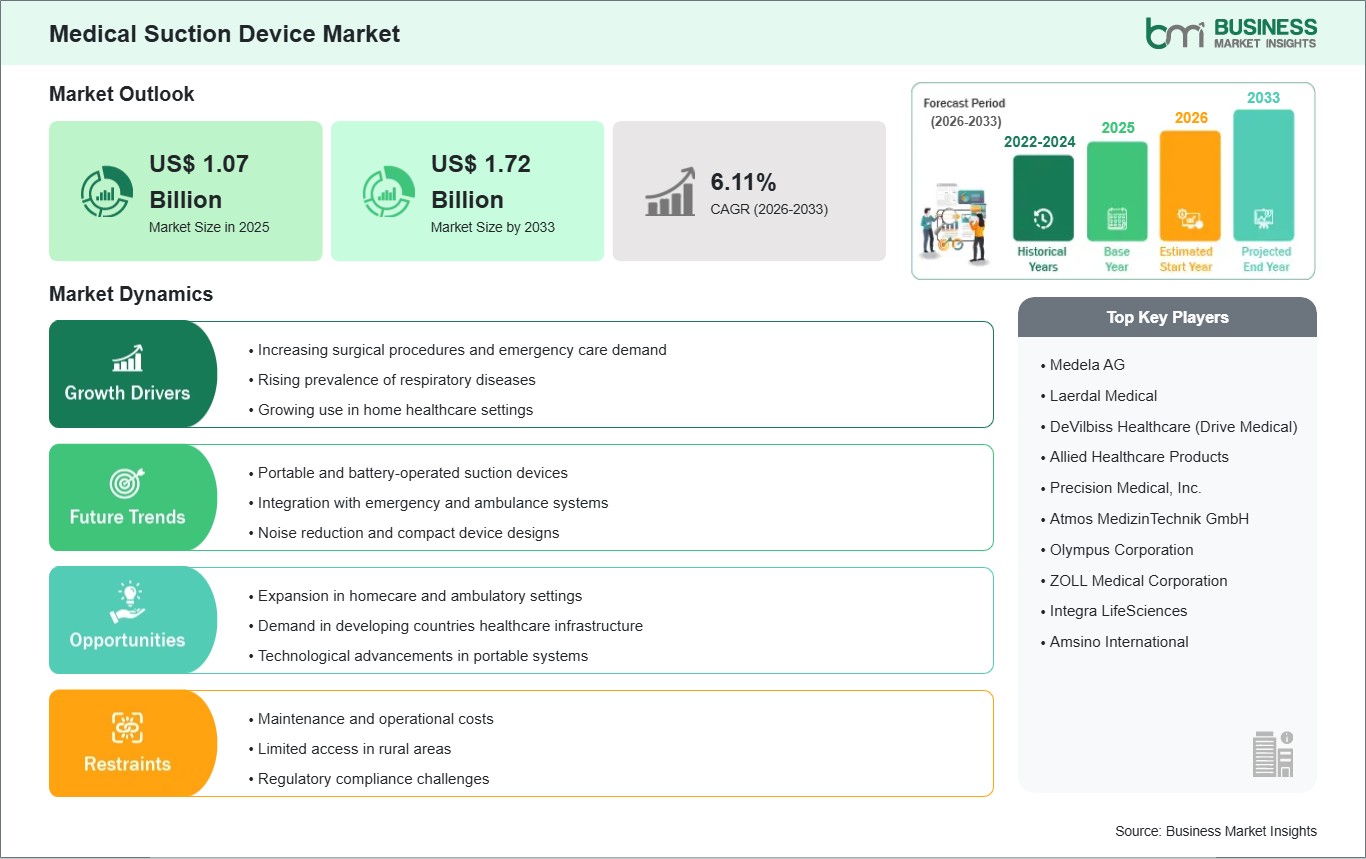
Medical suction devices, also referred to as aspirators, are specialized medical instruments designed to evacuate mucus, blood, saliva, and other bodily fluids from a patient's airway or surgical site. These systems function by generating negative pressure, which is transmitted through flexible tubing to a collection canister. Market expansion is fundamentally driven by the increasing global volume of surgical procedures, particularly minimally invasive surgeries that require clear visualization of the operative field. Furthermore, the rising prevalence of chronic respiratory diseases, such as Chronic Obstructive Pulmonary Disease (COPD) and cystic fibrosis, is accelerating the demand for airway clearance tools in both clinical and home care settings. The global aging population, who are more susceptible to respiratory distress and require frequent surgical interventions, serves as a primary driver for sustained market growth.
However, several factors can restrain market development. Stringent regulatory standards for device sterilization and material biocompatibility necessitate significant research and development investment. Inconsistent reimbursement policies for home-use suction equipment in certain regions can limit patient accessibility to advanced portable models. Additionally, the industry faces challenges related to the high maintenance and operating costs associated with frequent filter replacements and battery servicing, which can impact the adoption of high-end electronic systems in resource-limited environments.
Despite these hurdles, the market holds significant opportunities in the adoption of compact, lightweight, and long-life battery-powered units for the growing home healthcare sector. The rise of connected suction devices, which integrate with telehealth platforms to provide remote monitoring of fluid levels and pressure settings, and the expansion of healthcare infrastructure in emerging economies are expected to support long-term development within the sector.
Segment Analysis
Medical Suction Device Market Segmentation
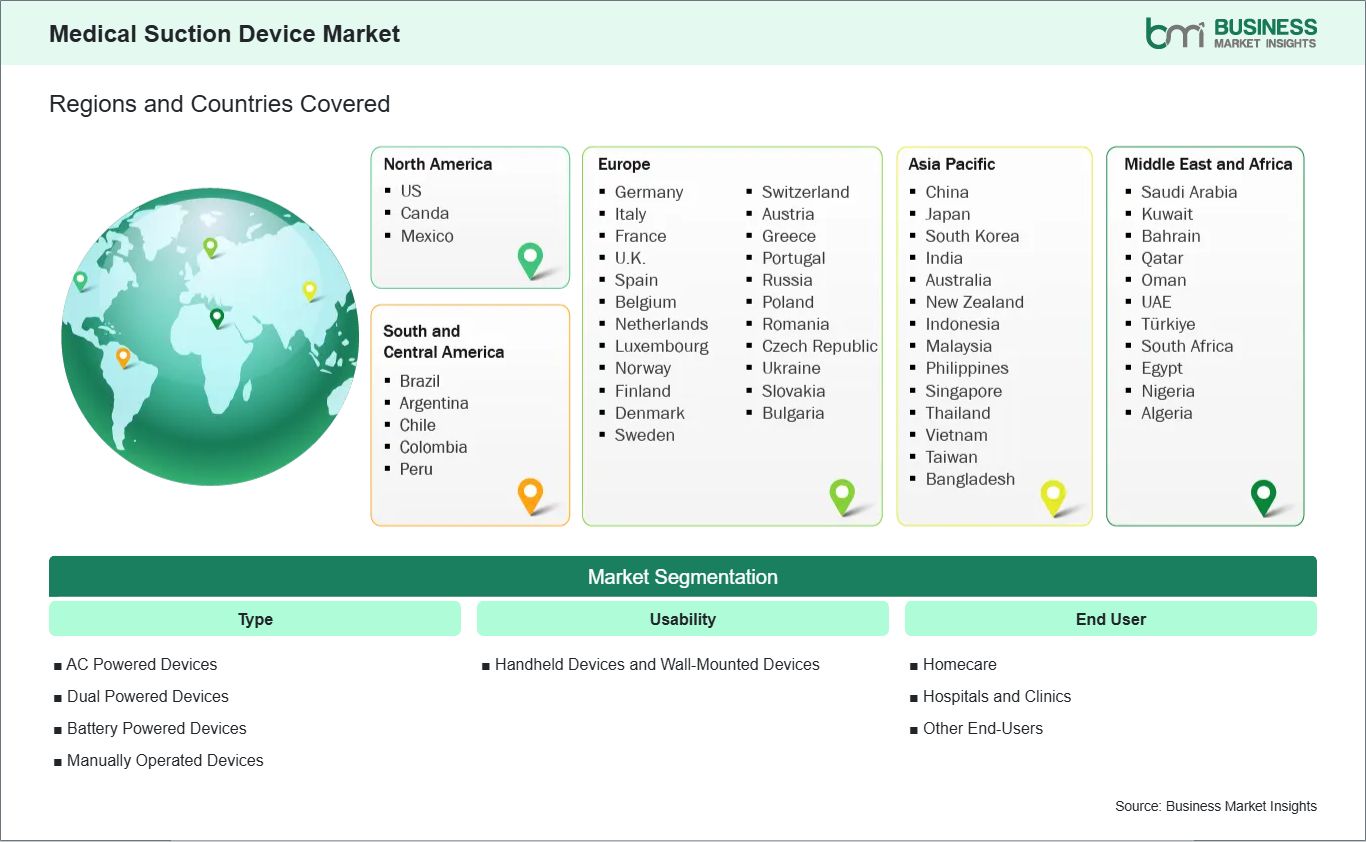
Key segments that contributed to the derivation of the Medical Suction Devices market analysis are type, usability, and end user.
- By Type, the market is segmented into AC Powered Devices, Dual Powered Devices, Battery Powered Devices, and Manually Operated Devices.
- By Usability, the market is divided into Handheld Devices and Wall-Mounted Devices.
- By End User, the market is categorized into Homecare, Hospitals and Clinics, and Others.
Market Forces
Medical Suction Device Market Drivers and Opportunities
Expanding Surgical Volumes and the Proliferation of Respiratory Care
The primary driver for the Medical Suction Devices Market is the systemic global rise in surgical procedures and the increasing prevalence of chronic respiratory disorders. The Growing Global Volume of Elective and Emergency Surgeries acts as a foundational catalyst, as surgical suction remains a non-discretionary requirement for maintaining a clear operative field and ensuring patient safety during general anesthesia. This momentum is further propelled by the Rising Incidence of Chronic Obstructive Pulmonary Disease (COPD) and Asthma; a growing geriatric population and deteriorating air quality are increasing the number of patients who require routine airway clearance to manage excessive secretions and prevent respiratory distress. In the technological sphere, the Rapid Adoption of Portable and Battery-Powered Aspirators serves as a critical driver, as these units allow for rapid response in ambulances and provide essential support during intra-hospital patient transport. Furthermore, the Stricter Global Standards for Infection Control are driving the adoption of closed-suction systems and disposable canisters, which minimize healthcare-associated infections (HAIs) and reduce clinical staff exposure to biohazardous fluids. Together, these factors, surgical demand, respiratory health trends, and safety mandates, ensure a robust and essential growth path for the global Medical Suction Devices Market.
AI-Native Pressure Regulation and the Emergence of Connected Home-Care
A significant high-value opportunity lies in the convergence of Medical Suction Devices with Artificial Intelligence (AI) and Smart Monitoring. Next-generation intelligent aspirators are being developed to utilize sensors that automatically adjust vacuum pressure based on the viscosity of the fluid being removed, optimizing efficiency while minimizing the risk of mucosal tissue trauma. There is also a major growth frontier in the development of Bluetooth-Enabled Suction Units for Remote Patient Monitoring (RPM); by transmitting usage data and secretion volume to cloud platforms, these devices allow respiratory therapists to track patient adherence and detect early signs of pulmonary exacerbations in home-care environments. Furthermore, the expansion of Ultra-Quiet, High-Flow Systems for Ambulatory Surgical Centers (ASCs) presents a lucrative opportunity, as these facilities require high-performance suction that does not interfere with delicate microsurgical or robotic procedures. Beyond the device itself, the rise of Eco-Friendly and Bio-Based Suction Consumables offers a unique frontier, particularly in regions where healthcare systems are prioritizing the reduction of single-use plastic waste. Manufacturers who focus on Fast-Charging, Universal Power Compatibility and those pioneering Closed-Loop Robotic Suction Integration are positioned to lead the global Medical Suction Devices Market.
Size and Share Analysis
Medical Suction Device Market Size and Share Analysis
The Medical Suction Devices market demonstrates steady growth, with size and share analysis revealing evolving trends and competitive positioning among key players. The report examines subsegments categorized within type, usability, and end user, offering insights into their contribution to overall market performance.
Based on type, the AC Powered Devices subsegment holds the primary market presence, acting as the ubiquitous foundational tool for intensive care units and operating theaters where continuous, high-volume suction is required. These systems are indispensable for the market, maintaining a significant position due to their reliable performance during long-duration surgeries. Dual Powered, Battery Powered, and Manually Operated Devices provide critical support, with manual units serving as an essential zero-power backup in remote or low-resource settings. A notable trend is the surge in the Battery Powered and Dual Powered Devices subsegments, which are registering the highest pace of adoption. These technologies are becoming essential for Point-of-Care and Pre-Hospital Medicine, as the move toward high-capacity lithium-ion cells allows for hospital-grade suction in ambulances and home-based respiratory management, effectively maintaining a critical presence in the burgeoning outpatient care vertical.
Report Coverage
Medical Suction Device Market Report Coverage and Deliverables
The "Medical Suction Devices Market Size and Forecast (2022–2033)" report provides a detailed analysis of the market covering below areas:
- Medical Suction Devices market size and forecast at global, regional, and country levels for all market segments covered under the scope
- Medical Suction Devices market trends, as well as drivers, restraints, and opportunities
- Medical Suction Devices market analysis covering key trends, global and regional framework, major players, regulations, and recent developments
- Industry landscape and competition analysis covering market concentration, heat map analysis, prominent players, and recent developments for the Medical Suction Devices market
- Detailed company profiles, including SWOT analysis
Geographic Insights
Medical Suction Device Market Geographic Insights
The geographical scope of the Medical Suction Devices market report is divided into five regions: North America, Asia Pacific, Europe, Middle East & Africa, and South & Central America.
North America maintains the dominant market share, supported by a high volume of surgical procedures, sophisticated healthcare infrastructure, and the early adoption of advanced portable suction technologies for emergency medical services (EMS). Europe represents a mature market characterized by stringent clinical safety standards and a strong institutional focus on infection control and specialized airway management. Asia Pacific is identified as the most rapidly advancing region, propelled by accelerating healthcare modernization, rising incidences of chronic respiratory conditions, and increasing public-private investments in specialized surgical facilities across emerging economies. Market progression is further supported by a transition toward battery-powered and dual-powered portable systems, which facilitate seamless patient transport and the expansion of home-based respiratory therapy. The increasing adoption of closed suction systems and specialized bacterial filters, alongside the strategic growth of ambulatory surgical centers (ASCs), solidifies Asia Pacific as a vital region for the evolution and future scaling of the Medical Suction Devices market.
Industry Activity
Recent Developments
The Medical Suction Devices market is evaluated by gathering qualitative and quantitative data post primary and secondary research, which includes important corporate publications, association data, and databases. A few of the key developments in the Medical Suction Devices market are:
- In January 2026, Boston Scientific announced the acquisition of Penumbra, Inc. for approximately $14.5 billion, expanding its portfolio in vascular and neurovascular devices, including thrombectomy and suction-assisted systems, and enhancing global access to innovative technologies.
- In December 2025, Intersurgical® announced the acquisition of Teleflex®`s Acute Care and Interventional Urology businesses, expanding its portfolio in anaesthesia, airway management, and suction devices. The move strengthens operational capacity, enhances technical expertise, and broadens product offerings for hospital and surgical care.
Trust & Transparency
Research Methodology
The market analysis combines proprietary research with secondary data from government agencies, company disclosures, regulatory filings, industry databases and expert interviews. Market estimates are validated through data triangulation, cross-market benchmarking and analyst
review.
View Full Research Methodology
Key Sources Referred:
World Bank – Global Trade IndicatorsWorld Trade Organization (WTO)(International Monetary Fund )IMFInternational Trade Administration (ITA)Company websiteCompany annual reportsCompany investor presentations