
Liquid Nitrogen Market Outlook: Size, Share, Trends, Growth Analysis, Competitive Landscape & Forecast, 2026-2033

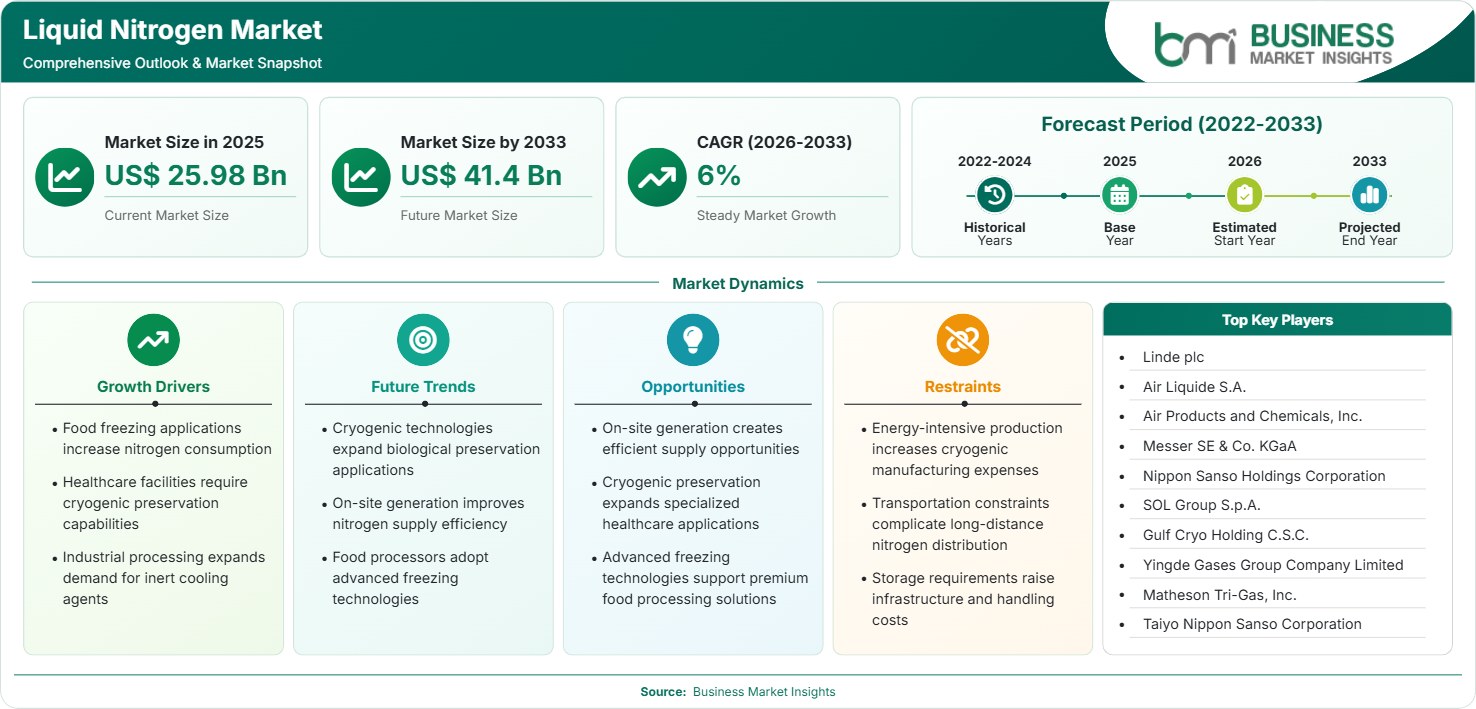
The Liquid Nitrogen Market size was valued at US$ 25.98 Billion in 2025 and is projected to reach US$ 41.4 Billion by 2033, growing at a CAGR of 6% during 2026–2033. Rising semiconductor fabrication, healthcare cryopreservation demand, food freezing applications, and industrial gas infrastructure expansion are accelerating adoption, while opportunities emerge from biobanking, advanced electronics manufacturing, and sustainable cold-chain investments.

Report Coverage
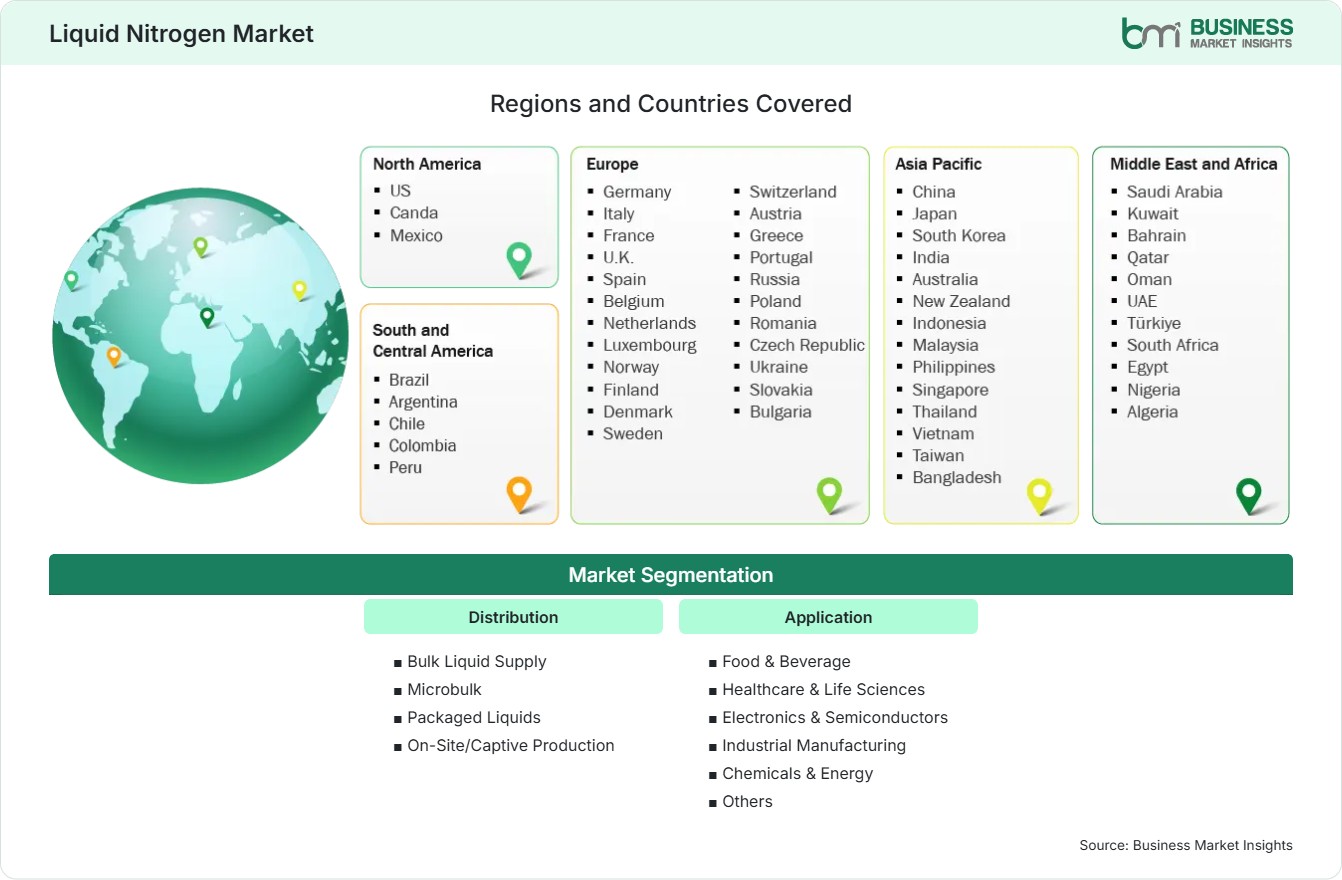
  • Distribution: Bulk Liquid Supply, Microbulk, Packaged Liquids, On-Site/Captive Production
  • Application: Food & Beverage, Healthcare & Life Sciences, Electronics & Semiconductors, Industrial Manufacturing, Chemicals & Energy, Others
US$ 25.98 Bn Market size in 2025
US$ 41.4 Bn Market Size by 2033
6% CAGR, 2026 - 2033
2026-2033 Forecast Period

AI Overview

Liquid Nitrogen Market Summary

  • North America Region: Holds a market share of 32%–35% in 2025, growing at a CAGR of 5.3%–5.8% during 2026–2033. Growth is supported by healthcare cryogenic storage, biotechnology expansion, food processing modernization, semiconductor manufacturing investments, and industrial gas network development across major consumption centers. The U.S. market benefits from strong biopharmaceutical activity, data-center cooling research, and semiconductor investments, expanding at approximately 5.5%–6.0% CAGR.
  • Fastest Growing Region: Asia Pacific accounts for 35%–38% share in 2025 and is expected to grow at a CAGR of 6.8%–7.4%. Semiconductor fabrication expansion, biotechnology manufacturing growth, food processing investments, industrialization, and government-backed technology initiatives continue to strengthen regional demand across developing economies.
  • Leading Segment: Food & Beverage represents 24%–27% share in 2025 and is projected to expand at 5.5%–6.0% CAGR. Demand is increasingly driven by flash-freezing processes, frozen food consumption growth, shelf-life enhancement requirements, food safety standards, and cold-chain optimization across emerging economies.
  • High Growth Segment: Electronics & Semiconductors holds 17%–20% share in 2025 and is projected to record 7.5%–8.2% CAGR. Increasing wafer fabrication capacity, advanced chip manufacturing, electronics miniaturization, and precision cooling requirements continue creating high-value demand throughout the semiconductor value chain.
  • Key Market Opportunity: Expansion of cryogenic infrastructure supporting regenerative medicine, biologics manufacturing, cell therapies, and long-term biospecimen preservation is creating substantial opportunities for suppliers offering reliable storage, transport, and monitoring solutions.
  • Major Market Players: Linde plc, Air Liquide S.A., Air Products and Chemicals, Inc., Messer SE & Co. KGaA, Nippon Sanso Holdings Corporation, SOL Group S.p.A., Gulf Cryo Holding C.S.C., Yingde Gases Group Company Limited, Matheson Tri-Gas, Inc., and Taiyo Nippon Sanso Corporation.
Strategic Insights

Liquid Nitrogen Market: Strategic Insights

Liquid Nitrogen Market Strategic Framework
FREE PDF
Request your free sample
Request free sample
Stakeholder View

Key Takeaways

  • The industry is still very concentrated among the global producers of industrial gases, since these producers have access to an extensive network of air separation plants, transportation networks, and long-term agreements with their customers.
  • In comparison with its traditional industrial applications, electronics manufacturing and healthcare cryogenic applications offer higher-margin opportunities because of the purity requirements and the level of service needed.
  • Digital tank monitoring, predictive maintenance, and smart logistics platforms are increasingly important in distinguishing one supplier from another when providing services for critical applications.
  • India, China, Vietnam and some of the Gulf states are becoming strategic destinations for investment due to the expansion of their manufacturing and healthcare infrastructure.
  • Capacity expansion, regional acquisitions, and agreements for the distribution of industrial gases are still influencing competitive positioning and geographic reach.
  • Large industrial buyers are increasingly allowing sustainability-focused production upgrades designed to reduce energy intensity to influence their procurement decisions.
Geographic Outlook

Liquid Nitrogen Market Regional Highlights

North America Liquid Nitrogen Market

North America accounted for approximately 32%–35% of global demand in 2025 and is projected to expand at a CAGR of 5.3%–5.8% through 2033. Strong healthcare infrastructure, biotechnology commercialization, food processing investments, and electronics manufacturing support regional consumption. The region benefits from mature industrial gas distribution networks and substantial investments in life sciences research. The Liquid Nitrogen Market share remains supported by high-value medical and semiconductor applications, while storage modernization and logistics optimization continue strengthening market competitiveness.

  • The number of cryogenic storage requirements being demanded by biopharmaceutical companies for the development of cell and gene therapies is on the rise.
  • Programs aimed at investing in semiconductors are increasing the demand for industrial gases of high purity.
  • The use of frozen food is still pushing forward industrial freezing and packaging applications.
  • Sophisticated logistics networks improve the reliability of the supply of goods to customers whose needs are critical to the mission.

US Liquid Nitrogen Market

The United States represents roughly 75%–80% of North American demand and is expected to record a CAGR of 5.5%–6.0%. Increases in semiconductor investments, developments in biotechnology, medical research efforts, and industrial modernization keep driving consumption growth. Research funding leads to developments in cryogenics in scientific laboratories and medical establishments, while investments in food processing drive commercial consumption.

  • The growth of domestic semiconductor facilities results in a steady demand for ultra-high-purity supplies.
  • The growth of cryogenic storage is supported by work in the areas of cell therapy, vaccine research, and biobanking.
  • The modernization of industrial manufacturing leads to the adoption of precision cooling technologies.
  • Increasingly, food processors are using cryogenic freezing to preserve the quality of their products.

Europe Liquid Nitrogen Market

Europe holds approximately 24%–27% share in 2025 and is projected to grow at 5.0%–5.6% CAGR through 2033. Germany still leads as the number one market, although the economies of Eastern Europe show higher growth rates. This is bolstered by developments in high-tech manufacturing, pharma manufacturing, food processing modernization, and efforts towards greater sustainability. The manufacturers in the region are continuing to invest in productive technology.

  • Germany continues to be the biggest consumer in the region as a result of its strong capacity in industrial manufacturing.
  • Poland and some of the Eastern European markets are experiencing a faster rate of expansion.
  • The need for greater cryogenic storage is supported by pharmaceutical innovation.
  • The regulations concerning food safety promote the use of advanced freezing systems.

Asia Pacific Liquid Nitrogen Market

Asia Pacific accounted for 35%–38% of demand in 2025 and is forecast to grow at 6.8%–7.4% CAGR, representing the fastest-growing region. China leads regional consumption, while India demonstrates strong expansion potential. Investments in semiconductor fabrication, healthcare infrastructure, industrial manufacturing, and food processing continue driving the Liquid Nitrogen Market growth trajectory across the region.

  • The demand for high-purity nitrogen is greatly increased by semiconductor megaprojects.
  • China is still the biggest regional market in terms of consumption volume.
  • India is one of the markets with the fastest growth in the areas of healthcare and industrial applications.
  • By extending the cold-chain infrastructure, food processing opportunities can be improved.
  • The government's initiatives involving manufacturing help to ensure long-term demand in the industrial sector.

Rest of World Liquid Nitrogen Market

Rest of World Region, comprising South and Central America and the Middle East and Africa, has a market share of 10%-13% and is estimated to grow at a CAGR of 6.0%-6.6%. Brazil and Saudi Arabia are the key markets, and the UAE shows potential for growth. Diversification of industries, food processing, and healthcare programs are helping sustain consumption patterns.

  • Brazil has the highest demand in South America as a result of its manufacturing and food industries.
  • Saudi Arabia benefits from the advantages of its industrial diversification initiatives and investments in the energy sector.
  • The UAE is quickly adopting this technology in the areas of healthcare and logistics.
  • As the cold-chain infrastructure is expanded, so too does the demand for cryogenic freezing solutions.
Global Market Geography
FREE PDF
Request your free sample
Request free sample
Segment Analysis

Liquid Nitrogen Market Segmentation

Distribution

The distribution segment accounted for approximately 100% market coverage across supply channels, with bulk liquid supply remaining dominant. Expansion of manufacturing facilities, food processing units, healthcare institutions, and semiconductor fabrication plants continues to influence purchasing models. The Liquid Nitrogen Market scope continues expanding through digital monitoring, decentralized supply infrastructure, and efficiency improvements. The segment is projected to grow at a CAGR of 5.8%–6.4% during 2026–2033.

  • Bulk Liquid Supply: Preferred by large industrial facilities requiring uninterrupted high-volume consumption. Growth is supported by manufacturing expansion, centralized production economics, and long-term industrial gas procurement agreements.
  • Microbulk: Increasingly adopted by hospitals, laboratories, and mid-sized manufacturing facilities seeking flexible storage solutions while avoiding frequent cylinder replacement requirements and associated logistics costs.
  • Packaged Liquids: Serves research institutions, specialty laboratories, universities, and smaller industrial users requiring limited quantities with enhanced ease of transport and operational flexibility.
  • On-Site/Captive Production: Gains traction among high-consumption facilities by reducing transport dependency, improving supply security, and supporting cost optimization through localized generation capabilities.

Application

The application segment remains highly diversified, supported by healthcare innovation, food preservation, electronics manufacturing, and industrial processing activities. The Food & Beverage segment held the largest Liquid Nitrogen Market share at approximately 24%–27% in 2025, while Electronics & Semiconductors is expected to register the fastest CAGR of 7.5%–8.2% through 2033.

  • Food & Beverage: Widely utilized in cryogenic freezing, texture preservation, food safety enhancement, and shelf-life extension applications supporting expanding global frozen-food consumption patterns.
  • Healthcare & Life Sciences: Demand is driven by cryopreservation, biobanking, reproductive medicine, vaccine storage, and cell therapy research requiring highly reliable cryogenic environments.
  • Electronics & Semiconductors: Benefits from semiconductor fabrication growth, precision manufacturing requirements, thermal management applications, and increasing investment in advanced chip production facilities.
  • Industrial Manufacturing: Supports shrink fitting, metal processing, cooling operations, and quality enhancement across automotive, aerospace, and heavy industrial production environments.
  • Chemicals & Energy: Utilized across storage, pipeline maintenance, inerting, and process optimization applications where extreme low-temperature capabilities improve operational efficiency.
Market Forces

Liquid Nitrogen Market Dynamics

Key Market Drivers

Expansion of Semiconductor Manufacturing Capacity

The global semiconductor industry continues investing aggressively in new fabrication facilities across the United States, China, South Korea, Taiwan, Japan, and India. Highly advanced wafer-processing environments will need cryogenic gases of very high purity for their cooling needs, manufacturing precision, and to prevent any contaminants. Semiconductor programs that have been supported by the government and involve massive investments worth billions of dollars are driving up the usage requirements in the manufacturing process. This trend directly supports Liquid Nitrogen Market growth because fabrication facilities operate continuously and require dependable gas supply infrastructure. Growing adoption of artificial intelligence hardware, high-performance computing systems, and advanced consumer electronics further strengthens demand.

Rising Demand for Biobanking and Cryopreservation

Healthcare institutions worldwide are expanding investments in cryogenic storage infrastructure to support regenerative medicine, reproductive healthcare, stem cell preservation, and biological research. As the number of biobanks and cell therapy development projects continues to increase, demand has been generated for low-temperature storage technology. Innovations in pharmaceuticals, initiatives in personalized medicine, and an expansion in the field of biologics production all have the need to store temperature-sensitive material securely. Institutions carrying out research are continually storing more biological samples in anticipation of their use in diagnostics and treatment in the future. This is coupled with investments in cryogenic monitoring technology by healthcare facilities.

Growth of Cryogenic Food Processing Technologies

Modern food producers are now using more cryogenic freezing systems for maintaining the quality, texture, appearance, and nutritional content of their products. Growing demand for frozen meals, ready-to-eat foods, seafoods, meats, and high-end convenience foods all around the world is prompting the use of advanced freezing methods. Growing regulatory pressure regarding food safety and shelf-life enhancement is promoting more investments in effective cold-processing systems. Cryogenic technology is not only cost-effective but also enhances production flexibility and minimizes product wastage as compared to mechanical freezing systems. Several multinational food producers have upgraded their processing plants. These factors continue influencing Liquid Nitrogen Market trends while expanding usage across food manufacturing facilities worldwide. Strong growth in organized retail and e-commerce grocery channels further reinforces long-term demand.

Key Market Opportunities

Development of Cell and Gene Therapy Infrastructure

Commercialization of cell and gene therapies will be among the most attractive areas for suppliers. The clinical pipelines keep growing worldwide, with health care providers increasingly allocating funding to cutting-edge therapies that require special cryopreservation technologies. There are ongoing and repetitive needs related to the production, transport, and storage of living cell-based therapies. Suppliers who can provide solutions in terms of storage systems and logistics will have more opportunities. The growing emphasis on precision medicine strengthens this opportunity further. The Liquid Nitrogen Market Forecasts indicate that healthcare-focused applications will remain a significant source of premium-margin growth opportunities throughout the forecast horizon.

Industrialization Across Emerging Economies

Rapid industrialization in Asia, the Middle East, Latin America, and selected African economies continues generating substantial opportunities for cryogenic gas suppliers. Governments are promoting manufacturing localization through policy support, tax incentives, infrastructure development, and industrial cluster initiatives. New production facilities require cooling, processing, preservation, and quality-control solutions supported by reliable cryogenic gas supply. Expansion of automotive manufacturing, electronics production, pharmaceutical facilities, and chemical plants creates multiple demand pathways. Localized industrial gas infrastructure investments also improve accessibility in previously underserved markets.

Digitalization of Cryogenic Distribution Networks

Deployment of connected storage systems, remote monitoring platforms, and predictive logistics technologies presents a major opportunity for operational differentiation. Large industrial users increasingly seek real-time visibility into inventory levels, consumption trends, and equipment performance. Smart monitoring solutions reduce supply interruptions, improve delivery efficiency, and enhance customer retention. Digital capabilities are becoming increasingly important in healthcare, semiconductor manufacturing, and research applications where supply reliability is mission-critical. Data-driven service models also create opportunities for recurring revenues beyond commodity gas sales.

Market Restraints and Challenges

High Energy Intensity of Production Operations

Factor: Air separation and liquefaction processes require substantial electricity consumption and continuous operation under highly controlled conditions. Energy costs remain a significant component of operating expenditure, particularly in regions experiencing price volatility.

Impact: Rising utility expenses can compress producer margins or lead to higher customer pricing, affecting competitiveness in price-sensitive end-use sectors. Facilities operating in regions with unstable energy markets face additional uncertainty regarding long-term profitability. The challenge becomes especially pronounced during periods of elevated power demand or supply disruption. Although technological advancements improve efficiency, energy intensity remains inherent to cryogenic production processes. This structural characteristic limits margin flexibility and can delay planned capacity expansions under unfavorable economic conditions.

Transportation and Storage Infrastructure Constraints

Factor: Distribution requires specialized cryogenic tanks, insulated transport equipment, safety systems, and trained personnel. Establishing and maintaining this infrastructure involves substantial capital expenditure and regulatory compliance obligations.

Impact: Limited infrastructure availability can restrict market penetration in emerging and remote locations despite growing demand potential. Transportation complexity also increases operational risks associated with supply interruptions and maintenance requirements. For customers operating critical facilities, disruptions can affect production schedules and research activities. Infrastructure limitations therefore extend delivery lead times, increase operating expenses, and create regional disparities in service availability. Suppliers must commit significant resources to distribution expansion, slowing access to high-growth markets where infrastructure development remains incomplete.

Company Analysis

Competitive Landscape

The competitive environment remains consolidated, with major industrial gas companies controlling production assets, transportation infrastructure, and long-term customer relationships. This Liquid Nitrogen Market analysis highlights strong competition centered on capacity expansion, distribution efficiency, and application-specific solutions.

Company Name

Overview

Products and Services relevant to this market

Linde plc

Global industrial gas leader with extensive global production and distribution infrastructure.

Liquid nitrogen supply, bulk delivery, microbulk systems, on-site generation, cryogenic solutions.

Air Liquide S.A.

Major industrial gas producer serving healthcare, electronics, and manufacturing customers worldwide.

High-purity liquid nitrogen, cryogenic storage, logistics, process solutions.

Air Products and Chemicals, Inc.

Industrial gas company with strong presence across manufacturing and energy sectors.

Liquid nitrogen production, bulk supply, cryogenic equipment, industrial services.

Messer SE & Co. KGaA

International industrial gases specialist operating across Europe, Asia, and the Americas.

Liquid nitrogen distribution, storage systems, industrial gas solutions.

Nippon Sanso Holdings Corporation

Leading Japanese industrial gas group with expanding global footprint.

Cryogenic gases, liquid nitrogen supply, semiconductor gas solutions.

SOL Group S.p.A.

European industrial and medical gas producer serving multiple end-use industries.

Medical-grade and industrial-grade liquid nitrogen offerings.

Gulf Cryo Holding C.S.C.

Regional industrial gas supplier focused on Middle Eastern markets.

Cryogenic liquids, storage services, distribution solutions.

Yingde Gases Group Company Limited

Large-scale industrial gas supplier with extensive operations in China.

Liquid nitrogen manufacturing and industrial gas supply services.

Matheson Tri-Gas, Inc.

North American industrial gas provider serving science and technology sectors.

Specialty nitrogen products, cryogenic services, storage solutions.

Taiyo Nippon Sanso Corporation

Industrial gas specialist supporting healthcare, electronics, and manufacturing customers.

Liquid nitrogen production, delivery systems, application engineering.

Trust & Transparency

Research Methodology

The market analysis combines proprietary research with secondary data from government agencies, company disclosures, regulatory filings, industry databases and expert interviews. Market estimates are validated through data triangulation, cross-market benchmarking and analyst review.

View Full Research Methodology

Questions Answered

Frequently Asked Questions

What does the Liquid Nitrogen Market Report indicate for investors?

The Liquid Nitrogen Market Report indicates sustained expansion supported by healthcare innovation, advanced manufacturing, semiconductor investments, and resilient demand across diverse industrial applications.

How concentrated is the competitive environment?

The industry is moderately concentrated, with major global industrial gas suppliers controlling substantial production and distribution capacity while regional specialists compete in specific geographic markets.

Which region is expected to grow fastest?

Asia Pacific is forecast to record the highest growth rate between 2026 and 2033 because of semiconductor investments, manufacturing expansion, healthcare development, and cold-chain infrastructure growth.

What application segment offers the greatest future opportunity?

Healthcare and life sciences applications present substantial opportunities due to expansion of biobanking, regenerative medicine, cell therapy research, and long-term biological sample preservation.

What factors are driving long-term demand?

Demand is largely supported by semiconductor manufacturing growth, healthcare cryopreservation needs, food freezing applications, and industrial processing requirements across developed and developing economies.

Access the Full Liquid Nitrogen Market Report

Get segment-level forecasts, regional estimates, competitive benchmarking, company profiles and downloadable Excel datasets.

Access the full Liquid Nitrogen Market Report
350 pages PDF & Excel | 2026-09-22
Similar Research

Related Market Reports