
Jigsaw Puzzle Market Outlook: Size, Share, Trends, Growth Analysis, Competitive Landscape & Forecast, 2026–2033

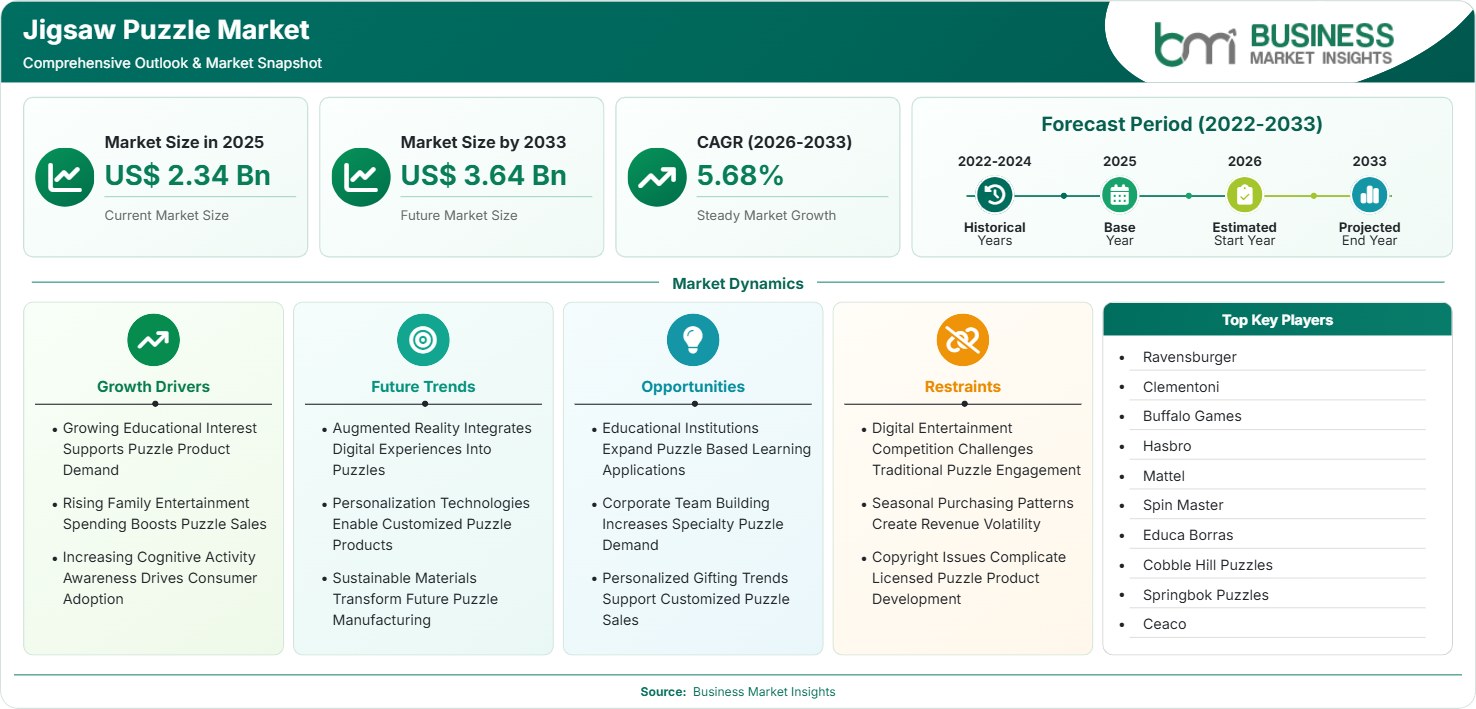
The Jigsaw Puzzle Market size was valued at US$ 2.34 billion in 2025 and is projected to reach US$ 3.64 billion by 2033, expanding at a CAGR of 5.68% during 2026–2033. Growth is supported by increasing interest in educational play, family entertainment activities, cognitive development products, and demand for creative leisure experiences among children and adults.

Report Coverage
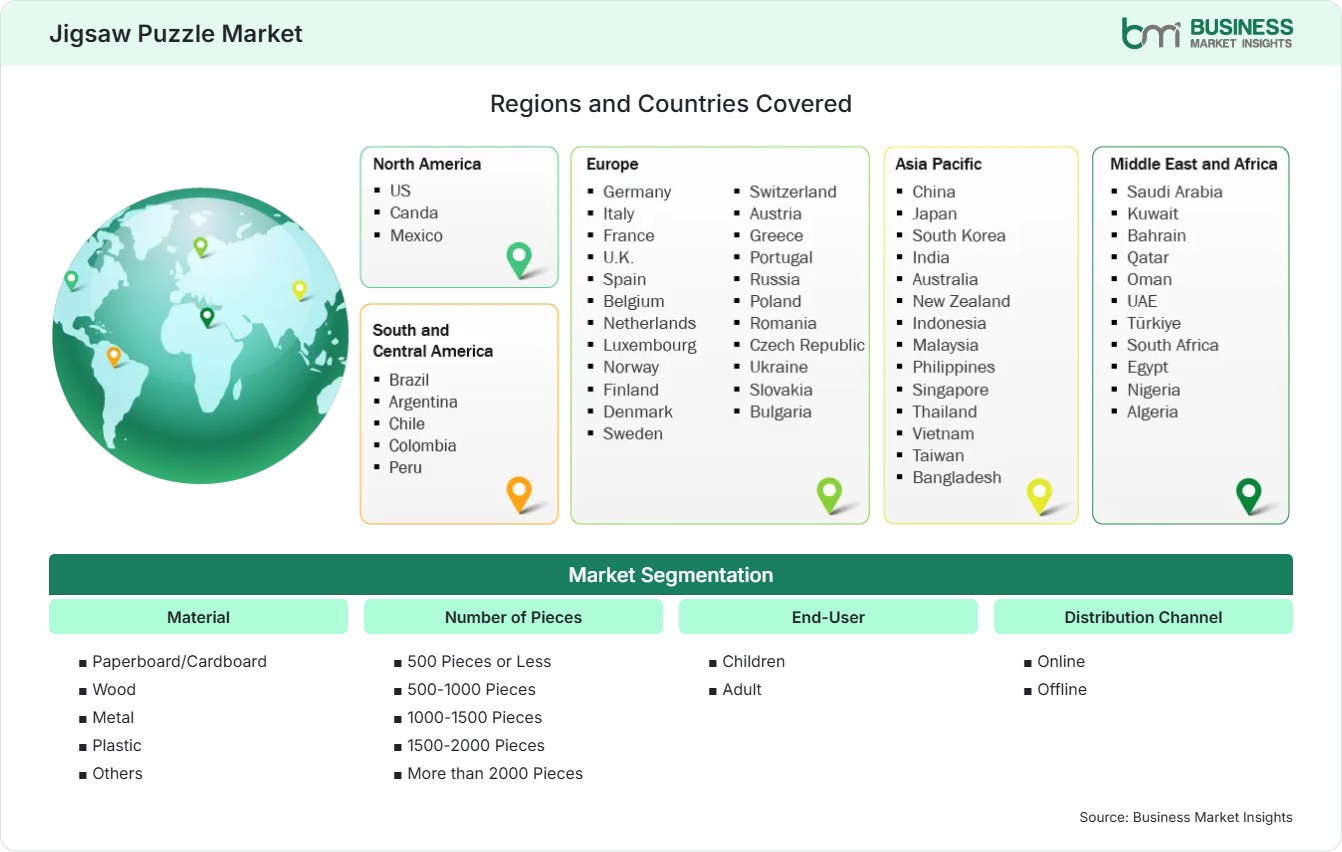
  • Material: Paperboard/Cardboard, Wood, Metal, Plastic, Others
  • Number of Pieces: 500 Pieces or Less, 500-1000 Pieces, 1000-1500 Pieces, 1500-2000 Pieces, More than 2000 Pieces
  • End-User: Children, Adult
  • Distribution Channel: Online, Offline
US$ 2.34 Bn Market size in 2025
US$ 3.64 Bn Market Size by 2033
5.68% CAGR, 2026 - 2033
2026-2033 Forecast Period

01 AI Overview

Jigsaw Puzzle Market Summary

  • North America Region: North America holds a leading position with a share ranging between 34%–37% in 2025 and is projected to grow at a CAGR of 5.2%–5.8% during 2026–2033. Strong consumer spending on educational toys, family entertainment products, and premium puzzle collections supports regional expansion. The U.S. market benefits from established toy retail networks, online purchasing adoption, and growing interest in adult puzzle activities, supporting a CAGR of 5.3%–5.9%.
  • Fastest Growing Region: Asia Pacific represents the fastest-growing region with a share ranging between 26%–29% in 2025 and is expected to expand at a CAGR of 6.4%–7.0% during 2026–2033. Rising disposable incomes, expanding educational product demand, urban lifestyles, and increasing awareness of cognitive learning activities are supporting market adoption across developing economies.
  • Leading Segment: Adult end users represent the leading segment with a share ranging between 55%–58% in 2025 and are projected to grow at a CAGR of 5.7%–6.2% during 2026–2033. Increasing interest in stress-relief activities, complex puzzle challenges, and recreational hobbies is supporting segment leadership.
  • High Growth Segment: Online distribution channels demonstrate strong expansion with a share ranging between 32%–35% in 2025 and a CAGR of 7.0%–7.6% during 2026–2033. Digital shopping platforms, wider product availability, customized options, and direct-to-consumer strategies are accelerating online sales growth.
  • Key Market Opportunity: Opportunities are emerging from personalized puzzles, educational applications, premium collectible designs, corporate gifting, and digital integration that enhances customer engagement and product customization.
  • Major Market Players: Ravensburger, Clementoni, Buffalo Games, Hasbro, Mattel, Spin Master, Educa Borras, Cobble Hill Puzzles, Springbok Puzzles, and Ceaco.
02 Strategic Insights

Jigsaw Puzzle Market: Strategic Insights

Jigsaw Puzzle Market Strategic Framework
FREE PDF
Request your free sample
Request free sample
03 Stakeholder View

Key Takeaways

  • The market is expanding beyond traditional children’s toys as adult consumers increasingly adopt puzzles for relaxation, mental stimulation, and hobby-based activities.
  • Educational applications are creating growth opportunities as schools, learning centers, and parents increasingly recognize puzzles as tools supporting problem-solving and cognitive development.
  • Product differentiation through premium artwork, personalized designs, licensed themes, and sustainable materials is becoming important for competitive positioning.
  • Online distribution is gaining importance by improving product accessibility, enabling customized purchases, and supporting direct engagement between manufacturers and consumers.
  • North America maintains a strong market position due to established toy markets, higher consumer spending, and strong demand for recreational products.
  • Emerging markets are providing expansion opportunities through rising disposable incomes, urbanization, increasing educational awareness, and growing interest in creative entertainment products.
04 Geographic Outlook

Jigsaw Puzzle Market Regional Highlights

North America Jigsaw Puzzle Market

North America accounted for a share ranging between 34%–37% in 2025 and is expected to grow at a CAGR of 5.2%–5.8% during 2026–2033. The region benefits from strong toy industry infrastructure, established retail networks, and increasing demand for adult recreational puzzles. The Jigsaw Puzzle Market share remains supported by premium products, branded collections, and online purchasing trends.

  • The U.S. represents the largest contributor due to strong consumer spending on educational and entertainment products.
  • Adult puzzle adoption is increasing through hobby communities, collectible designs, and complex puzzle formats.
  • Online platforms are improving access to specialized and premium puzzle categories.
  • Family entertainment trends continue supporting demand across residential consumers.

US Jigsaw Puzzle Market

The U.S. represented a share ranging between 82%–85% of North America in 2025 and is projected to grow at a CAGR of 5.3%–5.9% during 2026–2033. The market benefits from strong brand presence, established distribution channels, and increasing interest in puzzles among multiple age groups. The Jigsaw Puzzle Market growth is supported by educational applications, gifting trends, and premium puzzle collections.

  • Retailers are expanding puzzle selections through seasonal collections and exclusive product offerings.
  • Adult consumers are increasing purchases of challenging puzzles featuring artwork, landscapes, and licensed themes.
  • Educational institutions are adopting puzzles to support interactive learning methods.
  • Personalized puzzle products are gaining popularity for gifting and special occasions.

Europe Jigsaw Puzzle Market

Europe held a share ranging between 28%–31% in 2025 and is expected to expand at a CAGR of 5.0%–5.6% during 2026–2033. The region benefits from strong puzzle traditions, established manufacturers, and consumer interest in creative leisure activities. Germany, the U.K., France, and Italy represent important markets due to high demand for premium and educational puzzle products.

  • European consumers show strong preference for high-quality puzzle designs and sustainable materials.
  • Established brands continue expanding through innovative collections and licensed product ranges.
  • Educational and family-oriented activities support steady demand across the region.
  • Premium adult puzzle categories are gaining traction among hobby enthusiasts.

Asia Pacific Jigsaw Puzzle Market

Asia Pacific accounted for a share ranging between 26%–29% in 2025 and is projected to grow at a CAGR of 6.4%–7.0% during 2026–2033. Increasing educational spending, expanding middle-class populations, and rising interest in creative learning products are supporting regional growth. China, Japan, South Korea, and India are contributing significantly to market expansion.

  • China is witnessing increased demand through online retail growth and educational product adoption.
  • India is experiencing rising interest in puzzles due to expanding toy markets and learning-focused products.
  • Japan and South Korea continue supporting premium puzzle categories through strong hobby cultures.
  • E-commerce platforms are improving accessibility across emerging markets.

Rest of World Jigsaw Puzzle Market

Latin America, Middle East, and Africa represent emerging markets with a combined share ranging between 8%–11% in 2025 and are expected to grow at a CAGR of 4.8%–5.4% during 2026–2033. Growth is supported by increasing educational awareness, improving retail infrastructure, and rising demand for affordable entertainment products.

  • Growing urban populations are supporting demand for educational and recreational products.
  • Retail expansion is improving availability of branded puzzle products.
  • Family entertainment activities are creating new consumption opportunities.
  • Online channels are increasing access to international puzzle brands.
Global Market Geography
FREE PDF
Request your free sample
Request free sample
05 Segment Analysis

Jigsaw Puzzle Market Segmentation

Material

The material segment includes paperboard/cardboard, wood, metal, plastic, and others. Paperboard/cardboard represents the leading material category due to affordability, lightweight characteristics, wide availability, and suitability for mass-market puzzle production. The segment accounted for a share ranging between 68%–72% in 2025 and is expected to grow at a CAGR of 5.3%–5.9% during 2026–2033. Sustainable material innovations and premium finishing techniques are influencing product development strategies.

  • Paperboard/Cardboard: Paperboard and cardboard puzzles dominate due to cost efficiency, easy printing capabilities, and suitability for children’s, educational, and adult puzzle collections. Manufacturers are increasingly adopting recycled materials to address sustainability preferences.
  • Wood: Wooden puzzles are gaining demand in premium and educational categories due to durability, aesthetic appeal, and perceived higher quality. These products are commonly preferred for children’s learning applications and collectible puzzle ranges.
  • Metal: Metal puzzles represent a specialized category focused on complex designs, durability, and novelty experiences. Demand is supported by adult hobbyists seeking challenging and unique puzzle formats.
  • Plastic: Plastic puzzles offer durability, water resistance, and reusable characteristics. They are primarily used in specialized applications requiring stronger materials and long-lasting product performance.
  • Others: Other materials include mixed-material and innovative puzzle formats designed to provide differentiated experiences and premium positioning.

Number of Pieces

The number of pieces segment includes 500 pieces or less, 500–1000 pieces, 1000–1500 pieces, 1500–2000 pieces, and more than 2000 pieces. The 500 pieces or less category represents a significant share due to broad adoption among children, beginners, and casual users. The segment accounted for a share ranging between 42%–46% in 2025 and is projected to grow at a CAGR of 5.1%–5.7% during 2026–2033.

  • 500 Pieces or Less: These puzzles remain popular due to accessibility, shorter completion times, and suitability for children, families, and casual users seeking recreational activities.
  • 500–1000 Pieces: Medium-complexity puzzles attract both beginners and experienced users by providing a balance between challenge and completion time. This category is increasingly preferred among adult hobbyists.
  • 1000–1500 Pieces: These puzzles appeal to experienced consumers seeking detailed and challenging activities. Demand is supported by adult-focused collections, artistic themes, and premium designs.
  • 1500–2000 Pieces: Higher-piece-count puzzles target dedicated hobbyists and collectors interested in longer engagement and advanced problem-solving experiences.
  • More than 2000 Pieces: Large-format puzzles represent a niche premium category designed for expert users, collectors, and enthusiasts seeking complex recreational challenges.

End User

The end-user segment includes children and adults. Adult users represent the leading category due to increasing interest in relaxation activities, cognitive stimulation, and complex puzzle challenges. The segment accounted for a share ranging between 55%–58% in 2025 and is projected to grow at a CAGR of 5.7%–6.2% during 2026–2033. Growing awareness of mental wellness activities is supporting broader adoption among adult consumers.

  • Children: Children’s puzzles remain important due to educational benefits, skill development, and use in learning environments. Parents and educators are increasingly selecting puzzles to support problem-solving, creativity, and cognitive growth.
  • Adults: Adult puzzle adoption is expanding through premium collections, challenging designs, artistic themes, and hobby-based activities. Consumers increasingly use puzzles as screen-free entertainment and relaxation tools.

Distribution Channel

The distribution channel segment includes online and offline channels. Offline channels maintain a significant presence due to established toy stores, supermarkets, specialty retailers, and customer preference for physical product evaluation. However, online channels are expanding rapidly due to wider selections, convenience, and customized product availability. The Jigsaw Puzzle Market scope is expanding through digital commerce platforms that enable broader consumer reach.

  • Online: Online channels are experiencing strong growth through e-commerce platforms, direct-to-consumer brands, personalized puzzle offerings, and access to international product collections.
  • Offline: Offline distribution remains important through specialty toy stores, supermarkets, educational retailers, and gift stores offering immediate purchase availability and customer interaction.
06 Market Forces

Jigsaw Puzzle Market Dynamics

Key Market Drivers

Growing Educational Interest Supports Puzzle Product Demand

The growing recognition of puzzles as educational aids is fostering their acceptance by parents, schools, and learning institutions. Jigsaw puzzles enhance problem-solving, concentration, spatial perception, and logical thinking skills, making them an effective inclusion in educational programs. The puzzles are being used by schools and parents to add interactivity to their teaching methods, rather than traditional approaches. The manufacturers are focusing on designing age-appropriate, educationally themed, and skill-enhancing puzzle collections. The Jigsaw Puzzle Market analysis reveals that the educational uses would be a significant source of demand for the product in the future.

Rising Family Entertainment Spending Boosts Puzzle Sales

As more money is spent on family entertainment activities, demand for offline recreational products that foster interaction is increasing. Puzzles have become popular among families as an inexpensive form of entertainment through which they can share experiences, regardless of age. With the growing popularity of home activities, there is a growing demand for products that foster interaction and creativity without screens. Various types of puzzles, including family-friendly sizes and cooperative puzzles, are being developed by manufacturers for a wider consumer base. The increasing number of gifting events and the need for leisure products are also aiding sales growth.

Increasing Cognitive Activity Awareness Drives Consumer Adoption

As the importance of cognitive health and brain activity has increased, people tend to buy puzzles to stimulate their concentration and problem-solving skills through recreation. There is a growing trend among adults seeking relaxation to buy complex puzzles as a hobby. As a result, the industry's market scope has widened,, and manufacturers are producing high-end adult collections. The Jigsaw Puzzle Market trend shows growing consumer interest in puzzle products.  Rising consumer demand is driven by complex designs, artistic jigsaws, and limited-edition puzzles.

Key Market Opportunities

Educational Institutions Expand Puzzle Based Learning Applications

Educational institutions have provided opportunities by using puzzles in teaching. Educational institutions such as schools and training centers are adopting puzzles to increase engagement and facilitate skill development among learners. Manufacturers will have an opportunity to manufacture products tailored to meet curricular requirements and other learning objectives. There has been increased demand for educational puzzles that encourage creativity and critical thinking, driven by the growing use of interactive learning methods. Collaborations with educational institutions will also help promote the product and increase brand recognition.

Corporate Team Building Increases Specialty Puzzle Demand

More and more companies are looking into creative ways to build teams and solve problems together. There has been an emerging need for custom puzzles for corporate employee engagement programs, promotions, and events. There is a growing need for companies to offer special activities that not only foster teamwork but also provide memorable experiences for their employees. Manufacturers are increasingly providing personalized puzzles that will cater to corporate customers through designing branded, customized, and large-sized puzzles. This approach is creating new revenue streams other than conventional consumers.

Personalized Gifting Trends Support Customized Puzzle Sales

Demand for personalized gifts has fueled growth in customized puzzle products featuring personal photos, artwork, and design elements. Customers are choosing personalized puzzles for use during birthdays, anniversaries, celebrations, and other special events. Digital customization technology is enabling producers to create unique products with shorter production times and a better consumer experience. According to the Jigsaw Puzzle Market forecast, there will be opportunities for personalized products due to their growing consumer preference.

Market Restraints and Challenges

Digital Entertainment Competition Challenges Traditional Puzzle Engagement

Factor: Increasing consumer engagement with digital games, mobile applications, and online entertainment platforms creates competition for traditional puzzle products. Impact: Younger generations will dedicate much more time to digital pastimes and have less time for tangible puzzles, leading to a slower growth rate. Manufacturers are attempting to address this problem through innovations, educational features, licensed themes, and the inclusion of digital components.  But sustaining consumer interest demands constant innovation and adaptation based on their evolving entertainment preferences.

Seasonal Purchasing Patterns Create Revenue Volatility

Factor: Puzzle purchases often experience fluctuations during holidays, gifting seasons, and educational periods, creating uneven demand patterns throughout the year. Impact: Seasonal dependency can affect inventory planning, production scheduling, and revenue consistency for manufacturers and retailers. Companies are reducing this impact by expanding product categories, introducing year-round collections, and targeting diverse consumer groups including adults, educational users, and corporate buyers. Broadening applications beyond seasonal gifting can support more stable market performance.

07 Company Analysis

Competitive Landscape

The Jigsaw Puzzle Market analysis indicates that competition is shaped by product innovation, brand recognition, licensing strategies, material advancements, customization capabilities, and expansion across online and offline distribution channels. Companies are focusing on premium designs, educational applications, sustainable materials, and diverse product collections to strengthen their market presence. Established players are expanding their portfolios through partnerships, themed collections, and consumer-focused product development.

Company Name

Overview

Products and Services Relevant to This Market

Ravensburger

Global puzzle and game manufacturer known for premium-quality puzzle products.

Jigsaw puzzles for children and adults, educational puzzles, 3D puzzles, and licensed collections.

Clementoni

European puzzle manufacturer offering educational and entertainment-focused products.

Children’s puzzles, adult puzzles, educational collections, and themed puzzle designs.

Buffalo Games

Puzzle and game company focused on innovative designs and consumer entertainment products.

Adult puzzles, family puzzles, licensed artwork collections, and specialty puzzle formats.

Hasbro

Global toy and entertainment company with a broad portfolio of recreational products.

Puzzle products, licensed entertainment-based designs, and family-oriented games.

Mattel

Toy and entertainment company serving children and family consumer segments.

Character-based puzzles, children’s puzzle products, and entertainment-focused collections.

Spin Master

Global children’s entertainment company developing toys and interactive products.

Children’s puzzles, creative activity products, and educational entertainment solutions.

Educa Borras

Spanish puzzle manufacturer specializing in detailed puzzle collections.

Adult puzzles, children’s puzzles, artistic designs, and high-piece-count collections.

Cobble Hill Puzzles

Puzzle brand focused on premium artistic and challenging puzzle designs.

Adult jigsaw puzzles, scenic artwork collections, and specialty puzzle formats.

Springbok Puzzles

Established puzzle company offering unique designs and handcrafted puzzle experiences.

Adult puzzles, themed collections, and premium puzzle artwork.

Ceaco

Puzzle manufacturer offering affordable and themed puzzle collections.

Family puzzles, licensed puzzles, children’s puzzles, and entertainment-focused designs.

10 Trust & Transparency

Research Methodology

The market analysis combines proprietary research with secondary data from government agencies, company disclosures, regulatory filings, industry databases and expert interviews. Market estimates are validated through data triangulation, cross-market benchmarking and analyst review.

View Full Research Methodology

11 Questions Answered

Frequently Asked Questions

How will future product innovation influence market expansion?

Future innovation will focus on eco-friendly materials, advanced customization options, premium artwork, interactive learning formats, and expanded adult-oriented collections. These developments are expected to attract new consumer groups and support long-term market expansion.

What does the Jigsaw Puzzle Market report indicate about future competition?

The report indicates that competition will increasingly focus on product differentiation, sustainable materials, personalized offerings, educational applications, and digital commerce expansion. Companies offering innovative designs and diverse consumer-focused collections are expected to strengthen their market positions.

Why are personalized puzzles becoming more important?

Personalized puzzles are gaining popularity due to increasing demand for meaningful gifts and customized entertainment products. Digital customization platforms allow consumers to create unique designs using personal images, artwork, and special themes.

How are educational applications changing puzzle product demand?

Educational applications are expanding puzzle adoption by positioning products as tools for developing problem-solving skills, concentration, and creativity. Schools and parents are increasingly using puzzles to support interactive learning experiences and age-based skill development.

Which applications present the strongest opportunity in the Jigsaw Puzzle Market?

Educational institutions, adult hobby segments, family entertainment activities, personalized gifting, and corporate engagement programs represent strong opportunities. These applications benefit from puzzle-based learning, creative interaction, cognitive stimulation, and customized product experiences.

What factors are improving jigsaw puzzle return on investment?

Jigsaw puzzles improve value through long product lifecycles, reusable entertainment experiences, educational benefits, and broad appeal across children and adults. Premium designs, collectible editions, and personalized formats provide additional value by increasing consumer engagement and supporting repeat purchases.

Access the Full Jigsaw Puzzle Market Report

Get segment-level forecasts, regional estimates, competitive benchmarking, company profiles and downloadable Excel datasets.

Access the full Jigsaw Puzzle Market Report
350 pages PDF & Excel | 2026-08-11