
Integration Platform As A Service (iPaaS) Market Outlook: Size, Share, Trends, Growth Analysis, Competitive Landscape & Forecast, 2026-2033

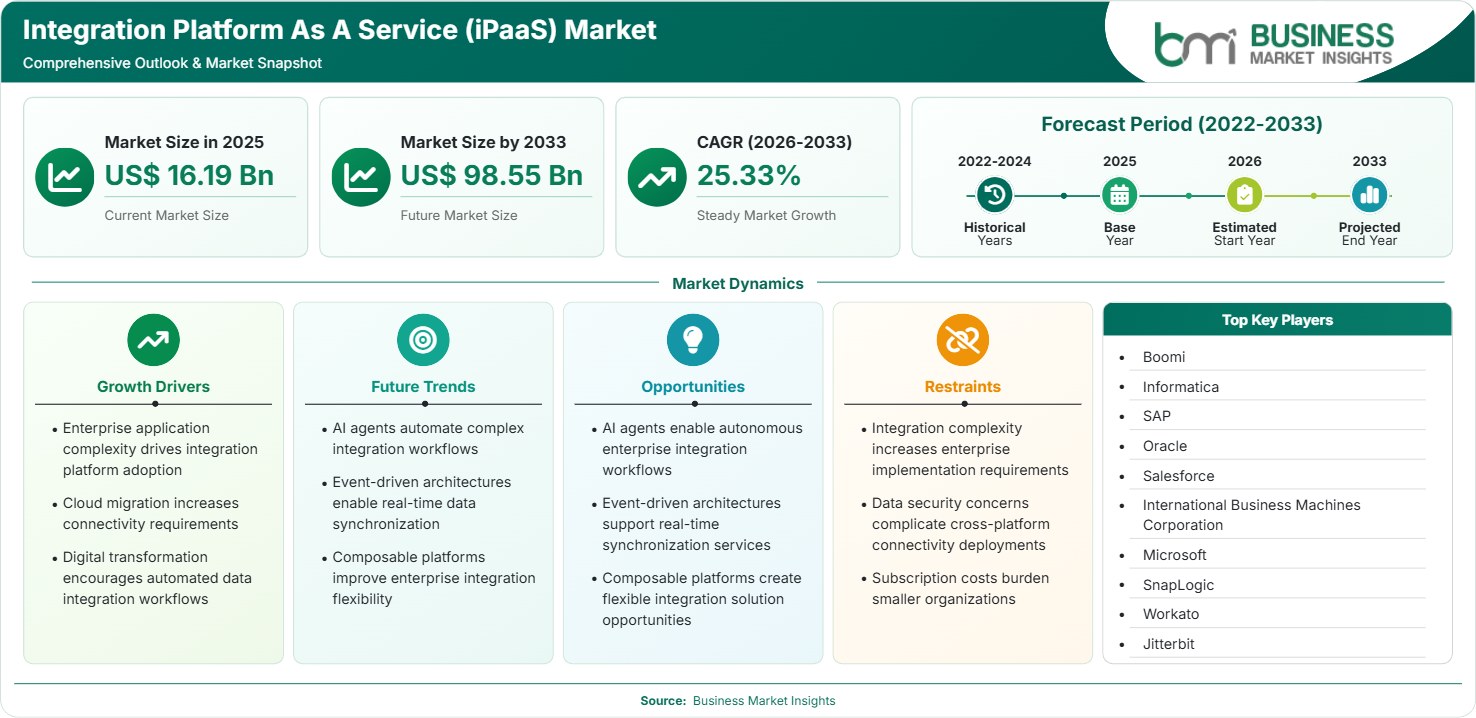
The Integration Platform As A Service Market size was valued at US$ 16.19 Billion in 2025 and is projected to reach US$ 98.55 Billion by 2033, growing at a CAGR of 25.33% during 2026–2033, driven by AI-enabled automation, hybrid-cloud complexity, API proliferation, SaaS expansion, and enterprise modernization opportunities.

Report Coverage
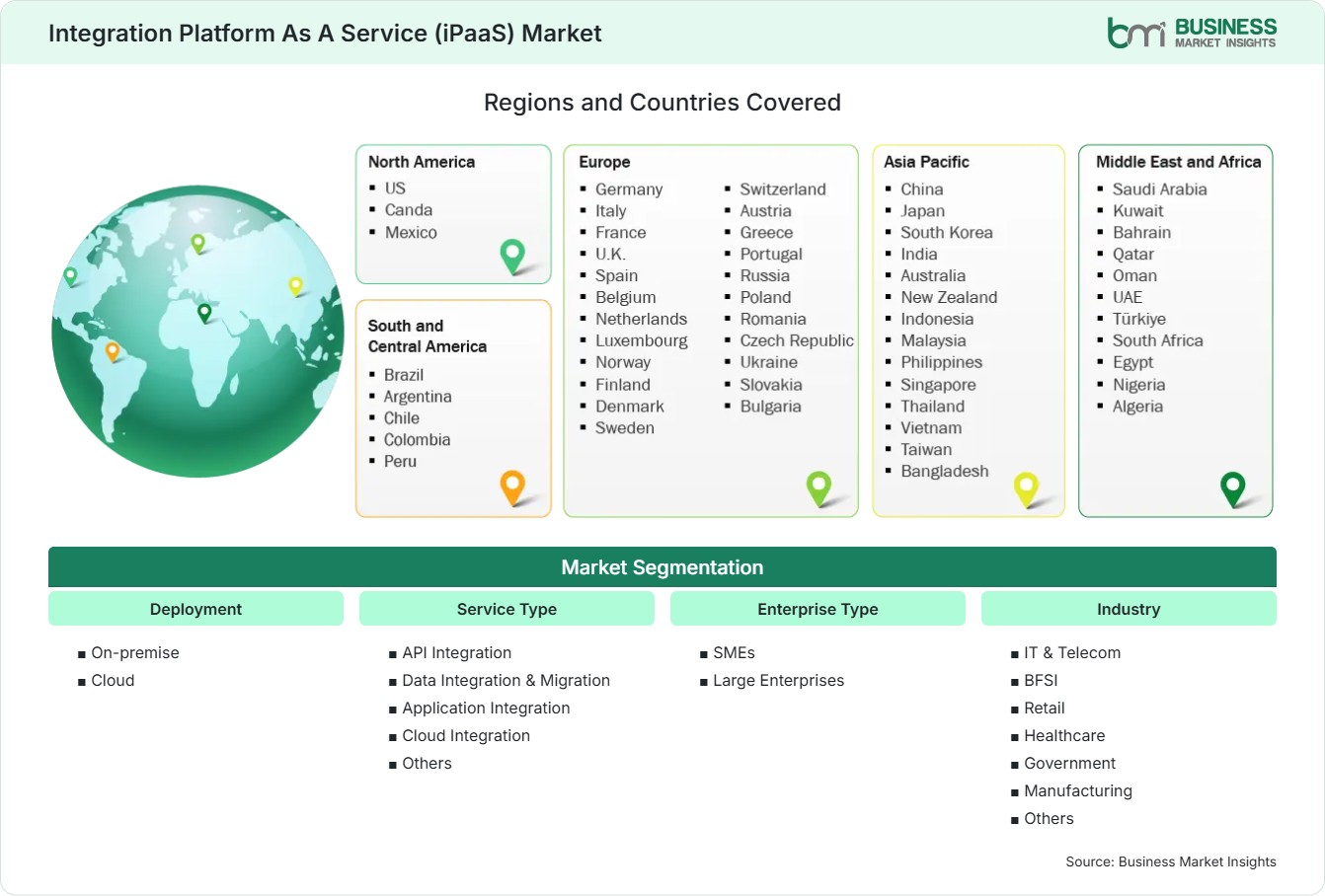
  • Deployment: On-premise, Cloud
  • Service Type: API Integration, Data Integration & Migration, Application Integration, Cloud Integration, Others
  • Enterprise Type: SMEs, Large Enterprises
  • Industry: IT & Telecom, BFSI, Retail, Healthcare, Government, Manufacturing, Others
US$ 16.19 Bn Market size in 2025
US$ 98.55 Bn Market Size by 2033
25.33% CAGR, 2026 - 2033
2026-2033 Forecast Period

AI Overview

Integration Platform As A Service (iPaaS) Market Summary

  • North America Region: North America holds a 35%–38% share in 2025, growing at a 24%–27% CAGR, influenced by cloud modernization, AI adoption, API governance, SaaS consolidation, cybersecurity requirements, and enterprise automation investments. The US remains the principal demand center, supported by hyperscale cloud adoption, mature enterprise software ecosystems, strong developer communities, and sustained spending on integration modernization.
  • Fastest Growing Region: Asia Pacific holds a 23%–26% share in 2025, growing at a 27%–30% CAGR, supported by digital public infrastructure, cloud migration, expanding SaaS ecosystems, fintech modernization, manufacturing digitization, and rising investments in intelligent automation.
  • Leading Segment: Cloud deployment holds a 58%–62% Integration Platform As A Service Market share in 2025, expanding at a 26%–29% CAGR, as enterprises prioritize elastic infrastructure, faster integration deployment, lower maintenance requirements, multicloud interoperability, centralized governance, and AI-ready architecture.
  • High Growth Segment: API Integration holds a 27%–30% share in 2025, expanding at a 28%–31% CAGR, supported by composable applications, API-led connectivity, partner ecosystems, microservices adoption, embedded services, real-time data exchange, and increasingly autonomous digital workflows.
  • Key Market Opportunity: AI agents, event-driven architectures, industry-specific connectors, API marketplaces, data governance, and integration observability are creating opportunities for vendors to move beyond connectivity toward intelligent enterprise orchestration.
  • Major Market Players: Boomi, Informatica, SAP, Oracle, Salesforce, International Business Machines Corporation, Microsoft, SnapLogic, Workato, and Jitterbit.
Strategic Insights

Integration Platform As A Service (iPaaS) Market: Strategic Insights

Integration Platform As A Service (iPaaS) Market Strategic Framework
FREE PDF
Request your free sample
Request free sample
Stakeholder View

Key Takeaways

  • The ecosystem is moving toward consolidated integration platforms that combine application connectivity, API management, data movement, workflow automation, observability, governance, and increasingly AI-agent orchestration. Buyers are therefore evaluating integration architecture as an enterprise control layer rather than an isolated middleware purchase.
  • Cloud deployment, API integration, and large-enterprise modernization represent the strongest near-term revenue pools, while SMEs provide a widening addressable base as low-code interfaces reduce specialist development requirements and implementation complexity.
  • Agentic AI is becoming an important product-design direction. Platforms are adding capabilities to discover, govern, observe, and orchestrate AI agents alongside conventional applications and APIs, creating demand for integration architectures capable of handling autonomous and event-driven workflows.
  • Asia Pacific offers an attractive expansion case because enterprises are simultaneously adopting cloud services, digital payments, connected manufacturing, public digital infrastructure, and SaaS applications. India, China, Japan, South Korea, Singapore, and Australia provide differentiated adoption opportunities.
  • Integration technology is attracting strategic investment as vendors seek broader capabilities spanning data integration, automation, API management, and AI. IBM's acquisition of StreamSets and webMethods strengthened its integration and data portfolio, demonstrating the strategic value of platform consolidation.
  • Integration platforms are increasingly becoming the connective infrastructure for AI initiatives. Enterprises need governed access to reliable business data and APIs, making integration quality, metadata, security, lineage, and observability increasingly important selection criteria.
Geographic Outlook

Integration Platform As A Service (iPaaS) Market Regional Highlights

North America Integration Platform As A Service Market

North America accounts for a 35%–38% share in 2025 and is projected to expand at a 24%–27% CAGR through 2033. The region benefits from mature cloud infrastructure, extensive SaaS penetration, established API ecosystems, and high enterprise automation spending. The market share is reinforced by demand from technology, BFSI, healthcare, retail, and manufacturing organizations. The Integration Platform As A Service Market growth outlook remains supported by AI adoption and modernization of legacy application estates across the US and Canada.

  • Cloud-first modernization is encouraging enterprises to consolidate fragmented middleware, APIs, workflows, and data pipelines within governed integration environments, reducing duplicated interfaces and accelerating application deployment cycles.
  • AI initiatives are increasing demand for secure connectivity between models, enterprise applications, vector databases, APIs, and operational systems, creating new requirements for real-time orchestration and policy-based access.
  • Large technology vendors benefit from established enterprise relationships, while specialist platforms compete through low-code development, faster deployment, prebuilt connectors, automation, and verticalized integration capabilities.
  • Regulatory requirements involving privacy, financial data, healthcare information, and cybersecurity are increasing demand for centralized monitoring, access controls, audit trails, and integration observability.

US Integration Platform As A Service Market

The US represents approximately 76%–80% of North America's share in 2025 and is projected to grow at a 24%–27% CAGR through 2033. Its position reflects substantial enterprise software spending, hyperscale cloud infrastructure, AI investment, and mature developer ecosystems. The US remains the principal innovation hub for iPaaS vendors, particularly in AI orchestration, API management, low-code automation, and enterprise integration governance.

  • Financial institutions and technology companies are adopting integration platforms to connect cloud-native services with legacy systems while maintaining security, auditability, and operational resilience across distributed architectures.
  • Healthcare organizations are expanding interoperability requirements as clinical, administrative, analytics, and patient-engagement systems increasingly exchange information through APIs and cloud-based applications.
  • Enterprise AI adoption is increasing the strategic importance of integration because AI applications require governed access to business applications, real-time data, APIs, documents, and transactional systems.

Europe Integration Platform As A Service Market

Europe holds a 20%–23% share in 2025 and is projected to register a 23%–26% CAGR through 2033. Germany, the UK, and France are leading markets, while Spain and the Netherlands provide attractive expansion opportunities. The regional Integration Platform As A Service Market share reflects cloud migration, digital transformation, industrial automation, and regulatory emphasis on data protection. Germany is estimated to grow at 23%–26% CAGR, while the UK can achieve 24%–27% CAGR.

  • Data protection requirements are encouraging enterprises to prioritize integration architectures with granular access controls, data governance, auditability, encryption, and regional processing capabilities.
  • Industrial companies are connecting ERP, manufacturing execution, supply-chain, IoT, and analytics environments, increasing demand for reliable hybrid integration across factory and enterprise systems.
  • Financial services organizations are modernizing integration layers to support open banking, digital channels, fraud analytics, cloud applications, and increasingly automated compliance processes.
  • France and Germany remain important enterprise markets, while digitally advanced Northern European economies offer opportunities for API-first services, cloud orchestration, and automation-led integration.

Asia Pacific Integration Platform As A Service Market

Asia Pacific represents a 23%–26% share in 2025 and is projected to expand at a 27%–30% CAGR, making it the fastest-growing regional market. China, Japan, India, South Korea, Singapore, and Australia provide major demand centers. India is positioned for 29%–32% CAGR, supported by digital transformation and cloud adoption. The regional Integration Platform As A Service Market growth is reinforced by fintech, manufacturing digitization, public digital infrastructure, and expanding SaaS adoption.

  • India combines rapidly expanding cloud usage, digital public infrastructure, fintech innovation, and enterprise modernization, creating broad opportunities for API-led integration and automated workflows.
  • China is developing demand around industrial digitization, cloud services, intelligent manufacturing, e-commerce ecosystems, and integration between enterprise applications and connected production environments.
  • Japan and South Korea offer sophisticated enterprise markets where integration spending is increasingly linked to modernization of legacy environments, automation, and connected manufacturing.
  • Southeast Asian economies are attracting cloud and digital investments, creating demand for scalable integration services supporting regional SaaS adoption, payments, logistics, and cross-border commerce.

Rest of World Integration Platform As A Service Market

Rest of World accounts for a 15%–18% share in 2025 and is expected to expand at a 22%–25% CAGR of the Integration Platform As A Service Market through 2033. South and Central America are benefiting from fintech, retail digitization, and cloud adoption, while the Middle East and Africa are developing demand through smart-city programs, government digitization, and enterprise modernization.

Brazil and the UAE are among the leading adoption markets, while Saudi Arabia and Mexico provide strong expansion opportunities as digital transformation programs accelerate.

  • Brazil's fintech ecosystem and expanding cloud usage are increasing demand for integration platforms capable of connecting banking, commerce, customer-engagement, and analytics applications.
  • Gulf economies are investing in digital government, smart infrastructure, cloud platforms, and AI initiatives, creating demand for secure integration across public and private-sector systems.
  • South Africa is developing opportunities around financial services, telecommunications, retail, and public-sector modernization, where legacy connectivity requirements remain substantial.
  • Mexico provides an attractive manufacturing and nearshoring opportunity as connected supply chains increase requirements for ERP, logistics, production, and partner-system integration.
Global Market Geography
FREE PDF
Request your free sample
Request free sample
Segment Analysis

Integration Platform As A Service (iPaaS) Market Segmentation

Deployment

Cloud deployment leads the market, with a share of 58%-62% in 2025, and is expected to grow at a CAGR of 26%-29% through 2033. The cloud architecture offers elasticity, fast deployment, centralized updates, and improved connectivity among distributed systems, and is therefore considered one of the main components within the scope of the Integration Platform As A Service Market.

  • On-premise: Supports organizations requiring infrastructure control, specialized security policies, legacy connectivity, and localized processing. Adoption remains relevant across regulated industries and complex enterprise environments where migration constraints delay cloud transition.
  • Cloud: Provides scalable infrastructure, managed upgrades, broad connector availability, rapid deployment, and multicloud interoperability. Demand is reinforced by SaaS adoption, distributed workforces, AI applications, and enterprises seeking lower integration infrastructure management requirements.

Service Type

API Integration is the dominant category, accounting for 27% to 30% of the market in 2025, with a CAGR of 28% to 31% from 2025 to 2033. API-driven architectures enable reusable services, composable applications, partner integration, and AI workflows. The Integration Platform As A Service Market trends prefer platforms that offer API lifecycle management and application orchestration.

  • API Integration: Enables reusable connectivity between applications, services, partners, and AI systems. Adoption rises with microservices, digital channels, embedded services, API ecosystems, and demand for governed real-time data access.
  • Data Integration & Migration: Supports movement, synchronization, transformation, and consolidation of enterprise information. Demand is driven by cloud migrations, analytics modernization, data-platform consolidation, and requirements for reliable information across distributed environments.
  • Application Integration: Connects business applications and automates transactions across ERP, CRM, HR, finance, supply-chain, and customer-service environments, reducing manual transfers and improving process consistency.
  • Cloud Integration: Enables interoperability among public clouds, private infrastructure, SaaS applications, and enterprise systems. Adoption is strengthened by multicloud strategies, workload portability, centralized governance, and distributed application architectures.

Enterprise Type

Large companies continue to dominate, with a market share of 57%–61% and a CAGR of 24%–27% in 2025, due to large application estates and complex integration needs. Small- and medium-sized businesses are growing fast as low-code interfaces, subscription model, connectors, and managed services ease their entry into the market.

  • SMEs: Adoption is supported by affordable subscription models, low-code development, standardized connectors, SaaS concentration, and growing requirements to automate sales, finance, customer service, and operational workflows.
  • Large Enterprises: Complex application landscapes, hybrid infrastructure, regulatory requirements, global operations, and extensive partner ecosystems sustain demand for centralized integration governance, API management, monitoring, and enterprise-scale orchestration.

Industry

The IT and telecom industry continues to dominate the list of verticals owing to high-density applications and API integration, whereas BFSI, healthcare, retail, government, and manufacturing offer significant growth potential. Integration Platform As A Service Market is now characterized by an increasing need for vertical-centric interoperability, security, automation, and data governance.

  • IT & Telecom: High application volumes, cloud-native architectures, APIs, network automation, and customer-service platforms create continuous requirements for scalable and observable integration.
  • BFSI: Banks and financial institutions use integration to connect core systems, digital channels, payment platforms, analytics, fraud controls, and regulatory reporting workflows securely.
  • Retail: Omnichannel commerce, inventory synchronization, customer analytics, marketplaces, payments, and fulfillment systems increase demand for real-time application and data connectivity.
  • Healthcare: Interoperability, patient engagement, clinical systems, administrative applications, analytics, and secure information exchange are increasing the need for governed integration architectures.
  • Government: Digital public services, citizen portals, identity systems, cloud migration, and interagency data exchange create demand for secure and auditable integration platforms.
  • Manufacturing: ERP, MES, IoT, supply-chain systems, plant automation, and analytics require reliable integration between operational technology and enterprise applications.
Market Forces

Integration Platform As A Service (iPaaS) Market Dynamics

Key Market Drivers

AI Agent Orchestration Is Expanding Integration Requirements

AI applications demand managed access to enterprise systems, APIs, databases, documents, and business processes, thus making integration a critical part of AI infrastructure. AI is considered one of the driving forces shaping iPaaS requirements in Gartner's 2026 forecast, and vendors are already augmenting their solutions with agent management and orchestration features. Integration Platform As A Service Market increasingly relies on the ability to manage machine-driven activities, enforce permissions, monitor autonomous activities, and connect agents to transactional applications. Such architecture transcends the borders of classic application connectivity by embracing dynamic orchestration. Vendors that can combine API management, data management, workflow management, observability, and AI governance will be able to capture high-value workloads.

SaaS Sprawl Is Increasing Enterprise Integration Complexity

Organizations are now implementing a variety of SaaS solutions, resulting in increased challenges in interfaces, synchronization, and governance. According to Boomi, enterprises could run hundreds of SaaS solutions, indicating the level of application fragmentation that technology teams face. Integration tools can solve the problem through reusable connectors, workflows, monitoring, and standards-based development processes. The Integration Platform As A Service market is thus moving towards a solution in which application-to-application, API, event, and data integrations will be performed within a single environment. As organizations seek to eliminate interface duplication and accelerate application implementation, there is a need for reusable integration capabilities rather than custom middleware projects.

Hybrid Cloud Modernization Is Sustaining Integration Demand

Enterprises typically do not move all workloads at once, resulting in cloud applications, legacy systems, private infrastructure, and third-party services coexisting. This results in a continuous need for integration solutions that would safely enable connection between these worlds without sacrificing performance or governance. IBM's investment in integration capabilities through StreamSets and webMethods illustrates how crucial it is to integrate data movement, application connectivity, and automation. It becomes clear how beneficial the Integration Platform As A Service Market is, given that any modernization program results in continuous integration needs during migration and post-migration optimization.

Key Market Opportunities

Verticalized Integration Platforms Can Increase Enterprise Penetration

Integration templates for individual industries could help achieve compliance and workflow efficiency in each industry. For BFSI, solutions can center on payments and core banking integration, while for healthcare, they could focus on interoperability and secure data exchange. The manufacturing implementation can be connected through ERP, MES, IoT, and supply chains in certain patterns. That means vendors can bundle connectors, workflows, governance, and observability together in line with industry-specific processes. Integration Platform As A Service Market forecasts can be positively affected by vertical specialization, as buyers will be more interested in measurable results than in general connectivity.

AI-Ready Data Connectivity Creates New Platform Value

Enterprise AI adoption creates an opportunity for integration vendors to become the governed access layer between AI systems and operational information. AI applications need current data, authenticated APIs, business rules, and controlled access to transactional systems. Platforms with metadata, lineage, security policies, event processing, and real-time connectivity capabilities may better fulfill this need than individual integration tools. The MuleSoft Agent Fabric release from Salesforce provides an indication of how such a discovery can be achieved through orchestration, governance, and observation of AI agents. It is strategically important because organizations will need their AI solutions to operate within control mechanisms rather than become disconnected automation islands.

Regional Cloud Infrastructure Is Opening Localized Expansion Paths

Expansion in emerging markets is an opportunity for vendors to match their integration services with data residency, sovereign infrastructure, digital government projects, and regional cloud ecosystems. India is an ideal case in point here because the intersection between cloud adoption by enterprises and financial technologies, healthcare systems, manufacturing technologies, and digital public infrastructure is taking place. Salesforce has already made MuleSoft available in India through Hyperforce with regional storage and computing facilities. The way forward for vendors lies in leveraging local cloud regions, regional partnerships, localized connectors, and compliance-driven deployments in order to enable their global platforms to overcome market-specific challenges.

Market Restraints and Challenges

Integration Security and Governance Complexity

Factor: Integration platforms integrate a multitude of applications, APIs, data sources, end-users, business partners, and increasingly intelligent AI agents, thereby increasing the number of access points that require security controls. Impact: Organizations will have to consider the governance of authentication, authorization, encryption, secrets management, API governance, data lineage, monitoring, and compliance within ever more distributed architectures. A lack of governance can lead to inadequate access controls, data duplication, rogue APIs, or even hidden automation. With the integration architecture becoming an integral part of business processes, there is now a drive towards visibility and governance, which complicates the platforms. This creates challenges for vendors in balancing usability and governance.

Legacy Complexity Can Extend Deployment Timelines

Factor: Big companies use legacy systems built earlier, with proprietary interfaces, disorganized databases, and custom enterprise systems that lack modern APIs or standard data models. Impact: The integration process in such an environment requires specialized adapters, transformation rules, and custom development and testing processes, thereby increasing integration time and costs. The integration platform can help with orchestration, but it cannot solve all problems associated with the architecture of legacy systems on its own. This problem is most relevant in BFSI, government, manufacturing, and healthcare, where critical systems cannot be changed instantly.

Company Analysis

Competitive Landscape

The Integration Platform As A Service Market analysis indicates a competitive environment combining broad enterprise software providers with specialist integration vendors. Gartner's 2026 assessment evaluated 18 leading iPaaS providers, including Boomi, Informatica, IBM, Microsoft, Oracle, Salesforce, SAP, SnapLogic, Tray.ai, Workato, and others, reflecting continued competition around AI, automation, governance, API management, and integration breadth.

Company Name

Overview

Products and Services relevant to this market

Boomi

Enterprise integration specialist with a broad cloud-native platform and established global partner ecosystem.

Boomi Enterprise Platform, application integration, API management, data management, workflow automation, and AI-agent management.

Informatica

Data-management and integration provider focused on enterprise data connectivity, governance, and intelligent automation.

Intelligent Data Management Cloud, application integration, data integration, API management, governance, and automation capabilities.

SAP

Global enterprise software provider integrating business applications, data, APIs, and cloud services.

SAP Integration Suite, API management, application integration, event-driven architecture, data integration, and process orchestration.

Oracle

Enterprise technology provider combining cloud infrastructure, applications, databases, and integration services.

Oracle Integration, application connectivity, API management, process automation, data integration, and SaaS integration.

Salesforce

CRM and cloud platform provider offering integration through MuleSoft and its broader enterprise ecosystem.

MuleSoft Anypoint Platform, API management, application integration, data integration, automation, and AI-agent orchestration.

International Business Machines Corporation

Technology company providing integration, automation, data, and hybrid-cloud capabilities for complex enterprises.

IBM webMethods, StreamSets technologies, API management, application integration, data integration, and automation.

Microsoft

Cloud and enterprise software provider supporting integration across Azure and business application environments.

Azure Integration Services, Logic Apps, API Management, Service Bus, Event Grid, and enterprise application connectivity.

SnapLogic

Specialist integration provider emphasizing low-code development, automation, and intelligent integration workflows.

SnapLogic Intelligent Integration Platform, application integration, API management, data integration, automation, and prebuilt connectors.

Workato

Enterprise automation and integration platform focused on connecting applications, data, workflows, and business teams.

Workato platform, application integration, API management, workflow automation, data integration, and AI-enabled automation.

Jitterbit

Integration and automation provider serving enterprises seeking application, API, data, and workflow connectivity.

Harmony platform, application integration, API management, data integration, workflow automation, and enterprise connectivity.

Trust & Transparency

Research Methodology

The market analysis combines proprietary research with secondary data from government agencies, company disclosures, regulatory filings, industry databases and expert interviews. Market estimates are validated through data triangulation, cross-market benchmarking and analyst review.

View Full Research Methodology

Questions Answered

Frequently Asked Questions

What should buyers evaluate in an Integration Platform As A Service Market report?

Buyers should evaluate deployment flexibility, connector breadth, API management, data integration, security, governance, observability, automation, AI capabilities, implementation requirements, ecosystem strength, and support for hybrid and multicloud architectures.

Which industries offer strong opportunities for integration platform providers?

BFSI, healthcare, manufacturing, retail, government, and IT and Telecom provide substantial opportunities because each sector manages complex application environments, regulatory requirements, data-sharing needs, and increasing automation workloads.

Why is cloud deployment gaining greater enterprise preference?

Cloud deployment provides elasticity, centralized updates, faster provisioning, broad connector availability, and easier connectivity across distributed applications. These benefits align with multicloud adoption, SaaS expansion, remote operations, and enterprise efforts to reduce infrastructure-management requirements.

How are AI agents changing enterprise integration requirements?

AI agents require governed access to enterprise data, APIs, applications, and workflows. This increases demand for agent discovery, orchestration, authentication, observability, policy enforcement, and real-time connectivity alongside conventional application integration.

What factors are shaping the Integration Platform As A Service Market through 2033?

AI adoption, SaaS proliferation, hybrid-cloud modernization, API-led architecture, low-code development, and enterprise automation are the principal structural forces. Integration platforms are increasingly becoming orchestration layers connecting applications, data, APIs, workflows, and AI agents.

Access the Full Integration Platform As A Service (iPaaS) Market Report

Get segment-level forecasts, regional estimates, competitive benchmarking, company profiles and downloadable Excel datasets.

Access the full Integration Platform As A Service (iPaaS) Market Report
350 pages PDF & Excel | 2026-09-22
Similar Research

Related Market Reports