
Industrial Seals Market Outlook: Size, Share, Trends, Growth Analysis, Competitive Landscape & Forecast, 2026-2033

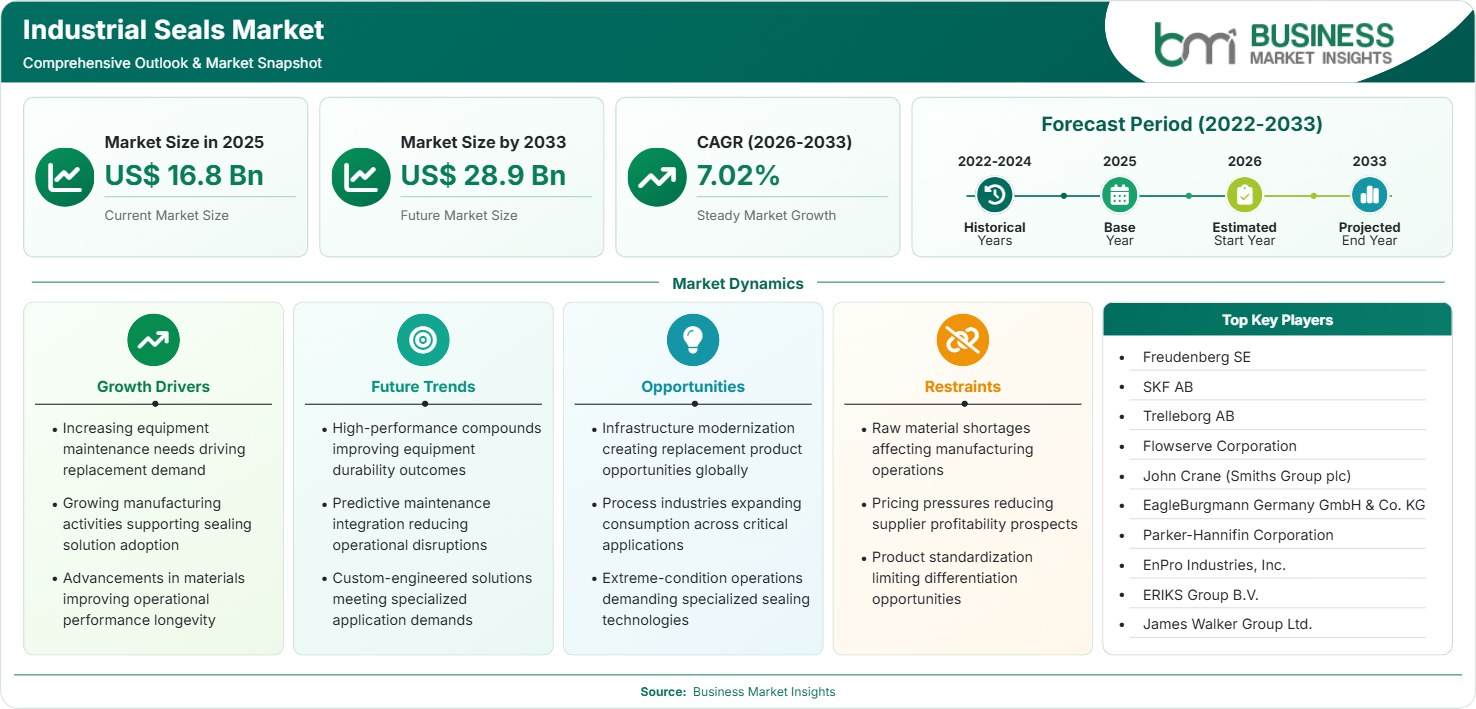
The Industrial Seals Market size was valued at US$ 16.8 Billion in 2025 and is projected to reach US$ 28.9 Billion by 2033, growing at a CAGR of 7.02% during 2026–2033. Rising industrial automation, growing renewable energy installations, expanding semiconductor manufacturing, and increasing demand for leakage prevention solutions are creating substantial opportunities across high-performance sealing applications.

Report Coverage
  • Type: Axial Seals, Radial Seals, Mechanical Seals, Carbon Seals
  • End Use Industry: Automotive, Renewable Energy & Utilities, Semiconductor, Metal and Mining, Food & Beverage, Oil & Gas, Energy, Aerospace & Defense, Marine, Construction & Agriculture Equipment, Chemicals and Pharmaceuticals, Water and Wastewater Treatment, Paper and Textile Manufacturing, Life Sciences
US$ 16.8 Bn Market size in 2025
US$ 28.9 Bn Market Size by 2033
7.02% CAGR, 2026 - 2033
2026-2033 Forecast Period

AI Overview

Industrial Seals Market Summary

  • North America Region: North America holds a market share of 34%–37% in 2025, growing with a CAGR of 6.2%–6.8% during 2026–2033. Demand is supported by shale energy operations, automation upgrades, aerospace production, wastewater investments, and predictive maintenance programs across industrial facilities.
  • The U.S. dominates regional demand, supported by advanced manufacturing investments and a CAGR of 6.3%–6.9% through 2033.
  • Fastest Growing Region: Asia Pacific accounts for 28%–31% market share in 2025 and is projected to grow at a CAGR of 8.1%–8.8% during 2026–2033. Rapid industrialization, semiconductor capacity expansion, energy infrastructure projects, localized manufacturing ecosystems, and modernization of processing industries continue accelerating demand across major economies.
  • Leading Segment: Mechanical Seals maintain a market share of 34%–38% in 2025 and are expected to expand at a CAGR of 7.1%–7.8%. Extensive deployment in pumps, compressors, mixers, and rotating equipment supports adoption where reliability, emission control, and operational efficiency remain critical priorities.
  • High Growth Segment: Semiconductor represents 7%–10% market share in 2025 and is forecast to register a CAGR of 9.5%–10.4%. Growing fabrication investments, contamination-control requirements, advanced process equipment deployments, and regional chip manufacturing incentives continue stimulating premium sealing demand globally.
  • Key Market Opportunity: Expanding deployment of hydrogen production facilities, carbon capture infrastructure, battery manufacturing plants, and advanced water treatment systems is generating demand for specialized seals capable of handling aggressive operating conditions.
  • Major Market Players: Freudenberg SE, SKF AB, Trelleborg AB, Flowserve Corporation, John Crane (Smiths Group plc), EagleBurgmann Germany GmbH & Co. KG, Parker-Hannifin Corporation, EnPro Industries, Inc., ERIKS Group B.V., and James Walker Group Ltd.
Strategic Insights

Industrial Seals Market: Strategic Insights

Industrial Seals Market Strategic Framework
FREE PDF
Request your free sample
Request free sample
Stakeholder View

Key Takeaways

  • The value chain is becoming increasingly integrated, with raw material suppliers, seal makers, equipment manufacturers, and after-market service providers all working together to improve lifecycle performance and cut down on maintenance costs.
  • Some of the most promising long-term growth opportunities for high-end sealing solutions are to be found in semiconductor fabrication plants, renewable energy infrastructure, hydrogen projects, and advanced water treatment systems.
  • Innovation is now being directed towards engineered materials, sensor-equipped monitoring facilities, low-emission designs, and sealing systems that are specifically designed for use under extreme temperatures and pressures.
  • The investment case for Asia Pacific is highly attractive because of growing industrial capacity, strong government support for manufacturing, and the increasing degree of localization of critical supply chains across a number of sectors.
  • The company's recent acquisitions in the fields of sealing technologies, fluid-handling systems, and industrial services show that its aim is to expand its product ranges and enhance its after-market revenue streams.
  • There is an increasing demand for durable sealing products as a result of sustainability objectives, the aim being to promote energy efficiency, the conservation of resources, control of emissions, and the reliability of equipment in process-intensive industries.
Geographic Outlook

Industrial Seals Market Regional Highlights

North America Industrial Seals Market

North America accounted for approximately 34%–37% of global demand in 2025 and is projected to grow at a CAGR of 6.2%–6.8% through 2033. The region has modern manufacturing capacity, oil and gas operations, aerospace investments, and widespread automation. Industrial businesses remain focused on equipment dependability and emission control. The Industrial Seals Market share remains supported by robust replacement demand and modernization of aging industrial infrastructure. Increasing energy-transition investments further stimulate the adoption of high-performance sealing technologies.

  • To improve the uptime of their equipment, satisfy emissions compliance requirements, and enhance the performance of their assets in upstream, midstream, and downstream installations, operators in the oil and gas industry are turning to advanced sealing systems.
  • Aerospace manufacturing increases demand for precision-engineered seals capable of withstanding extreme operating conditions, pressure variations, and stringent reliability requirements.
  • More industrial automation in factories shortens replacement cycles and leads to more use of condition-based maintenance solutions with new sealing technologies.
  • Upgrades to the water infrastructure in various municipalities lead to greater use of durable sealing products in pumps, valves, filtration systems, and treatment facilities.

US Industrial Seals Market

The United States represented approximately 72%–76% of the North American Industrial Seals Market demand in 2025 and is anticipated to expand at a CAGR of 6.3%–6.9% through 2033. Investment in semiconductor fabrication, defense systems, petrochemical processing, pharmaceuticals, and water management facilities ensures continued consumption. Local manufacturers keep stressing reliability, emission control, and efficiency. Growing reshoring projects and support by the government for advanced manufacturing are helping in modernization projects that call for sealing solutions.

  • The demand for sealing systems that are resistant to contamination is being driven by investments in semiconductor fabrication and the growing complexity of the production equipment together with the need for ultra-clean manufacturing environments.
  • The expansion of liquefied natural gas infrastructure and that of petrochemical processing facilities provides long-term opportunities for high-pressure and chemically resistant sealing technologies.
  • Aerospace and defence programmes promote the use of engineered materials which provide superior performance in tough operational environments and in mission-critical equipment.
  • The strategies associated with industrial digitalization are speeding up the implementation of predictive maintenance systems that are combined with advanced sealing components and monitoring platforms.

Europe Industrial Seals Market

Europe accounted for approximately 25%–28% of global Industrial Seals Market demand in 2025 and is forecast to grow at a CAGR of 6.5%–7.1% through 2033. Innovation of sustainable development, the program for modernization of industry, and stringent environmental standards promote the use of high technology sealants. Germany is the dominant market in the region, but Poland and some of the Eastern European countries show greater growth rates. The process industry is adopting the best sealants for its operations due to efficiency, emissions control, and stringent standards.

  • Germany provides the biggest source of regional revenue, due to its leadership in the manufacture of machinery, in the production of chemicals, and in the field of industrial automation.
  • Poland is one of the fastest-growing national markets, due to industrial investment and initiatives aimed at expanding manufacturing capacity.
  • There is a demand for durable sealing products among renewable energy projects in both Northern and Western Europe, these being used in wind power and utility applications.
  • The expansion of pharmaceutical manufacturing is leading to greater demands for hygienic and contamination-resistant sealing technologies.
  • The modernization of water treatment programs is still helping to ensure a steady procurement of industrial sealing solutions.

Asia Pacific Industrial Seals Market

Asia Pacific held approximately 28%–31% of global Industrial Seals Market demand in 2025 and remains the fastest-expanding regional market with a CAGR of 8.1%–8.8% through 2033. Market fundamentals are reinforced by rapid industrialization, infrastructure development, growth in semiconductor manufacturing, and growing domestic manufacturing capacity. China generates the highest regional revenues, whereas India is one of the fastest-growing regions. Sustained investments in the process industry and manufacturing facilities drive the demand for sealing products.

  • China is still the biggest consumer in the region as a result of its wide industrial capacity, ongoing infrastructure development, and extensive manufacturing ecosystems.
  • India shows one of the most robust growth patterns as industrial development, the production of electronics, and investment in energy speed up.
  • The addition of semiconductor production capacity in various regions greatly raises the demand for specialized sealing solutions that control contamination.
  • The expansion of renewable energy installations promotes wider acceptance in both wind turbine systems and in utility-scale infrastructure.
  • Investment in food processing and in the manufacturing of pharmaceuticals provides opportunities for hygienic and regulatory-compliant sealing products.

Rest of World Industrial Seals Market

Rest of World represented approximately 9%–12% of global demand in 2025 and is expected to expand at a CAGR of 7.0%–7.7% through 2033. The growth in South America and Central America depends on mining, agriculture, and energy development. The demands of the Middle East and Africa get their advantages out of petrochemical investment, water treatment, and industry diversification strategies. The region of the Middle East with the highest demand is Saudi Arabia, while the region of South America is Brazil.

  • Brazil gains advantages from investments in mining, food processing, the manufacturing of agricultural equipment, and energy infrastructure, all of which support the wider use of industrial equipment.
  • Saudi Arabia is still making investments in the petrochemical industry, in downstream manufacturing, and in its programmes aimed at industrial diversification, these needing advanced containment technologies.
  • The problem of water scarcity in various markets is leading to greater investment in filtration, desalination, and wastewater treatment infrastructure.
  • The mining activities taking place all over Latin America call for tough sealing solutions that are capable of functioning in difficult conditions.
  • The industrial expansion projects taking place in the Gulf area are leading to the need for engineered sealing systems to be used in critical applications.
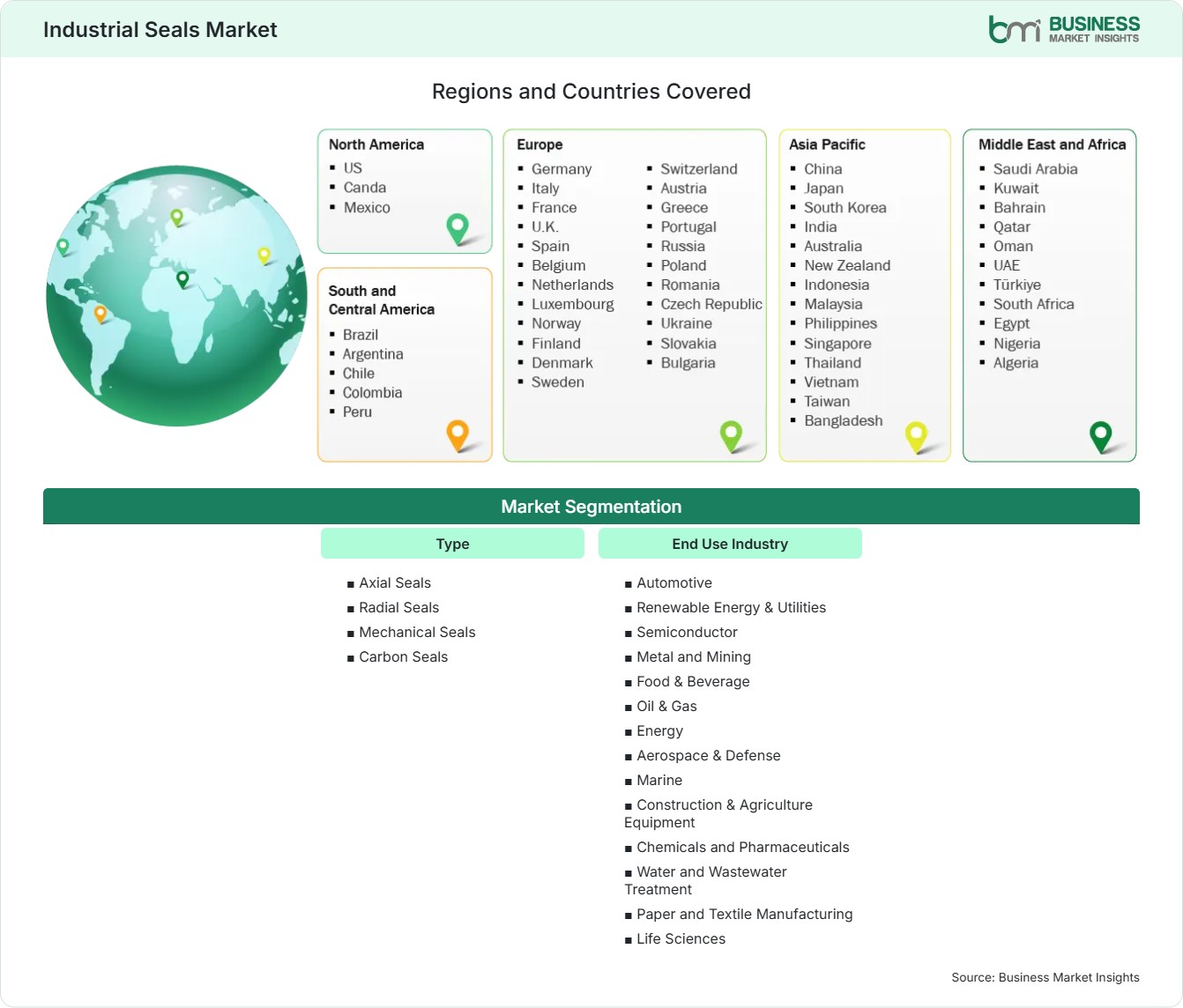
Global Market Geography
FREE PDF
Request your free sample
Request free sample
Segment Analysis

Industrial Seals Market Segmentation

Type

Type-based demand remains influenced by equipment reliability requirements, fluid containment performance, pressure resistance, and maintenance optimization objectives. This segment accounted for approximately 100% market participation across multiple product categories, with mechanical seals representing the largest individual category. Ongoing technology advancements, increasing industrial automation, and stricter environmental regulations continue supporting adoption. The Industrial Seals Market scope expands as manufacturers develop specialized solutions tailored for increasingly demanding operating environments.

  • Axial Seals: Widely deployed where axial movement compensation is essential. Adoption is supported by machinery requiring dependable leakage control, compact design characteristics, and stable performance under variable operating conditions.
  • Radial Seals: Extensively used in rotating equipment applications requiring contamination prevention and lubrication retention. Growth is supported by manufacturing automation, automotive production, and increasing industrial equipment utilization.
  • Mechanical Seals: The leading product category benefits from extensive use in pumps, compressors, mixers, and processing equipment where efficiency, safety, reliability, and reduced emissions remain critical priorities.
  • Carbon Seals: Preferred in high-temperature and high-speed environments due to their durability and thermal resistance. Aerospace, energy, and advanced industrial applications continue driving demand.

End Use Industry

End-use diversification remains a critical strength, reducing dependence on any single industry. This segment reflects broad deployment across energy, manufacturing, transportation, process industries, and infrastructure applications. Industrial operators increasingly prioritize lifecycle cost reduction, operational efficiency, environmental compliance, and equipment uptime. The Industrial Seals Market trends indicate growing demand from semiconductor manufacturing, renewable energy infrastructure, pharmaceuticals, and advanced industrial automation projects worldwide.

  • Automotive: Electrification initiatives, advanced manufacturing processes, and increasing vehicle production continue supporting demand for precision-engineered sealing technologies.
  • Renewable Energy & Utilities: Wind, solar, hydroelectric, and utility applications require durable sealing systems capable of supporting long operational lifecycles and reliability objectives.
  • Semiconductor: High-growth demand is driven by contamination-control requirements, fabrication facility expansion, and advanced process equipment investments globally.
  • Metal and Mining: Harsh operating environments create sustained demand for wear-resistant solutions designed to maintain equipment performance and reliability.
  • Food & Beverage: Stringent hygiene standards and expanding processing capacity encourage adoption of regulatory-compliant and contamination-resistant sealing technologies.
  • Oil & Gas: Exploration, production, refining, and transportation operations depend on high-performance sealing systems for safety and operational continuity.
  • Energy: Conventional and emerging energy infrastructure projects support broad deployment across turbines, compressors, generators, and fluid-handling systems.
  • Aerospace & Defense: Critical applications require advanced materials capable of performing under extreme temperatures, pressures, and operational conditions.
  • Marine: Commercial shipping, offshore operations, and naval applications continue generating demand for corrosion-resistant sealing technologies.
  • Construction & Agriculture Equipment: Expanding machinery fleets increase demand for sealing solutions that improve durability and equipment lifecycle performance.
  • Chemicals and Pharmaceuticals: Complex processing environments require chemical resistance, contamination control, and compliance with rigorous operational standards.
  • Water and Wastewater Treatment: Infrastructure modernization and sustainability initiatives support growing installation of pumps, valves, and filtration systems utilizing advanced seals.
  • Paper and Textile Manufacturing: Continuous processing operations depend on dependable sealing performance to reduce downtime and maintain production efficiency.
  • Life Sciences: Expanding biotechnology and laboratory infrastructure create demand for highly specialized sealing technologies supporting sensitive production environments.
Market Forces

Industrial Seals Market Dynamics

Key Market Drivers

Expansion of Industrial Automation and Smart Manufacturing

The increase in the use of Industry 4.0 technology has led to an increased need for sealing technologies that can facilitate automated machinery, robots, fast-moving machines, and predictive maintenance technology. Manufacturers are becoming more conscious about reducing downtime and increasing efficiency, and hence, the importance of efficient seals has increased. Monitoring technology is increasingly being incorporated into fluid management equipment, offering an opportunity for engineered seals to provide superior durability and data. Upgraded facilities with manufacturing equipment require seals that can work under tougher circumstances. These factors collectively contribute to sustained Industrial Seals Market growth across automotive, electronics, process industries, and precision manufacturing environments worldwide.

Increasing Investments in Energy and Process Industries

The energy industry continues to drive strong demand for industrial sealing technologies, driven by spending on conventional power generation, renewable energy projects, petrochemical plants, and transmission infrastructure. Since pumps, compressors, turbines, valves, and other rotating machinery need high-performance seals to ensure operational reliability and compliance with environmental regulations, leakage prevention and maintenance optimization are given priority by operators in light of the growing global energy demand. In the fields of refining, chemical processing, and utilities, conventional components are being replaced by more advanced sealing technologies, which are designed to cope with very high operating temperatures and pressures.

Stringent Environmental and Emission Compliance Requirements

Governments and regulatory agencies are implementing stricter standards related to industrial emissions, workplace safety, water conservation, and environmental protection. Facilities operating in oil and gas, chemicals, pharmaceuticals, and power generation sectors are increasingly investing in advanced sealing solutions to reduce fugitive emissions and improve containment efficiency. Manufacturers are responding by developing low-emission designs and engineered materials capable of maintaining integrity under aggressive operating conditions. Industrial Seals Market growth is also supported by replacement demand generated through compliance-driven upgrades. As sustainability objectives become embedded within industrial operating strategies, procurement priorities increasingly favor premium sealing technologies offering measurable performance benefits.

Key Market Opportunities

Hydrogen Economy and Clean Energy Infrastructure Development

Hydrogen generation, storage, transportation, and usage applications demand the use of high-grade sealants that can withstand extreme pressure conditions and also provide the molecular penetration properties of the material. The governments of North America, Europe, and the Asia Pacific regions are investing heavily in developing clean energy ecosystems, thus making long-term investments in the sealing industry an attractive option. Industrial Seals Market Forecasts increasingly acknowledge hydrogen infrastructure as a strategic growth avenue due to its expected role in decarbonization initiatives.

Semiconductor Manufacturing Capacity Expansion

Investment in the construction of semiconductor manufacturing plants continues to increase, as both governments and the private sector aim to achieve greater supply chain resilience and technological independence. The conditions required for semiconductor manufacturing should be of utmost cleanliness and depend heavily on sealing technology. All the semiconductor manufacturing machines, such as fabrication equipment, vacuum equipment, gas delivery systems, and chemical processing equipment, utilize special seals that decrease the risk of contamination. Increased investments in the US, China, India, Japan, South Korea, and Europe provide a suitable environment for the growth of companies dealing with high-end solutions.

Advanced Water and Wastewater Treatment Modernization

Widespread global worries about water security are leading to major investments in treatment facilities, distribution infrastructure, recycling systems, and desalination projects. It is imperative that sealing solutions be employed by all of the equipment in these facilities since the efficiency of operation and resource saving depend upon it. Continuous efforts are being made towards municipal infrastructure improvement programs and sustainable industries, and thus, further purchases can be anticipated. In developing nations, capacities are being increased to cater to the needs of an increasing population, while in developed nations, there is a need for replacing old infrastructure.

Market Restraints and Challenges

Volatility in Raw Material Costs and Supply Chain Complexity

The fact is that industrial sealing products depend on specialized elastomers, engineered polymers, carbon materials, metals, and composites, the costs of which can vary greatly due to fluctuations in commodity markets and geopolitical disruptions. In this way, the producers experience difficulty in maintaining their profitability levels and are unable to maintain their prices. This is due to the complex nature of the supply chain, which creates greater vulnerability during procurement and may increase the time required to deliver raw materials. In cases where there is economic uncertainty, the customers tend to postpone their programs and opt for substitutes.

Performance Requirements in Extreme Operating Conditions

The fact is that industrial applications nowadays involve higher temperatures, greater pressures, more aggressive chemicals, and more demanding rotational speeds than those found in traditional equipment environments. As a result, product development becomes more complicated and requires greater use of resources, involving extensive testing, material innovation, and various certification procedures. Failure in such cases can lead to expensive periods of downtime, environmental accidents, and safety problems for the operators. To remain competitive in specialized fields, manufacturers must continue to invest in research and development.

Company Analysis

Competitive Landscape

Industrial consolidation, product innovation, and aftermarket service expansion continue shaping the competitive environment. The Industrial Seals Market analysis highlights strong competition among global engineering companies focused on advanced materials, application-specific solutions, and reliability-enhancing technologies.

Company Name

Overview

Products and Services Relevant to this Market

Freudenberg SE

Global sealing technology leader serving automotive, industrial, energy, and process industries through extensive engineering expertise and material science capabilities.

Mechanical seals, radial shaft seals, engineered sealing systems, industrial sealing materials, and lifecycle support services.

SKF AB

Leading bearing and rotating equipment specialist with a significant portfolio of industrial sealing technologies and asset reliability solutions.

Radial seals, bearing-integrated sealing systems, lubrication management products, and maintenance solutions.

Trelleborg AB

Engineering group specializing in polymer-based solutions supporting demanding industrial, aerospace, marine, and energy applications.

Industrial seals, precision sealing systems, custom elastomer products, and fluid containment technologies.

Flowserve Corporation

Major flow-control and industrial equipment supplier serving energy, chemicals, power generation, and infrastructure sectors worldwide.

Mechanical seals, sealing support systems, pumps, flow-control equipment, and aftermarket services.

John Crane (Smiths Group plc)

Established provider of engineered technologies designed to improve reliability, efficiency, and compliance in critical operations.

Mechanical seals, filtration systems, couplings, digital reliability solutions, and asset optimization services.

EagleBurgmann Germany GmbH & Co. KG

Global specialist recognized for advanced sealing technologies deployed in demanding industrial and energy environments.

Mechanical seals, seal supply systems, expansion joints, magnetic couplings, and monitoring technologies.

Parker-Hannifin Corporation

Diversified motion and control technology company with extensive industrial sealing and fluid management expertise.

Engineered seals, O-rings, hydraulic sealing systems, fluid connectors, and industrial components.

EnPro Industries, Inc.

Industrial technology company serving mission-critical applications requiring precision sealing and engineered product solutions.

Sealing technologies, emission-control solutions, bearing protection products, and industrial engineered components.

ERIKS Group B.V.

Industrial services provider offering engineered components, maintenance support, and customized sealing solutions.

Industrial seals, fluid handling products, maintenance services, and engineered application support.

James Walker Group Ltd.

Specialized engineering company focused on sealing technologies for demanding industrial environments worldwide.

High-performance seals, gaskets, expansion joints, elastomer solutions, and technical engineering services.

Trust & Transparency

Research Methodology

The market analysis combines proprietary research with secondary data from government agencies, company disclosures, regulatory filings, industry databases and expert interviews. Market estimates are validated through data triangulation, cross-market benchmarking and analyst review.

View Full Research Methodology

Questions Answered

Frequently Asked Questions

What insights does an Industrial Seals Market Report typically provide?

An Industrial Seals Market Report generally evaluates industry structure, growth drivers, competitive developments, technology trends, regional demand patterns, segmentation performance, and future investment opportunities.

Which region is expected to create the strongest growth opportunities through 2033?

Asia Pacific is projected to generate the strongest expansion opportunities because of industrialization, semiconductor investments, manufacturing localization strategies, and infrastructure development activities.

How are technological advancements influencing product development?

Manufacturers are investing in engineered polymers, advanced carbon materials, sensor-enabled monitoring systems, and low-emission solutions that improve lifecycle performance under challenging operating conditions.

Which end-use industries generate the highest demand for sealing technologies?

Oil and gas, automotive, chemicals, energy, semiconductor manufacturing, food processing, aerospace, mining, pharmaceuticals, and water treatment industries collectively account for a substantial portion of global demand.

What factors are accelerating demand for industrial seals globally?

Demand is increasing because manufacturers seek higher equipment reliability, lower emissions, improved energy efficiency, reduced maintenance costs, and enhanced performance in automated production environments.

Access the Full Industrial Seals Market Report

Get segment-level forecasts, regional estimates, competitive benchmarking, company profiles and downloadable Excel datasets.

Access the full Industrial Seals Market Report
350 pages PDF & Excel | 2026-09-21
Similar Research

Related Market Reports