
Induction Motor Market Outlook: Size, Share, Trends, Growth Analysis, Competitive Landscape & Forecast, 2026-2033

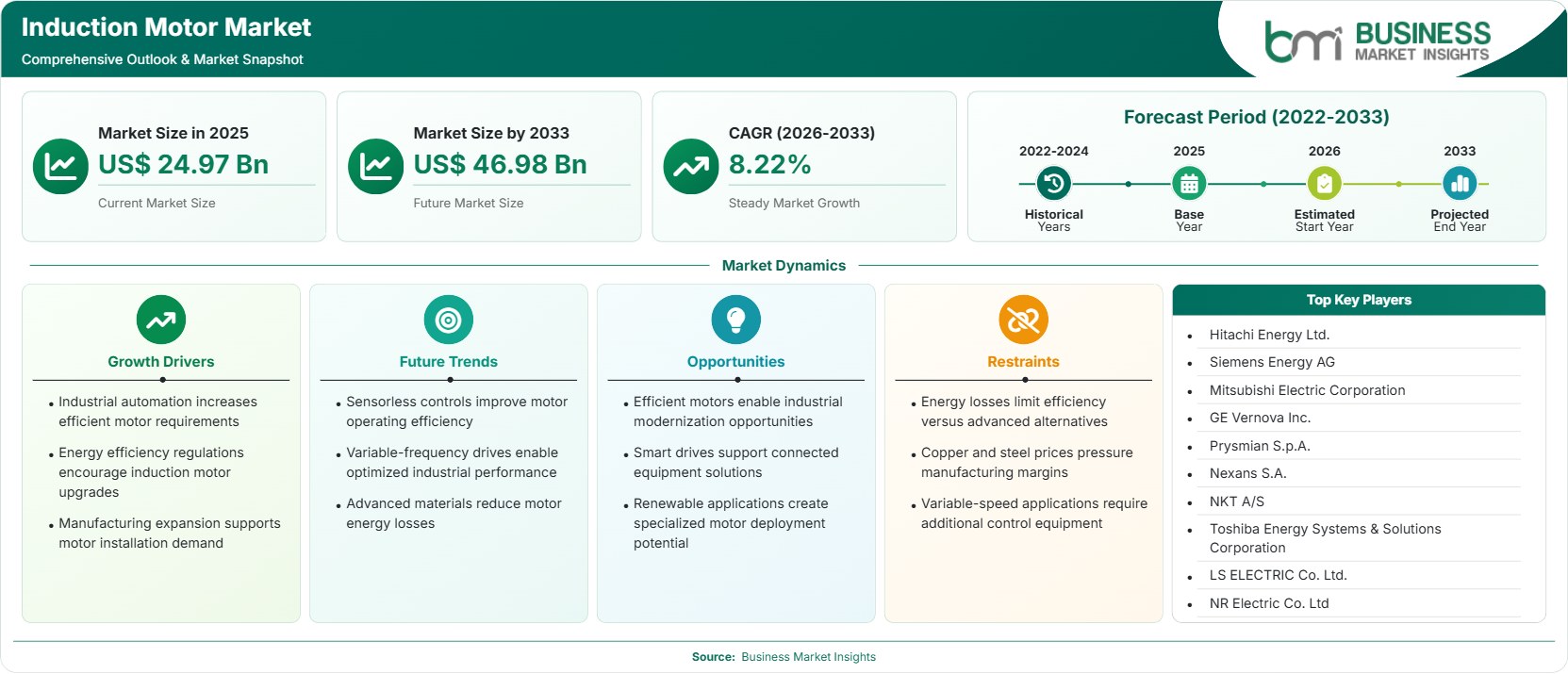
The Induction Motor Market size was valued at US$ 24.97 Billion in 2025 and is projected to reach US$ 46.98 Billion by 2033, growing at a CAGR of 8.22% during 2026–2033, driven by industrial automation, energy-efficiency upgrades, electrification, and demand for reliable motor systems.

Report Coverage
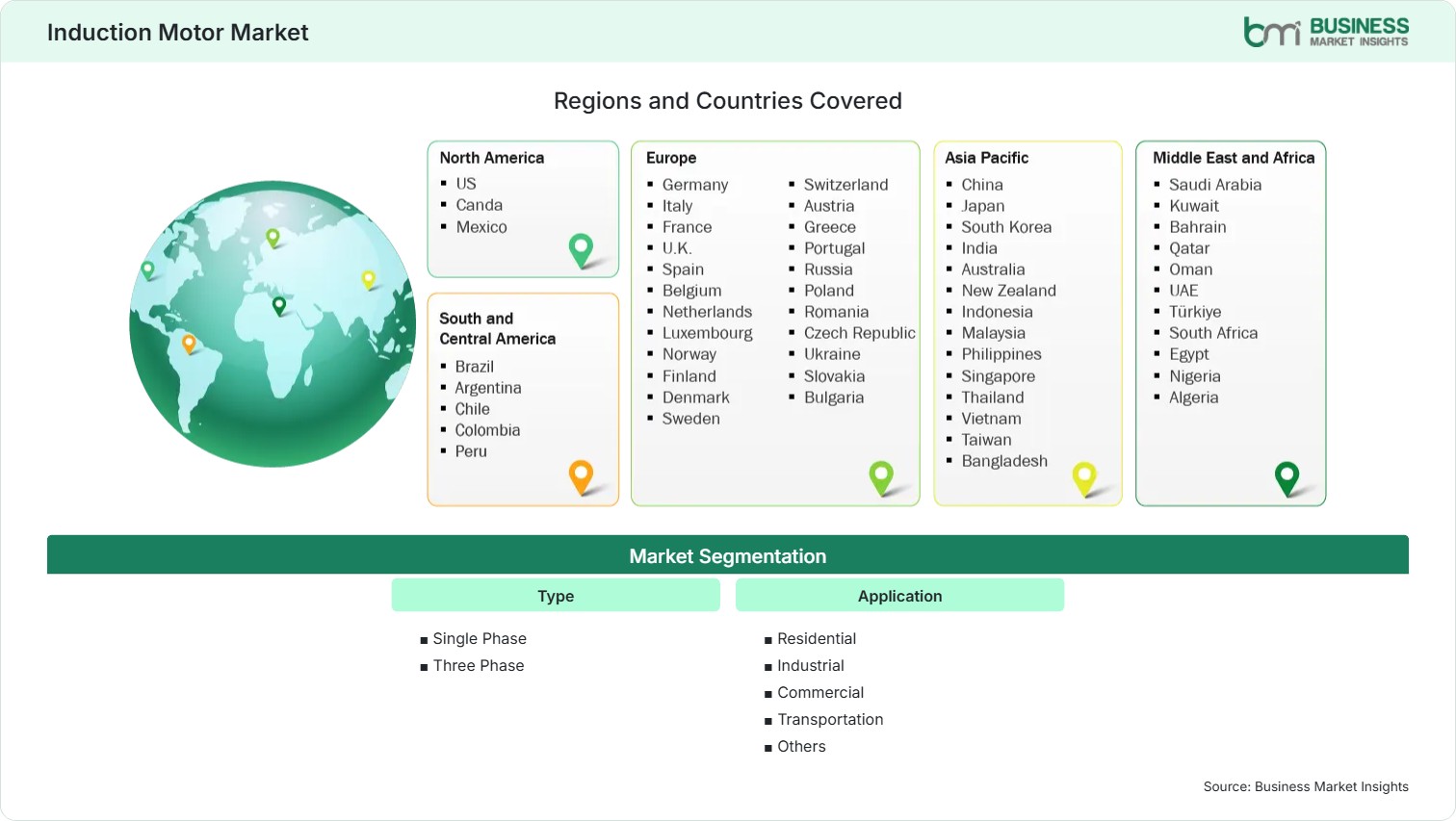
  • Type: Single Phase, Three Phase
  • Application: Residential, Industrial, Commercial, Transportation, Others
US$ 24.97 Bn Market size in 2025
US$ 46.98 Bn Market Size by 2033
8.22% CAGR, 2026 - 2033
2026-2033 Forecast Period

AI Overview

Induction Motor Market Summary

  • North America Region: North America holds an estimated 20%–24% share in 2025, growing at a 6.80%–7.60% CAGR during 2026–2033. Industrial automation, HVAC modernization, water infrastructure, and energy-efficiency requirements create replacement and retrofit opportunities for high-efficiency motors, variable frequency drives, and connected maintenance systems. The US market is projected to expand at a 6.60%–7.40% CAGR, supported by manufacturing modernization, HVAC efficiency upgrades, infrastructure investment, and industrial motor replacement demand.
  • Fastest Growing Region: Asia Pacific holds an estimated 43%–47% share in 2025 and is growing at a 9.20%–10.10% CAGR during 2026–2033. Factory automation, infrastructure construction, manufacturing expansion, electrification, and energy-efficiency programs are creating demand for scalable motor systems across industrial and commercial applications.
  • Leading Segment: Three-phase motors hold an estimated 70%–74% Induction Motor Market share in 2025 and are growing at a 7.90%–8.60% CAGR during 2026–2033. Their industrial suitability, operating efficiency, torque characteristics, and compatibility with variable frequency drives support widespread deployment in pumps, compressors, conveyors, and manufacturing machinery.
  • High Growth Segment: Transportation applications are estimated to expand at a 9.40%–10.30% CAGR during 2026–2033. Electrified mobility infrastructure, rail systems, auxiliary equipment, thermal management, and specialized traction-related applications are creating opportunities for efficient, durable, and controllable motor technologies.
  • Key Market Opportunity: Manufacturers can capture demand by combining premium-efficiency motors, integrated drives, condition monitoring, localized production, and retrofit services for industrial customers seeking lower operating costs and improved equipment reliability.
  • Major Market Players: ABB Ltd., Siemens AG, WEG S.A., Nidec Corporation, Regal Rexnord Corporation, Mitsubishi Electric Corporation, Toshiba Corporation, Hitachi Industrial Equipment Systems Co., Ltd., TECO Electric & Machinery Co., Ltd., and Yaskawa Electric Corporation.
Strategic Insights

Induction Motor Market: Strategic Insights

Induction Motor Market Strategic Framework
FREE PDF
Request your free sample
Request free sample
Stakeholder View

Key Takeaways

  • The value chain includes copper and electrical steel suppliers, rotor and stator manufacturers, motor assemblers, drive providers, distributors, system integrators, and maintenance companies. Competitive differentiation increasingly extends beyond the motor itself to engineering, commissioning, and after-sales support.
  • Three-phase motors used in industrial applications provide a substantial demand base. Transportation and specialized electrification-related uses offer opportunities for suppliers developing compact, efficient, and application-specific motor systems.
  • Premium-efficiency architectures, inverter-duty designs, advanced insulation, thermal optimization, and digital condition monitoring are influencing product development. Manufacturers are also evaluating magnet-free alternatives where application requirements support different motor technologies.
  • Asia Pacific combines industrial expansion, infrastructure development, and growing manufacturing capacity. India and Southeast Asian markets offer potential for suppliers establishing localized production, technical service, and distribution networks.
  • Industry participants are strengthening manufacturing footprints, automation capabilities, and integrated motor-drive offerings. Consolidation and strategic portfolio development can improve geographic coverage and expand access to specialized applications.
  • Buyers increasingly evaluate energy consumption, service availability, installation compatibility, and maintenance requirements. Vendors able to provide validated performance data and application-specific support can improve their position in technically demanding procurement processes.
Geographic Outlook

Induction Motor Market Regional Highlights

North America Induction Motor Market

North America accounts for an estimated 20%–24% Induction Motor Market share in 2025, with a projected 6.80%–7.60% CAGR during 2026–2033. Demand is supported by industrial automation, HVAC modernization, water infrastructure, and replacement of aging equipment. The region favors efficient motors compatible with advanced control systems and maintenance platforms. US manufacturing investments and Canadian industrial projects contribute to equipment demand. Mexico provides additional manufacturing and supply-chain opportunities. Customers increasingly assess lifecycle costs, energy consumption, and service responsiveness when selecting motor suppliers for industrial facilities and commercial installations.

  • Industrial retrofits: Aging machinery creates demand for high-efficiency replacements and inverter-compatible motors that can reduce operating costs without requiring complete equipment redesign.
  • HVAC modernization: Commercial building upgrades encourage efficient motor and drive combinations for fans, pumps, air-handling units, and cooling systems.
  • Water infrastructure: Pumping and wastewater facilities require durable motors with reliable operation, controllability, and maintenance support.
  • Manufacturing investment: Automation and production expansion support demand for standardized three-phase motors and application-specific configurations.

US Induction Motor Market

The United States accounts for around 16%-19% of total global demand in 2025, with a 6.60%-7.40% CAGR through 2033. Motor replacement and installation needs are driven by manufacturing modernization, upgrades to commercial HVAC systems, and infrastructure development. Energy efficiency standards affect motor purchase decisions across all relevant equipment types. Industrial customers demand that motors be performance-tested and compatible with inverters, and that spare parts be readily available.

  • Efficiency compliance: Federal energy-efficiency requirements influence product selection and encourage manufacturers to maintain compliant motor portfolios for applicable applications.
  • Industrial automation: Factory modernization supports demand for motors integrated with variable frequency drives and control systems.
  • Service availability: Regional inventory and technical support help reduce downtime during maintenance and equipment replacement.

Europe Induction Motor Market

Europe represents an estimated 22%–26% Induction Motor Market share in 2025, with a projected 6.90%–7.70% CAGR during 2026–2033. The standards set for energy efficiency, industrial decarbonization, and automation investments fuel the demand for energy-efficient motors. Germany remains one of the key consumers in the industrial sector, while Italy and France have their share in terms of consumption in the machinery, manufacturing, and infrastructure sectors. Poland and Spain remain attractive due to investment in machinery and industrial upgrades. The competition is in engineering, compliance, and motor-drive systems.

  • Germany: Industrial machinery, process manufacturing, and automation demand support advanced three-phase motors and integrated control systems.
  • Italy: Machinery production and industrial equipment manufacturing create demand for customized motor configurations and efficient drive-compatible products.
  • France: Infrastructure, manufacturing, and commercial facility upgrades provide opportunities for reliable motor systems and service contracts.
  • Poland and Spain: Industrial expansion and modernization support equipment replacement, distribution development, and local engineering services.

Asia Pacific Induction Motor Market

Asia Pacific region accounts for an estimated 43% - 47% of the market in 2025 and is expected to grow at a CAGR of 9.20% - 10.10% during 2026-2033. Countries such as China, India, Japan, and South Korea are among the key manufacturing and technological markets. China has a diverse manufacturing base, whereas India is a promising market due to development in infrastructure and manufacturing. Vietnam and Indonesia offer further growth through industrial investments. Some of the demand areas include pumps, compressors, conveyors, HVAC, machinery, and automation systems.

  • China: Large-scale manufacturing, infrastructure, and industrial equipment production support high-volume motor demand across multiple end-use industries.
  • India: Manufacturing investment, water infrastructure, commercial development, and industrial modernization create opportunities for local production and distribution.
  • Japan: Advanced automation and equipment engineering support demand for compact, reliable, and precisely controlled motor systems.
  • South Korea: Industrial manufacturing, machinery, and infrastructure projects contribute to demand for efficient and durable motor technologies.
  • Vietnam and Indonesia: Expanding industrial bases and manufacturing relocation support demand for motor systems in factories and infrastructure facilities.

Rest of World Induction Motor Market

South and Central America are expected to account for around 7%-10% of the Induction Motor Market in 2025, growing at a CAGR of 7.40%-8.40% from 2026 to 2033. Brazil- and Mexico-based supply chains cater to demand from the industry, agriculture, and infrastructure sectors. Applications include agriculture, water pumps, food processing, mining, and manufacturing.

The Middle East and Africa will have around 6%-9% share in 2025, growing at a CAGR of 7.80%-8.80%. Infrastructure development, water management, industrial growth, and manufacturing initiatives in Africa drive the demand for induction motors. The key countries for induction motor companies are Saudi Arabia, the UAE, and South Africa.

  • Brazil: Agricultural processing, mining, manufacturing, and water infrastructure support demand for robust motor solutions.
  • Saudi Arabia and the UAE: Industrial diversification, infrastructure projects, and water systems create opportunities for efficient motor-drive packages.
  • South Africa: Mining, utilities, and industrial equipment replacement support demand for durable motors and maintenance services.
  • Mexico: Manufacturing facilities and industrial supply-chain activity contribute to demand for motor systems across factories and commercial installations.
Global Market Geography
FREE PDF
Request your free sample
Request free sample
Segment Analysis

Induction Motor Market Segmentation

Type

The Induction Motor Market is led by three-phase induction motors, which account for 70% - 74% of market share in 2025 and are projected to grow at a 7.90% - 8.60% CAGR from 2026 - 2033. The single-phase motor is used for household and light commercial applications, whereas the three-phase motor meets the needs of industries with high power consumption requirements.

  • Single Phase: Single-phase motors serve household appliances, small pumps, fans, and light commercial equipment. Their straightforward installation, broad availability, and suitability for lower-power applications support continued demand across residential and small business settings.
  • Three Phase: Three-phase motors support industrial machinery, pumps, compressors, conveyors, and HVAC systems. Their operating characteristics, scalability, and compatibility with variable frequency drives encourage adoption in continuous-duty and automation-intensive applications.

Application

The industrial segment provides the highest demand base due to the presence of manufacturing machines, pumps, compressors, and process equipment. The transportation and specialty equipment segments provide application-specific avenues. Residential and commercial applications benefit from replacement cycles, building modernization, and efficient machinery. The Induction Motor Market spans a range of applications across different ratings and environments, driving demand for a diverse product portfolio.

  • Residential: Residential applications include household appliances, ventilation systems, and small pumping equipment. Demand depends on appliance production, replacement activity, motor reliability, and energy-efficient product designs.
  • Industrial: Industrial applications include manufacturing machinery, pumps, compressors, conveyors, and process equipment. Continuous-duty requirements, automation investment, and energy consumption management support demand for efficient three-phase motor systems.
  • Commercial: Commercial facilities use motors in HVAC, elevators, ventilation, refrigeration-related equipment, and water systems. Building upgrades and operating-cost reduction initiatives support demand for efficient and controllable motor solutions.
  • Transportation: Transportation applications include rail auxiliaries, specialized equipment, and electrification-related systems. Product requirements emphasize compact design, reliability, thermal management, and compatibility with specific operating conditions.
  • Others: Other applications include specialized equipment and niche installations outside the principal residential, industrial, commercial, and transportation categories. Demand depends on application-specific engineering and operating requirements.
Market Forces

Induction Motor Market Dynamics

Key Market Drivers

Industrial Automation and Expansion of Motor-Driven Equipment

Industrial automation is increasing the need for reliable motor systems across manufacturing, material handling, process equipment, and production lines. The relevance of the induction motor lies in its ease of integration into the current industrial setup and its ability to be paired with variable-frequency drives for speed control. In light of improved producers' production capacity, buyers take into account factors such as torque, efficiency, heating, and maintenance requirements. Induction Motor Market growth prospects are directly related to investments in automation equipment and infrastructure, as well as the renewal of old facilities. Manufacturers with various frame sizes and technical assistance can supply different equipment makers. The greatest demand exists where motor breakdowns affect process efficiency and productivity.

Energy-Efficiency Requirements and Lifecycle Cost Optimization

Motor efficiency has become an important purchasing criterion because electricity consumption represents a substantial portion of operating expenditure in many industrial systems. The need for efficiency and companies' energy management goals have driven buyers to consider premium-efficiency motors, variable-speed drives, and system performance. Replacing low-efficiency equipment can lead to energy savings when justified by the load profile, runtime, and operating conditions. Nevertheless, the actual benefits will result from motor loading, controls, maintenance, and application design. Companies are striving to develop better electromagnetic designs, insulating systems, bearing systems, and cooling technologies to achieve more efficient performance. These efforts contribute to the Induction Motor Market trends towards products offering a combination of motor performance and monitoring & drives.

Growth of Industrial Infrastructure and Electrification Investment

Infrastructure development facilitates the use of motors in water treatment, utility services, manufacturing plants, office buildings, and processing industries. Pumps, fans, compressors, conveyors, and auxiliary equipment require motors for project design and maintenance. Electrification schemes also contribute to the adoption of modern equipment by using electric drive motors, but different motors are suitable for different applications. There are greater opportunities for suppliers if projects involve efficiency, maintenance, environmental considerations, and standardization in their design. More opportunities are emerging in new manufacturing sectors as industrial facilities expand. Motor manufacturers with the capacity to manufacture, distribute, and technically service their motors within a region will offer more reliable service. The relationship between infrastructure development and motor needs is influenced by several factors.

Key Market Opportunities

Integrated Motor-Drive Packages and Digital Maintenance Services

Integrated motor-drive packages offer suppliers an opportunity to address customer requirements for simpler installation, improved control, and equipment monitoring. Combining a motor with a compatible drive can reduce engineering effort and improve coordination between system components. These could be used to measure vibrational levels, temperatures, loads, and other parameters to enable early detection of problems. The commercial viability would depend on installation costs, cybersecurity requirements, data compatibility, and the customer's ability to manage the system. The supplier could create recurring revenue streams via diagnostics, technical support, and lifecycle optimization services. The Induction Motor market forecasts is affected by the pace of industrial digitalization and end users' willingness to deploy connected devices. The solutions that demonstrate tangible benefits and are easy to integrate could be adopted.

Localized Manufacturing and Regional Distribution Development

The potential for localized manufacturing allows for reduced lead times, increased customization, and improved service coverage in highly competitive industrial markets. Clients that have plants require replacement availability, since machine unavailability can impact the client’s output and schedule. Regional manufacturing may facilitate product customization to local standards for voltage, certification, and environmental conditions, as well as standard equipment configurations. There is also potential in India, Southeast Asia, and certain markets in Latin America. The decision to invest will take into account component sourcing, manpower availability, quality control, logistics, and demand concentration. A regional approach will be most efficient where engineering capabilities and inventories are available.

High-Efficiency Retrofit Programs Across Industrial and Commercial Facilities

The retrofit process provides an opportunity to create demand when customers replace an existing motor or drive system. In industrial plants, commercial buildings, waterworks, and infrastructure companies, the decision to replace can be based on operating time, load profile, efficiency, and maintenance. The supplier can add value by providing appropriate dimensions, replacement information, installation support, and efficiency documentation. It is important that the decision to replace the motor be made with a proper assessment, because doing so without considering the entire driven system might affect the level of energy savings achieved. It is best when motor replacement is coupled with improvement of the pump, fan, compressor, and control system.

Market Restraints and Challenges

Raw Material Cost Volatility and Manufacturing Complexity

Factor: The production of induction motors is reliant on several inputs, including electrical steel, copper, aluminum, insulating materials, bearings, and precision parts. Variations in commodity prices, transportation costs, and supplier availability can affect manufacturing costs and schedules.

Impact: Cost constraints will limit margins, make pricing more difficult to commit to, and increase the working capital required to manage inventory. It might be harder for smaller companies to absorb the impact of changes in input prices than for larger companies with diversified sourcing and structured procurement processes. Product customization will increase production complexity, as manufacturers must handle frame sizes, ratings, certifications, and applications. Companies have to strike a balance between cost control and the quality and reliability of production and delivery.

Integration Requirements and Technical Selection Challenges

Factor: Proper functioning of motors depends on compatibility among the motor, drive, driven equipment, power source, control system, and operating environment. Improper selection may result in overheating, vibration, inefficiency, or wear and tear of components.

Impact: There may be increased engineering, commissioning, and maintenance costs due to poor integration. Variable frequency drives have requirements for motor insulation, cooling, the control system, and protective devices. The hazardous-area installations have even greater certification and installation requirements. This may increase project timelines and make supplier application engineering and technical support advantageous. Customers may also be unwilling to use smart technology solutions due to complexities and security concerns. This can be mitigated by using selection guides, certified motor-drive combinations, technical documentation, and field service support.

Company Analysis

Competitive Landscape

The Induction Motor Market analysis indicates competition across motor efficiency, application engineering, manufacturing scale, product breadth, and regional service coverage. Established manufacturers compete with specialized suppliers and industrial automation companies. The following companies represent a balanced selection of active global and regional participants.

Company Name

Overview

Products and Services relevant to this market

ABB Ltd.

Swiss technology and electrification company with established motor, drive, and industrial automation capabilities.

Industrial induction motors, premium-efficiency motors, variable frequency drives, condition monitoring, and lifecycle services.

Siemens AG

German industrial technology provider serving manufacturing, infrastructure, and process industries.

SIMOTICS motor systems, industrial drives, automation integration, engineering support, and digital monitoring solutions.

WEG S.A.

Brazilian electrical equipment manufacturer with a broad global industrial motor portfolio.

Three-phase induction motors, high-efficiency products, hazardous-area motors, drives, and industrial service solutions.

Nidec Corporation

Japanese motor manufacturer with diversified industrial, commercial, and specialized motor capabilities.

Industrial motors, compact motor systems, application-specific products, and integrated drive-related technologies.

Regal Rexnord Corporation

US-based industrial technology company serving motion control and power transmission applications.

Industrial motors, HVAC-related motor products, power transmission systems, and lifecycle support.

Mitsubishi Electric Corporation

Japanese technology company with extensive automation, electrical equipment, and drive capabilities.

AC motors, industrial drives, automation systems, motor control products, and engineering solutions.

Toshiba Corporation

Japanese technology group with industrial and infrastructure-related motor capabilities.

Industrial induction motors, high-performance motor systems, specialized products, and maintenance support.

Hitachi Industrial Equipment Systems Co., Ltd.

Industrial equipment provider serving manufacturing and infrastructure customers.

Industrial motor systems, electrical equipment, automation-related products, and service support.

TECO Electric & Machinery Co., Ltd.

Taiwanese electrical equipment manufacturer with motor and drive product expertise.

Three-phase motors, industrial motor systems, variable frequency drives, and application engineering.

Yaskawa Electric Corporation

Japanese automation and motion control company with expertise in industrial drive technologies.

Motor-drive systems, AC drives, automation solutions, motion control, and industrial integration services.

Trust & Transparency

Research Methodology

The market analysis combines proprietary research with secondary data from government agencies, company disclosures, regulatory filings, industry databases and expert interviews. Market estimates are validated through data triangulation, cross-market benchmarking and analyst review.

View Full Research Methodology

Questions Answered

Frequently Asked Questions

What is influencing the development of premium-efficiency motors?

Energy-efficiency requirements, electricity costs, industrial sustainability objectives, and demand for lower lifecycle expenses are influencing motor design. Manufacturers are improving electrical, thermal, and control-system performance to meet varied operating conditions.

How does the Induction Motor Market Report support procurement planning?

A Market Report can help stakeholders evaluate market structure, application trends, competitive participants, regional opportunities, and technology developments. Product-level selection still requires technical validation.

What should buyers consider when selecting an induction motor?

Buyers should evaluate power rating, voltage, operating speed, load characteristics, efficiency, enclosure, environmental conditions, installation dimensions, drive compatibility, and maintenance support.

Why are variable frequency drives important for induction motor applications?

Variable frequency drives enable speed and torque control, allowing motor operation to better match application requirements. In suitable systems, this can support energy management, process control, and reduced mechanical stress.

Which industries use induction motors most extensively?

Industrial manufacturing, water and wastewater, HVAC, pumps, compressors, conveyors, and process equipment represent important application areas. Demand depends on motor ratings, duty cycles, control requirements, and equipment configuration.

Access the Full Induction Motor Market Report

Get segment-level forecasts, regional estimates, competitive benchmarking, company profiles and downloadable Excel datasets.

Access the full Induction Motor Market Report
350 pages PDF & Excel | 2026-09-23
Similar Research

Related Market Reports