
Hydronic Radiators Market Outlook: Size, Share, Trends, Growth Analysis, Competitive Landscape & Forecast, 2026-2033

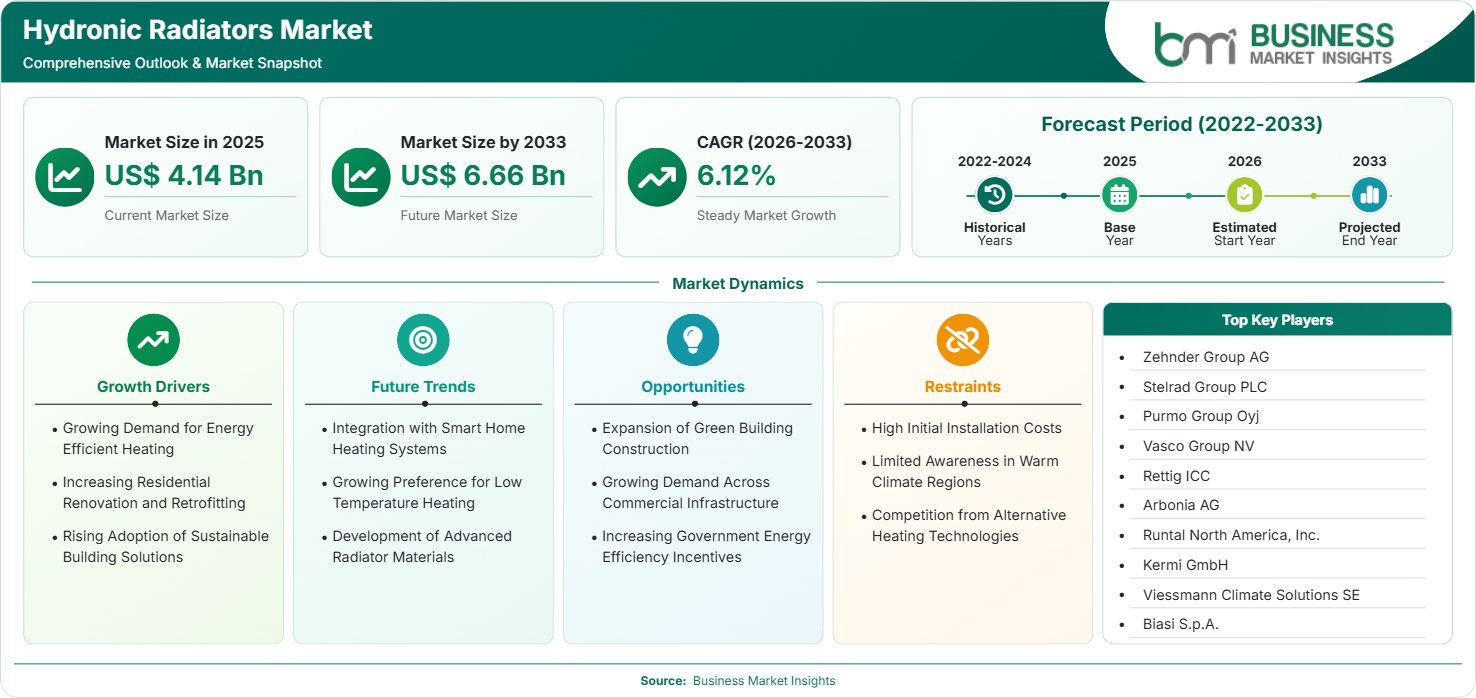
The Hydronic Radiators Market size was valued at US$ 4.14 Billion in 2025 and is projected to reach US$ 6.66 Billion by 2033, growing at a CAGR of 6.12% during 2026–2033, driven by energy efficiency mandates, building renovations, sustainable heating adoption, and expanding opportunities in green infrastructure projects.

Report Coverage
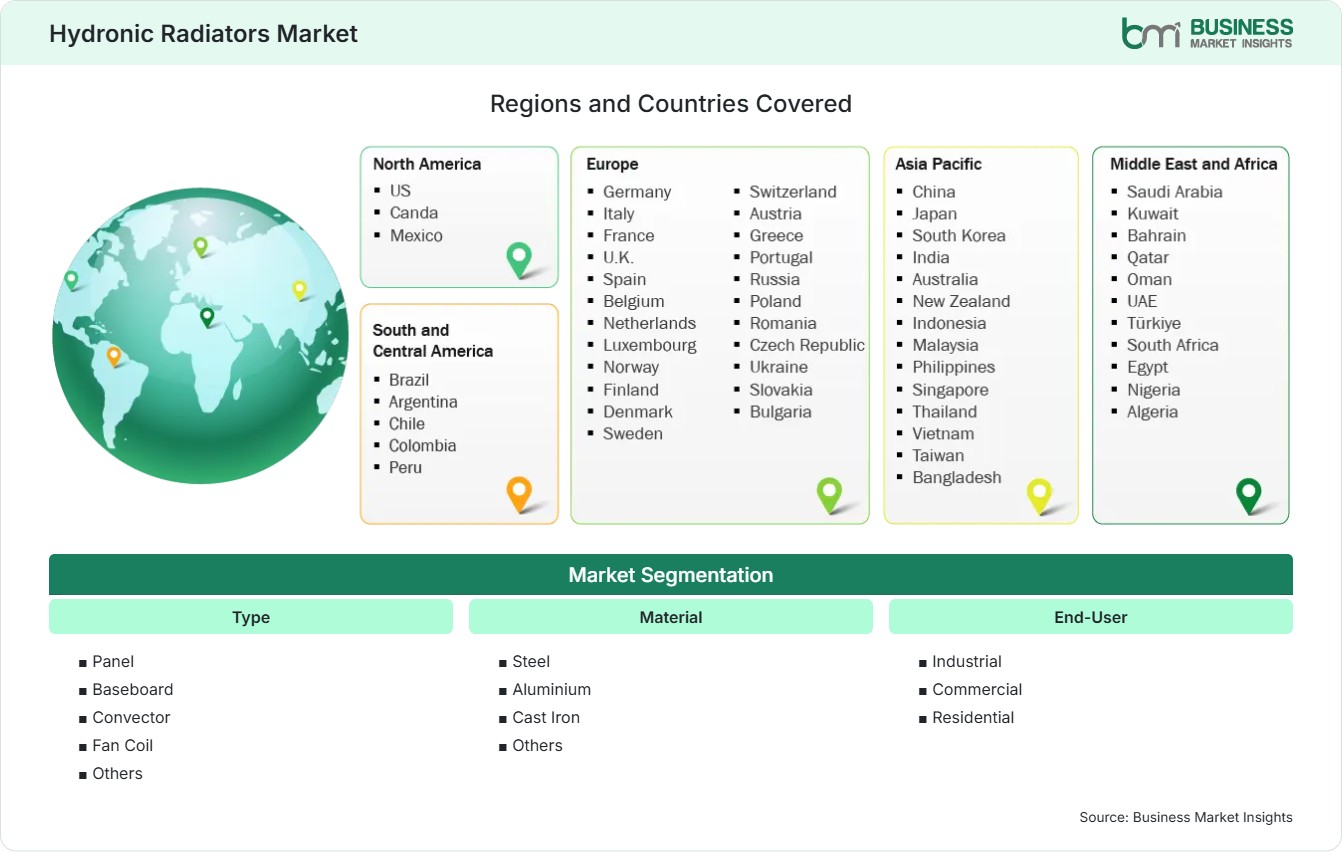
  • Type: Panel, Baseboard, Convector, Fan Coil, Others
  • Material: Steel, Aluminium, Cast Iron, Others
  • End-User: Industrial, Commercial, Residential
US$ 4.14 Bn Market size in 2025
US$ 6.66 Bn Market Size by 2033
6.12% CAGR, 2026 - 2033
2026-2033 Forecast Period

AI Overview

Hydronic Radiators Market Summary

  • North America Region: North America holds a 28%–32% share in 2025, growing with a CAGR of 5.80%–6.40% during 2026–2033, supported by residential retrofits, energy conservation programs, smart heating upgrades, and replacement of inefficient systems. The US market demonstrates steady adoption through advanced HVAC modernization initiatives, achieving a CAGR of 5.90%–6.30% between 2026 and 2033.
  • Fastest Growing Region: Asia Pacific captures a 24%–28% share in 2025 and expands at a CAGR of 6.60%–7.20% through 2026–2033, supported by urbanization, commercial construction growth, rising disposable incomes, and government-backed energy-efficient building programs.
  • Leading Segment: Residential end-user applications account for a 45%–49% share in 2025, expanding at a CAGR of 6.00%–6.50% during 2026–2033, driven by renovation activities, heating comfort requirements, replacement demand, and increasing adoption of efficient indoor climate solutions.
  • High Growth Segment: Aluminium material-based solutions represent a 27%–31% share in 2025 and register a CAGR of 6.80%–7.40% during 2026–2033, supported by lightweight construction, improved thermal conductivity, corrosion resistance, and compatibility with modern heating systems.
  • Key Market Opportunity: Growth opportunities are emerging from low-carbon buildings, district heating modernization, smart thermostat integration, and government incentives encouraging efficient heating technologies across residential and commercial infrastructure.
  • Major Market Players: Zehnder Group AG, Stelrad Group PLC, Purmo Group Oyj, Vasco Group NV, Rettig ICC, Arbonia AG, Runtal North America, Inc., Kermi GmbH, Viessmann Climate Solutions SE, and Biasi S.p.A.
Strategic Insights

Hydronic Radiators Market: Strategic Insights

Hydronic Radiators Market Strategic Framework
FREE PDF
Request your free sample
Request free sample
Stakeholder View

Key Takeaways

  • The supply chain is being refined through increasing cooperation between manufacturers of radiators, HVAC components, building automation and energy management companies to produce integrated heating systems with increased efficiency.
  • Opportunities found in residential renovation, which is an increasing trend as more and more people are replacing older heating systems with smaller and more efficient radiator units.
  • Product innovation is shifting toward lightweight aluminium designs, smart-connected heating controls, and systems optimized for integration with heat pumps and renewable energy-based heating infrastructure.
  • Europe remains a strategic investment region due to stringent energy performance regulations, renovation targets, and government initiatives supporting reduced dependence on fossil fuel-based heating systems.
  • There is further industry consolidation via mergers and cooperation among companies that focus on green construction and innovative HVAC applications.
Geographic Outlook

Hydronic Radiators Market Regional Highlights

North America Hydronic Radiators Market

North America maintains a 28%–32% share in 2025 and records a CAGR of 5.80%–6.40% from 2026–2033. The region benefits from replacement demand, energy efficiency programs, and modernization of heating infrastructure. The Hydronic Radiators Market share is influenced by residential renovation activity, climate conditions, and increasing adoption of efficient HVAC technologies.

  • Rising renovation activities in the US and Canada are encouraging replacement of older heating systems with advanced hydronic solutions offering improved efficiency and operational control.
  • Government energy efficiency standards are encouraging building owners to adopt modern heating technologies that reduce energy consumption and improve environmental performance.
  • Smart home adoption is supporting integration between radiators, thermostatic controls, and connected energy management platforms.
  • Manufacturers are expanding product portfolios with compact designs suitable for residential and commercial modernization projects.

US Hydronic Radiators Market

The US market represents a 22%–26% share in 2025 within the global landscape and grows at a CAGR of 5.90%–6.30% during 2026–2033. Demand is driven by replacement cycles, remodeling projects, and increasing interest in efficient heating systems. Residential applications dominate adoption, while commercial buildings contribute through energy optimization initiatives. Federal and state-level efficiency programs continue supporting upgrades in heating infrastructure across colder regions.

  • Residential remodeling projects are increasing demand for decorative and high-performance radiator designs suitable for premium housing applications.
  • Commercial facilities are adopting efficient heating systems to reduce operational expenses and meet sustainability objectives.
  • HVAC modernization trends are creating opportunities for manufacturers offering integrated control technologies and improved thermal performance.

Europe Hydronic Radiators Market

Europe accounts for a 34%–38% Hydronic Radiators Market share in 2025 and expands at a CAGR of 5.70%–6.20% through 2026–2033. The region remains the leading market due to established heating infrastructure, stringent energy regulations, and strong renovation programs. Germany, the UK, France, and Italy represent significant demand centers, while Nordic countries demonstrate advanced adoption of efficient heating technologies. Sustainability policies continue shaping product development strategies.

  • Germany is driving demand through building renovation initiatives and energy efficiency regulations encouraging replacement of conventional heating equipment.
  • The UK market benefits from decarbonization targets and increasing deployment of low-energy heating solutions in residential buildings.
  • France and Italy are supporting adoption through modernization of aging housing infrastructure and improved energy management programs.
  • Nordic countries continue adopting advanced heating technologies due to cold climates and strong sustainability commitments.

Asia Pacific Hydronic Radiators Market

Asia Pacific captures a 24%–28% share in 2025 and registers a CAGR of 6.60%–7.20% between 2026–2033. Rapid urbanization, expanding construction activity, and rising demand for comfortable indoor environments support regional growth. China, Japan, South Korea, and India are emerging markets with increasing investment in residential and commercial infrastructure. The region presents opportunities through new construction projects and energy-efficient building developments.

  • China is expanding adoption through urban housing projects and increasing focus on efficient residential heating systems.
  • Japan and South Korea are developing advanced heating solutions integrated with smart building technologies and energy management systems.
  • India presents emerging opportunities due to urban housing expansion and growing awareness of efficient climate control solutions.
  • Commercial infrastructure development is creating demand for reliable heating systems in offices, hotels, and institutional facilities.

Rest of World Hydronic Radiators Market

Rest of World contributes a 8%–12% share in 2025 and achieves a CAGR of 5.50%–6.10% during 2026–2033. South and Central America are witnessing gradual adoption due to residential development and infrastructure upgrades, while Middle East and Africa markets remain focused on premium buildings and specialized applications. Increasing construction activity and sustainability initiatives are improving market penetration across developing economies.

  • Brazil and Mexico are generating demand through residential construction growth and modernization of building heating systems.
  • Middle Eastern countries are adopting advanced heating technologies in luxury developments, hotels, and commercial infrastructure projects.
  • South African markets are exploring efficient heating solutions for residential and institutional applications.
  • Infrastructure investments across developing regions are supporting gradual adoption of modern radiator systems.
Global Market Geography
FREE PDF
Request your free sample
Request free sample
Segment Analysis

Hydronic Radiators Market Segmentation

Type

The Type segment represents a critical classification within Market, with panel solutions maintaining leadership through widespread residential adoption and installation flexibility. The segment accounted for a 42%–46% share in 2025 and is projected to expand at a CAGR of 5.90%–6.40% between 2026–2033. Demand is shaped by efficiency requirements, space optimization, and compatibility with modern heating networks. The Hydronic Radiators Market scope continues expanding as manufacturers develop improved thermal designs.

  • Panel: Panel radiators dominate residential and commercial installations due to compact structures, efficient heat distribution, aesthetic designs, and compatibility with low-temperature heating systems.
  • Baseboard: Baseboard radiators support residential applications where space efficiency and continuous perimeter heating are required, particularly in colder climates with established hydronic infrastructure.
  • Convector: Convector radiators provide rapid heat circulation through enhanced airflow mechanisms, supporting commercial buildings, offices, and applications requiring quick temperature regulation.
  • Fan Coil: Fan coil systems combine heating performance with forced air circulation, enabling flexible climate control solutions in commercial and institutional buildings.

Material

Material selection influences thermal performance, durability, manufacturing costs, and installation preferences across the industry. Steel remains the dominant material due to affordability and structural reliability, representing a 48%–52% share in 2025 with a CAGR of 5.60%–6.10% through 2026–2033. Aluminium-based solutions are gaining momentum because of lightweight construction and faster heat transfer capabilities. Material innovation is shaping future Hydronic Radiators Market trends.

  • Steel: Steel radiators remain widely adopted due to strength, cost efficiency, design flexibility, and suitability for large-scale residential and commercial heating installations.
  • Aluminium: Aluminium radiators offer lightweight construction, corrosion resistance, and improved thermal conductivity, supporting demand in modern energy-efficient heating applications.
  • Cast Iron: Cast iron radiators continue serving heritage buildings and premium residential projects because of durability, heat retention capability, and traditional design appeal.

End-User

The End-User segment reflects demand variations across residential, commercial, and industrial environments. Residential applications represented the largest share of 45%–49% in 2025 and are estimated to grow at a CAGR of 6.00%–6.50% during 2026–2033. Housing renovation programs, energy efficiency improvements, and consumer preference for comfortable indoor environments are strengthening adoption. Hydronic Radiators Market share within this segment is supported by replacement demand and sustainable building upgrades.

  • Industrial: Industrial users adopt hydronic heating solutions for warehouses, manufacturing facilities, and specialized environments requiring dependable temperature management and operational efficiency.
  • Commercial: Commercial buildings utilize radiator systems in offices, hospitality facilities, healthcare centers, and educational institutions seeking energy-efficient heating performance.
  • Residential: Residential applications represent the largest demand area due to renovation activity, improved heating comfort requirements, and adoption of efficient household climate control solutions.
Market Forces

Hydronic Radiators Market Dynamics

Key Market Drivers

Growing Demand for Energy Efficient Heating

Rising focus on energy conservation is accelerating adoption of advanced heating technologies across residential and commercial buildings. The Hydronic Radiators Market growth is driven by replacing old and less efficient heating devices and its compatibility with low-temperature technology. In addition, market trends suggest that there will be an increased demand for hydronic radiators which are compatible with heat pumps, intelligent thermostats, and renewable energy sources. Manufacturers are improving heat output, reducing material usage, and designing compact models to support evolving energy performance requirements across global construction markets.

Increasing Residential Renovation and Retrofitting

Residential renovation activities are creating significant demand for modern radiator replacement solutions, particularly across Europe and North America where aging housing infrastructure requires energy upgrades. Renovation programs by the government encourage homeowners to make their heating process more efficient while at the same time cutting down on operating costs. There is also growing popularity of aesthetically pleasing heaters that will enhance the appearance of the house interior, which drives product development in the Hydronic Radiators Market. There is increasing emphasis on developing flexible installation alternatives to cope with varying residential structures.

Rising Adoption of Sustainable Building Solutions

Sustainable construction approaches have led to the increased use of efficient heating systems within new constructions. Environmental certifications and carbon reductions goals have raised the need for the use of technologies that reduce energy consumption. Hydronic radiator systems have received more attention due to their ability to work efficiently using renewable heat sources and central heating systems. Building developers have been emphasizing the use of technology that enhances energy efficiency without compromising the level of comfort for the occupants. The market has benefited from the increased collaboration among HVAC manufacturers, construction firms, and building automation firms.

Key Market Opportunities

Expansion of Green Building Construction

The expansion of sustainable construction creates opportunities for radiator manufacturers to supply efficient heating solutions for environmentally certified buildings. Adoption of green building codes in Europe, Asia Pacific, and North America is leading to the inclusion of state-of-the-art heating technologies. Hydronic Radiators Market Forecasts indicate growing opportunities for investment in technology that is suitable for renewable energy sources and low-energy buildings. The industry players have the opportunity to make use of the growing demand for intelligent control systems, modular solutions, and products designed for heat pump applications.

Growing Demand Across Commercial Infrastructure

Commercial infrastructure development is creating new opportunities through increasing demand for reliable indoor climate solutions in offices, healthcare facilities, hotels, and educational buildings. Modern commercial projects require heating systems that deliver operational efficiency and improved occupant comfort. Integration with centralized building management systems provides additional growth opportunities for manufacturers offering connected radiator solutions. Expanding urban development projects across emerging economies are supporting demand for efficient heating technologies in newly constructed commercial facilities.

Increasing Government Energy Efficiency Incentives

Government subsidies for energy-saving renovations create an ideal situation for upgrading the heating system. Measures aimed at lowering carbon dioxide emissions and optimizing building energy efficiency will promote replacing old heating systems. Subsidy schemes in developed countries will enhance consumer interest in buying such types of equipment. Companies that develop their products according to regulation requirements gain competitive advantages. There is a chance to gain an advantage for firms producing highly efficient radiators, controls, and complete heating systems for the future.

Market Restraints and Challenges

High Initial Installation Costs

High upfront investment remains a challenge for adoption in price-sensitive markets. Factor: installation expenses associated with advanced radiator systems, plumbing modifications, and professional labor requirements can increase project costs. Impact: residential consumers and small businesses may postpone upgrades despite long-term energy savings. Although operational efficiency provides financial benefits over time, initial capital requirements influence purchasing decisions. Manufacturers are addressing this challenge through simplified installation designs, cost-effective materials, and expanded product ranges targeting different consumer budgets.

Limited Awareness in Warm Climate Regions

Limited understanding of hydronic heating benefits restricts adoption in regions with moderate or warm climates. Factor: consumers and builders often prioritize cooling solutions over heating technologies due to lower seasonal heating demand. Impact: market penetration remains slower in tropical and subtropical regions despite growing premium construction activity. Education initiatives, improved product awareness, and integration with multifunctional climate systems can help overcome adoption barriers. Manufacturers are focusing on targeted applications where efficient heating solutions provide measurable comfort and energy advantages.

Company Analysis

Competitive Landscape

The Hydronic Radiators Market analysis highlights a competitive environment shaped by global HVAC manufacturers, heating technology specialists, and companies investing in energy-efficient thermal solutions. Market participants are strengthening portfolios through advanced radiator designs, sustainable materials, smart control integration, and expansion across residential and commercial applications. Leading companies focus on improving product efficiency, reducing environmental impact, and developing heating systems compatible with renewable energy technologies.

Company Name

Overview

Products and Services relevant to this market

Zehnder Group AG

Zehnder Group AG is a global indoor climate solutions provider specializing in heating, ventilation, and air quality technologies.

Offers decorative radiators, towel warmers, and hydronic heating solutions designed for residential and commercial applications.

Stelrad Group PLC

Stelrad Group PLC is a major European heating solutions manufacturer with extensive radiator production capabilities and distribution networks.

Provides panel radiators, designer radiators, and energy-efficient heating products for domestic and commercial buildings.

Purmo Group Oyj

Purmo Group Oyj develops sustainable indoor climate solutions focused on heating efficiency, comfort, and building performance improvement.

Manufactures panel radiators, underfloor heating systems, and hydronic heating solutions for multiple construction sectors.

Vasco Group NV

Vasco Group NV specializes in premium heating solutions combining functionality, aesthetics, and advanced thermal performance.

Produces designer radiators, bathroom heating products, and customized hydronic solutions for modern interiors.

Rettig ICC

Rettig ICC operates as a leading heating solutions provider with strong European market presence and radiator manufacturing expertise.

Supplies panel radiators, specialty heating products, and energy-efficient solutions for residential heating applications.

Arbonia AG

Arbonia AG develops building technology solutions including heating and climate control products for modern infrastructure.

Offers radiators, heating components, and climate solutions supporting residential and commercial building requirements.

Runtal North America, Inc.

Runtal North America provides premium heating solutions focused on design flexibility and high-performance radiator systems.

Supplies steel panel radiators, decorative heating products, and hydronic solutions for architectural projects.

Kermi GmbH

Kermi GmbH is a German heating technology company recognized for innovative radiator and climate solutions.

Provides panel radiators, bathroom radiators, and hydronic heating systems emphasizing efficiency and design.

Viessmann Climate Solutions SE

Viessmann Climate Solutions SE develops integrated climate technologies supporting efficient and sustainable energy management.

Offers heating systems, smart controls, and radiator solutions compatible with modern energy-efficient buildings.

Biasi S.p.A.

Biasi S.p.A. manufactures heating equipment with expertise in residential and commercial thermal comfort applications.

Produces radiators, boilers, and heating solutions designed for efficient indoor climate management.

Trust & Transparency

Research Methodology

The market analysis combines proprietary research with secondary data from government agencies, company disclosures, regulatory filings, industry databases and expert interviews. Market estimates are validated through data triangulation, cross-market benchmarking and analyst review.

View Full Research Methodology

Questions Answered

Frequently Asked Questions

Why are smart controls becoming important in radiator systems?

Smart controls improve energy management by allowing automated temperature adjustment, remote monitoring, and integration with building management platforms, helping users reduce energy consumption while maintaining comfort.

What information is included in the Hydronic Radiators Market Report?

The Hydronic Radiators Report provides insights into market size, segmentation, regional developments, competitive positioning, growth factors, challenges, and future investment opportunities across global heating applications.

Which applications are creating new opportunities for radiator manufacturers?

Opportunities are expanding across green buildings, commercial infrastructure, residential renovations, and projects integrating heat pumps or renewable energy-based heating systems.

How do aluminium radiators differ from traditional steel models?

Aluminium radiators provide lightweight construction, faster heat transfer, and corrosion resistance, making them suitable for modern energy-efficient buildings. Steel models remain popular due to affordability and durability.

What factors are influencing adoption of hydronic heating systems in modern buildings?

Demand is influenced by energy efficiency requirements, renovation activity, renewable heating integration, and the need for improved indoor comfort. Modern systems provide compatibility with smart controls and low-temperature heating technologies.

Access the Full Hydronic Radiators Market Report

Get segment-level forecasts, regional estimates, competitive benchmarking, company profiles and downloadable Excel datasets.

Access the full Hydronic Radiators Market Report
350 pages PDF & Excel | 2026-08-25