
Hyaluronic Sunscreen Market Outlook: Size, Share, Trends, Growth Analysis, Competitive Landscape & Forecast, 2026-2033

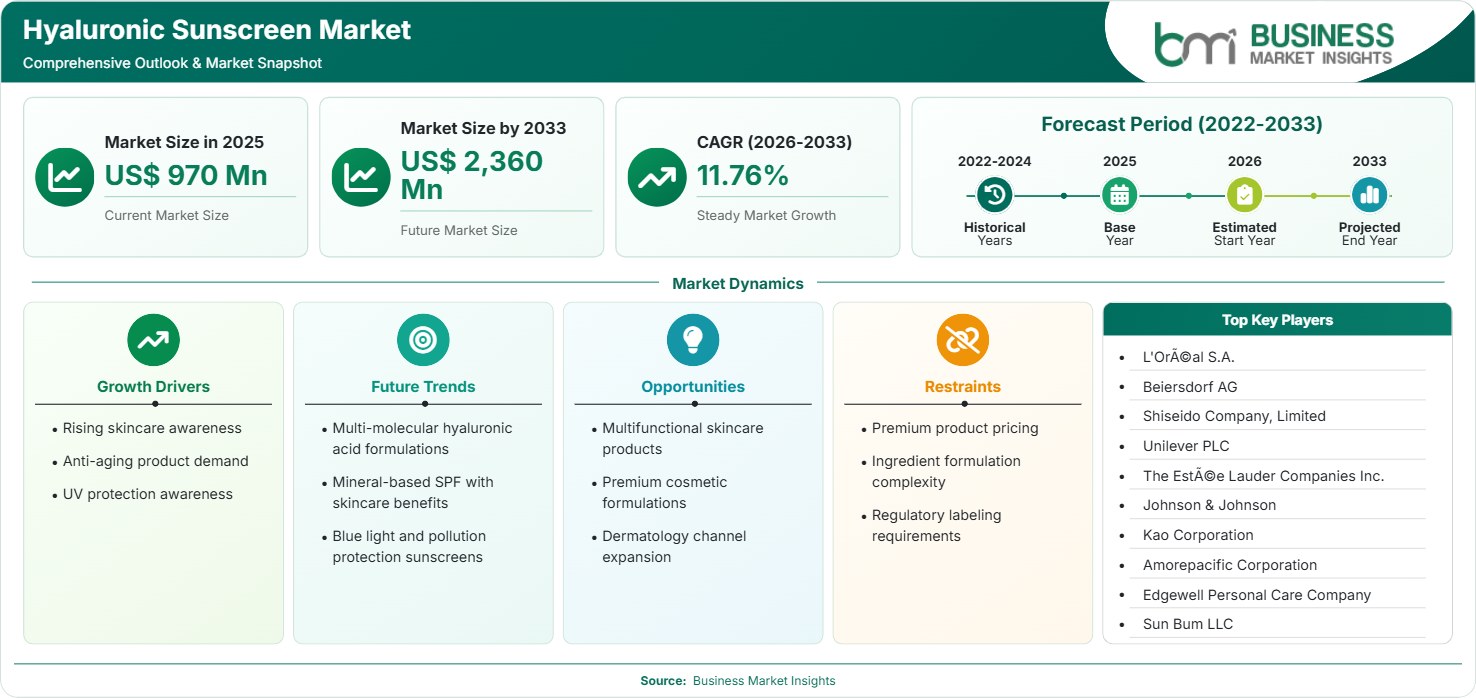
The Hyaluronic Sunscreen Market size was valued at US$0.97 billion in 2025 and is projected to reach US$2.36 billion by 2033, growing at a CAGR of 11.76% during 2026–2033. Market expansion is driven by increasing skincare awareness, rising demand for anti-aging formulations, growing consumer focus on daily UV protection, and innovation in hydrating sunscreen technologies combining cosmetic and dermatological benefits.

Report Coverage
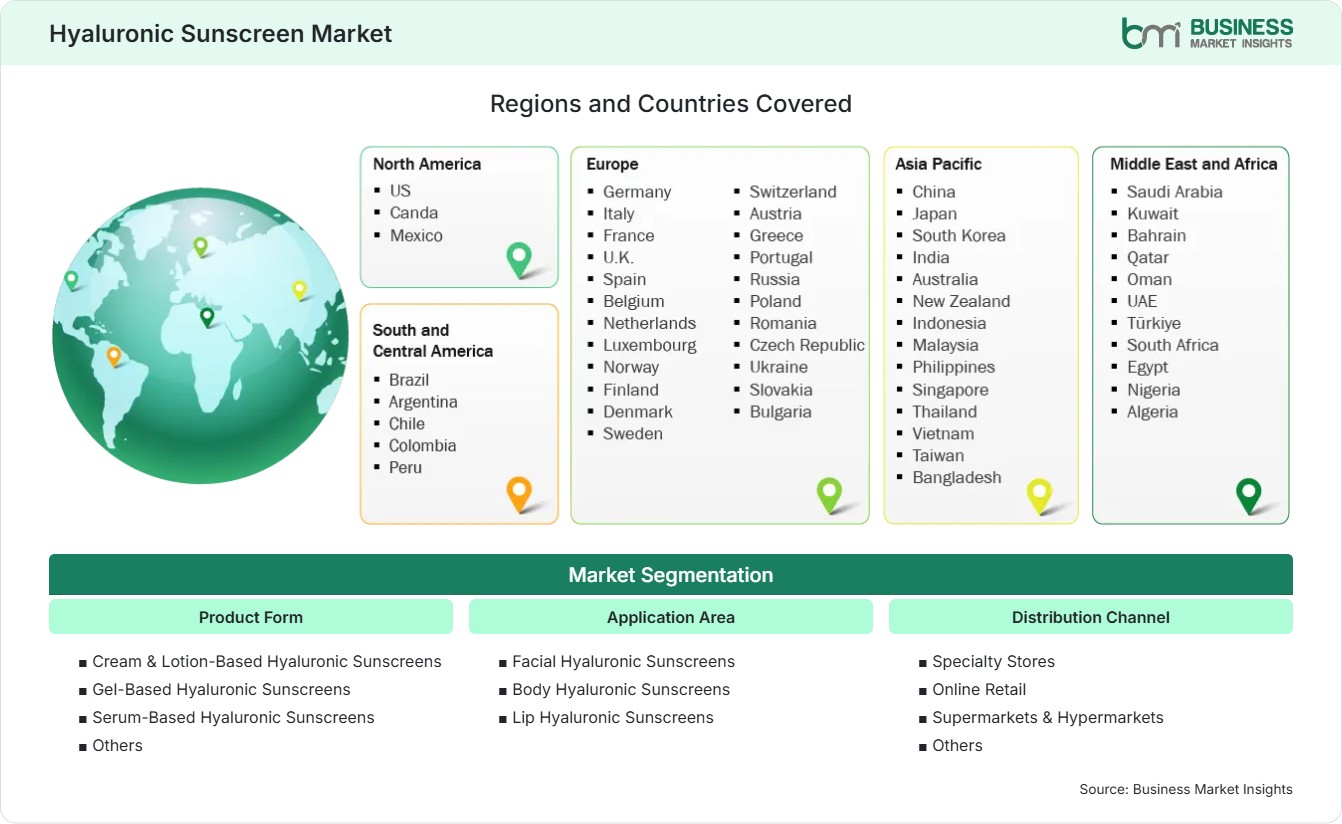
  • Product Form: Cream & Lotion-Based Hyaluronic Sunscreens, Gel-Based Hyaluronic Sunscreens, Serum-Based Hyaluronic Sunscreens, Others
  • Application Area: Facial Hyaluronic Sunscreens, Body Hyaluronic Sunscreens, Lip Hyaluronic Sunscreens
  • Distribution Channel: Specialty Stores, Online Retail, Supermarkets & Hypermarkets, Others
US$ 970 Mn Market size in 2025
US$ 2,360 Mn Market Size by 2033
11.76% CAGR, 2026 - 2033
2026-2033 Forecast Period

01 AI Overview

Hyaluronic Sunscreen Market Summary

  • North America Region: North America holds 32%–35% hyaluronic sunscreen market share in 2025 and is projected to expand at a 11%–12% CAGR during 2026–2033. Growth is supported by high consumer spending on premium skincare, strong awareness of sun damage prevention, and increasing demand for multifunctional beauty products. The U.S. market benefits from advanced cosmetic retail networks, dermatologist recommendations, and growing preference for lightweight hydrating sunscreen formulations, with growth projected at 11%–12% CAGR through 2033.
  • Fastest Growing Region: Asia Pacific represents a 28%–31% share in 2025 and is expected to grow at a 13%–14% CAGR during 2026–2033. Rising beauty consciousness, expanding middle-class consumers, increasing skincare routines, and strong adoption of innovative cosmetic ingredients are accelerating regional opportunities.
  • Leading Segment: Facial Hyaluronic Sunscreens account for 55%–58% share in 2025 and are projected to grow at a 12%–13% CAGR during 2026–2033. Demand is supported by daily skincare routines, anti-aging preferences, and consumer interest in lightweight facial protection products.
  • High Growth Segment: Serum-Based Hyaluronic Sunscreens represent 22%–25% of the hyaluronic sunscreen market share in 2025 and are expected to grow at a 13%–14% CAGR through 2033. Growth is driven by premium skincare trends, advanced formulations, and consumer preference for multifunctional products.
  • Key Market Opportunity: Development of multifunctional skincare products combining UV protection, hydration, anti-aging benefits, and dermatological performance creates strong opportunities for cosmetic brands expanding premium product portfolios.
  • Major Market Players: L'Oréal S.A., Beiersdorf AG, Shiseido Company, Limited, Unilever PLC, The Estée Lauder Companies Inc., Johnson & Johnson, Kao Corporation, Amorepacific Corporation, Edgewell Personal Care Company, Sun Bum LLC.
02 Strategic Insights

Hyaluronic Sunscreen Market: Strategic Insights

Hyaluronic Sunscreen Market Strategic Framework
FREE PDF
Request your free sample
Request free sample
03 Stakeholder View

Key Takeaways

  • The market ecosystem is shifting toward multifunctional skincare solutions where consumers increasingly prefer products combining UV defense, hydration, anti-aging properties, and cosmetic benefits.
  • Facial sunscreen products represent the strongest commercial opportunity due to daily skincare adoption, increasing preventive beauty routines, and growing consumer investment in premium facial care.
  • Product innovation is focusing on lightweight textures, improved ingredient compatibility, non-greasy formulations, and advanced delivery systems designed for different skin types and climates.
  • Asia Pacific presents significant growth potential due to expanding beauty markets, rising disposable income, increasing skincare education, and strong acceptance of innovative cosmetic ingredients.
  • Competitive strategies are increasingly focused on premium positioning, dermatologist collaborations, digital marketing, and expansion across online and specialty retail channels.
  • The integration of skincare science and cosmetic formulation expertise is creating opportunities for brands to differentiate through clinically positioned sunscreen products with enhanced consumer value.
04 Geographic Outlook

Hyaluronic Sunscreen Market Regional Highlights

North America Hyaluronic Sunscreen Market

North America accounted for 32%–35% share in 2025 and is projected to expand at a 11%–12% CAGR from 2026–2033 in the hyaluronic sunscreen market forecasts. The region maintains a strong position due to high awareness of UV protection, premium skincare adoption, and established cosmetic retail infrastructure. Increasing consumer interest in hydration-focused formulations and anti-aging products continues supporting demand across specialty stores, dermatology channels, and online platforms.

  • The U.S. remains a major market due to strong skincare expenditure, high product awareness, and increasing preference for multifunctional sun protection products.
  • Consumers are increasingly adopting daily sunscreen routines as awareness regarding premature aging and long-term UV exposure continues expanding.
  • Premium beauty brands are investing in innovative formulations combining active ingredients, hydration benefits, and advanced skin compatibility.
  • Online beauty platforms are strengthening market accessibility through product education, personalized recommendations, and direct-to-consumer purchasing models.

US Hyaluronic Sunscreen Market

The U.S. market represented 28%–31% share in 2025 and is expected to grow at a 11%–12% CAGR between 2026–2033. Growth is supported by strong demand for premium skincare, increasing consumer interest in preventative skin health, and expanding dermatologist-recommended products. The country remains a key innovation hub for sunscreen brands developing advanced hydration-focused and multifunctional formulations.

  • Rising demand for anti-aging skincare is encouraging consumers to adopt sunscreen products with added moisturizing and skin-supporting ingredients.
  • Beauty retailers and e-commerce platforms are increasing product visibility through educational campaigns and targeted skincare recommendations.
  • Dermatology professionals are influencing consumer purchasing decisions by promoting effective daily sun protection practices.

Europe Hyaluronic Sunscreen Market

Europe held 25%–28% share in 2025 and is forecast to grow at a 10%–11% CAGR during 2026–2033. The region benefits from strong cosmetic industry presence, high product quality standards, and increasing demand for science-backed skincare products. Germany, France, the United Kingdom, and Italy represent major markets, with France and Germany showing strong growth potential due to advanced beauty ecosystems.

  • France benefits from a strong cosmetic heritage and increasing consumer preference for premium skincare formulations with active ingredients.
  • Germany is experiencing growing demand for scientifically developed sunscreen products supported by consumer interest in skin health.
  • The United Kingdom is expanding adoption through online beauty channels and increasing awareness of preventive skincare routines.
  • Italy is witnessing rising interest in premium sun care products due to tourism, outdoor lifestyles, and beauty-conscious consumers.

Asia Pacific Hyaluronic Sunscreen Market

Asia Pacific represented 28%–31% share in 2025 and is projected to achieve a 13%–14% CAGR from 2026–2033, making it the fastest-growing regional market. The region benefits from expanding beauty industries, rising disposable income, increasing skincare awareness, and strong acceptance of innovative cosmetic ingredients. China, Japan, South Korea, India, and Southeast Asian countries are important growth markets.

  • South Korea continues influencing regional skincare trends through advanced formulations, beauty innovation, and strong consumer interest in functional cosmetics.
  • Japan supports market growth through established skincare culture, high product quality expectations, and demand for gentle formulations.
  • China is expanding rapidly due to growing beauty consumption, digital commerce adoption, and increasing interest in premium skincare products.
  • India represents an emerging opportunity due to rising awareness of UV protection and expanding personal care spending.

Rest of World Hyaluronic Sunscreen Market

Rest of World accounted for 9%–11% share in 2025 and is expected to grow at a 10%–12% CAGR during 2026–2033. Latin America, the Middle East, and Africa are gradually expanding due to increasing skincare awareness, rising urban populations, and growing availability of international cosmetic brands. Brazil, Mexico, UAE, and South Africa represent key developing opportunities.

  • Brazil is experiencing increased demand for sun care products due to strong outdoor lifestyles and growing beauty product consumption.
  • Mexico benefits from expanding cosmetic retail networks and rising consumer awareness regarding skin protection.
  • The UAE is adopting premium skincare products supported by high purchasing power and demand for advanced beauty solutions.
  • South Africa is developing through increasing access to global skincare brands and expanding personal care markets.
  • Emerging regions provide opportunities for brands introducing climate-specific formulations designed for different environmental conditions and consumer preferences.
Global Market Geography
FREE PDF
Request your free sample
Request free sample
05 Segment Analysis

Hyaluronic Sunscreen Market Segmentation

Product Form

The Product Form segment represents a key component of the market, supported by changing consumer preferences toward lightweight, hydrating, and multifunctional sun care products. The segment accounted for approximately 100% share in 2025 and is projected to grow at a 11%–12% CAGR from 2026–2034. Hyaluronic sunscreen market growth is influenced by formulation innovation, premium skincare adoption, ingredient compatibility, and demand for products suitable for daily skincare routines.

  • Cream & Lotion-Based Hyaluronic Sunscreens: Cream and lotion formulations remain widely adopted due to familiar textures, moisturizing benefits, broad consumer acceptance, and suitability for regular facial and body applications.
  • Gel-Based Hyaluronic Sunscreens: Gel formulations are gaining traction among consumers seeking lightweight, non-greasy textures, quick absorption, and comfortable wear in humid climates and active lifestyles.
  • Serum-Based Hyaluronic Sunscreens: Serum-based products are expanding through premium skincare trends, combining concentrated hydration benefits, UV protection, and advanced formulations targeting consumers seeking multifunctional solutions.
  • Others: Other product formats contribute through specialized formulations addressing niche consumer requirements, including customized textures, innovative delivery systems, and targeted skincare preferences.

Application Area

The Application Area segment is growing because consumers are beginning to include the use of sunscreen as part of their skincare regimen outside of situations that are conventionally related to sun exposure. This market segment accounted for about 100% of market share in 2025 and is projected to grow by about 12% to 13% from 2026 to 2034. Rising awareness of skin aging, environmental stressors, and preventive skincare practices is supporting adoption across facial, body, and lip care applications, aligning with hyaluronic sunscreen market trends.

  • Facial Hyaluronic Sunscreens: Facial applications represent the leading category due to daily skincare adoption, anti-aging concerns, and demand for lightweight protective formulations.
  • Body Hyaluronic Sunscreens: Body sunscreen products are gaining adoption through increasing outdoor activities, travel trends, and consumer awareness regarding comprehensive UV protection.
  • Lip Hyaluronic Sunscreens: Lip formulations are growing as consumers seek targeted protection against UV exposure while maintaining hydration and improving lip care routines.

Distribution Channel

The Distribution Channel segment is characterized by shifting consumer behavior, influenced by digital commerce, specialty beauty retailing, and greater product availability. This segment is underpinned by rising use of online retailing, high-end cosmetic products, and consumer education. It is characterized by the growing importance of online retail channels and personalized product recommendations in specialty stores.

  • Specialty Stores: Specialty stores remain important due to expert assistance, premium product displays, personalized recommendations, and access to professional skincare brands.
  • Online Retail: Online retail channels are expanding rapidly through digital marketing, influencer engagement, customer reviews, and convenient access to diverse sunscreen product portfolios.
  • Supermarkets & Hypermarkets: Supermarkets and hypermarkets support broader consumer reach through accessible locations, competitive pricing, and availability of popular skincare brands.
  • Others: Other distribution channels contribute through pharmacies, department stores, direct brand platforms, and emerging retail formats supporting wider market penetration.
06 Market Forces

Hyaluronic Sunscreen Market Dynamics

Key Market Drivers

Growing Skincare Awareness and Preventive Beauty Adoption

Increased consumer awareness of the importance of skincare is a significant driver of the Hyaluronic Sunscreen Market growth, as people increasingly focus on skin health and well-being through preventive measures. Growing consumer awareness of ultraviolet light exposure, environmental factors, and premature aging is driving demand for products with protective and hydrating properties. In terms of trends within the market, it has been observed that young consumers have a higher affinity for sunscreens that can be used as a part of their daily beauty routine rather than as a product that is to be used while outdoors.

Increasing Demand for Anti-Aging Skincare Solutions

Anti-aging product demand has increased due to growing interest in developing hyaluronic acid-containing sunscreens that protect against UV radiation while moisturizing. The current market trend is that consumers want to solve several problems at once with one product, such as wrinkles, dryness, and lack of skin elasticity. Hyaluronic acid is commonly used in skincare products due to its moisture retention ability; therefore, it is attractive in creating high-quality sunscreens. Companies are developing formulations focused on skin health and age prevention.

Increasing Awareness of UV Protection Benefits

Awareness of sun damage from UV rays has led to increased interest in innovative sunscreens that offer superior protection against skin problems. Customers are becoming aware of the significance of wearing sunscreen regularly to minimize the dangers of photoaging and skin damage. Medical experts, cosmetic firms, and educational programs have played a role in increasing sunscreen usage. Increased dermatologist-approved skincare product recommendation campaigns are motivating customers to buy sunscreen with more effective active ingredients, such as hyaluronic acid. Companies are taking advantage of this awareness by designing daily-use formulas.

Key Market Opportunities

Expansion of Multifunctional Skincare Product Categories

Skincare products with multiple functions offer tremendous potential, as customers are increasingly interested in regimens that combine multiple benefits in a single product to simplify their skincare process. Hyaluronic sunscreen fits this trend because it offers multiple benefits, including UV protection, moisturizing properties, and skin-care benefits. Today, beauty companies have become interested in hybrid products, which are designed specifically to attract consumers who are looking for efficient and high-performing skincare solutions.

Innovation in Premium Cosmetic Formulations

Premium cosmetics offer growth prospects due to rising consumer interest in high-performing formulas featuring advanced ingredients. There is ongoing research into the development of innovative sunscreen formulas with improved delivery systems, lightweight formulations, and superior ingredient blends. Growing demand for cosmetic products with dermatological positioning, clean-label claims, and clinically proven benefits is driving investments in R&D. Premium cosmetics are being marketed not only for their innovative packaging but also for personalized skincare and specific target groups.

Growth Through Dermatology Channel Expansion

Diversification of the dermatology channel will present new possibilities for manufacturers of hyaluronic sunscreens who need more credibility in their marketplaces. Increasingly, the purchase behavior of target customers is being influenced by recommendations from skincare professionals for products that provide daily skin protection and care. Joint activities of cosmetic manufacturers and skincare professionals will help increase the popularity and attractiveness of products among consumers who look for clinical products. There are other distribution channels beyond retail, such as dermatology clinics and specialized skincare centers.

Market Restraints and Challenges

Premium Product Pricing Limiting Mass Adoption

Factor: Premium hyaluronic sunscreen products often involve higher formulation costs due to advanced ingredients, research investments, specialized manufacturing processes, and premium packaging requirements. These factors increase retail prices compared with conventional sunscreen products. Impact: Higher pricing can restrict adoption among price-sensitive consumers, particularly in emerging markets where affordability influences purchasing decisions. While consumers are increasingly willing to pay for multifunctional skincare benefits, manufacturers must balance innovation with cost efficiency. Expanding accessible product ranges, optimizing supply chains, and introducing varied pricing strategies will be important approaches to improve broader market penetration.

Complexity of Advanced Ingredient Formulations

Factor: Developing stable hyaluronic sunscreen formulations requires technical expertise to ensure compatibility between active UV filters, moisturizing ingredients, preservatives, and different skin types. Formulation challenges can increase development timelines and manufacturing complexity. Impact: Ingredient compatibility issues may affect product performance, stability, consumer experience, and regulatory approval processes. Companies must invest in research capabilities, testing procedures, and formulation expertise to deliver safe and effective products. Continuous innovation in cosmetic science will remain essential for addressing technical challenges while maintaining product quality and meeting evolving consumer expectations.

07 Company Analysis

Competitive Landscape

The Hyaluronic Sunscreen Market analysis highlights a competitive environment shaped by global beauty companies, skincare specialists, and personal care manufacturers developing advanced sun protection formulations. Companies are focusing on ingredient innovation, premium positioning, dermatologist partnerships, digital distribution expansion, and multifunctional skincare solutions. Competitive differentiation is influenced by formulation quality, brand reputation, product efficacy, consumer engagement strategies, and the ability to address changing preferences for hydration-focused UV protection products.

Company Name

Overview

Products and Services relevant to this market

L'Oréal S.A.

Global beauty company with extensive skincare brands and strong research capabilities.

Hyaluronic acid sunscreens, facial sun care products, skincare formulations, and cosmetic innovation solutions.

Beiersdorf AG

International skincare company known for dermatological expertise and consumer care brands.

Hydrating sunscreens, facial protection products, skincare formulations, and sun care solutions.

Shiseido Company, Limited

Japanese beauty company specializing in premium skincare and cosmetic products.

Advanced sunscreen formulations, facial skincare products, UV protection technologies, and premium beauty solutions.

Unilever PLC

Global consumer goods company with broad personal care and skincare operations.

Sun protection products, moisturizing sunscreen formulations, skincare brands, and personal care solutions.

The Estée Lauder Companies Inc.

Premium beauty company focused on skincare innovation and luxury cosmetic products.

Premium sunscreen formulations, skincare products, anti-aging solutions, and beauty technologies.

Johnson & Johnson

Healthcare and consumer products company with established skincare and sun care expertise.

Sunscreens, skincare products, dermatological formulations, and consumer health solutions.

Kao Corporation

Japanese consumer products company with strong skincare and beauty product capabilities.

UV protection products, facial sunscreens, skincare formulations, and cosmetic technologies.

Amorepacific Corporation

South Korean beauty company specializing in innovative skincare and cosmetic products.

Hyaluronic sunscreen products, skincare solutions, beauty formulations, and premium cosmetics.

Edgewell Personal Care Company

Consumer care company offering personal care and sun protection products.

Sunscreens, skincare products, UV protection solutions, and personal care offerings.

Sun Bum LLC

Sun care brand focused on recreational and everyday UV protection products.

Sunscreen lotions, facial sunscreens, sun protection products, and skincare-focused formulations.

08 Industry Activity

Recent Developments

May 2026

OSEA launched its first facial sunscreen, Marine Screen SPF 50 Mineral Sunscreen, formulated with non-nano zinc oxide, hyaluronic acid, and Undaria seaweed. The fragrance-free, reef-safe sunscreen delivers broad-spectrum UV protection with a lightweight, non-greasy finish, expanding OSEA's daily skincare portfolio.

April 2026

ILIA Beauty unveiled Sun Serum Mineral Sunscreen SPF 50, its first standalone sunscreen formulated with seven molecular weights of hyaluronic acid and the Aquaxyl complex to provide broad-spectrum UV protection, long-lasting hydration, and skin barrier support. The product debuted exclusively through Sephora and ILIA's direct-to-consumer platform.

March 2026

Humuss Beauty entered the Indian market with its barrier-focused skincare range, launching Sun-sational SPF 50 Hyaluronic Acid Sunscreen alongside complementary hyaluronic acid and ceramide-based skincare products. The vegan, cruelty-free formulations are designed to provide lightweight sun protection and hydration for multiple skin types.

March 2026

The Derma Co. (Honasa Consumer Limited) appointed Sania Mirza as brand ambassador for its suncare portfolio while launching a new campaign for its 1% Hyaluronic Sunscreen Aqua Gel, highlighting dual benefits of broad-spectrum UV protection and skin hydration through hyaluronic acid under the theme "One Sunscreen, Two Superpowers."

10 Trust & Transparency

Research Methodology

The market analysis combines proprietary research with secondary data from government agencies, company disclosures, regulatory filings, industry databases and expert interviews. Market estimates are validated through data triangulation, cross-market benchmarking and analyst review.

View Full Research Methodology

11 Questions Answered

Frequently Asked Questions

What does the Hyaluronic Sunscreen Market Report cover?

The Market Report covers market size, segmentation, regional analysis, competitive landscape, growth drivers, opportunities, challenges, and future industry trends through 2033.

How are online channels influencing sunscreen sales?

Online channels are improving product accessibility through digital marketing, consumer reviews, educational content, influencer engagement, and direct access to diverse skincare product portfolios.

Which application area has the strongest market potential?

Facial hyaluronic sunscreens have strong market potential due to daily skincare adoption, increasing anti-aging concerns, and consumer preference for lightweight facial protection products.

Why are hyaluronic acid-based sunscreens gaining popularity?

Hyaluronic acid-based sunscreens are gaining popularity because they combine UV protection with hydration benefits, making them suitable for consumers seeking simplified and effective daily skincare routines.

What is driving the growth of the hyaluronic sunscreen market?

Growth is driven by increasing skincare awareness, rising demand for anti-aging products, growing understanding of UV protection, and consumer preference for multifunctional skincare formulations.

Access the Full Hyaluronic Sunscreen Market Report

Get segment-level forecasts, regional estimates, competitive benchmarking, company profiles and downloadable Excel datasets.

Access the full Hyaluronic Sunscreen Market Report
350 pages PDF & Excel | 2026-07-30