Human Machine Interface Market Regional Highlights
North America Human Machine Interface Market
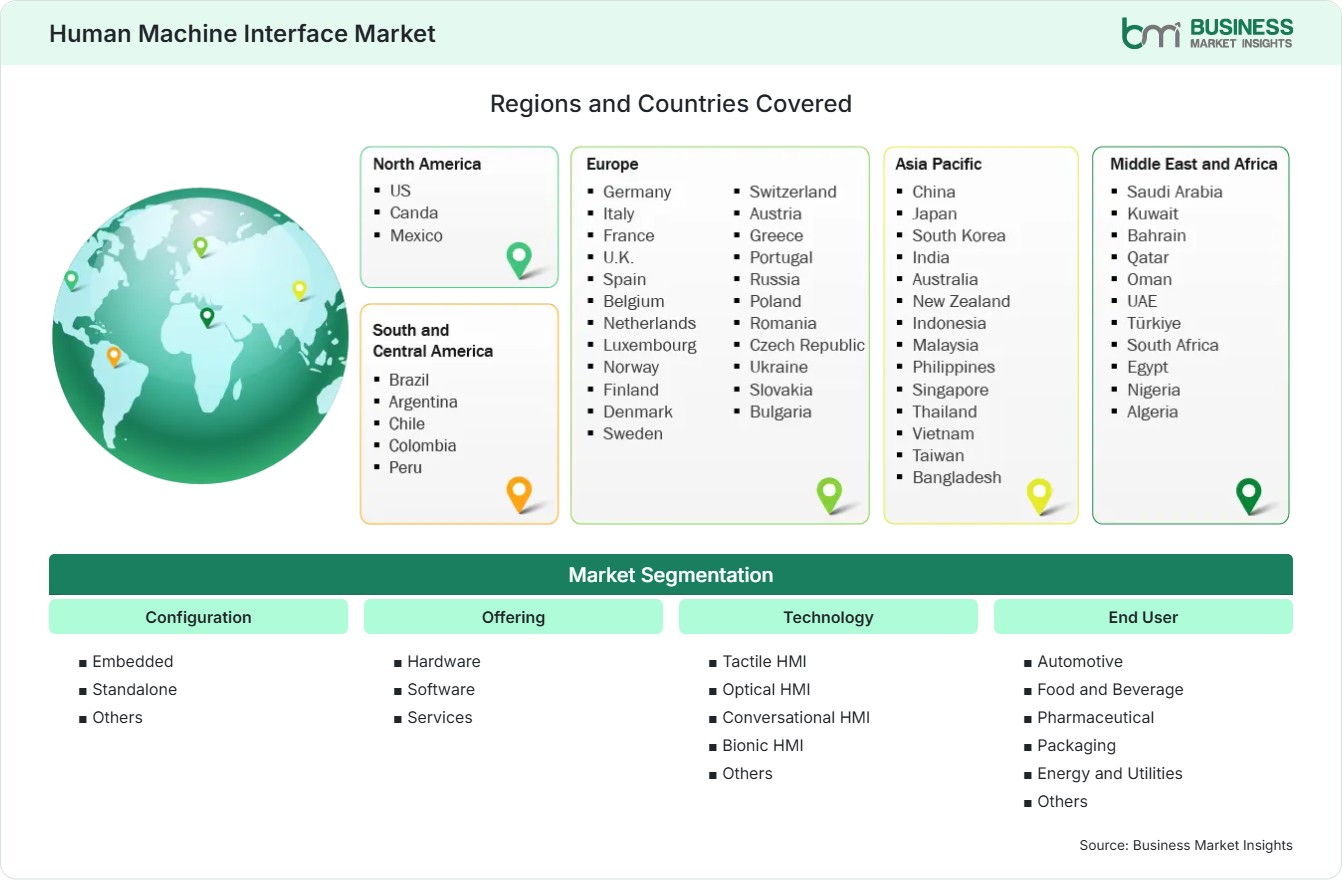
North America accounted for a market share of 34%–37% in 2025 and is projected to grow at a CAGR of 10%–12% between 2026–2033. The region benefits from advanced manufacturing infrastructure, automation adoption, and strong investments in industrial digitalization. The Human Machine Interface Market share remains supported by demand from automotive, aerospace, energy, and process industries.
- Industrial modernization initiatives are increasing demand for advanced operator interfaces, connected equipment monitoring, and automation control solutions.
- The United States remains the leading contributor due to manufacturing technology investments and industrial software adoption.
- Canada supports regional growth through automation deployment in energy, mining, and manufacturing applications.
- Companies are integrating analytics-enabled HMI platforms to improve production efficiency and operational visibility.
US Human Machine Interface Market
The US represented a market share of 29%–32% in 2025 and is expected to expand at a CAGR of 10%–11% during 2026–2033. The country maintains leadership through industrial automation investments, advanced manufacturing initiatives, and increasing demand for connected production systems. The Human Machine Interface Market growth is supported by technology adoption across automotive, energy, and manufacturing sectors.
- Automotive manufacturers are deploying advanced automation systems requiring intuitive operator interfaces and real-time process monitoring.
- Industrial companies are upgrading legacy systems with modern HMI platforms to improve productivity and reliability.
- Energy and utilities operators are adopting digital control interfaces for efficient asset management and monitoring.
- Software-driven HMI solutions are gaining traction through cloud connectivity and remote operational capabilities.
Europe Human Machine Interface Market
Europe held a market share of 26%–29% in 2025 and is forecast to register a CAGR of 10%–12% through 2026–2033. The region benefits from strong automation expertise, industrial engineering capabilities, and Industry 4.0 initiatives. Germany, the United Kingdom, France, and Italy remain major contributors, while Eastern European countries show increasing adoption potential.
- Germany leads adoption through advanced manufacturing facilities, industrial automation expertise, and smart factory investments.
- The United Kingdom supports growth through digital manufacturing programs and automation technology integration.
- France is expanding HMI deployment across automotive, aerospace, and process industries.
- Italy demonstrates increasing adoption through industrial equipment modernization and manufacturing automation.
- European manufacturers prioritize connected interfaces supporting efficiency, sustainability, and operational transparency.
Asia Pacific Human Machine Interface Market
Asia-Pacific region is projected to capture 32%-35% market share in 2025, and is estimated to maintain a CAGR of 13%-15% during 2026-2033. This region is the fastest-growing market owing to manufacturing growth, automation expenditure, and the adoption of smart factories. China, Japan, South Korea, and India are major contributors.
- China maintains a strong demand through large-scale manufacturing automation and industrial digital transformation initiatives.
- India experiences increasing adoption due to manufacturing expansion, government industrial programs, and automation investments.
- Japan continues advancing HMI technologies through robotics integration and precision manufacturing applications.
- South Korea supports growth through semiconductor, electronics, and advanced manufacturing automation.
- Southeast Asian economies attract investment through industrial development and smart production initiatives.
Rest of World Human Machine Interface Market
South and Central America accounted for a market share of 5%–7% in 2025, while the Middle East and Africa contributed 4%–6%. Regional growth is supported by industrial modernization, energy sector automation, and manufacturing investments. Brazil, Mexico, UAE, and South Africa represent important markets with increasing demand for connected control technologies.
- Brazil adopts HMI solutions across manufacturing, energy, and infrastructure projects requiring improved operational efficiency.
- Mexico benefits from automotive manufacturing expansion and increasing industrial automation deployment.
- UAE invests in digital infrastructure and automated industrial facilities supporting advanced interface adoption.
- South Africa experiences demand from mining, utilities, and process industries seeking improved monitoring capabilities.
- Emerging markets provide opportunities through modernization of existing industrial facilities and automation upgrades.