
Hot Runner Market Outlook: Size, Share, Trends, Growth Analysis, Competitive Landscape & Forecast, 2026-2033

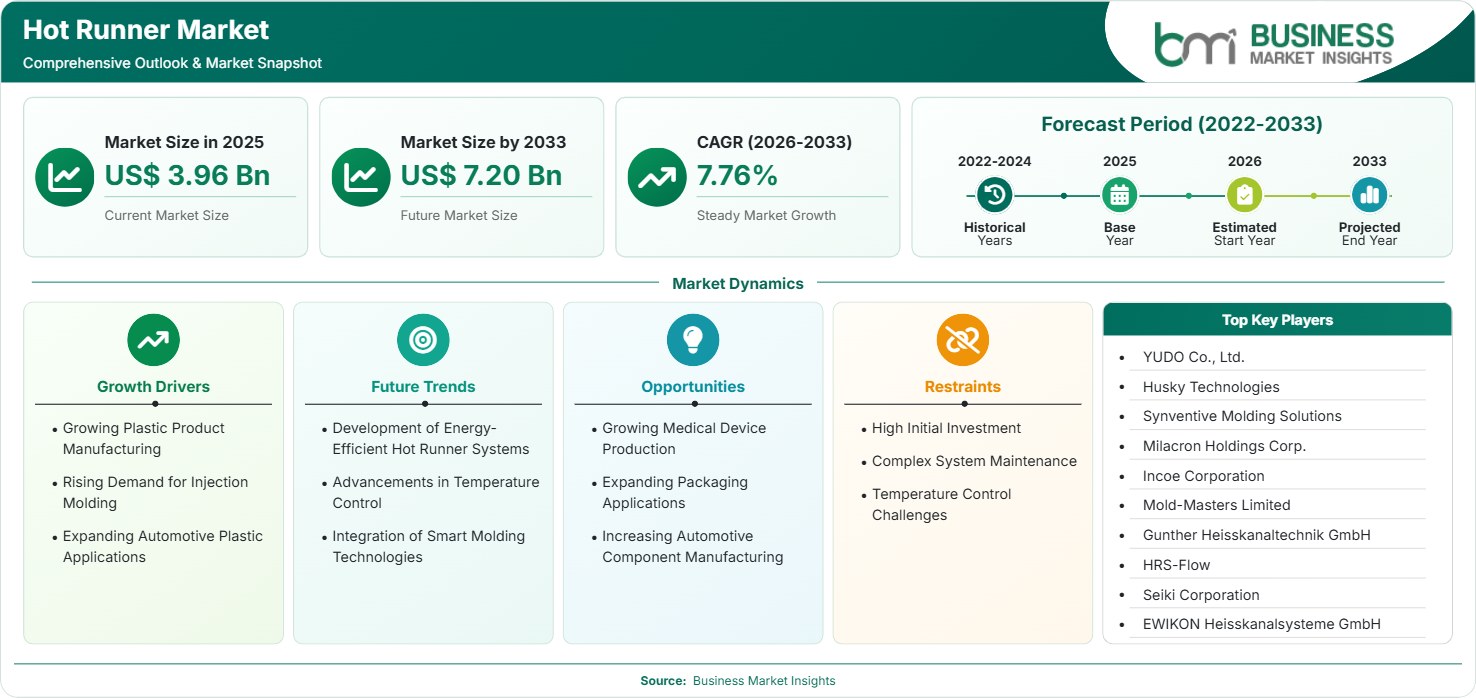
The Hot Runner Market size was valued at US$ 3.96 Billion in 2025 and is projected to reach US$ 7.20 Billion by 2033, growing at a CAGR of 7.76% during 2026–2033, supported by injection molding efficiency, material utilization, precision requirements, automation, and expanding high-volume plastic component production.

Report Coverage
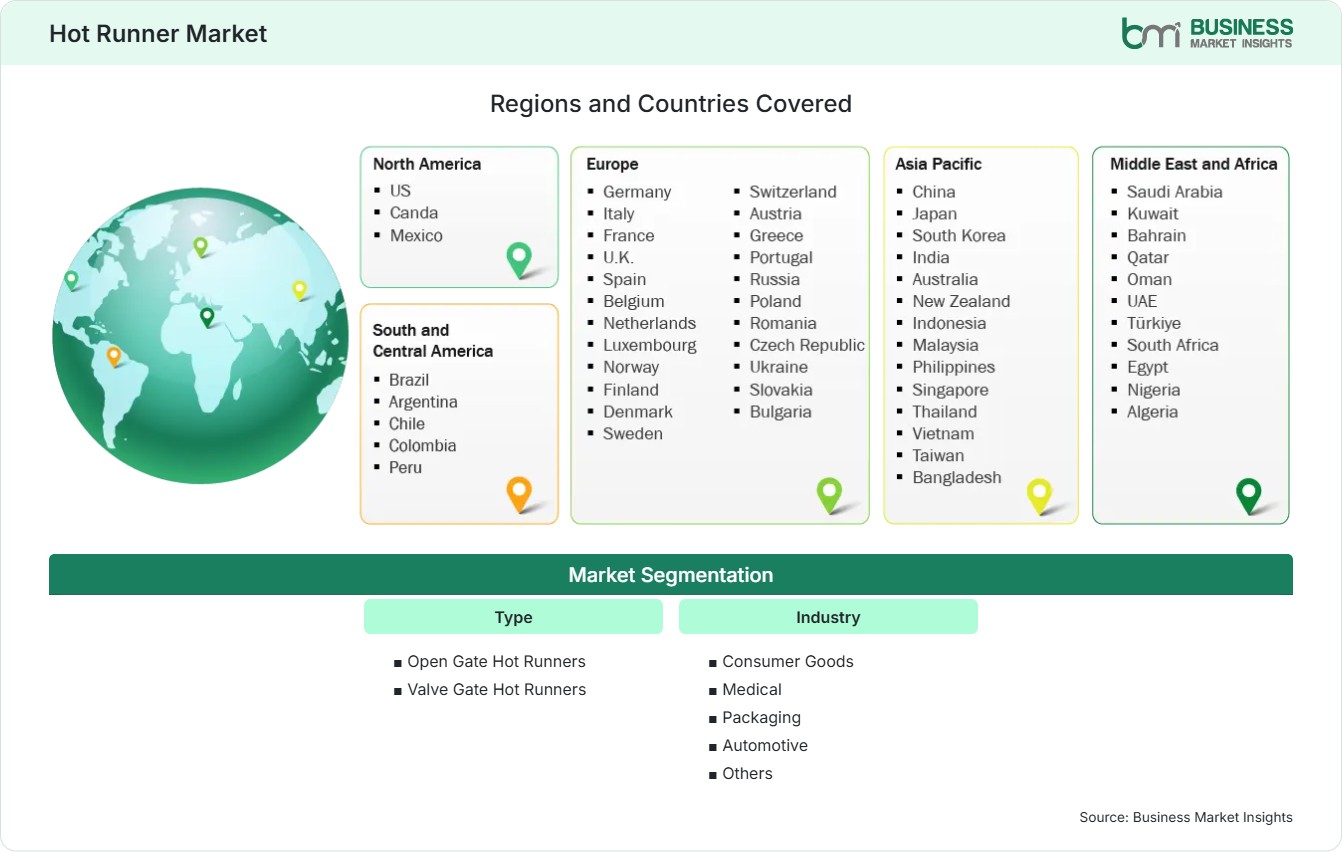
  • Type: Open Gate Hot Runners, Valve Gate Hot Runners
  • Industry: Consumer Goods, Medical, Packaging, Automotive, Others
US$ 3.96 Bn Market size in 2025
US$ 7.20 Bn Market Size by 2033
7.76% CAGR, 2026 - 2033
2026-2033 Forecast Period

AI Overview

Hot Runner Market Summary

  • North America Region: North America holds an estimated 24%–28% share in 2025, growing at a 7.20%–7.90% CAGR during 2026–2033, supported by advanced molding capabilities, precision tooling, automation adoption, reshoring initiatives, and demand for consistent component quality across industrial applications. The US represents the principal regional market, with an estimated 7.30%–8.00% CAGR, supported by established mold-making capabilities and demand for efficient production systems.
  • Fastest Growing Region: Asia Pacific accounts for an estimated 43%–47% share in 2025, advancing at a 8.10%–8.80% CAGR during 2026–2033, driven by expanding injection molding capacity, manufacturing diversification, packaging production, automotive component localization, tooling investments, and increasing preference for efficient multi-cavity production systems.
  • Leading Segment: Valve Gate Hot Runners represent an estimated 55%–59% share in 2025, expanding at a 7.90%–8.40% CAGR during 2026–2033, supported by precise material control, improved gate management, demanding component specifications, reduced visual defects, flexible cavity configurations, and greater suitability for controlled molding processes.
  • High Growth Segment: Medical is positioned as a high-growth industry segment, representing an estimated 10%–14% share in 2025 and advancing at a 8.40%–9.10% CAGR during 2026–2033, supported by precision requirements, repeatable molding, controlled processing, complex component geometries, and increasing emphasis on consistent production quality.
  • Key Market Opportunity: Greater integration of thermal control, process monitoring, modular tooling, and application-specific gate configurations can strengthen supplier differentiation while improving mold productivity, quality consistency, material utilization, and lifecycle economics.
  • Major Market Players: YUDO Co., Ltd.; Husky Technologies; Synventive Molding Solutions; Milacron Holdings Corp.; Incoe Corporation; Mold-Masters Limited; Gunther Heisskanaltechnik GmbH; HRS-Flow; Seiki Corporation; EWIKON Heisskanalsysteme GmbH.
Strategic Insights

Hot Runner Market: Strategic Insights

Hot Runner Market Strategic Framework
FREE PDF
Request your free sample
Request free sample
Stakeholder View

Key Takeaways

  • The value chain increasingly connects hot runner suppliers with mold designers, injection molding companies, resin processors, machine manufacturers, and component producers.
  • The strongest upside lies where production volumes, cavity counts, component complexity, and quality requirements justify greater process control. Packaging, automotive, consumer goods, and medical applications can each create distinct opportunities for customized runner architecture.
  • Product development is moving toward more controlled thermal management, improved gate configuration, modular construction, and better integration between tooling and production monitoring.
  • Asia Pacific presents the strongest expansion opportunity because manufacturing capacity, tooling activity, and plastic component production are becoming increasingly interconnected.
  • Investment priorities are likely to favor companies capable of combining hot runner components with application engineering, mold optimization, technical support, and lifecycle services.
Geographic Outlook

Hot Runner Market Regional Highlights

North America Hot Runner Market

North America represents an estimated 24%–28% share in 2025, with a 7.20%–7.90% CAGR during 2026–2033. The region benefits from established injection molding expertise, specialized tooling capabilities, and demand for repeatable production. Manufacturers increasingly evaluate tooling investments through productivity, quality, and maintenance requirements rather than acquisition cost alone. The regional opportunity is strongest where advanced molding processes require dependable thermal management and precise material delivery.

  • Packaging manufacturers emphasize repeatability because high-volume production magnifies small process inconsistencies. Hot runner configurations can support controlled material delivery and simplify tooling strategies where production continuity is commercially important.
  • Automotive molders require systems capable of handling complex component geometries, varied cavity configurations, and demanding cosmetic requirements. This encourages application-specific engineering rather than one-size-fits-all hot runner solutions.
  • Industrial manufacturers increasingly consider maintenance accessibility during tooling selection. Modular components and easier replacement can reduce operational disruption and strengthen the value proposition of premium systems.
  • North American suppliers can capture additional value by combining equipment with mold consultation, process optimization, technical support, and application-specific design services.

US Hot Runner Market

The US represents an estimated 18%–21% of Hot Runner Market share of North America in 2025, with a 7.30%–8.00% CAGR during 2026–2033. Demand is influenced by established molding infrastructure, high-value plastic components, and increasing emphasis on manufacturing efficiency. Buyers are increasingly concerned with production consistency, tooling utilization, serviceability, and process control.

  • Advanced molders increasingly prioritize controlled processing because component quality can directly affect downstream assembly, appearance, and rejection rates.
  • Medical applications create demand for carefully engineered systems where repeatability, cleanliness considerations, component precision, and process discipline influence tooling decisions.
  • Supplier proximity and technical support remain important because complex hot runner systems require knowledgeable commissioning, troubleshooting, and maintenance capabilities.

Europe Hot Runner Market

Europe accounts for an estimated 22%–26% share in 2025, advancing at a 7.00%–7.70% CAGR during 2026–2033. Germany, Italy, France, and the United Kingdom remain important manufacturing environments, while selected Central European markets provide additional production opportunities. The region places strong emphasis on tooling precision, engineering quality, resource efficiency, and manufacturing automation.

  • Germany supports demand for sophisticated tooling because precision molding and engineering-intensive manufacturing require reliable thermal and flow management.
  • Italy offers opportunities through established mold-making and plastics-processing capabilities, particularly where customized tooling supports specialized component production.
  • Central European production locations can create incremental demand as manufacturers seek efficient tooling systems alongside expanded molding capacity.
  • European customers increasingly value durable, serviceable equipment because lifecycle performance can influence the economics of complex injection molds.

Asia Pacific Hot Runner Market

Asia Pacific holds an estimated 43%–47% of Hot Runner Market share in 2025, with a 8.10%–8.80% CAGR during 2026–2033, making it the strongest regional growth opportunity. China, Japan, South Korea, and India contribute different demand characteristics based on manufacturing structure, tooling capabilities, and end-use production. China remains a major manufacturing environment, while India offers expanding opportunities as molding and component production broaden. Japan and South Korea maintain strong demand for precision-oriented tooling.

  • China offers broad demand across packaging, consumer goods, automotive components, and industrial plastics, creating opportunities for different hot runner configurations and tooling requirements.
  • India provides expanding opportunities as manufacturers increase domestic molding capabilities and seek improved production efficiency, quality consistency, and tooling productivity.
  • Japan emphasizes precision, reliability, and controlled manufacturing, supporting demand for technically sophisticated systems designed around exact molding requirements.
  • South Korea provides opportunities in high-value manufacturing where component quality, process stability, and tooling precision influence supplier selection.

Rest of World Hot Runner Market

South and Central America account for a substantial portion of the 6%–9% Rest of World share in 2025, with regional growth supported by packaging, automotive components, consumer products, and localized plastics processing. Brazil and Mexico-linked supply chains create opportunities for system suppliers seeking manufacturing diversification and regional service coverage.

  • Brazil offers opportunities where packaging and consumer-oriented plastic production require higher molding productivity and more consistent tooling performance.
  • Mexico-linked manufacturing activity can create demand for dependable tooling systems where production efficiency and component consistency are important purchasing criteria.
  • Middle Eastern manufacturers can represent emerging opportunities as localized industrial production increases and plastic component manufacturing becomes more diversified.
  • African markets remain selective, making distributor capability, technical training, and maintenance support important factors for successful market development.
Global Market Geography
FREE PDF
Request your free sample
Request free sample
Segment Analysis

Hot Runner Market Segmentation

Type

The Type segment is led by Valve Gate Hot Runners, which hold an estimated 55%–59% share in 2025 and are positioned at a 7.90%–8.40% CAGR during 2026–2033. Open gate systems remain relevant where simpler flow management and tooling economics support adoption. Overall Hot Runner Market trends indicate increasing preference for configurations aligned with part quality, cavity control, and application-specific production requirements.

  • Open Gate Hot Runners: Open gate configurations provide a comparatively straightforward approach to material delivery, supporting applications where tooling simplicity, reliable flow, and production economics remain central purchasing considerations.
  • Valve Gate Hot Runners: Valve gate systems support more controlled gate operation and are suited to demanding molding applications requiring greater control over filling, gate timing, appearance, and component consistency.

Industry

The Industry segment is influenced by packaging, automotive, consumer goods, and medical production requirements. Automotive and packaging collectively represent important demand centers because production volumes and component consistency can justify advanced tooling. Medical applications provide a strong growth pathway where precision and repeatability are particularly important. The Hot Runner Market scope therefore extends across both high-volume and high-value molding environments with different tooling priorities.

  • Consumer Goods: Consumer goods applications require consistent appearance, dimensional repeatability, and efficient cycle management, supporting hot runner adoption where production volumes make tooling productivity commercially important.
  • Medical: Medical molding emphasizes precision, repeatability, controlled processing, and consistent component quality, creating demand for carefully engineered runner systems matched to specialized mold designs.
  • Packaging: Packaging applications favor production efficiency and reliable material distribution because high-volume manufacturing places strong emphasis on cycle consistency, cavity balance, and predictable component quality.
  • Automotive: Automotive applications increasingly require complex plastic components with demanding dimensional and appearance characteristics, supporting advanced runner configurations designed around cavity geometry and controlled filling.
Market Forces

Hot Runner Market Dynamics

Key Market Drivers

Growing Plastic Product Manufacturing

The expansion of plastic component manufacturing directly supports the Hot Runner Market growth because higher production requirements increase the value of efficient material delivery and repeatable molding. Manufacturers making multi-cavity molds or complicated components also consider the use of tooling based on material usage, process reliability, cycle considerations, and maintenance. The hot runner system acts as a controlled route for the flow of molten material in the mold, enabling the system design to be made according to the layout of the cavities and gates. Manufacturers who can correlate the runner design with the resin characteristics and molding conditions can benefit more from their customers.

Rising Demand for Injection Molding

Injection molding remains central to the production of diverse plastic components, creating a structural requirement for tooling technologies that support productivity and repeatability. The Hot Runner Market trends are therefore closely connected to changes in molding complexity, cavity count, component geometry, and production economics. With the objective of ensuring consistency in the output, the runner becomes an essential element in mold design as compared to being a minor one. Open and Valve gates represent two distinct means of handling material flow and gate behavior. Suppliers can strengthen adoption by tailoring the system in accordance with production needs, including component appearance, filling behavior, cycle requirements, and material characteristics.

Expanding Automotive Plastic Applications

Automotive manufacturing still emphasizes engineered plastic parts more since plastic can allow intricate geometry, functional integration, weight management, and design. The automotive application opportunity also creates emphasis on dimensional control and surface quality. In this case, manufacturers use manifold designs, gate setups, heat management, and engineering support in their competition against standard equipment. Through the evolving product lineup of automotive parts, hot runner suppliers can capitalize on custom solutions created in response to part geometry, resin type, and production needs.

Key Market Opportunities

Growing Medical Device Production

Medical molding offers a strong opportunity because component manufacturing places substantial emphasis on repeatability, dimensional control, and carefully managed processing. The hot runner providers may be able to distinguish themselves by designing systems based on accurate mold geometry and application needs, instead of offering pre-designed systems. Technical services become commercially important because of the requirement for disciplined mold management in the medical production environment. Consequently, the Hot Runner Market Forecasts feature an interesting route to take through the medical applications market segment, since the technical sophistication will allow high positioning of systems.

Expanding Packaging Applications

Packaging provides an opportunity due to the fact that production economics largely hinge on throughput, repeatability, cavity usage, and material handling. There is potential for the hot runner system design to accommodate the number of cavities and gates used in each application in order for the manufacturer to adapt the tooling configuration to its production needs. Packaging requires a wide range of component configurations, wall types, and resin materials, which necessitates application-based engineering efforts. The opportunity can be enhanced with the help of modular tooling that allows for configuration changes and maintenance.

Increasing Automotive Component Manufacturing

Automotive component manufacturing creates opportunities for hot runner suppliers as plastic content expands across interior, exterior, under-the-hood, structural, and functional applications. Different requirements for filling, appearances, dimensioning, and material properties are placed on each one of these categories. This variety generates need for specialized systems rather than standardized designs. A supplier may gain competitive advantage with mold design starting from its design stage to installation and maintenance. Consumers seeking extended life spans of tools will appreciate the supplier’s capability to offer components that work together with technical expertise.

Market Restraints and Challenges

High Initial Investment

Factor: hot runner systems generally require more specialized components, thermal management equipment, engineering, and integration than simpler runner arrangements. Impact: the higher initial tooling commitment can influence purchasing decisions, particularly among smaller molders or applications with limited production volumes. Buyers may compare the upfront cost against expected productivity, material utilization, quality consistency, and tooling lifespan before selecting a configuration. This makes the commercial case dependent on application economics rather than technology preference alone. Suppliers can reduce the perceived barrier through modular configurations, application-specific engineering, lifecycle support, and clearer value communication.

Complex System Maintenance

Factor: hot runner systems combine heated manifolds, nozzles, gates, temperature controls, and mold interfaces that must operate in coordination. Impact: maintenance requirements can become more demanding when tooling is complex, material behavior is difficult to manage, or technical expertise is limited. Incorrect servicing can affect temperature stability, gate performance, and production continuity. Customers therefore place importance on component accessibility, diagnostic capability, technical documentation, and service support. Strong technical training and responsive service networks can therefore become important competitive differentiators without changing the underlying requirement for disciplined maintenance.

Company Analysis

Competitive Landscape

The Hot Runner Market analysis indicates a competitive environment shaped by system engineering, application specialization, tooling compatibility, component reliability, and customer support. The supplied company set includes established hot runner specialists and broader molding technology providers, creating competition across system design, gate technologies, thermal control, and application-specific engineering.

Company Name

Overview

Products and Services relevant to this market

YUDO Co., Ltd.

A specialized hot runner technology provider serving injection molding applications across varied production requirements and tooling configurations.

Hot runner systems, manifolds, nozzles, temperature control solutions, gate technologies, and application-oriented tooling support.

Husky Technologies

A major molding technology company with capabilities spanning injection molding systems and associated tooling technologies for demanding production environments.

Hot runner systems, controllers, injection molding solutions, tooling technologies, and application engineering for high-volume production.

Synventive Molding Solutions

A specialized supplier focused on hot runner technologies and engineered solutions for complex injection molding applications.

Hot runner systems, valve gate solutions, temperature controllers, manifolds, nozzles, and customized mold engineering support.

Milacron Holdings Corp.

A plastics processing technology provider with capabilities across injection molding equipment and supporting technologies.

Hot runner systems, molding technologies, process controls, tooling-related solutions, and technical support for plastics manufacturing.

Incoe Corporation

A specialist in hot runner technology focused on precision material delivery and engineered molding solutions.

Hot runner systems, manifolds, nozzles, valve gates, controllers, and application-specific system engineering.

Mold-Masters Limited

A recognized supplier of hot runner and molding technologies serving multiple high-volume and precision molding applications.

Hot runner systems, controllers, temperature management, valve gate systems, manifolds, and tooling support.

Gunther Heisskanaltechnik GmbH

A specialized hot runner technology company focused on engineered solutions for injection molding applications.

Hot runner systems, nozzles, controllers, manifolds, gate systems, and customized technical solutions for molds.

HRS-Flow

A hot runner specialist offering engineered flow and temperature management solutions for injection molding.

Hot runner systems, controllers, manifolds, nozzles, valve gates, and customized flow management solutions.

Seiki Corporation

A specialized provider of hot runner technologies designed for varied mold configurations and production requirements.

Hot runner systems, nozzles, manifolds, valve gates, controllers, and technical support for injection molding.

EWIKON Heisskanalsysteme GmbH

A specialist hot runner supplier focused on precision systems and application-specific injection molding requirements.

Hot runner systems, controllers, manifolds, nozzles, valve gate technologies, and engineered mold solutions.

Trust & Transparency

Research Methodology

The market analysis combines proprietary research with secondary data from government agencies, company disclosures, regulatory filings, industry databases and expert interviews. Market estimates are validated through data triangulation, cross-market benchmarking and analyst review.

View Full Research Methodology

Questions Answered

Frequently Asked Questions

Where can Hot Runner Market Report users identify the strongest application opportunities?

The strongest opportunities are concentrated in medical, packaging, automotive, and high-volume consumer manufacturing, where precision, material utilization, cycle consistency, and production uptime can justify advanced melt-delivery technology.

How can digital monitoring change maintenance practices?

Digital monitoring can identify abnormal temperatures, power consumption, sensor behavior, or process conditions before failures become production stoppages. This supports preventive maintenance and improves equipment availability.

What factors should manufacturers consider when selecting a system?

Manufacturers should evaluate resin characteristics, cavity count, gate location, cycle time, component geometry, temperature-control requirements, maintenance access, controller compatibility, service availability, and total lifecycle cost.

Why are hot runners important for high-cavitation packaging molds?

High-cavitation packaging molds benefit from reduced runner waste, controlled melt distribution, shorter cycles, and repeatable cavity filling. These characteristics become increasingly valuable as cavity counts and production volumes rise.

How does valve gate technology improve molded part quality?

Valve gate technology provides controlled opening and closing of individual gates, allowing processors to manage filling sequence, gate appearance, pressure distribution, and cavity balance more precisely than simpler open configurations.

Access the Full Hot Runner Market Report

Get segment-level forecasts, regional estimates, competitive benchmarking, company profiles and downloadable Excel datasets.

Access the full Hot Runner Market Report
350 pages PDF & Excel | 2026-08-19