
Hospital Architecture Market Outlook: Size, Share, Trends, Growth Analysis, Competitive Landscape & Forecast, 2026-2033

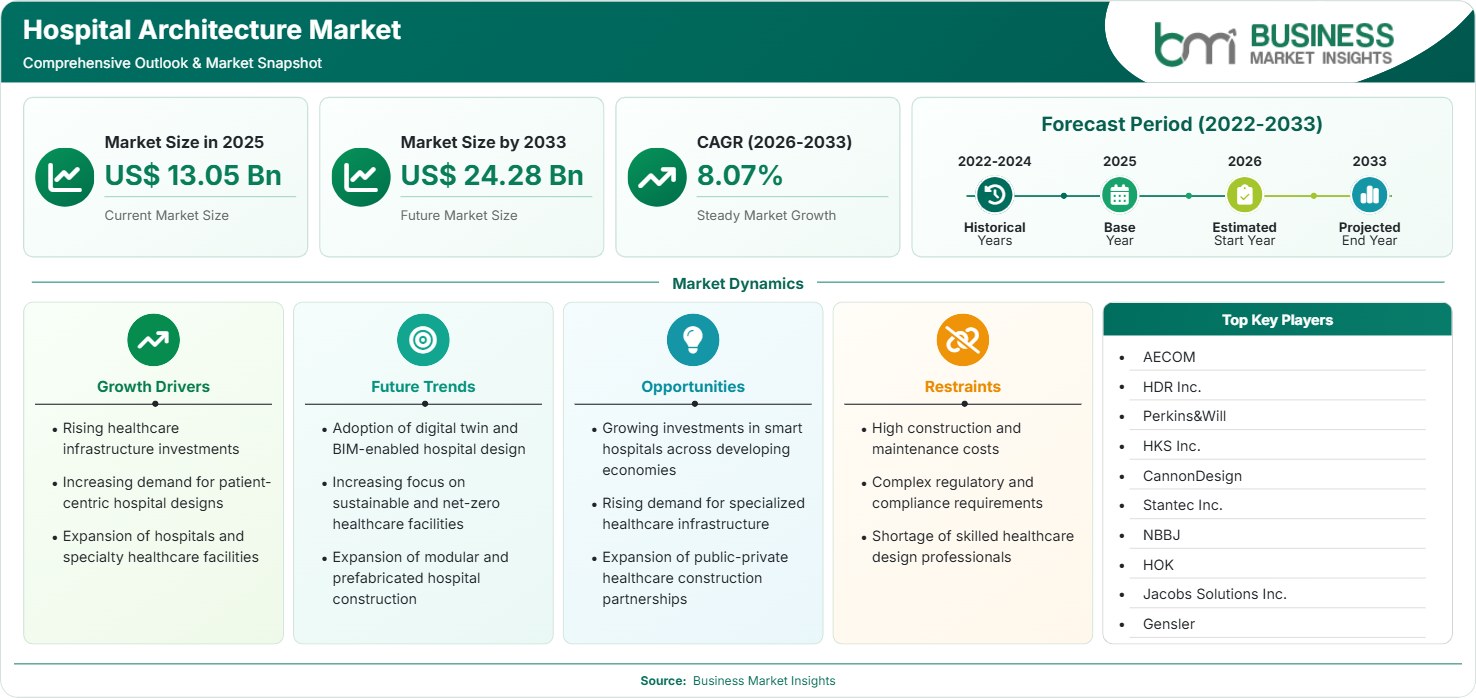
The Hospital Architecture Market size was valued at US$ 13.05 Billion in 2025 and is projected to reach US$ 24.28 Billion by 2033, growing at a CAGR of 8.07% during 2026–2033. Rising healthcare infrastructure investments, increasing demand for patient-centric environments, expansion of specialty healthcare facilities, and adoption of smart hospital concepts are driving architectural planning and design activities worldwide.

Report Coverage
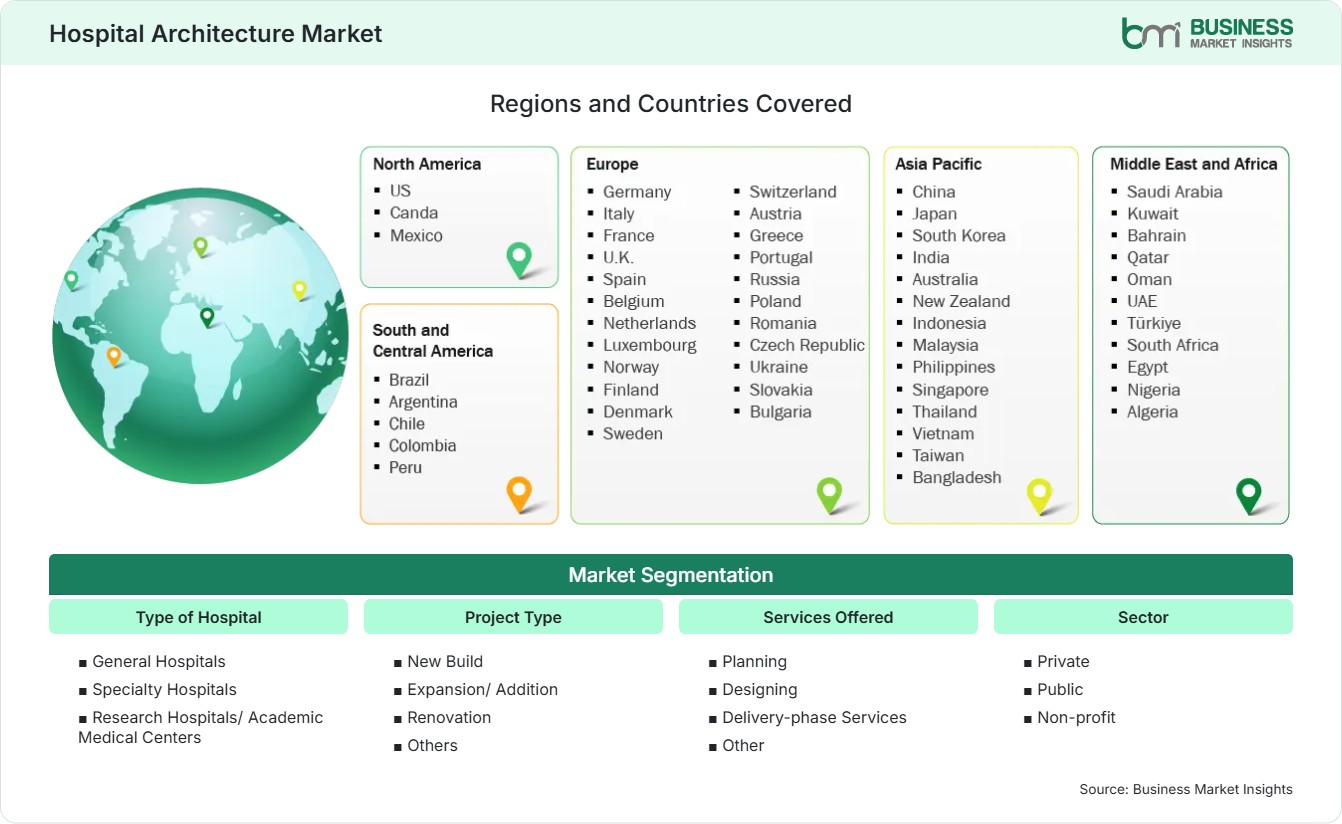
  • Type of Hospital: General Hospitals, Specialty Hospitals, Research Hospitals/ Academic Medical Centers
  • Project Type: New Build, Expansion/ Addition, Renovation, Others
  • Services Offered: Planning, Designing, Delivery-phase Services, Other
  • Sector: Private, Public, Non-profit
US$ 13.05 Bn Market size in 2025
US$ 24.28 Bn Market Size by 2033
8.07% CAGR, 2026 - 2033
2026-2033 Forecast Period

01 AI Overview

Hospital Architecture Market Summary

  • North America Region: North America accounts for 38%–41% share in 2025 and is projected to expand at a 7.6%–8.1% CAGR during 2026–2033. Growth is supported by healthcare modernization programs, hospital renovation projects, advanced medical facility planning, and demand for technology-enabled healthcare spaces. The U.S. dominates regional demand through large-scale healthcare investments, specialty hospital development, and modernization of aging facilities, growing at a 7.7%–8.2% CAGR.
  • Fastest Growing Region: Asia Pacific holds 27%–30% share in 2025 and is expected to grow at a 8.8%–9.4% CAGR through 2033, driven by healthcare infrastructure expansion, rising medical tourism, government healthcare investments, and increasing development of specialty hospitals.
  • Leading Segment: General Hospitals account for 45%–48% share in 2025 and are projected to grow at a 7.7%–8.2% CAGR, supported by increasing demand for comprehensive healthcare facilities, population growth, and modernization of existing hospitals.
  • High Growth Segment: Specialty Hospitals account for 24%–27% share in 2025 and are projected to grow at a 8.9%–9.5% CAGR, driven by rising demand for specialized treatment centers, advanced medical services, and disease-focused healthcare infrastructure.
  • Key Market Opportunity: Increasing smart hospital investments, specialized healthcare facility development, and public-private construction partnerships are creating significant opportunities for architecture firms and healthcare design specialists.
  • Major Market Players: AECOM, HDR Inc., Perkins&Will, HKS Inc., CannonDesign, Stantec Inc., NBBJ, HOK, Jacobs Solutions Inc., and Gensler.
02 Strategic Insights

Hospital Architecture Market: Strategic Insights

Hospital Architecture Market Strategic Framework
FREE PDF
Request your free sample
Request free sample
03 Stakeholder View

Key Takeaways

  • The healthcare architecture value chain is shifting toward integrated collaboration between architects, healthcare providers, technology companies, engineers, and construction specialists.
  • Specialty healthcare facilities and smart hospital developments represent major growth opportunities due to increasing demand for advanced medical services and patient-focused environments.
  • Innovation is centered on sustainable hospital designs, modular construction, digital infrastructure integration, and flexible spaces supporting evolving healthcare requirements.
  • Asia Pacific provides strong investment potential due to healthcare expansion programs, rising medical infrastructure demand, and increasing private sector participation.
  • Companies are strengthening market positions through strategic partnerships, healthcare design expertise, global project expansion, and technology-enabled architectural solutions.
  • Sustainability, operational efficiency, and regulatory compliance are becoming important factors influencing hospital planning and architectural decision-making.
04 Geographic Outlook

Hospital Architecture Market Regional Highlights

North America Hospital Architecture Market

North America accounted for 38%–41% share in 2025 and is projected to grow at a 7.6%–8.1% CAGR during 2026–2033. The region benefits from healthcare infrastructure modernization, replacement of aging facilities, expansion of specialty care centers, and increasing adoption of technology-enabled hospital environments. The U.S. represents the largest regional contributor due to healthcare investment capacity, advanced medical systems, and large-scale hospital renovation programs. Canada also supports growth through healthcare facility upgrades in hospital architecture market share.

  • Healthcare providers are investing in facility modernization projects to improve patient flow, operational efficiency, and integration of advanced medical technologies.
  • Increasing demand for specialty hospitals is encouraging architecture firms to develop customized healthcare environments focused on specific treatment areas.
  • Sustainable hospital designs are gaining adoption due to growing emphasis on energy efficiency, environmental standards, and long-term operational cost reduction.
  • Smart hospital initiatives are increasing demand for digitally integrated designs supporting connected medical systems and automated healthcare operations.

US Hospital Architecture Market

The U.S. represents 84%–87% of the North American market in 2025 and is projected to expand at a 7.7%–8.2% CAGR during 2026–2033. Growth is supported by healthcare infrastructure investments, hospital expansion projects, modernization of existing facilities, and increasing demand for patient-centric designs. The country continues to witness strong development of specialty hospitals, outpatient centers, and advanced medical facilities requiring specialized architectural expertise in hospital architecture market.

  • Hospital renovation projects are increasing as healthcare providers upgrade aging infrastructure and improve compliance with modern healthcare standards.
  • Specialty healthcare facilities are expanding due to rising demand for advanced treatment centers and focused medical services.
  • Healthcare organizations are prioritizing patient-centered designs that improve comfort, accessibility, and overall care experiences.
  • Technology integration is influencing hospital planning through demand for connected infrastructure and smart healthcare environments.

Europe Hospital Architecture Market

Europe accounted for 26%–29% share in 2025 and is projected to register a 7.9%–8.4% CAGR during 2026–2033. The region benefits from healthcare modernization programs, aging populations, sustainability requirements, and increasing investment in advanced medical facilities. Germany leads regional demand through healthcare infrastructure development in hospital architecture market, while the United Kingdom, France, and Nordic countries represent high-growth markets due to smart hospital adoption and healthcare facility upgrades.

  • Germany maintains leadership through healthcare infrastructure investments, hospital modernization programs, and advanced medical facility development.
  • The United Kingdom is expanding healthcare architecture projects through public healthcare upgrades and demand for efficient medical environments.
  • France is increasing investment in healthcare facilities focused on patient experience, sustainability, and improved healthcare accessibility.
  • Nordic countries are adopting innovative hospital designs emphasizing energy efficiency, digital integration, and patient-centered environments.
  • European sustainability regulations are encouraging architects to incorporate environmentally responsible materials and efficient building systems.

Asia Pacific Hospital Architecture Market

Asia Pacific accounted for 27%–30% share in 2025 and is projected to grow at a 8.8%–9.4% CAGR during 2026–2033, making it the fastest-growing region. Growth is driven by expanding healthcare access, rising medical infrastructure investments, increasing private hospital development, and growing demand for specialty healthcare facilities. China leads regional demand, while India, Japan, and Southeast Asian countries are witnessing increased construction activity supported by healthcare modernization initiatives hospital architecture market.

  • China is expanding healthcare infrastructure through government investments, hospital development programs, and increasing demand for advanced medical facilities.
  • India represents a high-growth market due to rising healthcare investments, private hospital expansion, and increasing demand for quality medical services.
  • Japan is focusing on healthcare facility modernization with emphasis on aging population requirements and advanced medical infrastructure.
  • Southeast Asian countries are increasing healthcare construction through medical tourism development and improving healthcare accessibility.
  • Smart hospital adoption is gaining momentum through digital healthcare initiatives and technology-enabled facility planning.

Rest of World Hospital Architecture Market

The Rest of World accounted for 5%–8% share in 2025 and is projected to grow at a 7.2%–7.8% CAGR during 2026–2033. South America is witnessing gradual healthcare infrastructure expansion through public investments and private hospital development. The Middle East and Africa are increasing adoption through large-scale healthcare projects, medical tourism initiatives, and modernization programs. Countries investing in advanced healthcare networks are creating opportunities for international architecture firms hospital architecture market growth.

  • Brazil is expanding healthcare infrastructure through hospital construction projects, modernization initiatives, and increasing private sector participation.
  • Mexico is developing medical facilities through healthcare expansion programs and growing demand for specialized treatment centers.
  • Gulf countries are investing in advanced healthcare projects supported by medical tourism growth and smart city initiatives.
  • Saudi Arabia is developing healthcare infrastructure through large-scale hospital projects and modernization programs.
  • South Africa is improving healthcare facilities through public and private sector investments focused on accessibility and quality improvement.
Global Market Geography
FREE PDF
Request your free sample
Request free sample
05 Segment Analysis

Hospital Architecture Market Segmentation

Type of Hospital

The type of hospital segment is expanding due to increasing healthcare infrastructure investments, rising patient volumes, and growing demand for specialized medical services. General Hospitals represent the leading category, accounting for 45%–48% share in 2025 and projected to grow at a 7.7%–8.2% CAGR during 2026–2033. Their dominance is supported by broad healthcare service coverage, increasing demand for primary and secondary care facilities, and modernization of existing hospital infrastructure in hospital architecture market.

  • General Hospitals: General hospitals dominate due to their ability to provide comprehensive healthcare services, including emergency care, diagnostics, surgery, and inpatient treatment. Increasing population growth and healthcare accessibility initiatives are driving expansion and renovation projects.
  • Specialty Hospitals: Specialty hospitals are witnessing strong growth due to increasing demand for focused treatment facilities such as oncology centers, cardiac hospitals, orthopedic centers, and rehabilitation facilities. Rising chronic disease prevalence and advanced treatment requirements are encouraging investment in specialized healthcare infrastructure.
  • Research Hospitals/ Academic Medical Centers: Research hospitals and academic medical centers are expanding through increased investments in medical research, advanced healthcare technologies, clinical training, and innovation-focused healthcare environments.

Project Type

The project type segment is influenced by healthcare infrastructure expansion, modernization requirements, and increasing demand for improved medical facilities. Renovation represents a major category, accounting for 34%–37% share in 2025 and projected to grow at a 7.8%–8.3% CAGR during 2026–2033. Aging healthcare infrastructure, regulatory upgrades, and the need to incorporate advanced technologies are driving renovation activities worldwide.

  • New Build: New hospital construction projects are increasing due to rising healthcare demand, population growth, healthcare access initiatives, and development of advanced medical campuses.
  • Expansion/ Addition: Hospital expansion projects are growing as healthcare providers increase capacity, add specialty departments, and upgrade service capabilities to meet rising patient requirements.
  • Renovation: Renovation projects lead adoption due to the modernization of existing facilities, improved patient experience requirements, infrastructure upgrades, and integration of smart healthcare systems.

Services Offered

The services offered segment is developing as healthcare organizations increasingly require comprehensive architectural support from initial planning to project completion. Designing Services account for 32%–35% share in 2025 and are projected to grow at a 8.0%–8.5% CAGR during 2026–2033. Increasing complexity of healthcare facilities and demand for efficient layouts are strengthening demand for specialized hospital design services.

  • Planning: Planning services are essential for determining facility requirements, patient flow management, capacity planning, and long-term healthcare infrastructure strategies.
  • Designing: Designing services represent a leading category due to increasing demand for patient-centric layouts, sustainable architecture, advanced medical environments, and technology-integrated facilities.
  • Delivery-phase Services: Delivery-phase services are gaining importance through project management, construction coordination, quality control, and ensuring compliance with healthcare standards.

Sector

The sector segment is influenced by healthcare funding models, government initiatives, and private healthcare expansion. Private Sector represents the leading category, accounting for 48%–51% share in 2025 and projected to grow at a 8.2%–8.7% CAGR during 2026–2033. Increasing private healthcare investments, specialty hospital development, and demand for premium medical facilities are supporting segment growth.

  • Private: Private healthcare providers are increasing investments in advanced hospital infrastructure, specialty centers, and patient-focused environments to improve service quality and operational efficiency.
  • Public: Public sector healthcare projects are expanding through government investments aimed at improving healthcare accessibility, upgrading facilities, and strengthening healthcare networks.
  • Non-profit: Non-profit healthcare organizations are contributing through community healthcare projects, affordable medical facilities, and infrastructure development focused on underserved populations.
06 Market Forces

Hospital Architecture Market Dynamics

Key Market Drivers

Rising Healthcare Infrastructure Investments

Increasing investments in healthcare infrastructure are significantly driving demand for hospital architecture services as governments, private healthcare providers, and investors focus on expanding medical facilities. Growing healthcare needs due to population growth, aging demographics, and increasing demand for advanced treatment options are encouraging the development of new hospitals and modernization of existing facilities. Healthcare organizations are allocating resources toward improving patient capacity, operational efficiency, and technology integration within hospital environments. These investments are supporting market growth by increasing demand for specialized planning, designing, and project management services. Emerging Hospital Architecture Market trends indicate rising adoption of sustainable designs, smart healthcare infrastructure, and flexible hospital layouts that can adapt to evolving medical requirements.

Increasing Demand for Patient-Centric Hospital Designs

There is a growing emphasis on improving patient experiences, leading to a more patient-centric approach to architecture in healthcare facilities. Current trends in hospital design are geared towards enhancing patient comfort, ease of access, patient safety, natural light availability, navigation, and interactions between patients and health care providers. Architects are creating facilities that offer a better clinical experience while minimizing patient stress and improving efficiency. The inclusion of healing environments, family-oriented spaces, infection-control facilities, and improved patient circulation is among the key elements in modern healthcare facility architecture.

Expansion of Hospitals and Specialty Healthcare Facilities

The construction of hospitals and specialized healthcare facilities has resulted in high demand for healthcare architecture around the world. There is an increase in chronic conditions, increased healthcare needs, and demand for specialized treatments. This has led to the development of oncology centers, cardiac hospitals, rehabilitation centers, and more such healthcare organizations. Healthcare organizations are developing specialized buildings for the use of specialized medical equipment. Private healthcare systems and multi-specialty hospitals are being developed, which helps the market grow. Architectural firms are providing designs that improve efficiency and integrate technology.

Key Market Opportunities

Growing Investments in Smart Hospitals Across Developing Economies

Rising investment in smart hospitals in developing economies presents significant growth opportunities for hospital architecture firms. Healthcare organizations have been deploying digital infrastructure, connectivity for healthcare devices, operational automation, and facility design technologies to enhance their performance. The developing economies have been building new healthcare facilities to increase access to healthcare services, enhance the quality of healthcare services, and relieve stress on the current healthcare infrastructure. Smart hospitals require special architectural designs due to the integration of digital infrastructure and technologies.

Rising Demand for Specialized Healthcare Infrastructure

Growing demand for specialized healthcare services is creating opportunities for architecture firms involved in designing focused medical facilities. Increasing cases of chronic diseases, rising demand for advanced treatments, and expansion of medical specialties are driving development of oncology centers, cardiovascular hospitals, rehabilitation facilities, and research institutions. Specialized healthcare infrastructure requires customized designs that support complex medical procedures, advanced equipment installation, and efficient patient management. Healthcare providers are increasingly investing in purpose-built facilities to improve treatment outcomes and enhance operational capabilities. This trend is encouraging architecture companies to develop expertise in specialty healthcare planning and design.

Expansion of Public-Private Healthcare Construction Partnerships

Public-private healthcare construction partnerships are creating new opportunities by combining government support with private sector expertise and investment capabilities. These partnerships are helping accelerate healthcare infrastructure development, particularly in regions facing increasing demand for medical facilities. Private organizations contribute architectural expertise, project management capabilities, and innovative construction approaches, while public institutions support accessibility and large-scale healthcare initiatives. The expansion of these collaborations is increasing demand for comprehensive healthcare planning, design, and delivery-phase services. Such partnerships are expected to support hospital development projects focused on improving healthcare availability, efficiency, and quality.

Market Restraints and Challenges

High Construction and Maintenance Costs

Factor: High construction and maintenance costs remain a significant challenge due to the complexity of healthcare facilities, advanced medical infrastructure requirements, specialized equipment integration, and strict quality standards. Impact: Higher project costs can delay hospital development, increase investment requirements, and limit expansion opportunities, particularly in cost-sensitive markets. Hospital construction requires substantial investment in safety systems, infection control infrastructure, energy management solutions, and specialized architectural features. Additionally, long-term maintenance requirements increase operational expenses for healthcare providers. Although efficient planning, modular construction, and technology integration can improve cost management, financial constraints continue to influence healthcare infrastructure decisions.

Complex Regulatory and Compliance Requirements

Factor: Complex regulatory and compliance requirements create challenges due to strict healthcare construction standards, safety regulations, accessibility guidelines, and operational requirements. Impact: Compliance complexity can increase project timelines, require specialized expertise, and raise development costs for healthcare facilities. Hospital architecture projects must address multiple regulations related to patient safety, infection prevention, emergency systems, medical equipment integration, and environmental standards. Architecture firms require extensive knowledge of healthcare regulations to successfully execute projects. Increasing regulatory requirements are encouraging collaboration between healthcare providers, architects, engineers, and compliance specialists to ensure efficient project completion while maintaining required standards.

07 Company Analysis

Competitive Landscape

The Hospital Architecture Market analysis highlights increasing competition among global architecture firms, engineering companies, and healthcare design specialists focusing on patient-centric planning, smart hospital development, sustainable healthcare infrastructure, and advanced facility design. Leading companies are expanding healthcare design capabilities through strategic partnerships, technology integration, global project execution, and specialized architectural solutions to support hospitals, specialty healthcare centers, and academic medical institutions.

Company Name

Overview

Products and Services Relevant to this Market

AECOM

Global infrastructure consulting and engineering company providing planning, design, and delivery solutions across healthcare and infrastructure sectors.

Healthcare planning, hospital design, project management, engineering services, and large-scale healthcare infrastructure solutions.

HDR Inc.

Architecture and consulting firm specializing in healthcare design and advanced medical environments.

Hospital architecture, healthcare planning, facility design, sustainable healthcare solutions, and patient-centered design strategies.

Perkins&Will

Global architecture and design firm focused on innovative and human-centered healthcare environments.

Healthcare facility planning, hospital design, research facility architecture, and sustainable design solutions.

HKS Inc.

Architecture and design company known for healthcare, institutional, and specialty facility projects.

Hospital architecture, medical campus planning, healthcare interior design, and advanced healthcare environments.

CannonDesign

Architecture and consulting firm specializing in healthcare, education, and science-related facilities.

Healthcare planning, hospital design, strategic facility consulting, and integrated architectural solutions.

Stantec Inc.

Global design and engineering company providing healthcare infrastructure and architectural services.

Healthcare architecture, medical facility planning, engineering, project management, and sustainable design services.

NBBJ

Design and architecture firm focused on healthcare innovation and experience-driven environments.

Hospital planning, healthcare design, research facilities, patient-centered architecture, and technology-enabled spaces.

HOK

Global architecture and design firm delivering healthcare and institutional projects.

Healthcare facility design, hospital planning, sustainable architecture, and integrated project solutions.

Jacobs Solutions Inc.

Global professional services company providing engineering, consulting, and infrastructure solutions.

Healthcare infrastructure consulting, project delivery, engineering services, and healthcare facility development support.

Gensler

Global architecture and design firm providing workplace, healthcare, and specialized environment solutions.

Healthcare design, hospital planning, interior architecture, strategic consulting, and patient experience-focused solutions.

10 Trust & Transparency

Research Methodology

The market analysis combines proprietary research with secondary data from government agencies, company disclosures, regulatory filings, industry databases and expert interviews. Market estimates are validated through data triangulation, cross-market benchmarking and analyst review.

View Full Research Methodology

11 Questions Answered

Frequently Asked Questions

What challenges affect hospital architecture market report?

High construction costs, complex regulatory requirements, long project timelines, and the need for specialized healthcare design expertise remain major challenges.

How are smart hospitals influencing hospital architecture?

Smart hospitals are influencing architecture through integration of digital infrastructure, connected medical systems, automated operations, and technology-enabled healthcare environments.

Why is specialty hospital architecture growing rapidly?

Specialty hospital architecture is expanding due to rising demand for focused treatment facilities, advanced medical services, and infrastructure designed for specific healthcare needs.

Which hospital type segment dominates the market?

General hospitals dominate due to broad healthcare service requirements, population growth, and continuous modernization of existing healthcare infrastructure.

What factors are driving growth in the Hospital Architecture Market forecasts?

Growth is driven by increasing healthcare infrastructure investments, expansion of hospitals and specialty healthcare facilities, demand for patient-centric designs, and adoption of smart hospital concepts.

Access the Full Hospital Architecture Market Report

Get segment-level forecasts, regional estimates, competitive benchmarking, company profiles and downloadable Excel datasets.

Access the full Hospital Architecture Market Report
350 pages PDF & Excel | 2026-08-06