
High Pressure Pump Market Outlook: Size, Share, Trends, Growth Analysis, Competitive Landscape & Forecast, 2026-2033

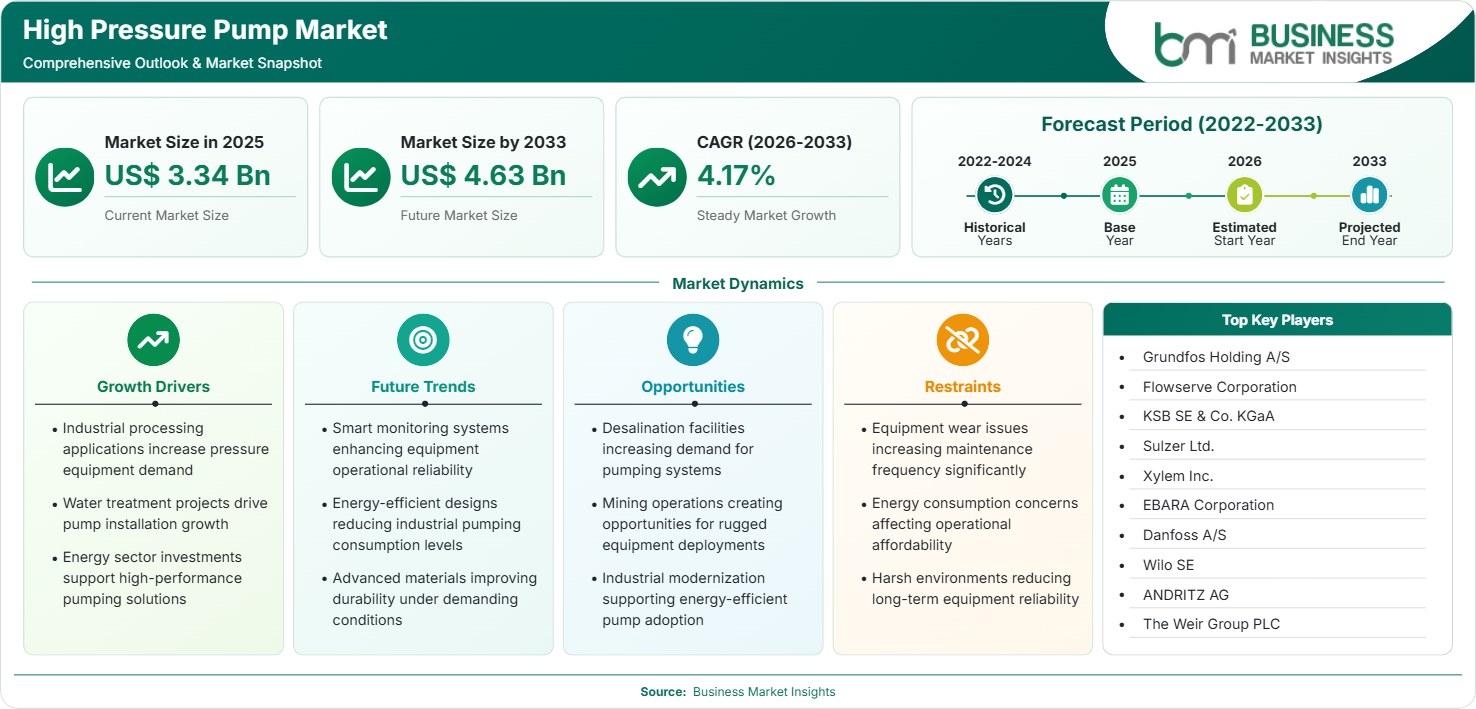
The High Pressure Pump Market size was valued at US$ 3.34 Billion in 2025 and is projected to reach US$ 4.63 Billion by 2033, growing at a CAGR of 4.17% during 2026–2033, driven by industrial water demand, energy efficiency, desalination, mining, and process automation opportunities.

Report Coverage
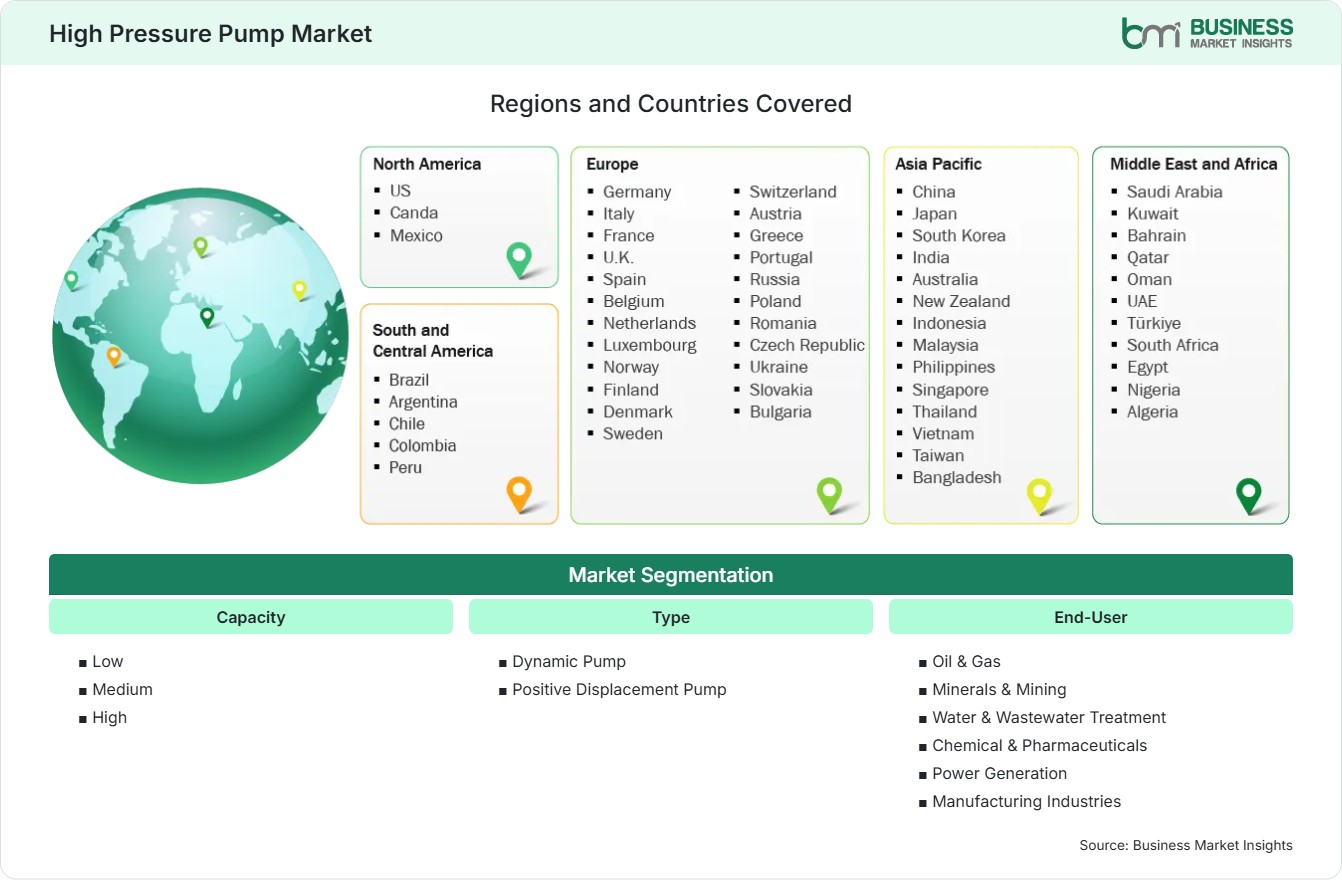
  • Capacity: Low, Medium, High
  • Type: Dynamic Pump, Positive Displacement Pump
  • End-User: Oil & Gas, Minerals & Mining, Water & Wastewater Treatment, Chemical & Pharmaceuticals, Power Generation, Manufacturing Industries
US$ 3.34 Bn Market size in 2025
US$ 4.63 Bn Market Size by 2033
4.17% CAGR, 2026 - 2033
2026-2033 Forecast Period

AI Overview

High Pressure Pump Market Summary

  • North America Region: North America holds market share of 26%–30% in 2025, growing with a CAGR of 3.6%–4.0%, influenced by water infrastructure modernization, industrial efficiency upgrades, oilfield applications, desalination, and replacement demand. US applications emphasize efficient pressure boosting, industrial water reuse, chemical processing, and advanced manufacturing systems, supported by modernization investments and stricter efficiency requirements.
  • Fastest Growing Region: Asia Pacific holds market share of 32%–36% in 2025, growing with a CAGR of 4.5%–4.9%, supported by urbanization, manufacturing expansion, mining investments, water treatment capacity additions, industrial automation, and expanding energy infrastructure across India, China, Southeast Asia, and Australia.
  • Leading Segment: Medium capacity pumps, operating at 100 to 500 Bar, hold market share of 42%–46% in 2025, growing with a CAGR of 4.0%–4.4%, supported by broad applicability across industrial processing, water treatment, chemical manufacturing, power facilities, and pressure boosting systems.
  • High Growth Segment: Positive displacement pumps hold market share of 38%–42% in 2025, growing with a CAGR of 4.6%–5.0%, driven by precise metering, demanding pressure requirements, chemical handling, hydraulic applications, oilfield injection, mining, and specialized industrial processing operations.
  • Key Market Opportunity: Energy optimization, smart controls, water reuse, high-pressure desalination, industrial retrofits, and digitally monitored pumping systems create opportunities for suppliers combining hydraulic efficiency with predictive maintenance and lifecycle services.
  • Major Market Players: Grundfos Holding A/S; Flowserve Corporation; KSB SE & Co. KGaA; Sulzer Ltd.; Xylem Inc.; EBARA Corporation; Danfoss A/S; Wilo SE; ANDRITZ AG; The Weir Group PLC.
Strategic Insights

High Pressure Pump Market: Strategic Insights

High Pressure Pump Market Strategic Framework
FREE PDF
Request your free sample
Request free sample
Stakeholder View

Key Takeaways

  • The supply chain extends from castings, forgings, impellers, shafts, seals, bearings, motors, drives, controls, and instrumentation to complete engineered packages. Competitive differentiation increasingly depends on system integration, application engineering, service capability, and lifecycle optimization rather than pump hardware alone.
  • Medium-capacity systems provide the broadest addressable application base because they can serve water boosting, industrial cleaning, boiler support, chemical circulation, mining processes, and manufacturing applications without the engineering complexity associated with extreme-pressure installations.
  • Variable-speed drives, IE4 and IE5 motors, condition monitoring, hydraulic redesign, machine-learning analytics, and remote diagnostics are moving pump procurement toward measurable lifecycle performance. Sulzer reports that its energy optimization program combines digital analysis, machine learning, retrofit engineering, and ongoing monitoring.
  • India, Southeast Asia, China, and selected Middle Eastern markets offer strong application opportunities where industrial expansion intersects with water stress, desalination, mining, energy infrastructure, and manufacturing localization.
  • Strategic investment is increasingly directed toward manufacturing capacity, service networks, digital monitoring, and specialized engineered solutions. Grundfos expanded its Texas production footprint in 2025 to increase capacity and shorten North American lead times.
  • Aftermarket optimization represents an important revenue pool because installed pumps can remain operational for many years while operating away from their preferred efficiency range. Suppliers capable of combining audits, retrofit engineering, spare parts, monitoring, and maintenance contracts can capture recurring value.
Geographic Outlook

High Pressure Pump Market Regional Highlights

North America High Pressure Pump Market

North America accounts for 26%–30% High Pressure Pump Market share in 2025 and is projected to grow at a CAGR of 3.6%–4.0% through 2033. Demand centers on municipal water upgrades, industrial processing, oilfield services, chemical plants, mining, and energy-intensive facilities.

  • Municipal utilities are prioritizing efficient pressure boosting and water distribution equipment as infrastructure modernization increases demand for dependable pumping systems.
  • Industrial operators are replacing older pump-motor combinations with variable-speed configurations that better match fluctuating process loads and reduce unnecessary energy consumption.
  • Oil and gas applications continue requiring engineered high-pressure systems for injection, pipeline services, refining, and process circulation despite changing upstream investment patterns.
  • Chemical and manufacturing plants increasingly emphasize containment, corrosion resistance, monitoring, and maintainability when specifying high-pressure pumping equipment.

US High Pressure Pump Market

The US represents approximately 68%–72% of North American High Pressure Pump Market demand in 2025 and is projected to expand at a CAGR of 3.8%–4.2%. Demand is supported by municipal water investment, industrial modernization, semiconductor and advanced manufacturing expansion, food processing, chemicals, and energy infrastructure.

  • Aging industrial assets create replacement opportunities where improved hydraulics, variable-speed control, and efficient motors can reduce operating expenditure.
  • Water utilities and commercial facilities are increasingly evaluating pressure systems through lifecycle cost rather than initial purchase price.
  • High-pressure cleaning, sanitation, chemical processing, and specialized manufacturing provide recurring demand for compact, controllable pumping systems.

Europe High Pressure Pump Market

Europe represents 22%–26% High Pressure Pump Market share in 2025 and is expected to register a CAGR of 3.9%–4.3%. Germany, France, Italy, the United Kingdom, and the Netherlands provide a strong installed base, while Spain, Poland, and selected Central European markets offer higher growth opportunities.

  • Germany remains a major engineering and manufacturing center, supporting demand for technically advanced pumps in chemicals, power, industrial water, and process applications.
  • Spain offers desalination and water-efficiency opportunities, reinforced by industrial energy optimization requirements and water-management pressures.
  • The United Kingdom and France provide replacement opportunities in municipal infrastructure, industrial utilities, pharmaceutical manufacturing, and energy facilities.
  • Italy and Poland benefit from manufacturing modernization, food processing, chemicals, and infrastructure investment requiring reliable pressure control.
  • European procurement increasingly evaluates energy consumption, digital diagnostics, emissions, materials compliance, and total lifecycle cost.

Asia Pacific High Pressure Pump Market

Asia Pacific holds 32%–36% High Pressure Pump Market share in 2025 and is projected to grow at a CAGR of 4.5%–4.9%, making it the largest regional demand center. China, Japan, South Korea, India, and Australia anchor established demand, while India, Indonesia, Vietnam, and selected Southeast Asian economies provide higher-growth applications.

  • China maintains a large industrial installed base requiring process pumping, water treatment, chemical circulation, mining, and power-generation equipment.
  • India combines industrial expansion, urbanization, water infrastructure investment, and manufacturing localization, creating demand across municipal and industrial high-pressure applications.
  • Southeast Asia is attracting manufacturing capacity in electronics, chemicals, food processing, and industrial products, increasing demand for dependable process-water systems.
  • Australia provides specialized opportunities in mining, minerals processing, water treatment, and remote infrastructure requiring robust high-pressure equipment.
  • Japan and South Korea emphasize efficiency, reliability, automation, and compact equipment across advanced manufacturing and industrial processing environments.

Rest of World High Pressure Pump Market

South and Central America represent an important emerging demand pool, supported by mining, food processing, municipal water infrastructure, oil and gas, and industrial modernization. The regional High Pressure Pump Market is projected to expand at a CAGR of 3.7%–4.1% through 2033 as industrial water reuse and resource-processing projects increase.

  • Brazil combines industrial water demand with mining, food processing, pulp and paper, and energy infrastructure requirements.
  • Chile and Peru provide specialized demand for abrasion-resistant systems serving mining, mineral processing, slurry-related utilities, and water-transfer applications.
  • Gulf markets prioritize desalination, water reuse, district utilities, petrochemicals, and oilfield services, requiring reliable equipment under demanding operating conditions.
  • South Africa offers opportunities in mining, municipal water, industrial processing, and power infrastructure where reliability and service availability are important procurement factors.
  • North African markets provide developing opportunities in desalination, municipal treatment, irrigation, and industrial water management.
Global Market Geography
FREE PDF
Request your free sample
Request free sample
Segment Analysis

High Pressure Pump Market Segmentation

Capacity

The capacity segment is led by Medium systems at 42%–46% High Pressure Pump Market share in 2025, with a 4.0%–4.4% CAGR through 2034. Their broad operating range supports water treatment, manufacturing, chemicals, power, and industrial utilities, while high-capacity systems target specialized applications.

  • Low (20 to 100 Bar): Low-pressure configurations serve general industrial transfer, water boosting, cleaning, irrigation, and building applications, with demand supported by efficient motors, compact systems, and replacement of inefficient legacy equipment.
  • Medium (100 to 500 Bar): Medium-pressure equipment addresses the widest range of industrial duties, including process water, boiler support, chemical circulation, mining utilities, and industrial cleaning, supporting balanced demand across sectors.
  • High (Above 500 Bar): Above-500-Bar systems serve specialized injection, hydraulic, testing, waterjet, descaling, and demanding process applications where engineered materials, precision control, sealing, and reliability justify higher equipment complexity.

Type

Positive Displacement Pump systems account for 38%–42% High Pressure Pump Market share in 2025 and are projected to grow at a 4.6%–5.0% CAGR through 2034. Their precise flow control and pressure capability strengthen adoption in demanding applications, while dynamic pumps retain broad industrial use.

  • Dynamic Pump: Dynamic pumps support continuous-flow applications including water supply, cooling, circulation, pressure boosting, and industrial utilities, benefiting from efficient multistage configurations and variable-speed control.
  • Positive Displacement Pump: Positive displacement designs provide controlled flow at high pressure, supporting metering, injection, hydraulic systems, chemical handling, oilfield services, and specialized industrial processes requiring consistent delivery.

End-User

Oil & Gas remains a technically intensive end-user segment, while water and wastewater treatment provides expanding demand as utilities and industries invest in treatment, reuse, and pressure management. Industrial manufacturing also benefits from automation and efficiency-focused replacement cycles.

  • Oil & Gas: High-pressure pumps support injection, process circulation, pipeline services, refinery operations, and enhanced recovery, where reliability, pressure stability, materials compatibility, and maintenance access directly affect production continuity.
  • Minerals & Mining: Mining applications require robust pumping for process water, dewatering, mineral processing, slurry-related utilities, and remote operations, creating demand for abrasion resistance and dependable service support.
  • Water & Wastewater Treatment: Treatment plants use high-pressure equipment for membrane processes, reverse osmosis, pressure boosting, water reuse, and distribution, supported by infrastructure expansion and increasing water-security requirements.
  • Chemical & Pharmaceuticals: These industries require precise, reliable pressure control for circulation, dosing, cleaning, processing, and transfer, with material compatibility and contamination control influencing equipment specifications.
  • Power Generation: High-pressure systems support boiler feed, cooling, condensate, descaling, and auxiliary services, with efficiency and reliability becoming increasingly important as operators modernize long-life plant equipment.
  • Manufacturing Industries: Manufacturing facilities use pressure systems for cleaning, cooling, hydraulic processes, process water, and equipment utilities, creating demand for compact packages, variable-speed control, and condition monitoring.
Market Forces

High Pressure Pump Market Dynamics

Key Market Drivers

Industrial Energy Efficiency and Variable-Speed Pumping

Increasing energy efficiency has become a procurement factor, as pumps operate continuously across industries, ranging from waterworks to chemical plants, from power stations to manufacturing, and resource processing. According to IEA, the analysis shows that industry constituted almost 40% of the world’s final energy consumption in 2024, and improving motors, pumps, fans, and compressors represents an important energy efficiency potential. These changes reinforce High Pressure Pump Market growth by improving lifecycle economics.

Expansion of Industrial Water Treatment and Reuse

Water treatment is a structural demand driver in the sense that industries have to increase water availability and manage the cost associated with discharge, water treatment, and operation. According to the WHO and UNICEF, 2.1 billion people lacked access to safe drinking water in 2024, while industrial and municipal water treatment facilities require investment in treatment and distribution. The use of high-pressure equipment is highly applicable for reverse osmosis and other applications. The High Pressure Pump Market trends toward higher-efficiency hydraulics and digitally controlled systems as operators seek stable pressure while reducing energy consumption.

Growth of Mining and Resource-Processing Applications

Mine development entails the necessity for reliable pumping for dewatering, mineral processing, water transportation, cooling, and utilities services. Capital spending on resource projects creates a need for pumps designed for hard-duty cycle operation rather than regular building-services pump design. Mining operations in Australia, Chile, Peru, China, India, and some parts of Africa offer application possibilities since mineral extraction is done in arid regions. High Pressure Pump Market growth therefore, benefits from equipment capable of delivering pressure over long distances while controlling energy use.

Key Market Opportunities

Digital Pump Optimization and Predictive Maintenance

Digital measurement technology provides a chance to convert pumps into measured process elements. The sensors can measure vibration, temperature, pressure, flow, power consumption, and pump runtime to detect degradation and inefficient operating points. Sulzer observed that 68% out of 464 pumps analyzed by their operational research worked outside the optimum range for over 50% of their runtime. High Pressure Pump Market Forecasts can therefore incorporate increasing lifecycle-service revenue as manufacturers combine equipment sales with monitoring, optimization, software, and retrofit packages.

Desalination, Water Reuse, and Industrial Water Security

This makes desalination and water reuse a promising potential application since high-pressure pumping is a key element of membrane water treatment technologies. The issue of water shortage, along with urbanization, industrial water requirements, and climate change, prompts utility companies and industries to explore additional water sources. Increased hydrological uncertainty and greater risks of droughts and floods are considered major water management issues according to UN-Water. Opportunities lie in enhancing pump performance at feed membrane pressure, minimizing vibrations, and prolonging seal life.

High-Pressure Applications in Decarbonization Infrastructure

Technical challenges of pressure in carbon capture, hydrogen processing, advanced fuel development, and industrial decarbonization processes exist. There is a need to address challenging fluid handling, harsh conditions, material compatibility issues, and high reliability requirements. In an announcement, Flowserve confirmed its participation in a project on carbon capture through high-pressure injection systems for supercritical CO2, indicating the extent to which pumping and sealing technologies are penetrating into new infrastructure. This is not just about selling pumps.

Market Restraints and Challenges

High Initial Cost and Engineering Complexity

Factor: Pressure pumps need stronger casings, special seals, precision machining, sophisticated bearings, drive mechanisms, and engineering to match their application. This makes them more expensive to invest in than regular pumps.

Impact: Small-scale industries would delay the upgrading process if the current machinery is working, since it would be cheaper for them in terms of lifecycle costs. Installation complexities would result in increased costs because the foundation, pipelines, electrical and control systems, and commissioning would have to meet pressure and flow demands.

Maintenance Requirements and Skilled-Service Availability

Factor: High-pressure pumps run under high mechanical and hydraulic stresses. The integrity of seals, alignment, lubrication, vibration, and wear must be considered to ensure sustained functioning.

Impact: Neglecting maintenance can lead to unexpected downtime, higher use of spare parts, decreased hydraulic efficiency, and even safety hazards, especially in mining and oil fields. Trained engineers are not always available in all emerging markets; there is increased reliance on the services of the manufacturers.

Company Analysis

Competitive Landscape

The High Pressure Pump Market analysis indicates competition is shaped by hydraulic efficiency, pressure capability, application engineering, installed base, service coverage, digital monitoring, and the ability to customize systems for demanding industrial duties. Leading suppliers increasingly combine pump hardware with motors, drives, controls, diagnostics, aftermarket services, and energy optimization. KSB, for example, offers multistage high-pressure systems and ultra-high-pressure designs, while Sulzer markets barrel pumps for water injection and high-differential-pressure applications.

Company Name

Overview

Products and Services relevant to this market

Grundfos Holding A/S

Global pump and water-technology company with strong exposure to building services, industrial water, utilities, and energy-efficient systems.

High-pressure booster systems, multistage pumps, Hydro HP systems, controls, variable-speed solutions, monitoring, service, and water-management technologies.

Flowserve Corporation

US-based flow-control supplier serving energy, chemical, industrial, and infrastructure customers through engineered equipment and lifecycle services.

Engineered industrial pumps, high-pressure process equipment, seals, valves, aftermarket services, and specialized solutions for demanding fluids and applications.

KSB SE & Co. KGaA

German pump and valve manufacturer with extensive expertise across water, energy, industrial, chemical, and process applications.

Multistage high-pressure pumps, barrel pumps, pressure booster systems, motors, drives, monitoring, engineering, and maintenance services.

Sulzer Ltd.

Swiss engineering group with specialized rotating-equipment, pump, service, retrofit, and digital optimization capabilities across industrial markets.

High-pressure barrel pumps, booster pumps, water-injection systems, pump retrofits, energy optimization, monitoring, and lifecycle services.

Xylem Inc.

Water-technology company serving municipal, industrial, commercial, and infrastructure customers with pumping and treatment technologies.

Industrial pumps, water-management systems, pressure solutions, controls, analytics, treatment equipment, and lifecycle services.

EBARA Corporation

Japanese engineering company active in pumps, water infrastructure, industrial equipment, precision machinery, and specialized fluid technologies.

Industrial and municipal pumps, booster systems, wastewater equipment, high-efficiency pumping technologies, engineering, and service solutions.

Danfoss A/S

Engineering company with strong capabilities in hydraulic systems, drives, controls, and high-power pump technologies.

Axial piston pumps, hydraulic systems, variable-displacement technologies, controls, drives, and integrated fluid-power solutions.

Wilo SE

German pump manufacturer focused on intelligent, efficient pumping solutions across building services, water management, and industrial applications.

Multistage pressure-boosting systems, smart pumps, high-efficiency motors, controls, monitoring, water supply, and wastewater solutions.

ANDRITZ AG

International technology group providing engineered pumping and fluid-handling solutions for industrial, energy, and infrastructure applications.

High-pressure MP-series pumps, multistage pumps, engineered systems, maintenance, process solutions, and application-specific engineering.

The Weir Group PLC

Global engineering company serving mining and resource-processing markets with equipment designed for demanding operating conditions.

Mine-water pumping, process pumps, slurry-related systems, wear-resistant components, service, maintenance, and engineered mining solutions.

Trust & Transparency

Research Methodology

The market analysis combines proprietary research with secondary data from government agencies, company disclosures, regulatory filings, industry databases and expert interviews. Market estimates are validated through data triangulation, cross-market benchmarking and analyst review.

View Full Research Methodology

Questions Answered

Frequently Asked Questions

How can predictive maintenance reduce high-pressure pump downtime?

Predictive maintenance uses measurements such as vibration, temperature, pressure, flow, power consumption, and operating hours to identify deviations from normal performance.

Which applications require positive displacement pumping technology?

Positive displacement pumps are used where controlled flow, precise dosing, high differential pressure, or difficult fluid characteristics are important.

How does pump efficiency affect total operating expenditure?

Pump efficiency influences electricity consumption throughout the equipment lifecycle. Small efficiency differences can become material when pumps operate continuously at high flow or pressure.

Why are variable-speed drives increasingly paired with high-pressure pumps?

Variable-speed drives allow pump output to follow actual system demand. This can reduce throttling losses, improve process control, lower mechanical stress, and reduce energy consumption when flow requirements fluctuate.

What factors determine the pressure class selected for an industrial pump?

The High Pressure Pump Market Report highlights that Pressure requirements depend on process conditions, elevation, friction losses, fluid characteristics, required flow rate, safety margins, and equipment duty cycles.

Access the Full High Pressure Pump Market Report

Get segment-level forecasts, regional estimates, competitive benchmarking, company profiles and downloadable Excel datasets.

Access the full High Pressure Pump Market Report
350 pages PDF & Excel | 2026-10-12
Similar Research

Related Market Reports