
Pressure Vessel Market Outlook: Size, Share, Trends, Growth Analysis, Competitive Landscape & Forecast, 2026-2033

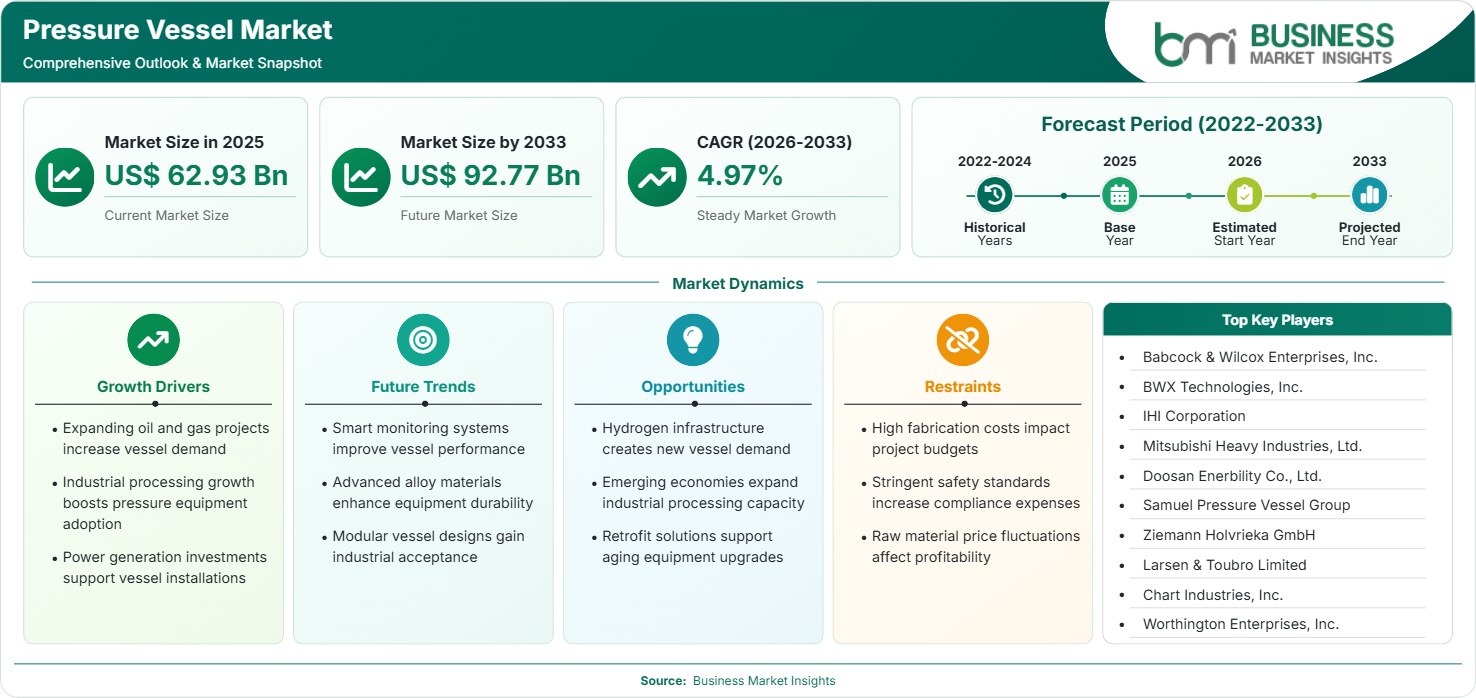
The Pressure Vessel Market size was valued at US$ 62.93 Billion in 2025 and is projected to reach US$ 92.77 Billion by 2033, growing at a CAGR of 4.97% during 2026–2033, driven by power infrastructure expansion, refinery modernization, hydrogen investments, industrial processing demand, and advancing vessel materials, creating opportunities across energy, chemicals, and manufacturing sectors.

Report Coverage
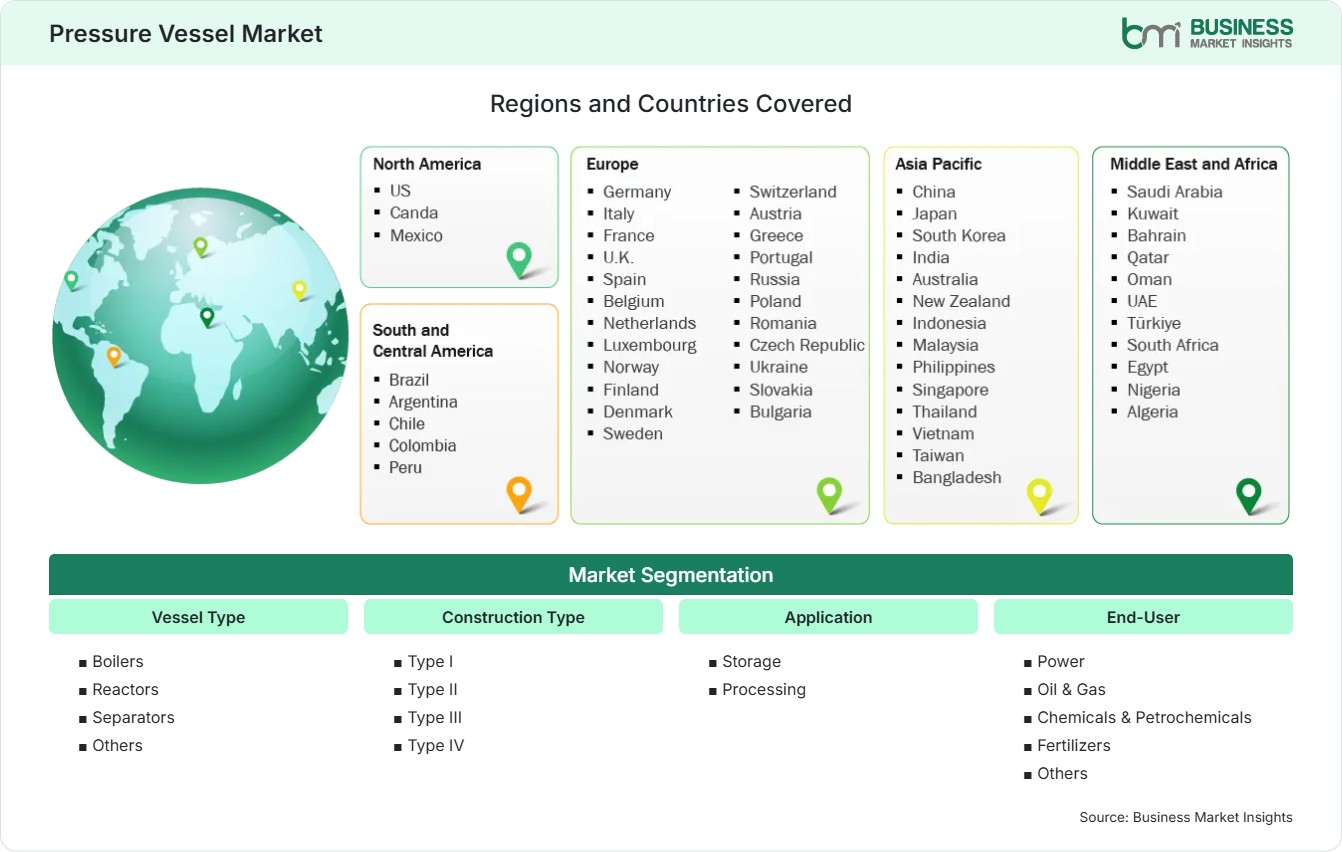
  • Vessel Type: Boilers, Reactors, Separators, Others
  • Construction Type: Type I, Type II, Type III, Type IV
  • Application: Storage, Processing
  • End-User: Power, Oil & Gas, Chemicals & Petrochemicals, Fertilizers, Others
US$ 62.93 Bn Market size in 2025
US$ 92.77 Bn Market Size by 2033
4.97% CAGR, 2026 - 2033
2026-2033 Forecast Period

AI Overview

Pressure Vessel Market Summary

  • North America Region: North America holds a market share of 32%–35% in 2025, growing with a CAGR of 4.2%–4.6% during 2026–2033. Demand is supported by refinery upgrades, LNG investments, nuclear life-extension projects, hydrogen infrastructure development, process safety compliance, digital monitoring adoption, advanced fabrication capabilities, and replacement of aging industrial equipment. U.S. market benefits from energy infrastructure investment and process manufacturing expansion, advancing at 4.3%–4.7% CAGR.
  • Fastest Growing Region: Asia Pacific holds a market share of 36%–39% in 2025 and expands at a CAGR of 5.8%–6.3% during 2026–2033. Industrialization, petrochemical capacity additions, power generation investments, expanding fertilizer production, manufacturing relocation, hydrogen deployment programs, and growing domestic engineering capabilities continue supporting regional demand acceleration.
  • Leading Segment: Power accounts for a 28%–31% share in 2025 and advances at a CAGR of 4.8%–5.2% through 2033. Grid expansion, thermal plant modernization, nuclear deployments, steam generation requirements, utility-scale projects, industrial energy security priorities, and reliability requirements support sustained equipment procurement worldwide.
  • High Growth Segment: Type IV accounts for a 12%–15% share in 2025 and grows at a CAGR of 6.8%–7.4% during 2026–2033. Lightweight composite construction, hydrogen mobility applications, corrosion resistance, transportation efficiency, decarbonization objectives, storage innovations, and investment in clean-energy infrastructure accelerate adoption.
  • Key Market Opportunity: Rising hydrogen storage deployments create substantial opportunities for advanced composite vessels, engineering services, aftermarket inspection solutions, localized manufacturing capacity, and digital monitoring technologies across energy and industrial ecosystems.
  • Major Market Players: Babcock & Wilcox Enterprises, Inc.; BWX Technologies, Inc.; IHI Corporation; Mitsubishi Heavy Industries, Ltd.; Doosan Enerbility Co., Ltd.; Samuel Pressure Vessel Group; Ziemann Holvrieka GmbH; Larsen & Toubro Limited; Chart Industries, Inc.; Worthington Enterprises, Inc.
Strategic Insights

Pressure Vessel Market: Strategic Insights

Pressure Vessel Market Strategic Framework
FREE PDF
Request your free sample
Request free sample
Stakeholder View

Key Takeaways

  • The industry operates through a highly specialized value chain involving steel producers, forging companies, fabricators, EPC contractors, inspection agencies, and end-users requiring regulatory-certified equipment.
  • Hydrogen storage, petrochemical processing, and fertilizer expansion projects represent the most attractive volume opportunities due to increasing capacity additions and infrastructure spending.
  • Advanced composites, digital monitoring systems, non-destructive testing technologies, and corrosion-resistant materials are reshaping product development strategies and R&D priorities.
  • India, China, Saudi Arabia, and Southeast Asian economies provide compelling investment opportunities because of large-scale industrialization and energy infrastructure programs.
  • Strategic acquisitions increasingly target engineering expertise, cryogenic technologies, and hydrogen-storage capabilities as manufacturers seek broader product portfolios.
  • Lifecycle services including refurbishment, certification, digital inspection, and predictive maintenance are becoming important profit pools beyond new vessel installations.
Geographic Outlook

Pressure Vessel Market Regional Highlights

North America Pressure Vessel Market

North America accounted for 32%–35% of global demand in 2025 and is projected to expand at a CAGR of 4.2%–4.6% through 2033. The region benefits from extensive refining infrastructure, natural gas processing facilities, LNG investments, and nuclear asset modernization programs. Pressure Vessel Market share remains supported by replacement demand from aging industrial facilities. Chemical manufacturing expansion and industrial safety mandates continue supporting capital expenditure. Engineering capabilities, mature inspection ecosystems, and technology adoption strengthen competitiveness while hydrogen and carbon capture projects create incremental procurement opportunities across multiple end-user sectors.

  • Refinery modernization projects increase demand for reactors, separators, and processing equipment capable of meeting stricter operational efficiency and emissions objectives.
  • LNG export facilities across the U.S. Gulf Coast support demand for large-scale storage and processing vessel deployments.
  • Carbon capture and hydrogen infrastructure initiatives encourage procurement of specialized containment systems with enhanced performance requirements.
  • Digital asset monitoring and predictive maintenance technologies improve uptime and support lifecycle service revenues.

US Pressure Vessel Market

The United States represents approximately 75%–78% of regional revenue and is forecast to grow at 4.3%–4.7% CAGR during the assessment period. Strong investments in industrial gases, petrochemical facilities, nuclear upgrades, and LNG exports sustain demand. A substantial installed equipment base supports recurring inspection and replacement activity. Federal incentives promoting low-carbon technologies and domestic manufacturing contribute to equipment modernization. Specialized fabrication expertise and a mature engineering ecosystem continue strengthening the country's competitive positioning in industrial processing applications.

  • Gulf Coast petrochemical investments continue generating large-order opportunities for process and storage systems.
  • Hydrogen demonstration programs encourage adoption of advanced containment technologies for transportation and stationary applications.
  • Nuclear facility upgrades require highly engineered pressure-retaining equipment and certified manufacturing processes.
  • Increasing focus on operational safety accelerates asset replacement cycles across industrial sectors.

Europe Pressure Vessel Market

Europe represents 22%–25% of the market share in 2025 and is estimated to grow at a CAGR of 4.0%–4.5% through 2033. The demand is driven by investments in energy transitions, process improvements, and process safety measures. Germany continues to dominate the region, while industrial activities in Eastern Europe create additional growth opportunities. The deployment of hydrogen facilities and the modernization of the chemical industry drive demand for equipment. Equipment manufacturers are focusing on sustainability, efficiency throughout the lifecycle, and adherence to high engineering standards.

  • Germany leads regional consumption with extensive chemical, energy, and industrial manufacturing facilities.
  • Poland emerges among faster-growing markets, supported by industrial modernization and energy infrastructure spending.
  • Hydrogen valley projects stimulate demand for composite and high-pressure storage technologies.
  • Circular-economy objectives encourage upgrades to efficient processing equipment and supporting infrastructure.

Asia Pacific Pressure Vessel Market

Asia Pacific commands a 36%–39% share in 2025 and records the fastest expansion at 5.8%–6.3% CAGR through 2033. China leads regional demand through aggressive industrial capacity growth, while India demonstrates one of the strongest growth profiles. Expanding refining, petrochemical, fertilizer, and power projects support procurement activity. Government-backed manufacturing initiatives and infrastructure spending attract fabrication investments. Growing adoption of advanced industrial technologies and increasing domestic engineering capabilities strengthen regional competitiveness. Pressure Vessel Market share gains are expected as industrial production continues expanding.

  • China remains the largest consumer due to extensive processing, energy, and manufacturing infrastructure.
  • India records strong growth driven by refinery expansion, chemicals investment, and infrastructure development.
  • Southeast Asia benefits from foreign investment in industrial processing and energy projects.
  • Rising electricity demand supports conventional and alternative power generation installations.
  • Localization of engineering and fabrication capabilities improves cost competitiveness across the region.

Rest of World Pressure Vessel Market

Rest of World represents 9% to 12% of total demand and is growing at a CAGR of 5.0% to 5.5% through 2033. The Middle East will benefit from investments in hydrocarbon processing facilities, diversification of its industrial base, and megaprojects. South & Central America will get support from mining projects, chemicals, and energy developments. Procurement activity in the region will be spearheaded by Saudi Arabia, while Brazil shows promise of growth. Increased capacity and energy transition projects will fuel investments in modern process equipment.

  • Saudi Arabia continues investing in downstream integration and petrochemical processing capacity.
  • United Arab Emirates supports demand through industrial diversification and energy infrastructure projects.
  • Brazil benefits from chemical production, energy investment, and industrial modernization programs.
  • Mining and metallurgical developments across Latin America create equipment demand opportunities.
Global Market Geography
FREE PDF
Request your free sample
Request free sample
Segment Analysis

Pressure Vessel Market Segmentation

Vessel Type

This segment is estimated to capture 42%-45% market share by 2025 and exhibit a growth of 5.0%-5.4% CAGR. Demand trends are determined by developments in the energy, chemical, and industrial processing industries. The Pressure Vessel Market is continually expanding due to technological advancements.

  • Boilers: Widely deployed in power generation and industrial steam applications, supported by energy efficiency upgrades, utility investments, and replacement demand from aging thermal infrastructure.
  • Reactors: Critical within chemical and petrochemical processing operations where high-pressure reactions require precise engineering, advanced metallurgy, and compliance with stringent performance specifications.
  • Separators: Extensively used across oil and gas operations to improve process efficiency, product purity, and operational safety within upstream and downstream facilities.

Construction Type

Construction is one of the technology-oriented segments witnessing increasing innovation in materials. Construction is anticipated to occupy 25%–28% market share throughout 2025, with a 5.3%–5.7% CAGR. Hydrogen storage weight, corrosion resistance, and hydrogen-storing materials are driving the acceptance of innovative vessel architectures across industrial and transportation applications.

  • Type I: Traditional metallic vessels remain widely adopted due to cost-effectiveness, established fabrication practices, regulatory familiarity, and suitability for numerous industrial applications.
  • Type II: Hybrid reinforcement improves performance characteristics while maintaining cost competitiveness, supporting use in industrial gas transportation and storage applications.
  • Type III: Composite-over-metal designs provide weight reduction and durability advantages, increasing adoption in high-pressure containment requirements across emerging energy sectors.
  • Type IV: Advanced composite configurations support hydrogen mobility, lightweight transportation requirements, and long-term corrosion resistance across demanding operating environments.

Application

The application segmentation segment highlights operational needs in both the storage and processing sectors. This segment accounts for 30%-33% market share in 2025 and records a 4.9%-5.3% CAGR. Pressure Vessel Market trends is a term that is increasingly relevant in digital process management and storage technologies supporting emerging energy applications.

  • Storage: Demand is driven by industrial gases, LNG facilities, chemical inventory management, and expanding hydrogen infrastructure requiring secure containment solutions.
  • Processing: Processing applications benefit from rising petrochemical, refining, fertilizer, and specialty chemical production requiring reactors, separators, and related equipment.

End-User

End-user industries bring diversification in terms of demand profiles. The industry holds a market share of 35%-38% in 2025 and experiences a 5.0%-5.4% CAGR. Priorities for energy security, industrial development projects, and process efficiency continue driving procurement activity across sectors.

  • Power: Utility expansion, nuclear investments, and thermal plant upgrades support demand for boilers and associated high-pressure systems.
  • Oil & Gas: Exploration, processing, transportation, and refining activities require reliable containment systems capable of operating under demanding conditions.
  • Chemicals & Petrochemicals: Capacity additions and process optimization initiatives generate sustained demand for specialized reactors and processing vessels.
  • Fertilizers: Global food security requirements support investment in ammonia and fertilizer production facilities needing pressure-retaining equipment.
Market Forces

Pressure Vessel Market Dynamics

Key Market Drivers

Expansion of Energy and Industrial Processing Infrastructure

The need for electricity in the global market, investments in petrochemicals, and upgrades to refineries will sustain demand for equipment purchases. According to international assessments in the energy industry, increases in electricity consumption and the expansion of industrial capacity in Asia and the Middle East are sustaining long-term capital spending. Pressure vessel products will continue to be needed for steam production, process control, and storage purposes. Pressure Vessel Market growth is driven by rising applications across the LNG, fertilizer, chemicals, and utilities segments. High efficiency is sought after by end users to decrease downtime and enhance safety performance. Growing infrastructure pipeline investments provide clear demand visibility for fabricators, engineering firms, inspection firms, and component makers operating across several industrial sectors.

Stringent Safety and Compliance Requirements

The standards concerning pressure vessels, their inspection cycles, and reliability have become more stringent. According to regulatory frameworks, such as ASME certification and regional equipment directives, the replacement of old equipment is encouraged. Such expenditure, being compliance-driven, sustains itself during periods of cyclicality due to the associated costs of any failure. Vessels equipped with monitoring capabilities are better suited for good asset integrity management. Demand for certification and testing of vessels is on the rise in all process industries. Operators seek equipment capable of delivering improved performance metrics while satisfying evolving safety expectations and insurance requirements across global industrial facilities.

Growth in Hydrogen and Industrial Gas Applications

Development projects for hydrogen, investments in industrial gases, and clean energy endeavors have created substantial demand for containment systems. The growing need for pressurized systems is driving the use of composite and specialty vessels. It is becoming clear that there is a link between decarbonization efforts and demand for the pressure vessel market, given government support for hydrogen networks. Gas manufacturers are improving their capacity to store and transport gases, necessitating high-quality, high-performing systems. Weight, corrosion resistance, and durability are some factors guiding buyers' choices. Advanced materials and hydrogen-related technologies can give companies an edge here.

Key Market Opportunities

Commercialization of Large-Scale Hydrogen Storage Systems

There is a several-year investment horizon for developing hydrogen infrastructure, including production, transportation, and storage. High-pressure technologies play a crucial role in the application of compressed hydrogen in the mobility, industrial, and utility segments. Governments and private entities continue to invest in the development of demonstration and commercial projects. Pressure Vessel Market Forecasts are increasingly influenced by the growing demand for Type III and Type IV solutions, which provide weight and strength benefits. Opportunities extend beyond equipment sales into engineering services, inspection, digital monitoring, and lifecycle support. Suppliers capable of scaling manufacturing capacity and achieving certification requirements stand to capture value across emerging hydrogen supply chains globally.

Digital Inspection and Predictive Asset Management

The industry is implementing technology-driven machinery and analytics solutions to ensure reliability and decrease maintenance costs. With smart monitoring technology, early detection of wear, degradation, and other abnormal phenomena is possible. The combination of inspection technologies and industrial software platforms delivers value through asset longevity and efficient maintenance. Service models are gaining popularity for their revenue-generating potential. Companies providing hardware, software, and engineering services can stand out among competitors when participating in tenders. This trend creates opportunities across both new installations and large installed equipment bases globally.

Localization of Manufacturing in Emerging Economies

Developing countries are increasingly fostering local manufacturing capacity to improve the robustness of their industrial chains and reduce their dependence on imports. The construction of industrial corridors and other infrastructure projects will help build up regional manufacturing centers. Local manufacturing supports timely delivery, reduced logistics costs, and regulatory compliance. Increasing demand for chemicals, fertilizers, electricity, and industrial gases is sufficient to attract investment. Collaboration between the technology suppliers worldwide and the regional manufacturers is likely to increase. This will help transfer knowledge and improve equipment availability.

Market Restraints and Challenges

Volatility in Raw Material and Fabrication Costs

Factor: Pressure vessel manufacturing depends heavily on steel, specialty alloys, forgings, and energy-intensive fabrication processes, exposing producers to price fluctuations across global commodity markets. Impact: Cost volatility complicates project budgeting, compresses margins, and can delay procurement decisions among industrial customers. Long project cycles amplify financial exposure because pricing assumptions may change before equipment delivery. Manufacturers are increasingly using long-term contracts and supply-chain diversification strategies to mitigate risk. However, unpredictable material costs remain a challenge for maintaining profitability, especially on fixed-price projects requiring highly specialized engineering and compliance certifications.

Complex Certification and Skilled Labor Constraints

Factor: Production requires qualified welders, inspectors, engineers, and certification expertise capable of meeting stringent industry requirements. Impact: Labor shortages can extend lead times, raise project costs, and limit manufacturing scalability in certain regions. Regulatory compliance processes add complexity and increase administrative burden during fabrication and deployment. As advanced materials and hydrogen applications gain traction, skills requirements become even more specialized. Companies must invest in workforce development, training programs, and quality assurance systems to remain competitive. Failure to secure technical expertise may restrict capacity expansion and project execution efficiency.

Company Analysis

Competitive Landscape

The competitive environment reflects a mix of diversified engineering firms and specialized manufacturers. Current Pressure Vessel Market analysis indicates that technological capability, certification expertise, material engineering, and global project execution remain key differentiators.

Company Name

Overview

Products and Services relevant to this market

Babcock & Wilcox Enterprises, Inc.

Global energy and environmental technology provider with extensive pressure equipment engineering capabilities.

Boilers, pressure components, steam generation systems, aftermarket services, industrial engineering solutions.

BWX Technologies, Inc.

Specialized manufacturer serving nuclear and high-specification industrial applications.

Nuclear-grade vessels, heavy fabrication, engineered pressure systems, lifecycle support services.

IHI Corporation

Japanese industrial conglomerate with strong process equipment and plant engineering portfolio.

Pressure vessels, storage systems, process equipment, energy infrastructure solutions.

Mitsubishi Heavy Industries, Ltd.

Major engineering enterprise serving energy, industrial, and process markets worldwide.

Reactors, boilers, industrial vessels, plant engineering and maintenance services.

Doosan Enerbility Co., Ltd.

Leading power and industrial equipment manufacturer with fabrication expertise.

Boilers, reactors, pressure-retaining systems, energy infrastructure equipment.

Samuel Pressure Vessel Group

Specialized pressure vessel manufacturer focused on industrial containment solutions.

Custom vessels, storage tanks, fabrication, engineering support and inspection services.

Ziemann Holvrieka GmbH

Process technology specialist supplying engineered vessels for industrial applications.

Stainless steel tanks, processing vessels, turnkey engineering solutions.

Larsen & Toubro Limited

Major engineering and manufacturing company with heavy fabrication capabilities.

High-pressure reactors, process vessels, refinery and petrochemical equipment.

Chart Industries, Inc.

Global provider focused on gas handling and cryogenic technologies.

Storage systems, cryogenic vessels, hydrogen infrastructure equipment and services.

Worthington Enterprises, Inc.

Industrial manufacturing company active in pressure containment products.

Cylinders, storage solutions, industrial gas containment technologies.

Trust & Transparency

Research Methodology

The market analysis combines proprietary research with secondary data from government agencies, company disclosures, regulatory filings, industry databases and expert interviews. Market estimates are validated through data triangulation, cross-market benchmarking and analyst review.

View Full Research Methodology

Questions Answered

Frequently Asked Questions

What does the Pressure Vessel Market Report typically evaluate?

A comprehensive Market Report examines demand trends, technology adoption, regional opportunities, competitive positioning, regulatory influences, and forecast developments across segments and end-user industries.

How is hydrogen affecting industry demand?

Hydrogen projects require reliable high-pressure storage and transport solutions, creating opportunities for Type III and Type IV vessels as energy-transition programs advance globally.

What technologies are influencing product development?

Composite materials, digital monitoring systems, predictive maintenance tools, corrosion-resistant alloys, and hydrogen-compatible vessel technologies are shaping next-generation equipment design.

Which region is expanding the fastest?

Asia Pacific records the strongest growth due to industrialization, refinery investments, fertilizer expansion, manufacturing development, and increasing power infrastructure spending across key economies.

Which industry generates the highest demand for pressure vessels?

Power generation remains the largest end-user segment because boilers, reactors, and related systems are essential for thermal and nuclear power applications worldwide.

Access the Full Pressure Vessel Market Report

Get segment-level forecasts, regional estimates, competitive benchmarking, company profiles and downloadable Excel datasets.

Access the full Pressure Vessel Market Report
350 pages PDF & Excel | 2026-08-28