
Hardware Security Modules Market Outlook: Size, Share, Trends, Growth Analysis, Competitive Landscape & Forecast, 2026–2033

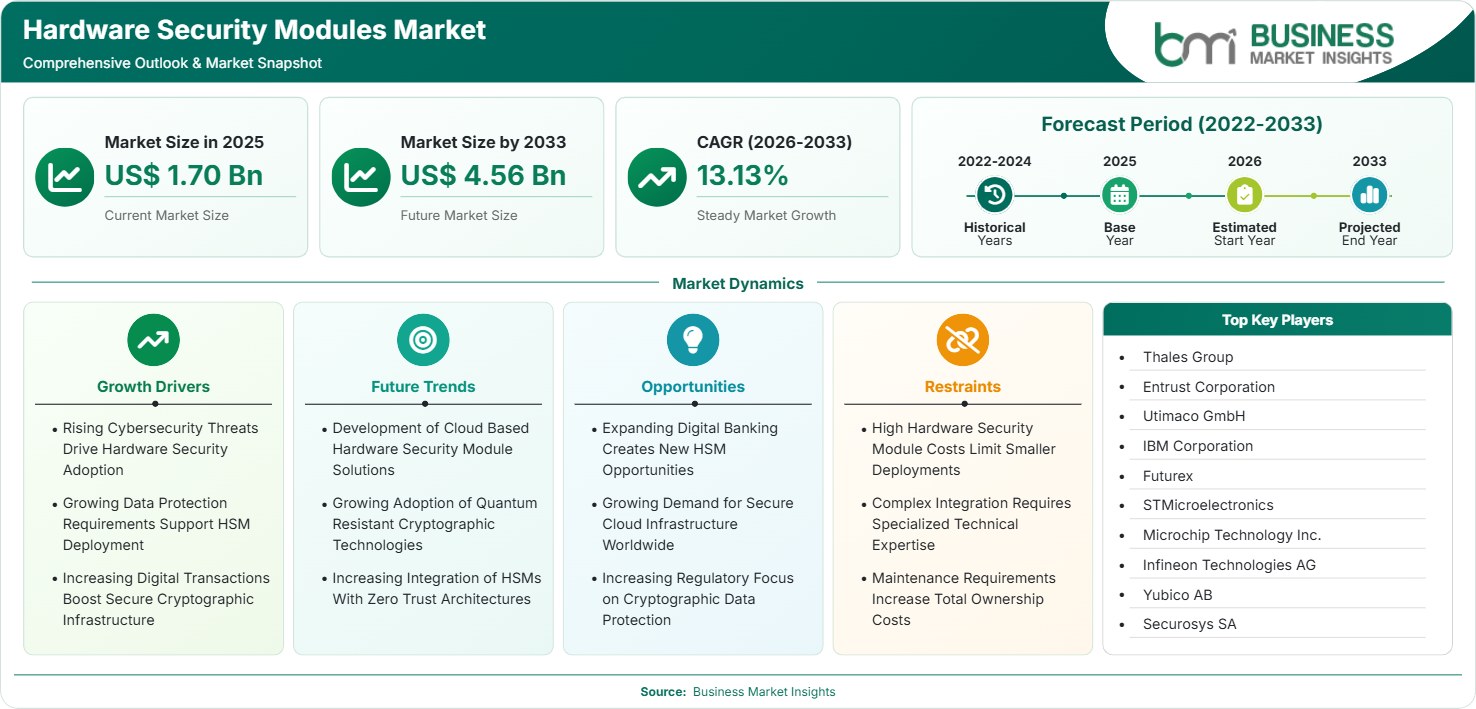
The Hardware Security Modules Market size was valued at US$ 1.70 billion in 2025 and is projected to reach US$ 4.56 billion by 2033, growing at a CAGR of 13.13% during 2026–2033, driven by cybersecurity, encryption, cloud adoption, regulatory compliance, and expanding digital transactions.

Report Coverage
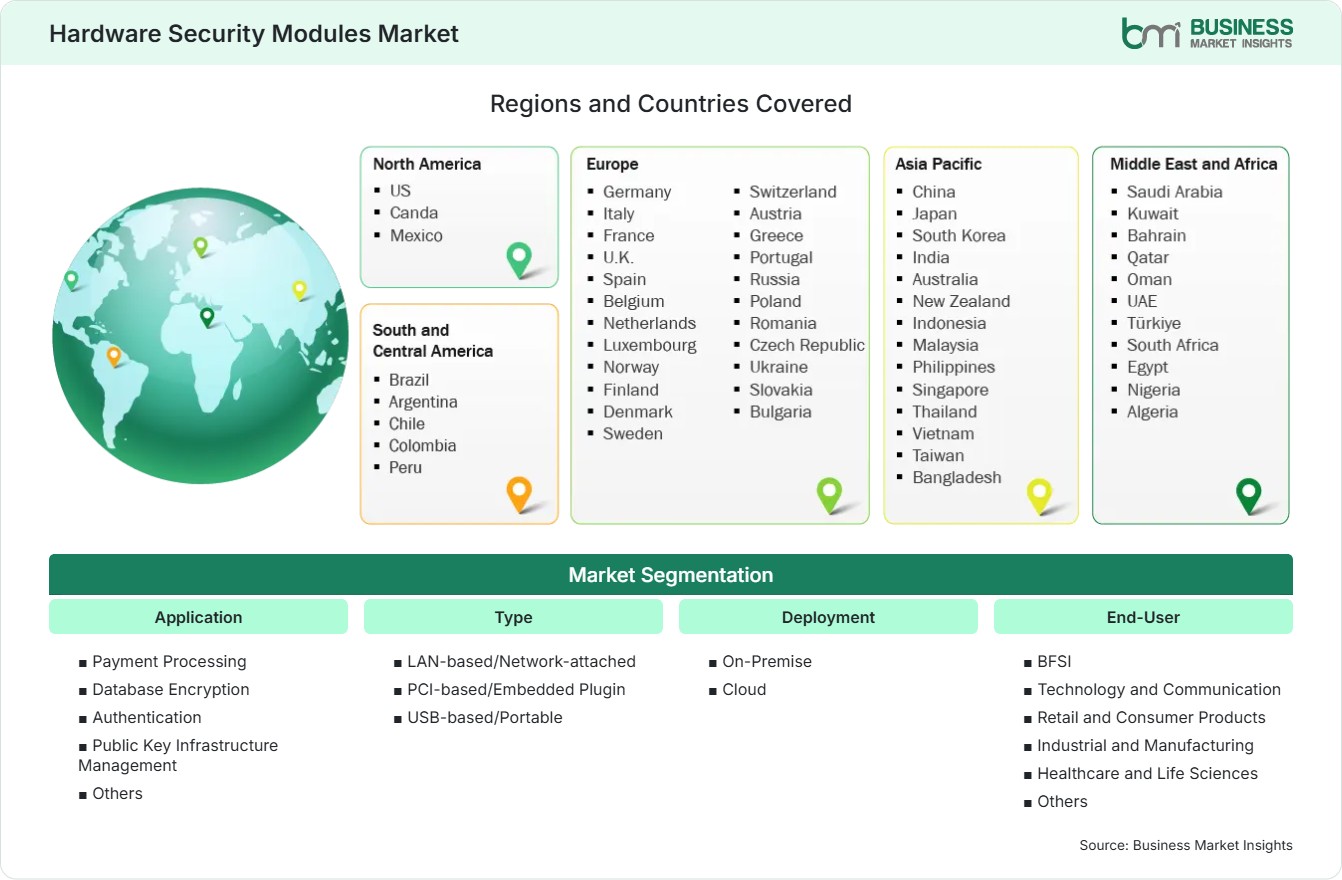
  • Application: Payment Processing, Database Encryption, Authentication, Public Key Infrastructure Management, Others
  • Type: LAN-based/Network-attached, PCI-based/Embedded Plugin, USB-based/Portable
  • Deployment: On-Premise, Cloud
  • End-User: BFSI, Technology and Communication, Retail and Consumer Products, Industrial and Manufacturing, Healthcare and Life Sciences, Others
US$ 1.70 Bn Market size in 2025
US$ 4.56 Bn Market Size by 2033
13.13% CAGR, 2026 - 2033
2026-2033 Forecast Period

AI Overview

Hardware Security Modules Market Summary

  • North America Region: North America holds a 34%–37% share in 2025, growing at a CAGR of 11.5%–12.3%, influenced by cybersecurity modernization, financial-sector encryption, cloud migration, compliance requirements, and increasing protection of sensitive cryptographic keys. The U.S. Hardware Security Modules Market benefits from mature enterprise security infrastructure, strong cloud adoption, and stringent cryptographic controls, supporting a CAGR of 11.8%–12.6% during 2026–2033.
  • Fastest Growing Region: Asia Pacific accounts for a 25%–28% share in 2025 and advances at a CAGR of 15.0%–16.0%, supported by digital banking expansion, cloud infrastructure investment, electronic payments, data localization requirements, and rising cybersecurity spending.
  • Leading Segment: Payment Processing represents a 27%–30% share in 2025 and records a CAGR of 12.8%–13.6%, supported by transaction security requirements, payment authentication, cryptographic key management, card personalization, and growing digital payment volumes.
  • High Growth Segment: Cloud-based deployment captures a 31%–34% share in 2025 and expands at a CAGR of 16.5%–17.5%, driven by hybrid infrastructure, HSM-as-a-Service adoption, remote administration, scalable encryption, and demand for flexible key management.
  • Key Market Opportunity: The strongest opportunity lies in cloud-integrated cryptographic security, where organizations increasingly require scalable key protection, centralized policy management, remote administration, and secure encryption across distributed workloads.
  • Major Market Players: Thales Group, Entrust Corporation, Utimaco GmbH, IBM Corporation, Futurex, STMicroelectronics, Microchip Technology Inc., Infineon Technologies AG, Yubico AB, and Securosys SA.
Strategic Insights

Hardware Security Modules Market: Strategic Insights

Hardware Security Modules Market Strategic Framework
FREE PDF
Request your free sample
Request free sample
Stakeholder View

Key Takeaways

  • Cryptographic security is becoming an infrastructure capability rather than a point solution, increasing the importance of interoperability between HSMs, identity systems, encryption platforms, certificate authorities, databases, and cloud environments.
  • Cloud deployment offers the strongest commercial upside because organizations increasingly require centralized cryptographic control while maintaining flexible infrastructure, remote administration, workload portability, and consistent security policies.
  • Product development is shifting toward stronger automation, simplified management interfaces, remote administration, cloud integration, high-availability architectures, and support for evolving cryptographic algorithms.
  • Asia Pacific presents an attractive investment environment because expanding digital payments, cloud infrastructure, data governance requirements, and enterprise modernization are creating new demand across financial and technology-intensive applications.
  • Security providers are increasingly pursuing partnerships, platform integrations, and broader ecosystem participation to extend cryptographic capabilities across applications, cloud infrastructure, identity environments, and payment systems.
  • Buyers are placing greater emphasis on lifecycle management, auditability, certification, resilience, and operational simplicity, making service capabilities and integration expertise increasingly important alongside hardware performance.
Geographic Outlook

Hardware Security Modules Market Regional Highlights

North America Hardware Security Modules Market

North America represents 34%–37% of 2025 demand and is projected to grow at a CAGR of 11.5%–12.3% through 2033. Hardware Security Modules Market share remains supported by mature cybersecurity programs, financial-sector encryption, cloud migration, and regulatory requirements.

  • Financial institutions continue prioritizing hardware-backed key protection for payment processing, authentication, encryption, and transaction security.
  • Enterprise cloud adoption is increasing demand for architectures that connect dedicated cryptographic hardware with virtualized applications, enabling organizations to retain control over sensitive keys.
  • Canada and the United States remain leading markets, while demand from technology companies, healthcare organizations, and critical infrastructure operators broadens application opportunities beyond traditional banking and payment environments.

US Hardware Security Modules Market

The U.S. accounts for 72%–75% of North American demand in 2025 and is forecast to expand at a CAGR of 11.8%–12.6%. Hardware Security Modules Market growth reflects advanced cloud adoption, financial digitization, cybersecurity regulation, and enterprise encryption requirements.

  • Financial services remain a core application because payment processing, certificate management, authentication, and encryption require tightly controlled cryptographic keys and reliable security mechanisms throughout increasingly distributed technology environments.
  • Federal and regulated organizations continue emphasizing validated cryptographic controls, strengthening procurement requirements for secure modules that provide physical protection, controlled interfaces, authentication, key management, and documented security assurance.
  • Enterprise modernization is broadening demand as organizations connect HSM infrastructure with cloud workloads, databases, application programming interfaces, identity platforms, and automated certificate-management processes across hybrid environments.

Europe Hardware Security Modules Market

Europe holds 26%–29% of 2025 demand and is projected to advance at a CAGR of 12.2%–13.0%. Germany and the United Kingdom remain leading markets, while France and the Netherlands provide strong growth opportunities as digital trust requirements deepen.

  • European organizations increasingly integrate cryptographic controls into broader cybersecurity governance, emphasizing key custody, authentication, encryption, auditability, and secure lifecycle management across regulated digital environments.
  • Financial institutions are strengthening payment and identity security architectures, creating opportunities for HSM deployments that support transaction authentication, certificate services, secure key generation, and controlled cryptographic operations.
  • Germany remains a leading Hardware Security Modules Market because industrial digitization and secure enterprise infrastructure create demand for hardware-backed cryptographic protection across manufacturing, financial, technology, and public-sector applications.

Asia Pacific Hardware Security Modules Market

Asia Pacific captures 25%–28% of 2025 demand and is expected to register a CAGR of 15.0%–16.0%, making it the fastest-growing region. China, Japan, and South Korea lead established demand, while India offers strong expansion potential.

  • Rapid digital payment adoption is increasing requirements for secure transaction processing, encryption, authentication, and cryptographic key management.
  • Cloud infrastructure expansion is encouraging enterprises to adopt centralized cryptographic services that can protect distributed workloads.
  • India is emerging as a high-growth market as financial digitization, cloud adoption, cybersecurity investment, and expanding digital public infrastructure increase the need for stronger protection of sensitive cryptographic assets.

Rest of World Hardware Security Modules Market

Rest of World accounts for 10%–13% of 2025 demand and is projected to grow at a CAGR of 11.0%–11.8%. South America and the Middle East provide the strongest opportunities as financial digitization and cloud adoption accelerate.

Middle Eastern markets are increasingly investing in digital banking, government platforms, cloud infrastructure, and cybersecurity modernization. Saudi Arabia and the United Arab Emirates represent leading markets, while South Africa and Brazil provide additional opportunities as financial and enterprise technology systems become more digitally connected.

  • Financial-sector modernization is creating demand for stronger encryption, authentication, payment security, and centralized cryptographic governance across developing digital ecosystems.
  • Gulf economies are expanding secure digital infrastructure, creating opportunities for HSM deployments supporting government services, financial institutions, cloud workloads, and enterprise identity platforms.
  • Brazil remains a significant South American opportunity because financial digitization and payment technology adoption increase requirements for secure cryptographic processing and key management.
  • South Africa provides a regional technology hub where banking, telecommunications, and enterprise applications can support demand for secure cryptographic infrastructure and managed security services.
Global Market Geography
FREE PDF
Request your free sample
Request free sample
Segment Analysis

Hardware Security Modules Market Segmentation

Application

Application demand is led by payment processing and authentication because both require controlled cryptographic operations and secure key custody. The segment represents a 27%–30% share in 2025 and expands at a CAGR of 12.8%–13.6% during 2026–2033 as digital transactions and identity services increase.

  • Payment Processing: Payment environments use secure modules for transaction cryptography, PIN processing, card authentication, key generation, and payment credential protection, supporting reliable transaction authorization across increasingly digital payment ecosystems.
  • Database Encryption: HSMs protect encryption keys used with sensitive databases, helping enterprises separate key custody from stored information while strengthening access control, auditability, and centralized encryption governance.
  • Authentication: Authentication applications rely on protected cryptographic operations for credentials, certificates, signatures, and identity verification, particularly where organizations require stronger control over privileged keys and authentication infrastructure.
  • Public Key Infrastructure (PKI) Management: PKI deployments use secure modules to protect certificate authority keys, signing operations, and certificate lifecycle processes, supporting trusted identities across enterprise, government, and connected-device environments.

Type

Type demand reflects different infrastructure architectures, with network-attached modules supporting enterprise environments while embedded and portable configurations address specialized applications. The segment holds a 24%–27% share in 2025 and records a CAGR of 11.7%–12.5% through 2033.

  • LAN-based/Network-attached: Network-attached modules provide centralized cryptographic services for multiple applications, making them suitable for enterprises requiring shared key management, high availability, controlled administration, and scalable security infrastructure.
  • PCI-based/Embedded Plugin: Embedded modules integrate cryptographic functions closely with computing infrastructure, supporting applications where low-latency operations, dedicated processing, and controlled hardware boundaries are important operational requirements.
  • USB-based/Portable: Portable modules address specialized deployment requirements where secure cryptographic capabilities must be transported, isolated, or connected directly to individual systems for controlled authentication and key-management activities.

Deployment

Deployment is shifting toward flexible architectures that combine dedicated hardware protection with cloud accessibility. The segment accounts for a 35%–38% share in 2025 and records a CAGR of 15.5%–16.5% during 2026–2033 as organizations modernize infrastructure.

  • On-Premise: On-premise deployment remains important for organizations requiring direct physical control, dedicated infrastructure, predictable access policies, and close integration with internal security operations and regulated workloads.
  • Cloud: Cloud deployment supports scalable cryptographic services across distributed applications, reducing infrastructure constraints while enabling remote administration, centralized policies, workload flexibility, and integration with modern cloud environments.

End-User

End-user demand is concentrated among organizations managing sensitive transactions, regulated information, proprietary technology, and critical operational systems. The segment represents a 30%–33% share in 2025 and expands at a CAGR of 12.5%–13.4% through 2033.

  • BFSI: Banks and financial institutions require protected cryptographic operations for payments, authentication, encryption, certificate management, and transaction processing, making HSM infrastructure fundamental to secure digital financial services.
  • Technology and Communication: Technology and communication companies deploy HSMs to secure applications, cloud services, identity systems, encryption keys, digital certificates, and high-volume data exchanges across interconnected platforms.
  • Retail and Consumer Products: Retail organizations use cryptographic infrastructure to strengthen payment environments, customer authentication, transaction processing, and protection of sensitive consumer information across increasingly digital commerce operations.
  • Industrial and Manufacturing: Industrial users apply secure cryptography across connected equipment, enterprise systems, intellectual property protection, authentication, and operational technology environments where data integrity and controlled access are essential.
  • Healthcare and Life Sciences: Healthcare organizations use protected cryptographic keys for sensitive records, identity management, encryption, research information, and connected systems requiring stronger controls over confidential digital assets.
Market Forces

Hardware Security Modules Market Dynamics

Key Market Drivers

Rising Cybersecurity Threats Drive Hardware Security Adoption

The increased risk of cyber threats is prompting organizations to focus on having encrypted cryptographic keys as opposed to depending on software-only security controls. Having hardware-provided protection ensures that there is a separate demarcation where all cryptographic actions are done and helps build resilience against any attempts at theft. This trend becomes even more important in light of companies' increased connection of applications, identities, databases, cloud workloads, and remote users. HSM systems can facilitate the process of encryption, authentication, signature, and key generation within secure environments. The increased demand will go beyond the traditional payment scenarios and into enterprise security, digital identity, cloud infrastructure, and interconnected devices.

Growing Data Protection Requirements Support HSM Deployment

The organizations have become vulnerable to high standards for securing information in their life cycle. Cryptographic techniques can help reduce exposure, but the reliability of cryptographic techniques is determined by the management process for the cryptographic keys, such as generation, storage, retrieval, rotation, and disposal. The HSMs provide the environment that helps in carrying out these processes. They also help separate protected information and the cryptographic keys used to protect it. With the integration of security policies in hybrid environments, the need for centralized key management is increasing. Protection using hardware technology also aids in better governance through restricted access and cryptographic processes. The needs of these organizations will help drive Hardware Security Modules market trends such as integrated key management, lifecycle management, central management, and greater interoperability.

Increasing Digital Transactions Boost Secure Cryptographic Infrastructure

Authentication, encryption, integrity, and credential management would have to be reliable processes for digital transactions. As the payment and other financial services become digital through the internet, there will be a need for even more sophisticated transactional security systems, but they should not limit their functionality. The role of HSMs lies in that they offer a secure platform where cryptographic operations required in transactions and authentication can take place. The ongoing evolution of standards for securing payment is further leading firms to re-examine their cryptographic architecture and its life cycle management processes. Such developments make it possible to have solutions that will work well with traditional payment systems as well as emerging cloud-based transaction systems.

Key Market Opportunities

Expanding Digital Banking Creates New HSM Opportunities

With the growth of digital banking platforms, the volume of transactions, authentication processes, customer communications, and applications that will need cryptography is growing. There is thus a chance for HSM providers to help banks upgrade their payment architecture, digital identity solutions, mobile applications, and APIs. Banks will be able to take advantage of architectures that will offer centralized key management across different channels and applications. Cloud HSMs will make the process of upgrading even more convenient for the banks. Moreover, emerging banking ecosystems will give HSM companies the chance to integrate cryptographic controls into digital banking solutions during the design phase rather than implementing security measures at a later stage. Hardware Security Modules Market Forecasts will depend on the level of success in providing cryptographic security within digital architectures.

Growing Demand for Secure Cloud Infrastructure Worldwide

Cloud migration is influencing the way applications are deployed, information is stored, and controls are being enforced. In this regard, the protection of cryptographic operations needs to be performed in a manner that spans virtualized infrastructure, distributed computing, various regions, and varied application environments. HSM products could give rise to an environment where keys are protected in isolation, yet applications using these keys are hosted in the cloud without the constraint of hosting everything in data centers. There are benefits to managed services, HSM as a service, hybrid models, and APIs as well.

Increasing Regulatory Focus on Cryptographic Data Protection

Regulatory focus on issues of data security, digital identity, payment security, and operational resilience has led to an increased need for formalizing cryptographic governance practices. Requirements go beyond merely ensuring that the data is encrypted to managing key access, establishing security procedures, monitoring sensitive processes, and having the proper measures in place at all stages of the information life cycle. These goals can be met with the use of HSMs, which provide controlled environments for storing and processing data using cryptography. There is also a need for companies operating in several jurisdictions to have security architectures that can meet different regulatory requirements without having fragmented systems. It creates a need for valid products, controls, administrative functions, and auditable management functions.

Market Restraints and Challenges

High Hardware Security Module Costs Limit Smaller Deployments

Factor: The cost involved in the procurement of hardware, certification, redundancy, maintenance, and management is often very high for small businesses.Impact: Heavy costs may result in a postponement of implementation, restricted deployment scope, or use of more general security measures where risk appetite allows. Considerations related to costs affect the choice of whether to have dedicated infrastructure or managed cryptography. One needs to take into account performance and availability needs, compliance constraints, service support, and total life-cycle cost rather than the price alone of the equipment. This problem is especially acute when multiple applications need their own secure environment or geographically diverse infrastructure.

Complex Integration Requires Specialized Technical Expertise

Factor: HSMs need to be integrated with various payment systems, databases, certificate authorities, identity solutions, cloud computing, applications, and enterprise security operations. Impact: The complexity of integration may lead to extended deployment times, increased implementation expenses, and reliance on specialist cryptographic knowledge during operation. Proper policies need to be set in regard to key generation, access, rotation, backup, restoration, authorization, and revocation, as well as application interoperability. Badly designed integration may raise availability concerns despite the proper operation of the underlying security module. It becomes even more difficult in hybrid environments with cryptographic services across different physical and cloud infrastructures. Vendors and service providers can deal with this restraint using standardized interfaces, automation, migration support, professional services, education, and management solutions.

Company Analysis

Competitive Landscape

Hardware Security Modules Market analysis indicates a competitive environment shaped by cryptographic certification, product breadth, integration capability, deployment flexibility, and support for regulated applications. Differentiation increasingly depends on interoperability and lifecycle management rather than hardware specifications alone.

Company Name

Overview

Products and Services relevant to this market

Thales Group

A global technology provider with established cybersecurity and digital identity capabilities serving regulated and enterprise environments.

Hardware security modules, payment HSMs, cloud HSM services, key management, encryption, and cryptographic lifecycle solutions.

Entrust Corporation

A security technology company focused on trusted identities, digital certificates, payments, and data protection.

Network HSMs, payment HSMs, cloud HSM services, key management, certificate solutions, and cryptographic security.

Utimaco GmbH

A specialist cybersecurity provider known for hardware-backed cryptographic security and compliance-oriented solutions.

Hardware security modules, payment HSMs, key management, cloud integration, digital signatures, and cryptographic infrastructure.

IBM Corporation

A technology company providing enterprise security, hybrid cloud, encryption, and specialized cryptographic infrastructure.

Cloud HSM services, dedicated cryptographic hardware, key management, encryption, certificate management, and enterprise security integration.

Futurex

A cybersecurity company specializing in enterprise and payment cryptographic infrastructure.

HSM appliances, payment security modules, key management, certificate services, cloud cryptography, and secure transaction processing.

STMicroelectronics

A semiconductor manufacturer supplying secure hardware technologies for connected and embedded applications.

Secure microcontrollers, cryptographic hardware, secure elements, authentication technologies, and embedded security components.

Microchip Technology Inc.

A semiconductor supplier supporting secure embedded computing, connectivity, and industrial applications.

Secure elements, cryptographic devices, authentication products, secure key storage, and embedded security technologies.

Infineon Technologies AG

A semiconductor company providing hardware security technologies across automotive, industrial, IoT, and digital applications.

Security controllers, trusted platform technologies, secure elements, cryptographic hardware, and embedded security solutions.

Yubico AB

A security technology provider focused on strong authentication and hardware-based identity protection.

Hardware authentication devices, cryptographic authentication, identity security, and secure access technologies.

Securosys SA

A Swiss security specialist focused on cryptographic infrastructure and secure key management.

HSMs, cloud HSM services, digital signature infrastructure, PKI protection, key management, and cryptographic services.

Trust & Transparency

Research Methodology

The market analysis combines proprietary research with secondary data from government agencies, company disclosures, regulatory filings, industry databases and expert interviews. Market estimates are validated through data triangulation, cross-market benchmarking and analyst review.

View Full Research Methodology

Questions Answered

Frequently Asked Questions

How is cryptographic infrastructure evolving in the Hardware Security Modules Market?

Cryptographic infrastructure is moving toward automated lifecycle management, cloud integration, centralized administration, hybrid deployment, stronger interoperability, and greater support for evolving security requirements. Organizations increasingly seek unified approaches that manage keys across multiple applications and environments.

What factors should buyers evaluate before selecting an HSM?

According to the Hardware Security Modules Market report, buyers should consider certification, cryptographic capabilities, deployment model, interoperability, performance, high availability, disaster recovery, key lifecycle management, administration requirements, integration support, scalability, and total ownership costs.

Which applications commonly require HSM protection?

Common applications include payment processing, database encryption, authentication, public key infrastructure, digital signatures, certificate authorities, secure transaction processing, and protection of encryption keys used by enterprise applications.

How do cloud HSMs differ from traditional HSM deployments?

Cloud HSMs provide cryptographic capabilities through cloud-accessible infrastructure, reducing the need for organizations to operate all physical equipment themselves. They can support remote administration, scalable capacity, distributed applications, and integration with modern cloud architectures.

Why are HSMs important for enterprise cybersecurity?

HSMs provide a dedicated environment for protecting cryptographic keys and performing sensitive cryptographic operations. They can strengthen security by separating key protection from application environments while supporting controlled access, authentication, auditing, and lifecycle management.

Access the Full Hardware Security Modules Market Report

Get segment-level forecasts, regional estimates, competitive benchmarking, company profiles and downloadable Excel datasets.

Access the full Hardware Security Modules Market Report
350 pages PDF & Excel | 2026-09-15
Similar Research

Related Market Reports