
Hand Gloves Market Outlook: Size, Share, Trends, Growth Analysis, Competitive Landscape & Forecast, 2026-2033

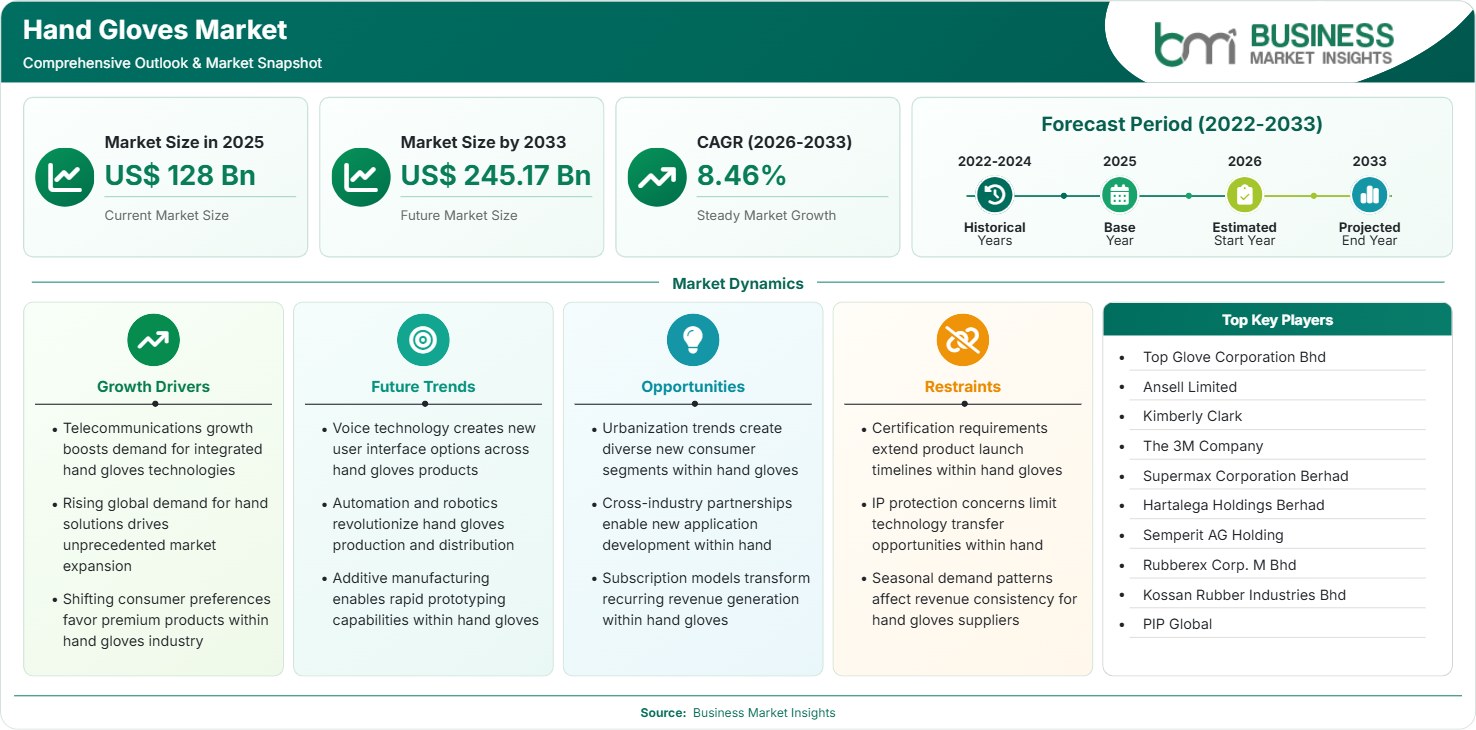
The Hand Gloves Market size was valued at US$ 128 Billion in 2025 and is projected to reach US$ 245.17 Billion by 2033, growing at a CAGR of 8.46% during 2026–2033. Rising workplace safety regulations, expanding healthcare infrastructure, increasing industrial automation, and growing demand for disposable protective gloves are accelerating adoption, while innovation in sustainable materials and premium protective solutions continues creating new market opportunities.

Report Coverage
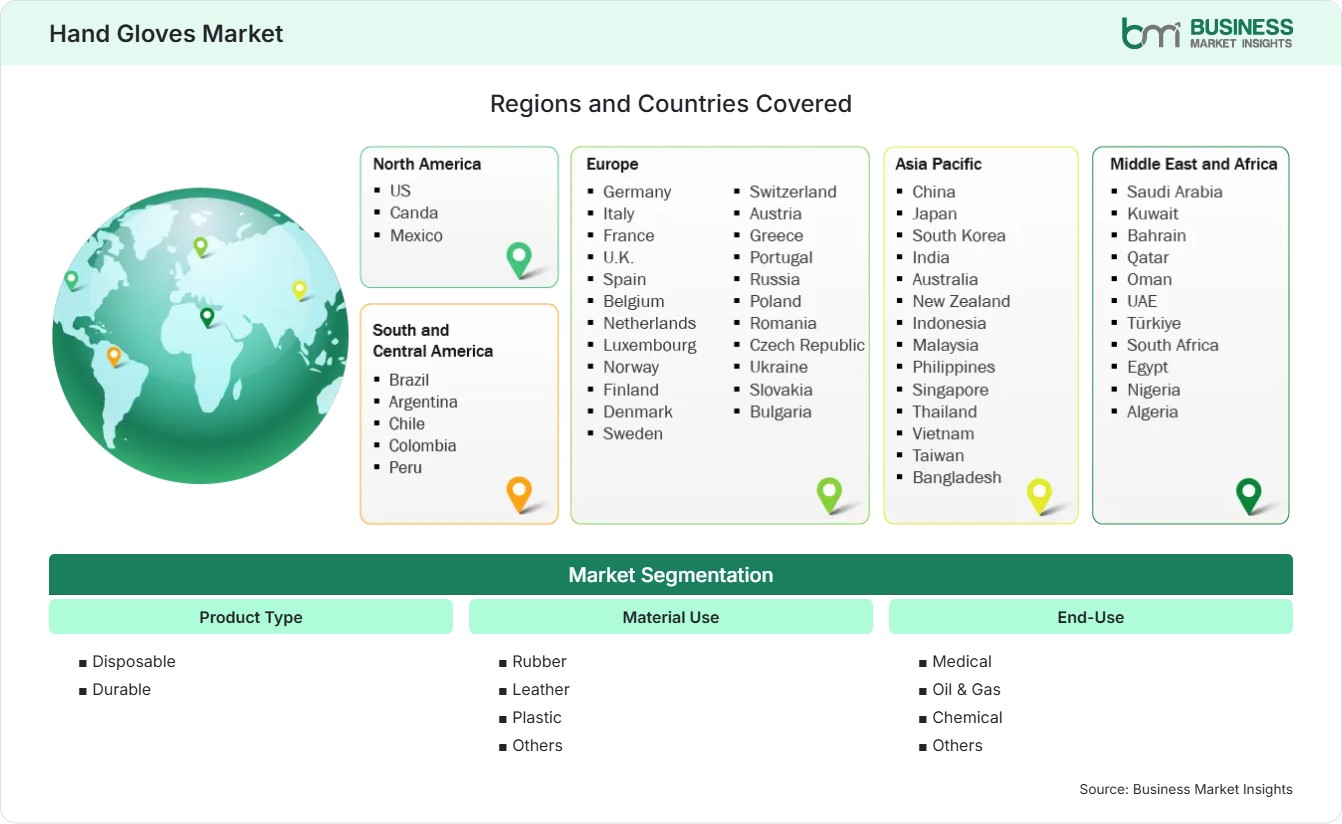
  • Product Type: Disposable, Durable
  • Material Use: Rubber, Leather, Plastic, Others
  • End-Use: Medical, Oil & Gas, Chemical, Others
US$ 128 Bn Market size in 2025
US$ 245.17 Bn Market Size by 2033
8.46% CAGR, 2026 - 2033
2026-2033 Forecast Period

01 AI Overview

Hand Gloves Market Summary

  • North America Region: North America holds 34%–37% market share in 2025, growing with a CAGR of 7.4%–7.8% during 2026–2033. Strict occupational safety regulations, advanced healthcare systems, expanding industrial manufacturing, and increasing demand for premium protective equipment continue supporting long-term market expansion and innovation across multiple industries. The U.S. represents the largest regional contributor, supported by OSHA compliance, strong healthcare procurement, and expanding industrial safety investments, advancing at a CAGR of 7.5%–7.9%.
  • Fastest Growing Region: Asia Pacific holds 28%–31% market share in 2025 while expanding at a CAGR of 10.2%–10.8% during 2026–2033. Manufacturing expansion, healthcare modernization, growing exports, increasing worker safety awareness, and investments in production capacity continue strengthening regional demand across industrial and medical applications.
  • Leading Segment: Disposable gloves account for 58%–62% market share in 2025 and are expected to grow at a CAGR of 8.7%–9.2%. Rising infection control standards, expanding healthcare services, food processing requirements, and increased single-use protective equipment demand continue driving widespread adoption worldwide.
  • High Growth Segment: Medical end-use represents 39%–43% market share in 2025 while advancing at a CAGR of 9.4%–10.0%. Increasing surgical procedures, diagnostic testing, aging populations, healthcare infrastructure investments, and stricter hygiene standards continue creating sustained opportunities for manufacturers.
  • Key Market Opportunity: Growing investment in biodegradable gloves, antimicrobial coatings, smart wearable protective gloves, and localized manufacturing facilities enables companies to meet sustainability goals while improving supply resilience and serving expanding healthcare and industrial customers worldwide.
  • Major Market Players: Top Glove Corporation Bhd, Ansell Limited, Kimberly-Clark Corporation, 3M Company, Supermax Corporation Berhad, Hartalega Holdings Berhad, Semperit AG Holding, Rubberex Corporation (M) Berhad, Kossan Rubber Industries Bhd, Medline Industries, LP.
02 Strategic Insights

Hand Gloves Market: Strategic Insights

Hand Gloves Market Strategic Framework
FREE PDF
Request your free sample
Request free sample
03 Stakeholder View

Key Takeaways

  • The industry value chain is becoming increasingly regionalized as manufacturers diversify raw material sourcing, automate production facilities, and establish localized distribution networks to reduce supply-chain risks while improving responsiveness to healthcare and industrial customers.
  • Healthcare, pharmaceutical manufacturing, and food processing applications present the strongest long-term commercial opportunities because tightening hygiene regulations and infection prevention protocols continue increasing consumption of high-quality disposable and specialty protective gloves.
  • Product innovation is shifting toward biodegradable materials, antimicrobial coatings, enhanced tactile sensitivity, chemical-resistant formulations, and smart protective solutions that improve worker safety while supporting sustainability objectives across industrial sectors.
  • North America remains the leading revenue contributor due to mature regulatory frameworks and high healthcare expenditure, while Asia Pacific offers the most attractive investment environment through manufacturing expansion, export competitiveness, and growing industrialization.
  • Strategic mergers, production capacity expansions, long-term supply agreements, and investments in advanced manufacturing technologies are strengthening competitive positioning as companies seek greater resilience against raw material volatility and changing customer requirements.
  • Future competitive advantage will increasingly depend on sustainable manufacturing practices, regulatory compliance, product differentiation, and resilient global supply networks capable of meeting rising demand across medical and industrial end-use sectors.
04 Geographic Outlook

Hand Gloves Market Regional Highlights

North America Hand Gloves Market

North America accounted for 34%–37% of the Hand Gloves Market share in 2025 and is projected to expand at a CAGR of 7.4%–7.8% through 2033. Strong occupational safety legislation, extensive healthcare expenditure, and mature manufacturing industries continue supporting stable regional demand. The United States dominates regional consumption, while Canada experiences steady adoption across healthcare, food processing, and industrial manufacturing. Investments in automation, premium nitrile gloves, and sustainable manufacturing practices further strengthen long-term competitiveness, supported by stringent workplace compliance standards and resilient domestic distribution networks.

  • OSHA regulations continue driving replacement demand for certified industrial protective gloves across manufacturing, construction, mining, and logistics sectors while employers prioritize worker safety compliance and reduce workplace injury risks through premium protective equipment.
  • Healthcare providers increasingly procure nitrile and surgical gloves due to infection prevention initiatives, expanding outpatient facilities, rising surgical volumes, and stronger emergency preparedness strategies across public and private healthcare institutions.
  • Food processing companies are adopting high-quality disposable gloves to comply with FDA food safety regulations, improve hygiene standards, and minimize contamination risks throughout production, packaging, and distribution operations.
  • Regional manufacturers continue investing in automated production lines, advanced material technologies, and localized supply chains, improving manufacturing efficiency while reducing dependence on imported products during demand fluctuations.
  • Sustainability initiatives encouraging recyclable packaging and environmentally responsible manufacturing processes are creating additional procurement opportunities among institutional buyers seeking long-term environmental compliance.

US Hand Gloves Market

The United States represents approximately 77%–81% of North American revenue and is anticipated to register a CAGR of 7.5%–7.9% during 2026–2033. Demand remains supported by extensive healthcare infrastructure, industrial automation, food manufacturing expansion, and continuous investments in workplace safety. Increasing domestic production capacity, higher procurement by hospitals, and stronger regulatory enforcement continue reinforcing the country's leadership position within the regional marketplace.

  • Growing hospital admissions, outpatient procedures, and diagnostic testing continue increasing procurement volumes for disposable examination and surgical gloves throughout healthcare systems nationwide.
  • Manufacturing modernization encourages adoption of chemical-resistant and cut-resistant gloves, improving worker productivity while ensuring compliance with evolving industrial safety requirements.
  • Federal investments supporting healthcare preparedness and domestic manufacturing resilience continue strengthening long-term supply chain security and procurement reliability.
  • Increasing sustainability commitments encourage manufacturers to develop biodegradable materials, energy-efficient production methods, and environmentally responsible packaging solutions for institutional customers.

Europe Hand Gloves Market

Europe captured approximately 25%–28% market share in 2025 and is forecast to grow at a CAGR of 7.8%–8.3% through 2033. Strict occupational health regulations, advanced medical infrastructure, and sustainability initiatives continue supporting steady demand across industrial and healthcare applications. Germany remains the largest regional market, while Poland records one of the fastest growth rates at 8.7%–9.2%, supported by expanding manufacturing activities and healthcare investments.

  • Germany leads regional consumption owing to its strong automotive, chemical, and healthcare industries, supported by rigorous worker protection regulations and advanced industrial manufacturing capabilities.
  • Poland experiences rapid expansion through industrial investments, healthcare modernization, and increasing exports of protective equipment across European markets.
  • Food processing and pharmaceutical industries continue strengthening demand for disposable gloves as hygiene regulations become increasingly stringent throughout production facilities.
  • Circular economy initiatives encourage manufacturers to introduce recyclable packaging and environmentally responsible manufacturing technologies, enhancing product competitiveness.
  • Rising investments in laboratory research and biotechnology facilities continue creating sustained demand for high-performance protective gloves across scientific applications.

Asia Pacific Hand Gloves Market

Asia Pacific accounted for 28%–31% of global revenue in 2025 and is projected to register the fastest CAGR of 10.2%–10.8% during the forecast period. Strong manufacturing capabilities, expanding healthcare infrastructure, and increasing industrialization continue driving regional expansion. China remains the leading market, while India demonstrates the fastest growth with a CAGR of 11.1%–11.7%, supported by healthcare investments and expanding industrial production.

  • Malaysia, Thailand, and China remain leading manufacturing hubs, supplying substantial export volumes through integrated production ecosystems and competitive manufacturing costs.
  • India's expanding healthcare infrastructure, pharmaceutical production, and industrial workforce continue accelerating demand for disposable and durable protective gloves.
  • Rising awareness regarding workplace safety standards encourages industrial facilities to increase procurement of certified protective equipment across multiple sectors.
  • Government incentives supporting domestic manufacturing and export competitiveness continue attracting investments in advanced glove production technologies.
  • Expanding food processing, electronics manufacturing, and healthcare industries create diversified long-term demand across regional markets.

Rest of World Hand Gloves Market

The rest of the world represented 10%–13% Hand Gloves Market share in 2025 and is projected to expand at a CAGR of 8.5%–9.0% through 2033. South & Central America continue benefiting from expanding healthcare systems and food processing industries.

The Middle East & Africa experience increasing demand through oil & gas projects, mining activities, and healthcare modernization. Brazil remains the largest regional Hand Gloves Market, while Saudi Arabia demonstrates one of the strongest growth trajectories with a CAGR of 9.1%–9.6%, supported by industrial diversification initiatives.

  • Brazil continues leading regional consumption due to healthcare expansion, food manufacturing growth, and increasing occupational safety awareness across industrial sectors.
  • Saudi Arabia benefits from industrial diversification programs, infrastructure projects, and expanding healthcare investments supporting protective equipment demand.
  • Mining, oil and gas, and construction sectors continue increasing procurement of durable protective gloves for hazardous work environments.
  • Healthcare modernization initiatives across Gulf countries and Latin America strengthen demand for premium disposable medical gloves.
  • Regional distribution partnerships and localized warehousing improve product availability while enhancing supply chain resilience for institutional buyers.
Global Market Geography
FREE PDF
Request your free sample
Request free sample
05 Segment Analysis

Hand Gloves Market Segmentation

Product Type

Disposable products accounted for 58%–62% market share during 2025 and are expected to grow at a CAGR of 8.7%–9.2% through 2033. Increasing healthcare procedures, food safety regulations, and industrial hygiene requirements continue driving adoption. The Hand Gloves Market scope continues expanding as manufacturers develop environmentally sustainable disposable materials alongside premium reusable protective products for industrial applications.

  • Disposable: Widely utilized across hospitals, laboratories, food processing facilities, and pharmaceutical manufacturing because they reduce contamination risks, improve hygiene compliance, and support infection prevention initiatives across high-volume operations.
  • Durable: Increasingly preferred in chemical processing, construction, manufacturing, mining, and heavy industrial environments where extended product life, superior mechanical protection, and cost efficiency remain primary purchasing considerations.

Material Use

Rubber-based products maintained approximately 49%–53% Hand Gloves Market share in 2025 and are projected to expand at a CAGR of 8.8%–9.3% through 2033. Superior elasticity, chemical resistance, and user comfort continue supporting broad adoption across healthcare and industrial applications, while manufacturers invest in advanced formulations to improve durability and sustainability.

  • Rubber: Continues dominating healthcare and industrial applications due to flexibility, chemical resistance, durability, and reliable barrier protection supporting diverse occupational safety requirements.
  • Leather: Preferred across welding, heavy manufacturing, mining, and construction because of excellent abrasion resistance, thermal protection, and long operational lifespan.
  • Plastic: Increasingly adopted within food handling, packaging, and light industrial operations requiring economical, lightweight, and disposable protective solutions with adequate contamination control.

End-Use

Medical applications represented 39%–43% of Hand Gloves Market revenue in 2025 and are forecast to register a CAGR of 9.4%–10.0% through 2033. Expanding healthcare infrastructure, aging populations, infection prevention initiatives, and increasing diagnostic procedures continue strengthening procurement across hospitals, clinics, and laboratories.

  • Medical: Growing surgical procedures, diagnostic testing, patient care activities, and infection prevention protocols continue increasing demand for premium disposable examination and surgical gloves worldwide.
  • Oil & Gas: Hazardous operating environments require chemical-resistant and durable gloves capable of protecting workers from abrasions, extreme temperatures, and hazardous substances throughout exploration and production activities.
  • Chemical: Strong demand originates from manufacturing facilities requiring advanced resistance against corrosive materials while maintaining worker dexterity, operational efficiency, and regulatory compliance across production environments.
06 Market Forces

Hand Gloves Market Dynamics

Key Market Drivers

Expanding Healthcare Infrastructure and Infection Prevention Standards

Healthcare systems worldwide continue increasing procurement of protective gloves as infection prevention remains a strategic priority across hospitals, clinics, laboratories, and diagnostic centers. As per the estimates of the World Health Organization (WHO), hundreds of millions of people suffer from healthcare-associated infections each year, which drives the need for quality disposable protective gear. More surgeries, more diagnostic tests, and aging populations fuel the use of gloves in developing and developed nations. Governments' spending on healthcare systems along with stringent sterilization policies keeps supporting the industry. Hand Gloves Market growth is enhanced by increased pharmaceutical manufacturing and biotechnology R&D, both of which require good control of contamination. Manufacturers are producing nitrile materials with enhanced sensory, chemical, and environmental properties to enable health care practitioners to satisfy demanding clinical performance standards in a cost-effective manner.

Stringent Workplace Safety Regulations Across Industrial Sectors

Industrial employers continue investing in certified protective equipment to comply with occupational health and safety regulations established by organizations including OSHA in the United States and the European Agency for Safety and Health at Work. The manufacturing industry, the construction industry, the mining industry, the automotive industry, the food processing industry, and logistics are all demanding workers use specialized protective gloves that reduce chemical, cut, abrasion, and heat injuries. Automation has decreased repetitive manual work but, at the same time, there has been an increased need for specialized protective gear with better dexterity and sturdiness. The increase in industrial production in Asia Pacific, the Middle East, and Latin America is another factor driving procurement. Companies also understand that by offering better protection to employees, they will have lower downtime and claim costs. Innovation in ergonomic glove technology and material engineering has allowed manufacturers to meet new industrial standards.

Growing Industrial Automation and Material Innovation

Modern manufacturing technologies have revolutionized glove production through automation with dipping machines, robotics for quality control, artificial intelligence for defect detection, and energy-efficient techniques that improve production efficiency. They help enhance the consistency of the manufacturing process, minimize material waste, and expand production capacity while ensuring competitive prices are maintained. In the meantime, there is also continuous investment in technologies for nitrile, neoprene, and polymer blends, which offer superior puncture and chemical resistance and comfort. Hand Gloves Market trends also indicate increasing demand for biodegradable materials and sustainable production processes, helping companies comply with regulatory requirements while advancing their sustainability programs. The need for continued research and development cannot be stressed enough.

Key Market Opportunities

Expansion of Sustainable and Biodegradable Protective Gloves

Environmental regulations, as well as corporate sustainability initiatives, are driving increased investment in biodegradable glove materials, recyclable packaging solutions, renewable energy, and green manufacturing processes. Environmental criteria are also being integrated into the sourcing process by health-care providers, multinational companies, and food processors; thus encouraging suppliers to provide environmentally friendly products. Advances in materials science have made it possible to produce biodegradable nitrile and natural rubber products without compromising performance while protecting the environment when they are disposed of. Hand Gloves Market Forecasts indicate that companies capable of combining environmental compliance with high-performance product characteristics are likely to secure stronger institutional contracts, expand premium product offerings, and strengthen competitive positioning as sustainability becomes an increasingly influential purchasing consideration across global markets.

Rising Demand Across Emerging Healthcare Economies

The health care investments made in Asia Pacific, Middle East, Africa, and Latin America will always generate huge business opportunities for the makers of the protective gloves. The growing population, greater health insurance coverage, more hospital constructions, and disease prevention funding from the government are some of the reasons for increased use of the disposable examination and surgical gloves. There are other benefits of making these products locally too. International healthcare organizations continue to provide support for increased capacity through funding, technical assistance, and procurement relationships. Local manufacturers can be more responsive in their operations by establishing manufacturing plants and distribution channels locally, thereby lowering transportation costs.

Digital Manufacturing and Smart Protective Equipment

Industry 4.0 technologies present significant opportunities for manufacturers seeking greater operational efficiency and product differentiation. Artificial intelligence-assisted quality inspection, predictive equipment maintenance, digital production monitoring, and robotic automation improve manufacturing productivity while minimizing defects and production costs. On the other hand, research into wearable sensor-enabled safety gloves that can track workers' fatigue, exposure to harmful chemicals, and ergonomic performance is creating new business opportunities in the industry. Smart personal protective gear aligns with broader efforts towards workplace digitization and occupational health tracking technologies. Organizations that are making significant investments in smart manufacturing facilities, digital supply chains, and smart protective gears are anticipated to improve their competitiveness in the future as they serve more sophisticated industrial clients.

Market Restraints and Challenges

Raw Material Price Volatility and Supply Chain Disruptions

 Factor: Volatile raw material availability and international logistics challenges increase procurement uncertainty for manufacturers.

Impact: The increase in cost of production leads to narrow margins, price fluctuations, and a lack of competitiveness, especially when the business has to deal with suppliers with whom they have entered into long-term contracts with fixed pricing. Interruptions in transportation around the globe and trade policies in different regions can lead to delays in the receipt of raw materials. In order to avoid this risk, companies now use diversified suppliers, local sourcing, and inventory strategies.

Regulatory Compliance Complexity and Environmental Disposal Concerns

Factor: Regulatory variation across jurisdictions increases compliance costs while extending product development and certification timelines.

Impact: Small-scale producers have greater difficulty when expanding their presence overseas and will have less room for pricing as a result of greater cost requirements due to testing, documentation, and certification. Furthermore, the process of disposing of huge amounts of disposable protective gloves raises ecological problems due to landfill buildup and plastic waste generation. This situation necessitates ongoing commitment to biodegradable raw materials, cleaner technology, life cycle analysis, and recycling of packaging, which entails heavy costs of research and development.

07 Company Analysis

Competitive Landscape

The competitive environment remains moderately consolidated, with global manufacturers focusing on production automation, sustainable materials, product innovation, and geographic expansion. Hand Gloves Market analysis indicates that leading companies are strengthening their positions through capacity expansion, strategic acquisitions, advanced nitrile technologies, and healthcare-focused product portfolios to address rising demand from medical and industrial end users.

Company Name

Overview

Products and Services Relevant to this Market

Top Glove Corporation Bhd

World's largest rubber glove manufacturer with extensive global manufacturing and distribution capabilities serving healthcare and industrial customers.

Disposable examination gloves, surgical gloves, nitrile gloves, latex gloves, industrial protective gloves, OEM manufacturing services.

Ansell Limited

Global leader in personal protective equipment serving healthcare, industrial, laboratory, and life sciences sectors with innovative safety solutions.

Medical gloves, chemical-resistant gloves, cut-resistant gloves, cleanroom gloves, surgical gloves, industrial PPE solutions.

Kimberly-Clark Corporation

Multinational manufacturer supplying workplace safety and laboratory protection products through globally recognized professional brands.

Disposable gloves, laboratory gloves, cleanroom products, industrial safety solutions, hygiene products, protective apparel.

3M Company

Diversified technology company offering industrial and healthcare safety products with strong innovation and global distribution capabilities.

Industrial protective gloves, safety equipment, personal protective equipment, workplace safety products, healthcare protection solutions.

Supermax Corporation Berhad

Malaysian glove manufacturer specializing in premium disposable medical gloves with exports across numerous international healthcare markets.

Nitrile examination gloves, latex gloves, surgical gloves, disposable protective gloves, OEM manufacturing.

Hartalega Holdings Berhad

Advanced glove manufacturer recognized for automated production technologies and high-quality nitrile glove manufacturing expertise.

Nitrile examination gloves, medical gloves, cleanroom gloves, industrial disposable gloves, specialty protective products.

Semperit AG Holding

European industrial manufacturer providing premium hand protection solutions across industrial, medical, and specialty applications worldwide.

Industrial gloves, chemical-resistant gloves, disposable gloves, medical gloves, specialty protective equipment.

Rubberex Corporation (M) Berhad

Manufacturer specializing in household, industrial, and healthcare gloves supported by diversified international distribution channels.

Household gloves, industrial gloves, medical examination gloves, specialty rubber gloves, OEM manufacturing solutions.

Kossan Rubber Industries Bhd

Leading Malaysian manufacturer with integrated production facilities serving healthcare and industrial customers across international markets.

Disposable medical gloves, nitrile gloves, cleanroom gloves, industrial gloves, technical rubber products.

10 Trust & Transparency

Research Methodology

The market analysis combines proprietary research with secondary data from government agencies, company disclosures, regulatory filings, industry databases and expert interviews. Market estimates are validated through data triangulation, cross-market benchmarking and analyst review.

View Full Research Methodology

11 Questions Answered

Frequently Asked Questions

What future opportunities are expected in this market?

Future opportunities include biodegradable glove materials, smart protective gloves, AI-enabled manufacturing, localized production facilities, recyclable packaging, and expansion into emerging healthcare markets with improving medical infrastructure.

Which companies are leading the Hand Gloves Market Report?

Major participants include Top Glove Corporation Bhd, Ansell Limited, Kimberly-Clark Corporation, 3M Company, Supermax Corporation Berhad, Hartalega Holdings Berhad, Semperit AG Holding, Rubberex Corporation (M) Berhad, and Kossan Rubber Industries Bhd.

Which product segment generates the highest revenue?

Disposable gloves account for the largest revenue contribution because of their extensive usage in hospitals, laboratories, food processing facilities, pharmaceutical manufacturing, and diagnostic centers where contamination prevention is essential.

Which region dominates the market?

North America remains the largest regional market due to advanced healthcare infrastructure, stringent occupational safety regulations, high industrial safety awareness, and strong procurement by hospitals, manufacturing industries, and government organizations.

What are the primary factors driving the Hand Gloves Market?

Growing healthcare expenditure, stricter workplace safety regulations, rising industrial automation, increasing food safety requirements, and expanding pharmaceutical manufacturing are the major factors supporting long-term market expansion across developed and emerging economies.

Access the Full Hand Gloves Market Report

Get segment-level forecasts, regional estimates, competitive benchmarking, company profiles and downloadable Excel datasets.

Access the full Hand Gloves Market Report
350 pages PDF & Excel | 2026-08-17