
Green Silica Market Outlook: Size, Share, Trends, Growth Analysis, Competitive Landscape & Forecast, 2026-2033

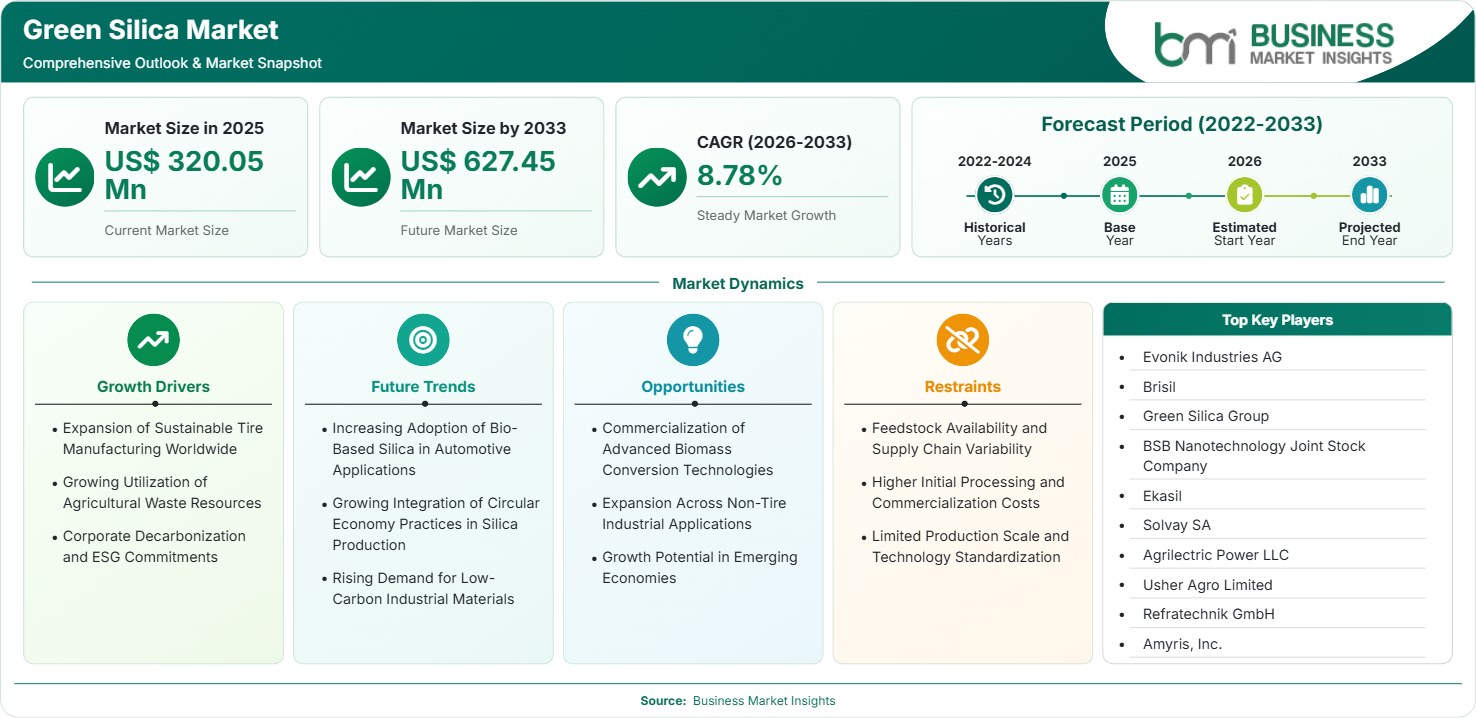
The Green Silica Market size was valued at US$ 320.05 Million in 2025 and is projected to reach US$ 627.45 Million by 2033, growing at a CAGR of 8.78% during 2026–2033. Rising demand for sustainable tire materials, increasing circular economy initiatives, agricultural waste valorization, low-carbon manufacturing technologies, and expanding adoption of bio-based fillers across industrial applications are creating substantial opportunities.

Report Coverage
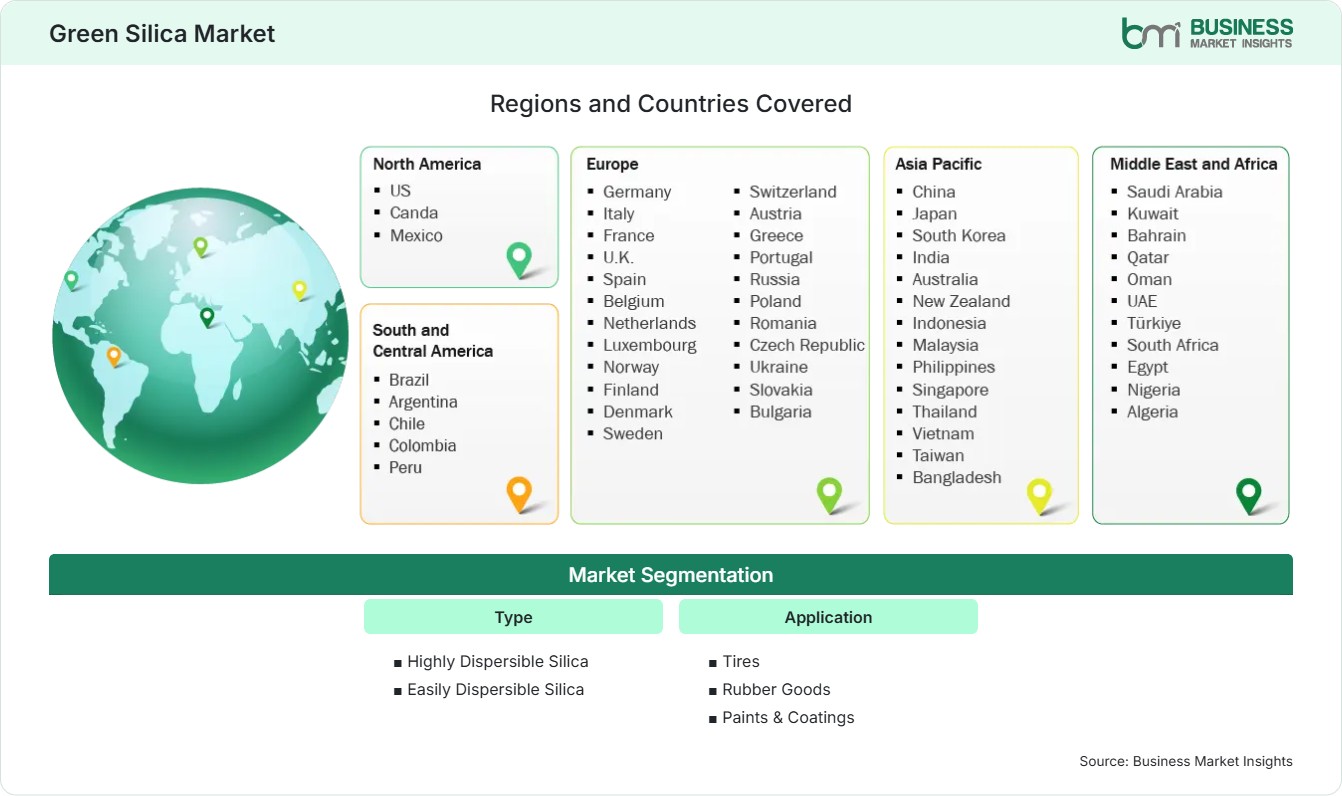
  • Type: Highly Dispersible Silica, Easily Dispersible Silica
  • Application: Tires, Rubber Goods, Paints & Coatings
US$ 320.05 Mn Market size in 2025
US$ 627.45 Mn Market Size by 2033
8.78% CAGR, 2026 - 2033
2026-2033 Forecast Period

01 AI Overview

Green Silica Market Summary

  • North America Region: North America holds a market share of 32%–35% in 2025, growing with a CAGR of 7.8%–8.4% during 2026–2033. Demand is supported by sustainable tire manufacturing, corporate decarbonization targets, biomass utilization programs, advanced material innovation, and investments in environmentally responsible supply chains across industrial sectors. The U.S. represents the largest regional contributor, advancing at 8.0%–8.6% CAGR through strong sustainable materials adoption.
  • Fastest Growing Region: Asia Pacific accounts for 28%–31% of revenue in 2025 and is projected to expand at 9.6%–10.3% CAGR through 2033. Growth is driven by expanding tire production, abundant rice husk availability, industrial sustainability programs, increasing environmental regulations, and rising investments in green materials processing infrastructure.
  • Leading Segment: Highly Dispersible Silica holds 58%–61% market share in 2025 and advances at 8.5%–9.1% CAGR. Strong demand originates from premium tire manufacturing, fuel-efficiency requirements, rolling resistance reduction initiatives, and the need for improved durability in automotive applications worldwide.
  • High Growth Segment: Tires represent 46%–49% market share in 2025 while expanding at 9.4%–10.1% CAGR. Automotive electrification, stringent emission regulations, sustainable mobility trends, and growing use of eco-friendly reinforcing fillers continue supporting accelerated segment expansion.
  • Key Market Opportunity: Increasing commercialization of rice husk ash conversion technologies enables manufacturers to create high-value silica products while reducing agricultural waste disposal, supporting circular economy objectives and sustainable industrial development.
  • Major Market Players: Evonik Industries AG, Brisil, Green Silica Group, BSB Nanotechnology Joint Stock Company, Ekasil, Solvay SA, Agrilectric Power LLC, Usher Agro Limited, Refratechnik GmbH, and Amyris, Inc.
02 Strategic Insights

Green Silica Market: Strategic Insights

Green Silica Market Strategic Framework
FREE PDF
Request your free sample
Request free sample
03 Stakeholder View

Key Takeaways

  • Value chain integration of agricultural waste suppliers, biomass processing, silica extraction companies, and industrial customers is gaining prominence to craete more sustainable and resilient supply chain.
  • Tire manufacturing remains the most attractive growth avenue due to increasing demand for fuel-efficient, low-rolling-resistance, and environmentally responsible mobility solutions.
  • The trend in technological development focuses on achieving higher purity of extraction processes, energy efficiency of the manufacturing process, and scalability of processing technology.
  • Asia Pacific presents a compelling investment destination owing to abundant rice husk availability, growing automotive production capacity, and supportive sustainability policies.
  • The collaborations between chemical firms and food processing industries have become more prevalent as companies are striving for feedstock assurance and optimal supply chains.
  • The sustainability reporting regulations and decarbonization initiatives of companies are shaping purchase decisions within the industrial materials sector.
04 Geographic Outlook

Green Silica Market Regional Highlights

North America Green Silica Market

North America accounts for 32%–35% of global revenue in 2025 and is projected to expand at a CAGR of 7.8%–8.4% through 2033. Strong sustainability commitments from automotive manufacturers, increasing demand for eco-friendly tire compounds, and growing investments in biomass utilization technologies support regional expansion. Government initiatives promoting industrial decarbonization and circular economy practices continue encouraging adoption across rubber, coatings, and specialty materials applications. The region also benefits from established research infrastructure and advanced manufacturing capabilities that facilitate commercialization of bio-derived silica solutions.

  • U.S. tire manufacturers increasingly prioritize sustainable reinforcing fillers to improve fuel efficiency, lower rolling resistance, and support corporate environmental objectives, creating long-term demand for bio-based silica alternatives.
  • Industrial sustainability programs across the United States and Canada are accelerating investment in agricultural waste valorization projects that transform rice husk ash and biomass residues into high-value materials.
  • Growing adoption of ESG frameworks among multinational corporations encourages procurement of lower-carbon raw materials, strengthening market penetration opportunities across automotive and industrial manufacturing sectors.
  • Collaboration between research institutions, chemical producers, and downstream users is improving product performance characteristics while supporting development of commercially scalable manufacturing technologies.
  • The Green Silica Market share in North America continues benefiting from stringent environmental standards that encourage resource efficiency and adoption of circular production models.

US Green Silica Market

The United States Green Silica Market represents 72%–76% of North American revenue in 2025 and is expected to grow at a CAGR of 8.0%–8.6% through 2033. Rising investment in sustainable materials innovation, expanding adoption of environmentally responsible tire technologies, and increased interest in agricultural waste conversion are driving market development. Federal and state-level sustainability initiatives further encourage commercialization of advanced biomass processing solutions. Strong presence of specialty chemical manufacturers and technology developers supports ongoing product innovation and capacity expansion activities.

  • Growing investment in electric vehicle tire technologies is increasing demand for high-performance reinforcing materials capable of enhancing durability and energy efficiency.
  • Universities and industrial research centers are developing improved extraction technologies that enhance silica purity while reducing operational energy consumption.
  • Corporate net-zero commitments are accelerating demand for sustainable industrial inputs and creating procurement opportunities for bio-derived materials.
  • Domestic manufacturing initiatives continue supporting localized supply chains and investment in advanced material production facilities.

Europe Green Silica Market

Europe holds approximately 27%–30% Green Silica Market share in 2025 and is projected to grow at 8.2%–8.9% CAGR through 2033. Regional growth is supported by ambitious carbon reduction targets, strict environmental regulations, and increasing demand for sustainable materials across automotive and industrial sectors. The European Green Deal and circular economy strategies continue encouraging utilization of renewable resources and waste-derived industrial inputs. Germany leads regional demand, while Eastern European countries are emerging as attractive production and investment destinations.

  • Germany remains the leading national market with strong automotive manufacturing activity and extensive adoption of sustainable tire technologies supporting consistent demand growth.
  • France and the Netherlands are increasing investments in circular economy infrastructure and advanced materials development programs focused on reducing industrial environmental impacts.
  • Poland demonstrates one of the highest regional growth trajectories due to expanding manufacturing capacity and increasing sustainability-focused industrial investments.
  • European tire manufacturers continue integrating environmentally responsible reinforcing materials to comply with evolving emissions and sustainability requirements.
  • Strong regulatory support for waste reduction and resource efficiency enhances long-term commercial prospects across industrial applications.

Asia Pacific Green Silica Market

Asia Pacific represents 28%–31% of global Green Silica Market revenue in 2025 and is forecast to record the fastest CAGR of 9.6%–10.3% through 2033. The region benefits from abundant rice husk availability, expanding tire manufacturing capacity, and rising environmental awareness. Governments are increasingly supporting biomass utilization initiatives and industrial sustainability programs. China leads regional consumption, while India and Southeast Asian economies are emerging as major production hubs due to favorable feedstock availability and expanding industrial infrastructure.

  • China dominates regional demand through its extensive automotive manufacturing ecosystem and increasing adoption of sustainable industrial materials.
  • India is among the fastest-growing national markets, supported by abundant agricultural residues, expanding tire production, and rising investments in circular economy projects.
  • Thailand and Vietnam are strengthening their positions as production centers through growing biomass processing capacity and favorable feedstock availability.
  • Regional governments continue introducing sustainability-focused policies that encourage waste valorization and environmentally responsible manufacturing practices.
  • Expanding industrialization and infrastructure development create additional demand opportunities across coatings, rubber goods, and specialty materials applications.

Rest of World Green Silica Market

The Rest of World region accounts for approximately 9%–12% of market revenue in 2025 and is projected to expand at a CAGR of 8.4%–9.0% through 2033. South and Central America benefit from significant agricultural activity and biomass availability, supporting feedstock supply for sustainable silica production. Meanwhile, Middle East and Africa markets are gradually increasing investments in industrial diversification and environmentally sustainable manufacturing. Growing awareness of circular economy principles continues creating opportunities across multiple end-use industries.

South America remains the primary contributor within the region, while selected Gulf countries are emerging as important adopters of sustainable industrial materials through economic diversification initiatives.

  • Brazil leads regional development owing to extensive agricultural resources, expanding sustainability initiatives, and increasing commercialization of biomass-derived industrial products.
  • Argentina is witnessing growing interest in agricultural residue utilization projects aimed at generating value-added industrial materials.
  • Gulf Cooperation Council countries are investing in sustainable manufacturing technologies to support industrial diversification beyond traditional sectors.
  • South Africa is emerging as a notable market due to increasing industrial sustainability programs and environmental compliance initiatives.
  • Rising interest in circular economy models supports broader adoption of renewable and waste-derived raw materials across regional industries.
Global Market Geography
FREE PDF
Request your free sample
Request free sample
05 Segment Analysis

Green Silica Market Segmentation

Type

The Type segment represents a critical component of market development, with Highly Dispersible Silica emerging as the leading category. The segment accounts for 58%–61% share in 2025 and is expected to grow at 8.5%–9.1% CAGR through 2033. Demand is influenced by performance requirements in tire manufacturing, evolving automotive efficiency standards, and increasing use of sustainable reinforcing materials. The Green Silica Market scope continues expanding as manufacturers develop advanced grades tailored for specialized industrial applications.

  • Highly Dispersible Silica: Widely used in premium tire manufacturing due to superior dispersion characteristics, enhanced rolling resistance performance, and ability to support sustainability objectives while maintaining high product quality standards.
  • Easily Dispersible Silica: Increasingly adopted in rubber compounds and specialty applications where simplified processing, improved manufacturing efficiency, and consistent material performance are essential operational requirements.

Application

Application-based demand is led by the tire industry, which accounts for 46%–49% share in 2025 and is projected to expand at 9.4%–10.1% CAGR through 2033. Rising vehicle production, sustainability requirements, and demand for energy-efficient mobility solutions continue supporting adoption. Green Silica Market trends indicate increasing utilization across coatings and specialty industrial products as manufacturers seek environmentally responsible alternatives to conventional materials while enhancing performance characteristics and supporting regulatory compliance objectives.

  • Tires: Strong adoption is supported by fuel-efficiency requirements, electric vehicle growth, reduced rolling resistance targets, and increasing emphasis on sustainable raw material sourcing among global tire manufacturers.
  • Rubber Goods: Industrial rubber applications increasingly incorporate sustainable fillers to improve durability, processing efficiency, and environmental performance while aligning with broader sustainability objectives.
  • Paints & Coatings: Manufacturers are exploring bio-derived silica for rheology control, durability enhancement, and formulation optimization as sustainability becomes an increasingly important purchasing consideration.
06 Market Forces

Green Silica Market Dynamics

Key Market Drivers

Expansion of Sustainable Tire Manufacturing Worldwide

Global tire manufacturers are increasingly incorporating sustainable materials into product portfolios to meet emissions reduction goals and improve vehicle efficiency. The green silica extracted from the rice husk ash has contributed towards improving rolling resistance performance while also adhering to the aims of the circular economy. As per the international automotive industry sustainability movements, companies are continuing their efforts to invest in less carbon emitting materials in order to comply with the regulatory framework as well as customer expectations. This is especially true in terms of luxury passenger vehicles as well as electric vehicles tires. The Green Silica Market growth has become increasingly associated with the sustainable mobility shift in the automotive industry.

Growing Utilization of Agricultural Waste Resources

Rice production generates hundreds of millions of tons of agricultural residues annually, creating significant opportunities for waste valorization. Rice husk ash can be transformed into high-value silica, thereby ensuring reduced need for landfills and creation of economically viable products in industry. The governments in Asia and Latin America are now supporting such biomass utilization programs that are meant to ensure resource efficiency and sustainability in the industry. This will help industries in establishing stable supply chain of raw material while minimizing the impact on the environment, unlike the process of silica production traditionally used.

Corporate Decarbonization and ESG Commitments

Large multinational manufacturers increasingly evaluate suppliers based on environmental performance and carbon reduction capabilities. Green silica is highly desirable compared to traditional substances due to its use of sustainable feedstocks and circular manufacturing processes. Sustainability reporting and ESG investments are shaping buying behavior among the automobile, industrial, and specialty materials industries. According to Green Silica Market trends, there is increasing interest from businesses that want to lower the emissions created through the lifecycle of their products. As environmental sustainability gains importance as a competitive advantage, the adoption of sustainable industrial raw materials is set to increase.

Key Market Opportunities

Commercialization of Advanced Biomass Conversion Technologies

Emerging processing technologies are improving extraction efficiency, reducing energy consumption, and enabling production of higher-purity silica grades suitable for demanding industrial applications. These developments provide more opportunities for commercialization within the automotive, coatings, specialty chemicals, and advanced materials industries. Investment in the development of production infrastructure could greatly increase the profitability and efficiency of the company and enhance the consistency of the product. Green Silica Market Forecasts show that technology is becoming a crucial element in further industry growth. Companies that can develop affordable and scalable production technologies can capture substantial market share.

Expansion Across Non-Tire Industrial Applications

Although the tires production continues to account for the largest share, prospects are developing in paints and coatings, industrial rubbers, building materials, and specialty chemicals. More and more producers tend to adopt natural raw materials to meet sustainability targets without deteriorating functionality. The green silica is capable of providing benefits in rheology adjustment, reinforcement, durability improvement, and product differentiation. Expansion to other industries will help decrease dependency on auto sales trends and provide alternative revenue sources. Further innovations and consumer education activities are going to contribute to quicker adoption within several industrial segments over the forecast period.

Growth Potential in Emerging Economies

Emerging markets represent opportunities for industries to grow due to the abundant agricultural raw material, rising industrialization, and sustainability policy support. Numerous countries in Asia, Latin America, and Africa have been developing circular economy solutions that promote the recycling of agricultural waste and turning it into valuable products. Furthermore, emerging markets can offer good cost positions and an increasing local demand for sustainable materials. The creation of facilities for manufacturing in such markets could help with the efficient flow of the value chain along with meeting the economic development goals.

Market Restraints and Challenges

Feedstock Availability and Supply Chain Variability

Factor: Agricultural residue quality and availability can fluctuate due to seasonal production patterns, climatic conditions, and regional farming practices.

Impact: Feedstock supply variability could result in problems related to production consistency, efficiencies, and cost structure of production operations. Producers need to organize diverse networks of feedstock procurement and control systems to counterbalance possible shortages of supply. Also, in some cases, competition for use of the biomass residues will impact their availability and prices. This will require high coordination on the part of suppliers and processing companies. Feedstock management is essential for sustainable production volume and industry scalability.

Higher Initial Processing and Commercialization Costs

Factor: Advanced extraction technologies, purification systems, and quality control requirements often require substantial capital investment.

Impact: The increased cost of production may make the product less competitive than conventional silicon-based products, especially in cost-sensitive markets. The smaller companies may have difficulties getting funding to build plants on a commercial scale and install the technology. Customer qualification in regulated industries may add time to commercialization process. Although the sustainability factor adds strong value propositions to the product, making the cost of production equal to that of the conventional products is a difficult task.

07 Company Analysis

Competitive Landscape

The competitive environment reflects ongoing Green Silica Market analysis focused on sustainability, process innovation, feedstock security, and expansion into high-value industrial applications.

Company Name

Overview

Products and Services relevant to this market

Evonik Industries AG

Global specialty chemicals company with extensive silica expertise and strong sustainability-focused innovation programs.

High-performance silica materials, specialty additives, tire reinforcement solutions, and sustainable industrial material technologies.

Brisil

India-based producer specializing in rice husk ash-derived silica and sustainable material development.

Green silica products, biomass utilization technologies, and industrial-grade silica solutions.

Green Silica Group

Brazilian company focused on transforming agricultural residues into value-added silica products.

Sustainable silica materials, waste valorization solutions, and industrial feedstock processing services.

BSB Nanotechnology Joint Stock Company

Vietnam-based materials company serving industrial and specialty chemical sectors.

Nano-silica products, green silica solutions, and advanced material technologies.

Ekasil

Thailand-based manufacturer focused on environmentally responsible silica production.

Rice husk-derived silica products and sustainable industrial materials.

Solvay SA

Global chemical company investing in sustainable materials and specialty product innovation.

Specialty silica technologies, industrial additives, and advanced material solutions.

Agrilectric Power LLC

U.S.-based biomass energy and agricultural residue processing company.

Rice husk ash processing, renewable energy generation, and silica feedstock solutions.

Usher Agro Limited

Indian agribusiness enterprise involved in rice processing and biomass utilization activities.

Rice husk derivatives, biomass materials, and sustainable industrial feedstocks.

Refratechnik GmbH

Industrial materials company serving refractory and specialty material markets.

Advanced silica materials and industrial performance solutions.

Amyris, Inc.

Biotechnology-focused company with expertise in sustainable industrial material development.

Renewable materials technologies, bio-based product platforms, and sustainability-focused innovations.

10 Trust & Transparency

Research Methodology

The market analysis combines proprietary research with secondary data from government agencies, company disclosures, regulatory filings, industry databases and expert interviews. Market estimates are validated through data triangulation, cross-market benchmarking and analyst review.

View Full Research Methodology

11 Questions Answered

Frequently Asked Questions

What information does a Green Silica Market Report typically provide?

A comprehensive report generally includes market sizing, growth projections, competitive assessment, technology trends, regional analysis, segmentation insights, regulatory developments, and strategic opportunities across key end-use industries.

What factors influence adoption across industrial sectors?

Key adoption drivers include sustainability goals, environmental regulations, carbon reduction initiatives, circular economy programs, and technological advancements that improve product quality and production efficiency.

Which region is expected to grow the fastest?

Asia Pacific is projected to record the highest growth rate due to abundant feedstock availability, expanding automotive production, supportive sustainability policies, and increasing industrial investment in biomass-derived materials.

Which application generates the highest demand for Green Silica Market?

Tire manufacturing represents the largest application segment because green silica improves rolling resistance performance, fuel efficiency, and sustainability credentials. Increasing adoption of electric vehicles further strengthens demand within this application category.

What makes green silica different from conventional silica?

Green silica is primarily produced from agricultural residues such as rice husk ash rather than conventional mineral-based sources. This approach supports waste utilization, reduces environmental impacts, and contributes to circular economy objectives while maintaining industrial performance characteristics.

Access the Full Green Silica Market Report

Get segment-level forecasts, regional estimates, competitive benchmarking, company profiles and downloadable Excel datasets.

Access the full Green Silica Market Report
350 pages PDF & Excel | 2026-08-26