
Grain Oriented Electrical Steel Market Outlook: Size, Share, Trends, Growth Analysis, Competitive Landscape & Forecast, 2026-2033

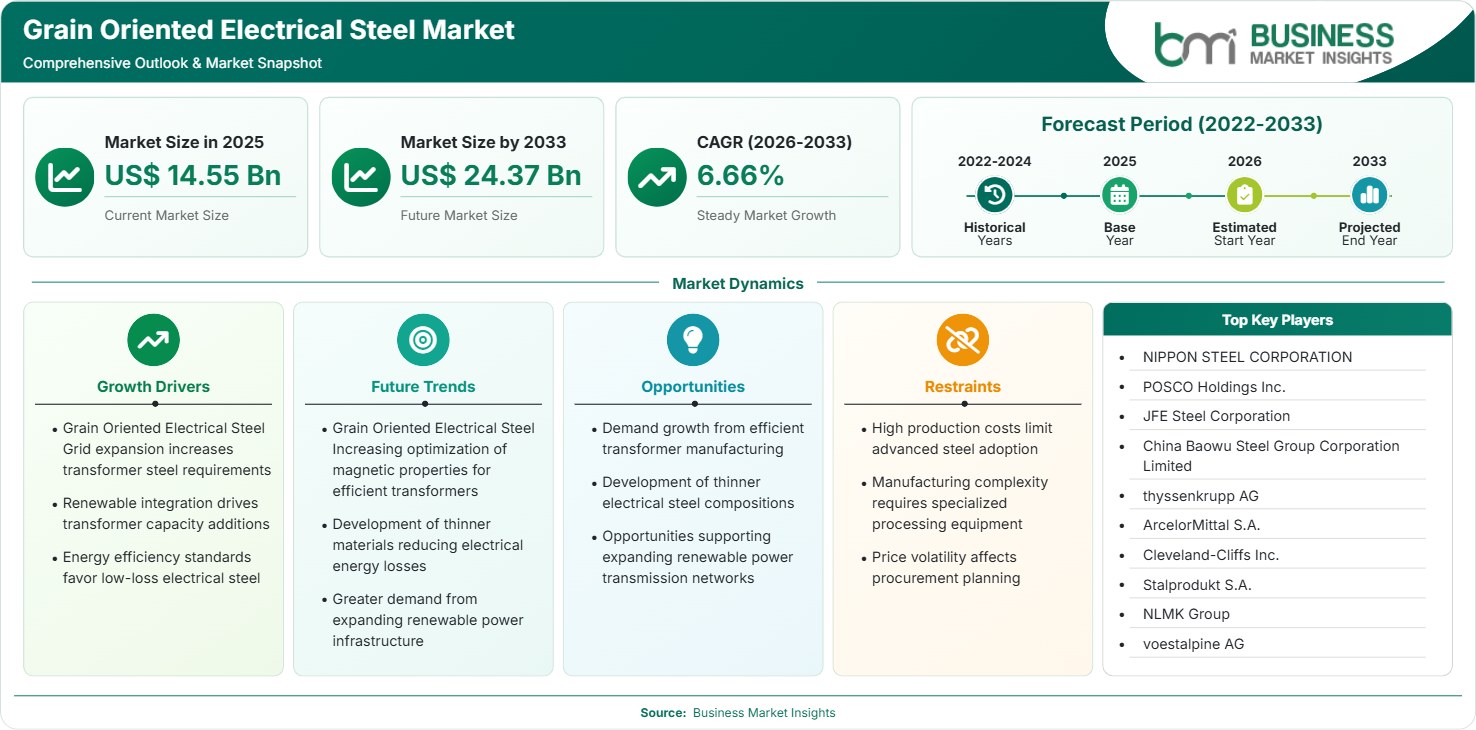
The Grain Oriented Electrical Steel Market size was valued at US$ 14.55 Billion in 2025 and is projected to reach US$ 24.37 Billion by 2033, growing at a CAGR of 6.66% during 2026–2033, driven by grid expansion, transformer replacement, renewable integration, data-center power demand, and low-loss steel innovation.

Report Coverage
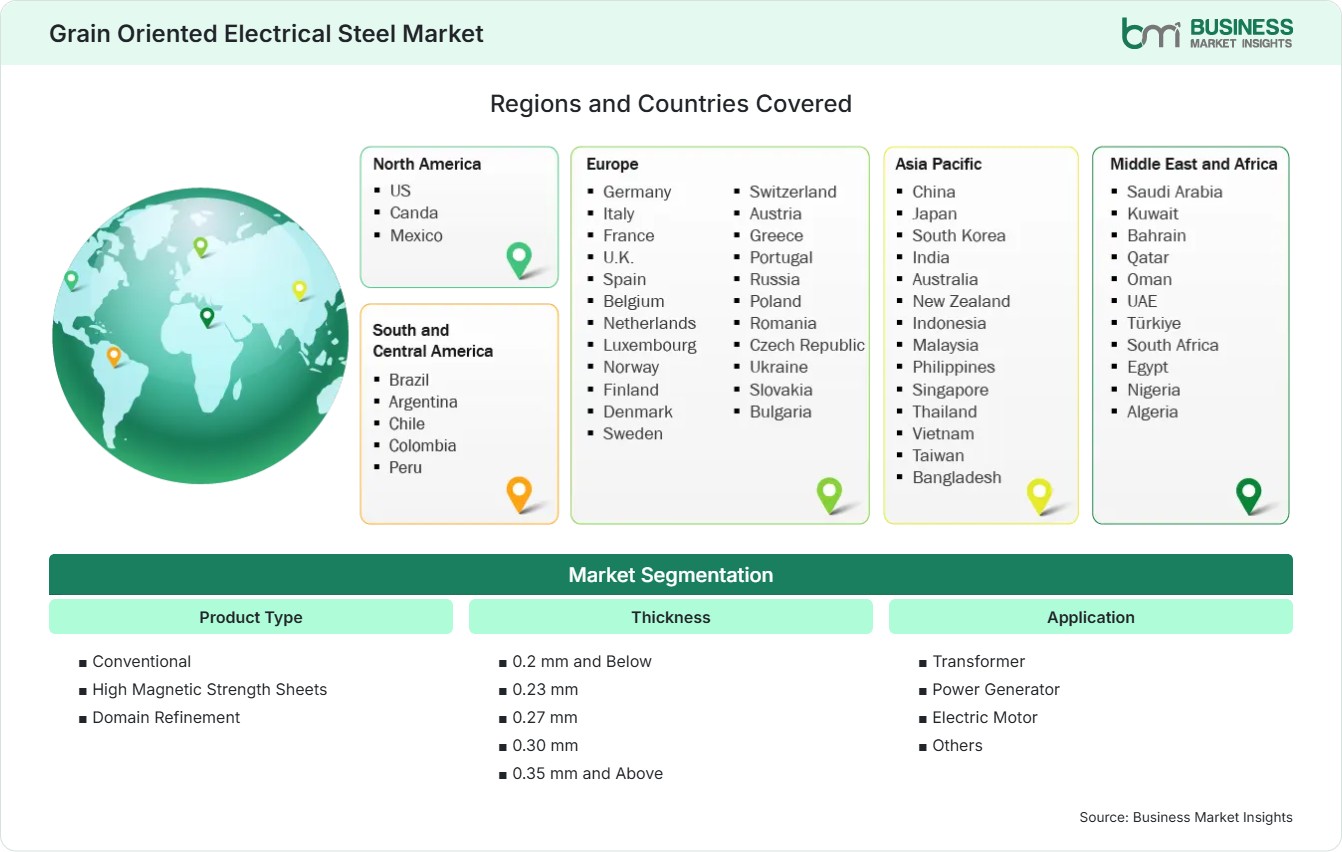
  • Product Type: Conventional, High Magnetic Strength Sheets, Domain Refinement
  • Thickness: 0.2 mm and Below, 0.23 mm, 0.27 mm, 0.30 mm, 0.35 mm and Above
  • Application: Transformer, Power Generator, Electric Motor, Others
US$ 14.55 Bn Market size in 2025
US$ 24.37 Bn Market Size by 2033
6.66% CAGR, 2026 - 2033
2026-2033 Forecast Period

AI Overview

Grain Oriented Electrical Steel Market Summary

  • North America Region: North America holds a 10%–13% Grain Oriented Electrical Steel Market share in 2025, growing at a 5.8%–6.8% CAGR through 2033, supported by transformer replacement, grid modernization, data-center expansion, renewable integration, and domestic electrical-steel supply. The US accounts for 78%–84% of regional demand, with a 6.0%–7.0% CAGR through 2033.
  • Fastest Growing Region: Asia Pacific holds a 67%–71% share in 2025, advancing at an 7.0%–7.8% CAGR, supported by electricity-demand growth, transformer manufacturing, renewable-energy deployment, industrialization, data centers, and expanding domestic electrical-steel capacity.
  • Leading Segment: Conventional products hold a 65%–69% share in 2025, expanding at a 6.0%–6.8% CAGR, supported by established transformer specifications, broad availability, proven processing performance, replacement demand, and continued grid infrastructure investment worldwide.
  • High Growth Segment: Domain Refinement products hold an 8%–12% Grain Oriented Electrical Steel Market share in 2025, advancing at an 8.5%–10.0% CAGR, driven by lower core losses, premium transformer efficiency requirements, advanced processing, energy-saving targets, and demand for higher-performing magnetic materials.
  • Key Market Opportunity: Higher-efficiency transformers, data-center infrastructure, renewable-grid interconnection, and domestic electrical-steel capacity expansion create opportunities for producers offering premium grades, localized supply, lower-carbon manufacturing, and long-term contracts.
  • Major Market Players: NIPPON STEEL CORPORATION, POSCO Holdings Inc., JFE Steel Corporation, China Baowu Steel Group Corporation Limited, thyssenkrupp AG, ArcelorMittal S.A., Cleveland-Cliffs Inc., Stalprodukt S.A., NLMK Group, and voestalpine AG.
Strategic Insights

Grain Oriented Electrical Steel Market: Strategic Insights

Grain Oriented Electrical Steel Market Strategic Framework
FREE PDF
Request your free sample
Request free sample
Stakeholder View

Key Takeaways

  • The value chain is growing more integrated since steel producers, makers of transformers, utilities, and companies that produce energy equipment all want reliable access to high-grade electrical steel. By entering into long-term supply agreements, it is possible to cut down on the risks associated with capacity shortages, delays in qualification, and fluctuating material prices.
  • The demand for transformer applications is most evident since grain-oriented electrical steel is mainly intended for use in transformer cores. The need for efficient transformers and the related core materials is increasing because of the replacement of outdated grid assets, the interconnection of renewable energy sources, industrial electrification, and the rising loads in data centers.
  • Innovation in products is now focusing on thinner gauges, higher permeability, domain refinement, better coatings, and lower-carbon production methods. For instance, Nippon Steel provides HI-B, HI-B LS, and HI-B PM grades, which include domain-refinement technologies aimed at reducing iron loss.
  • India presents a significant opportunity for localization since there is strong demand for electricity, substantial deployment of renewables, and activity in the area of transformer manufacturing, all of which are favorable towards developing local GOES capacity. JFE Steel and JSW Steel aim to set up an integrated system for manufacturing and sales that will cover Nashik and Vijayanagar.
  • More of the investment is now being directed towards securing capacity and achieving product differentiation; the fact that the JFE Steel and JSW Steel joint venture has acquired Thyssenkrupp Electrical Steel India is an example of a strategic move aimed at establishing regional production and capturing long-term demand.
Geographic Outlook

Grain Oriented Electrical Steel Market Regional Highlights

North America Grain Oriented Electrical Steel Market

North America represents a 10%–13% share in 2025 and records a 5.8%–6.8% CAGR through 2033. The United States dominates regional consumption through transformer replacement, transmission upgrades, renewable interconnection, and data-center expansion. Canada contributes through grid modernization and electrification. The Grain Oriented Electrical Steel Market share is supported by demand for high-efficiency transformer cores and resilient regional supply.

  • The need for replacing transformers is a major source of demand as electricity companies modernize their outdated infrastructure and deal with the increasing electricity loads caused by manufacturing, data centers, renewable generation, and electrification in a number of end-use sectors.
  • The importance of ensuring a domestic supply is increasing since the availability of electrical steel has an effect on the schedules for manufacturing transformers. Manufacturers who have production located locally, along with existing qualification records and the ability to deliver reliably, can thus strengthen their relationships with transformer producers.
  • Premium grades are receiving increasing attention in those cases where utilities place a priority on transformer efficiency and on energy savings over the transformer's lifetime. Transformer cores can maintain their existing manufacturing processes while using domain-refined materials with high permeability to reduce operating losses.
  • The development of data centres is increasing the demand for local transformers. According to an analysis by the IEA, data centres are a major factor in the rise in US electricity demand and thus highlight the need for reliable transformer and electrical-steel supply chains.

US Grain Oriented Electrical Steel Market

The US Grain Oriented Electrical Steel Market represents 78%–84% of North American demand in 2025 and advances at a 6.0%–7.0% CAGR through 2033. Demand is supported by transformer manufacturing, grid reinforcement, renewable projects, industrial electrification, and data-center construction.

  • Data-center expansion is creating additional electricity infrastructure requirements, strengthening demand for distribution and power transformers and therefore supporting high-quality GOES consumption.
  • Transformer manufacturers increasingly value predictable domestic or regional supply, especially where imported material faces longer logistics cycles, qualification requirements, and changing trade conditions.
  • Adoption of premium magnetic grades can occur when operators assess transformer purchases not only on the initial cost of the equipment but on their lifecycle losses as well.

Europe Grain Oriented Electrical Steel Market

Europe Grain Oriented Electrical Steel Market accounts for a 11%–14% share in 2025 and grows at a 5.2%–6.2% CAGR through 2033. Germany, Italy, France, and the United Kingdom represent major demand centers, while Germany remains a significant production and technology hub. Energy-efficiency regulation and supply-chain resilience support premium material adoption.

  • Germany combines its demand for transformers with its existing expertise in electrical steel, thereby supporting the development of premium grades, high-efficiency cores, and low-carbon materials for use in energy infrastructure applications.
  • Because of the investment in the grid, the industrial electrification, and the need for generation infrastructure, France has a continuous demand for transformer materials that have controlled magnetic losses and reliable processing characteristics.
  • The United Kingdom has the chance to take advantage of grid reinforcement, the integration of renewable energy, and the replacement of its outdated electrical infrastructure, which in turn increases the demand for efficient transformer components and a reliable supply of steel.
  • In 2025, ThyssenKrupp Steel launched bluemint powercore, a low-carbon GOES product aimed at use in transformers and in the energy sector, and this reflects its increasing differentiation in terms of embodied emissions.

Asia Pacific Grain Oriented Electrical Steel Market

Asia Pacific Grain Oriented Electrical Steel Market holds a 67%–71% share in 2025 and records a 7.0%–7.8% CAGR through 2033. China, Japan, South Korea, and India form the principal demand centers, while India represents a high-growth opportunity at approximately 8.0%–9.0%.

  • China is still a major demand center since the consumption of electricity, industrial production, the installation of renewable energy sources, and investment in the power grid all result in great demands for transformers and the related core materials.
  • India has great potential when it comes to expanding its capacity since investment in electricity demand, data centers, renewable energy generation, and transmission is promoting local production of high-grade grain-oriented electrical steel.
  • Japan has advanced technology in the field of electrical steel and the ability to carry out premium-grade manufacturing, which meets the demand for thin-gauge, high-permeability, and domain-refined products.
  • South Korea carries out large-scale steel production alongside the manufacture of transformers and electrical equipment, thus establishing an integrated system for the supply of high-quality GOES.

Rest of World Grain Oriented Electrical Steel Market

Rest of World Grain Oriented Electrical Steel Market represents a 5%–8% share in 2025 and expands at a 5.0%–6.0% CAGR through 2033. Latin America is supported by transmission investment, industrial expansion, and renewable integration. Middle Eastern markets benefit from power-system development and diversification, while Africa presents selective opportunities linked to grid access and infrastructure upgrades.

  • Brazil can tap into its demand potential by expanding its transmission system, increasing its renewable generation, electrifying its industry, and replacing the aging transformers it has across its widely dispersed power infrastructure.
  • The Gulf markets offer opportunities due to their large-scale power infrastructure, industrial development, renewable energy projects, and the new commercial loads that require reliable transformer capacity and efficient electrical components.
  • In South Africa and in other parts of Africa, there are certain opportunities, the reason being that grid expansion and reliability schemes call for efficient transformers, even though purchases are still affected by financing conditions and the way in which projects are carried out.
  • Regional suppliers have the opportunity to compete by providing standardized premium grades, reliable logistics, technical support, and flexible order quantities that are appropriate for markets in which there is no large-scale domestic GOES production.
Global Market Geography
FREE PDF
Request your free sample
Request free sample
Segment Analysis

Grain Oriented Electrical Steel Market Segmentation

Product Type

Conventional products hold a 65%–69% share in 2025 and grow at a 6.0%–6.8% CAGR through 2033. Established transformer specifications, broad availability, proven fabrication behavior, and replacement demand support the category. The Grain Oriented Electrical Steel Market scope is expanding toward premium grades as utilities increasingly evaluate lifecycle energy efficiency.

  • Conventional: Established transformer applications support broad adoption because conventional grades provide predictable magnetic performance, manufacturing compatibility, established specifications, and dependable supply across mainstream transformer production.
  • High Magnetic Strength Sheets: Higher magnetic strength supports compact transformer designs, improved material utilization, and applications requiring elevated flux density, encouraging adoption among manufacturers pursuing efficiency and reduced core volume.
  • Domain Refinement: Domain refinement reduces magnetic losses by modifying magnetic-domain structure, supporting premium transformer efficiency, lifecycle energy savings, and advanced applications where material performance commands greater commercial value.

Thickness

The 0.23 mm and 0.27 mm categories collectively represent a substantial portion of demand, supported by established transformer specifications and balanced performance. Thinner products gain attention where lower core losses and compact designs justify additional processing costs. The Grain Oriented Electrical Steel Market trends increasingly favor precise gauge control, improved surface coatings, and optimized magnetic performance.

  • 0.2 mm and Below: Ultra-thin gauges target premium efficiency requirements, enabling lower eddy-current losses and compact transformer designs where material performance justifies tighter manufacturing tolerances.
  • 0.23 mm: A widely established gauge balances magnetic performance, manufacturing practicality, and transformer fabrication requirements, making it suitable for diverse power and distribution transformer configurations.
  • 0.27 mm: This thickness offers a practical combination of magnetic properties, mechanical handling, availability, and cost, supporting continued use across mainstream transformer-core manufacturing.
  • 0.30 mm: The gauge remains relevant for applications where established fabrication practices and balanced magnetic performance are prioritized over maximum material efficiency.
  • 0.35 mm and Above: Thicker sheets serve applications where cost, mechanical handling, established equipment, and acceptable magnetic losses remain more important than ultra-low-loss premium performance.

Application

Transformers hold a 51%–54% Grain Oriented Electrical Steel Market share in 2025 and grow at a 6.5%–7.2% CAGR through 2033, supported by grid expansion, renewable integration, replacement demand, and data-center infrastructure. Power generators, electric motors, and other applications provide additional demand.

  • Transformer: Transformers remain the core application because directional magnetic properties and low iron loss support efficient energy transmission, distribution, voltage conversion, and reduced operating losses.
  • Power Generator: Generator applications use electrical steel where magnetic efficiency contributes to reliable energy conversion, supporting demand from conventional generation, renewable projects, and industrial power systems.
  • Electric Motor: Selected motor designs can use grain-oriented material where directional magnetic properties align with specific magnetic circuits, although non-oriented electrical steel remains more prevalent for conventional rotating machines.
  • Others: Specialized inductive and electrical applications provide incremental demand where directional magnetic characteristics, processing requirements, and efficiency benefits justify GOES over alternative magnetic materials.
Market Forces

Grain Oriented Electrical Steel Market Dynamics

Key Market Drivers

Grid modernization increases transformer material demand

The need for more transformer capacity is due to higher electricity demand, the increasing integration of renewable energy, the aging of the transmission assets, and the rising loads from data centers. Since 2021, the prices and the time taken to procure key grid components such as power transformers have almost doubled; this situation supports market growth as transformer manufacturers need a reliable supply of core material.

Energy efficiency raises demand for premium magnetic grades

Transformer operators increasingly evaluate energy consumption across long operating lifetimes. Materials with lower magnetic losses can command greater value when efficiency savings offset higher material costs. Nippon Steel's product portfolio demonstrates this technological direction through HI-B, HI-B LS, and HI-B PM grades designed around high permeability and reduced iron loss. Domain refinement, improved coatings, and thinner gauges therefore create differentiation beyond conventional steel production. This dynamic supports Grain Oriented Electrical Steel Market growth in premium product categories, particularly where transformer manufacturers compete on lifecycle efficiency.

Data-center electrification strengthens transformer requirements

The amount of electricity used by data centers is increasing quickly due to the growth of artificial intelligence and cloud infrastructure. Since more power is needed, new substations, transformers, and distribution equipment must be installed, which in turn raises the demand below the line for efficient transformer cores. This has led to a new route for demand in addition to the usual investments made by utilities. Companies that can offer steady, high-grade GOES and technical support are able to take part in transformer programs linked with hyperscale facilities, industrial campuses, and high-density digital infrastructure.

Key Market Opportunities

Indian capacity localization creates strategic supply opportunities

India presents an attractive investment opportunity because transformer demand is increasing alongside electrification, renewable deployment, industrialization, and data-center construction. JFE Steel Corporation and JSW Steel Limited committed approximately ¥120 billion for the expansion of GOES manufacturing capacity in India in 2025, with cumulative investment reported at approximately ¥290 billion. This creates opportunities for domestic processing, technical partnerships, equipment suppliers, transformer manufacturers, and downstream service providers. The Grain-Oriented Electrical Steel Market Forecasts, therefore, need to consider geographic diversification of production, not simply consumption growth.

Lower-carbon electrical steel creates premium product differentiation

The need for lower-carbon materials is creating a business opportunity that extends beyond just magnetic performance. Bluemint Powercore, introduced by Thyssenkrupp Steel in 2025, is aimed at use in GOES applications and boasts a reported reduction in production CO2 intensity of up to 50%. This means that manufacturers have the opportunity to differentiate their products based on environmental features, traceability, and lifecycle emissions. Transformer makers who supply utilities, data centres, and renewable energy projects may soon include embodied-carbon requirements when making their purchasing decisions. Producers who achieve both low-loss performance and lower-carbon manufacturing can thus meet the procurement criteria that have hitherto been mainly focused on price, availability, and technical qualification.

Advanced processing expands premium transformer applications

Producers have a variety of options for increasing the value of their products, such as carrying out domain refinement, using thinner gauges, applying better insulation coatings, and increasing permeability. Nippon Steel's domain-refined products show that surface treatment can reduce iron losses without affecting the suitability of the material for use in different types of transformers. This approach also presents an opportunity for transformer manufacturers who want to use smaller cores, achieve greater efficiency, and lower their energy consumption over the lifetime of the product. Additionally, producers can create differentiated products for high-value applications in which material costs make up a smaller part of the total asset value.

Market Restraints and Challenges

Capital intensity limits rapid capacity expansion

The production of GOES equipment involves specialized skills in metallurgy, rolling, annealing, coating, domain control, quality testing, and process engineering. As demand for transformers rises, capacity cannot be increased rapidly, leading to supply shortages and making long-term planning more essential. Since high-performance grades demand especially strict process control, even minor variations in grain orientation, gauge, coating, or annealing can affect magnetic performance. Because of this high level of capital investment, the advantage goes to companies that already have the necessary technical expertise and a record of having qualified customers.

Trade pressure and raw-material volatility challenge margins

Electrical-steel producers are exposed to changes in energy costs, the prices of alloying materials, international trade conditions, freight expenses, and the presence of low-priced imports. The result is that pressure on margins may reduce a company's ability to make investments and could lead to temporary changes in production. In December 2025, ThyssenKrupp Electrical Steel announced cuts in production and temporary closures at its plants in Gelsenkirchen and Isbergues, giving the reason of the arrival of cheap imports and the difficult market situation. While trade protection measures, regional capacity policies, and a diversified approach to sourcing can help to reduce some of this exposure, the producers are still susceptible to fluctuations in energy prices and in the state of the steel market.

Company Analysis

Competitive Landscape

The Grain Oriented Electrical Steel Market analysis shows competition centered on magnetic performance, product breadth, manufacturing scale, technology ownership, customer qualification, geographic proximity, and supply reliability. Leading producers increasingly differentiate through high-permeability grades, domain refinement, lower-carbon manufacturing, and regional capacity investments.

Company Name

Overview

Products and Services relevant to this market

NIPPON STEEL CORPORATION

Japanese steel producer with extensive electrical-steel technology and premium GOES manufacturing capabilities.

ORIENTCORE, HI-B, HI-B LS, HI-B PM, domain-refined grades, coatings, technical support, and transformer applications.

POSCO Holdings Inc.

Korean industrial group with established electrical-steel production, technical expertise, and large-scale steelmaking infrastructure.

Grain-oriented electrical steel, high-grade magnetic products, coatings, transformer materials, and technical development.

JFE Steel Corporation

Japanese integrated steel producer expanding GOES manufacturing and regional capacity in India.

Grain-oriented electrical steel, J2ES products, premium magnetic grades, technical solutions, and transformer-core materials.

China Baowu Steel Group Corporation Limited

Major Chinese steel group with broad electrical-steel manufacturing and domestic transformer-market exposure.

Grain-oriented electrical steel, premium magnetic grades, coated electrical sheets, and transformer materials.

thyssenkrupp AG

European industrial group with specialized electrical-steel operations and strong transformer-material expertise.

Powercore GOES, Bluemint Powercore, high-performance grades, low-carbon products, and technical services.

ArcelorMittal S.A.

Global steel producer expanding advanced electrical-steel capabilities and regional manufacturing investments.

Electrical steel products, specialized magnetic materials, production technology, and energy-transition steel solutions.

Cleveland-Cliffs Inc.

US steel producer with established electrical-steel capabilities serving domestic electrical-equipment applications.

Electrical steel, transformer materials, magnetic products, coatings, and North American supply services.

Stalprodukt S.A.

Polish specialty steel producer recognized for electrical-steel manufacturing and transformer applications.

Grain-oriented electrical steel sheets, transformer-core materials, magnetic products, and processing services.

NLMK Group

International steel producer with electrical-steel capabilities and established European market participation.

Grain-oriented electrical steel, transformer materials, magnetic grades, coatings, and technical support.

voestalpine AG

Austrian steel group supplying specialty electrical materials for demanding energy and industrial applications.

Electrical steel, high-performance magnetic materials, coatings, processing, and application engineering.

Trust & Transparency

Research Methodology

The market analysis combines proprietary research with secondary data from government agencies, company disclosures, regulatory filings, industry databases and expert interviews. Market estimates are validated through data triangulation, cross-market benchmarking and analyst review.

View Full Research Methodology

Questions Answered

Frequently Asked Questions

What does the Grain Oriented Electrical Steel Market Report cover?

The Grain Oriented Electrical Steel Market Report evaluates product types, thickness categories, applications, regional demand, technology developments, competitive positioning, capacity investments, supply-chain risks, and opportunities associated with transformer and electricity-infrastructure expansion.

What role does domain refinement play in electrical steel?

Domain refinement modifies magnetic-domain behavior to reduce iron losses. It supports premium transformer materials where efficiency improvements can justify higher material costs and additional processing requirements.

Why is India becoming important for GOES production?

India combines rising electricity demand, renewable integration, transformer manufacturing, industrialization, and expanding data-center infrastructure. JFE Steel and JSW Steel are investing in domestic GOES capacity to address this expanding ecosystem.

How are thinner gauges affecting GOES demand?

Thinner gauges can reduce eddy-current losses and support higher-efficiency transformer designs. Premium grades below conventional thickness levels require tighter manufacturing controls but can provide additional value where lifecycle energy savings are commercially important.

Why is grain-oriented electrical steel important for transformers?

Grain-oriented electrical steel aligns magnetic properties preferentially along the rolling direction, reducing core losses in transformer applications. This allows transformer manufacturers to improve energy efficiency while controlling core size and operating losses.

Access the Full Grain Oriented Electrical Steel Market Report

Get segment-level forecasts, regional estimates, competitive benchmarking, company profiles and downloadable Excel datasets.

Access the full Grain Oriented Electrical Steel Market Report
350 pages PDF & Excel | 2026-09-30
Similar Research

Related Market Reports