
Electrical Insulation Tape Market Outlook: Size, Share, Trends, Growth Analysis, Competitive Landscape & Forecast, 2026-2033

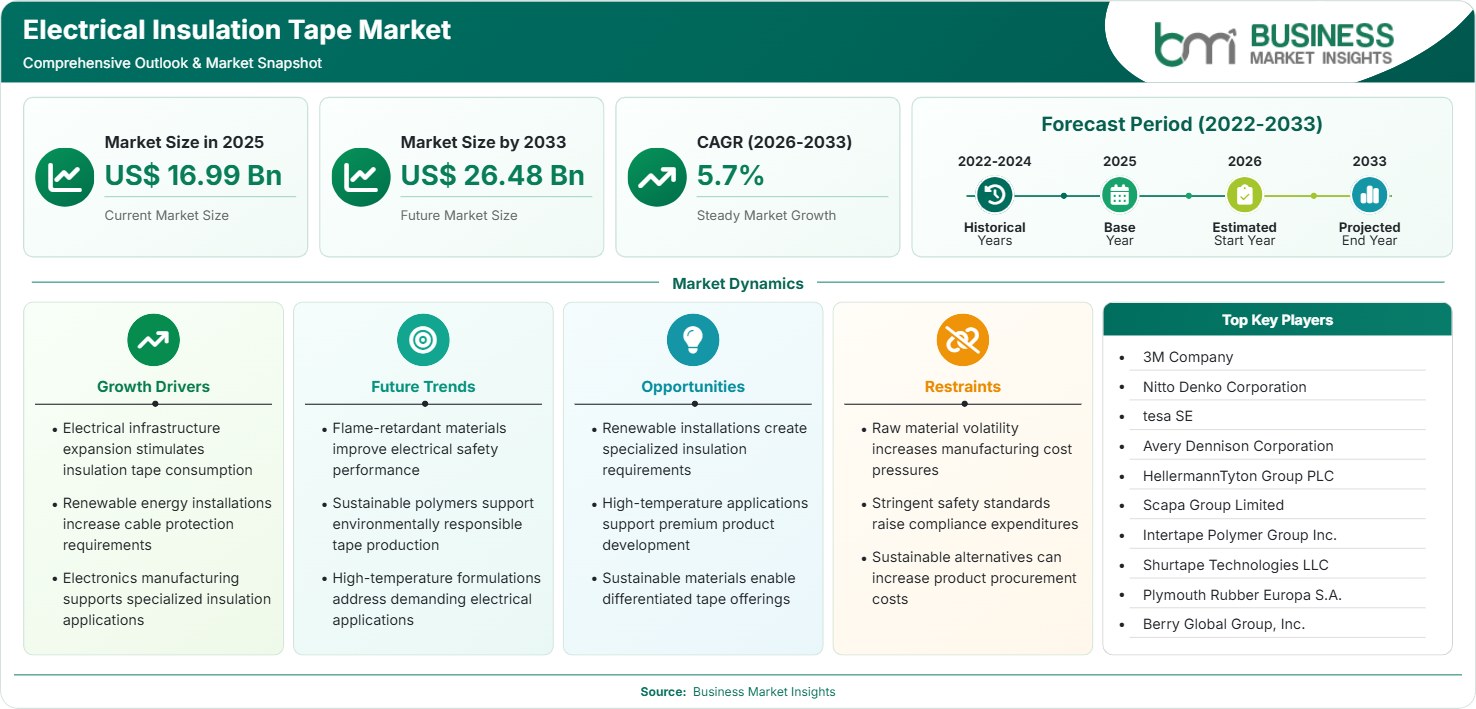
The Electrical Insulation Tape Market size was valued at US$ 16.99 Billion in 2025 and is projected to reach US$ 26.48 Billion by 2033, growing at a CAGR of 5.7% during 2026–2033. Rising electrification investments, renewable energy deployment, expansion of consumer electronics manufacturing, grid modernization programs, and increasing demand for advanced insulation materials are creating substantial long-term opportunities across industrial and electrical applications.

Report Coverage
  • Material: PVC, Glass Cloth, PET, Others
  • Application: Electrical & Electronics, Aerospace, Industrial, Others
US$ 16.99 Bn Market size in 2025
US$ 26.48 Bn Market Size by 2033
5.7% CAGR, 2026 - 2033
2026-2033 Forecast Period

AI Overview

Electrical Insulation Tape Market Summary

  • North America Region: North America holds a market share of 34%–37% in 2025, growing with a CAGR of 4.8%–5.2% during 2026–2033, influenced by grid modernization, EV infrastructure expansion, electronics manufacturing upgrades, renewable integration, utility investments, advanced insulation standards, industrial automation growth, transmission refurbishment projects, safety compliance requirements, and power distribution network expansion. The U.S. market benefits from utility investments, EV adoption, and industrial electrification initiatives, advancing at a CAGR of 4.9%–5.3%.
  • Fastest Growing Region: Asia Pacific holds a market share of 29%–32% in 2025, growing with a CAGR of 6.8%–7.3% during 2026–2033, driven by electronics production growth, renewable installations, urbanization, transmission investments, EV manufacturing expansion, industrial development, grid upgrades, semiconductor capacity additions, rising power demand, and expanding electrical equipment exports.
  • Leading Segment: PVC holds a market share of 41%–44% in 2025, growing with a CAGR of 5.2%–5.6% during 2026–2033, supported by cost efficiency, flame resistance, flexibility, widespread electrical applications, ease of installation, durable insulation performance, large-scale industrial consumption, established supply chains, and strong replacement demand.
  • High Growth Segment: Electrical & Electronics accounts for 47%–50% share in 2025, growing with a CAGR of 6.2%–6.8% during 2026–2033, driven by expanding electronics manufacturing, consumer device production, EV electronics integration, renewable equipment demand, advanced circuitry requirements, smart device adoption, semiconductor investments, product miniaturization, and electrical safety standards.
  • Key Market Opportunity: Advanced insulation solutions for electric vehicles, renewable power infrastructure, high-performance electronics, and smart grids are generating demand for durable, heat-resistant, and environmentally compliant tape technologies across emerging industrial applications.
  • Major Market Players: 3M Company, Nitto Denko Corporation, tesa SE, Avery Dennison Corporation, HellermannTyton Group PLC, Scapa Group Limited, Intertape Polymer Group Inc., Shurtape Technologies LLC, Plymouth Rubber Europa S.A., and Berry Global Group, Inc.
Strategic Insights

Electrical Insulation Tape Market: Strategic Insights

Electrical Insulation Tape Market Strategic Framework
FREE PDF
Request your free sample
Request free sample
Stakeholder View

Key Takeaways

  • The market value chain is highly integrated, spanning raw material suppliers, adhesive formulators, converters, distributors, OEMs, and utility operators, ensuring stable demand from both replacement and project-based procurement channels.
  • Electrical and electronics applications present the strongest upside as semiconductor manufacturing, EV electronics, consumer devices, and industrial automation systems require increasingly sophisticated insulation and protection materials.
  • Product innovation is shifting toward halogen-free, environmentally compliant, high-temperature, and high-dielectric-strength solutions capable of supporting demanding industrial and renewable energy applications.
  • Asia Pacific offers an attractive investment environment due to rapid industrialization, expanding electrical infrastructure, growing electronics exports, and large-scale renewable energy deployment projects.
  • Strategic acquisitions and portfolio expansion initiatives continue across adhesive technologies and specialty tapes as manufacturers seek access to new end-use sectors and improve geographic reach.
  • Grid modernization programs worldwide are creating sustained demand for durable insulation products capable of improving reliability, operational safety, and maintenance efficiency within power transmission networks.
    Regional Trends and Share Analysis
Geographic Outlook

Electrical Insulation Tape Market Regional Highlights

North America Electrical Insulation Tape Market

North America accounted for approximately 34%–37% of global revenue in 2025 and is projected to expand at a 4.8%–5.2% CAGR through 2033. The region is experiencing the advantages of utility modernization, the use of renewable energy, electrification initiatives, and modern transmission networks. There are various automation projects and electric vehicle charging installations that are contributing to the demand for high-performance insulation products. There is an active manufacturing base in the region with high specification and compliance needs. The Electrical Insulation Tape Market share remains significant due to sustained investments in energy security and electrical reliability.

  • Utility operators are increasing investments in transmission and distribution upgrades, boosting demand for durable insulation materials capable of delivering moisture resistance, thermal stability, and long service life in critical grid environments.
  • EV infrastructure expansion across the United States and Canada is creating additional demand for insulation systems used in battery packs, wiring harnesses, charging stations, and high-voltage electrical assemblies.
  • Industrial automation adoption across manufacturing facilities is accelerating consumption of specialty insulation solutions designed for robotics, sensors, control systems, and high-performance electrical equipment.
  • Renewable energy projects increasingly require advanced cable management and protection products, supporting demand from solar farms, wind installations, energy storage facilities, and supporting electrical infrastructure.

US Electrical Insulation Tape Market

The United States represents approximately 76%–79% of North American Electrical Insulation Tape Market revenue and is anticipated to grow at a 4.9%–5.3% CAGR during 2026–2033. The factors that help in driving growth include investment in manufacturing, upgrades in utilities, adoption of renewable energy sources, and production of electric vehicles. There are federal infrastructure programs that are helping in the upgrading of electrical grid systems and factories. High demand for aerospace, electronics, and industrial industries helps in driving the demand for advanced insulation materials with good dielectric properties.

  • Large-scale semiconductor and electronics manufacturing investments continue to increase demand for precision electrical insulation products supporting sensitive equipment and advanced production environments.
  • Growing adoption of renewable energy technologies requires reliable insulation materials for cable systems, transformers, switchgear, and related power transmission applications.
  • Modernization of industrial facilities is encouraging greater use of automation systems, creating consistent demand for insulation products designed for high-performance electrical operations.
  • Aerospace manufacturing activities maintain demand for lightweight, flame-resistant, and temperature-stable insulation solutions capable of meeting stringent operational requirements.

Europe Electrical Insulation Tape Market

Europe holds approximately 24%–27% of global Electrical Insulation Tape Market revenue in 2025 and is forecast to register a 4.9%–5.4% CAGR through 2033. The focus of regulations on energy efficiency, industrial development, and electrification will help in developing the market. Germany is still the market leader owing to its manufacturing prowess, while the countries of Eastern Europe are growing relatively fast. The rise in the use of renewable energy sources and electric mobility has led to rising demand for insulation materials. High-quality standards have spurred the adoption of high-performing insulation materials.

  • Germany leads regional demand with strong automotive, industrial equipment, and electrical engineering sectors requiring high-reliability insulation components for safety-critical operations.
  • Poland and several Central European nations are emerging as high-growth markets, supported by manufacturing expansion, infrastructure upgrades, and increasing foreign direct investment.
  • Renewable energy projects throughout Europe continue to stimulate demand for insulation materials used in wind turbines, solar installations, substations, and grid infrastructure.
  • Sustainability regulations are encouraging adoption of environmentally compliant and halogen-free insulation products without compromising electrical performance and durability.

Asia Pacific Electrical Insulation Tape Market

Asia Pacific accounted for approximately 29%–32% of global revenue in 2025 and is projected to record the fastest regional expansion at a 6.8%–7.3% CAGR through 2033. China is the largest market in the region, whereas India is the fastest-growing economy. Favorable conditions include robust electronics manufacturing capabilities, investments in power infrastructure, increasing EV manufacturing, and rapid urbanization. Governments in the region continue to invest in transmission projects, renewables, and industry. The region contributes significantly to overall Electrical Insulation Tape Market growth because of its dominant role in global electronics and electrical equipment manufacturing.

  • China maintains leadership through its extensive electronics manufacturing ecosystem, renewable energy investments, and large-scale grid infrastructure development initiatives.
  • India demonstrates strong growth prospects driven by industrialization, electrification projects, renewable energy deployment, and expanding domestic manufacturing capabilities.
  • Southeast Asian countries are attracting electronics production investments, increasing demand for insulation products used across manufacturing and assembly operations.
  • Electric vehicle manufacturing expansion across Asia Pacific is creating significant opportunities for high-temperature and high-voltage insulation applications.
  • Rising investments in battery production facilities support additional demand for specialized insulation products capable of meeting stringent safety and performance requirements.

Rest of World Electrical Insulation Tape Market

The Rest of World region accounts for approximately 10%–13% of global Electrical Insulation Tape Market revenue in 2025 and is expected to advance at a 5.5%–6.0% CAGR through 2033. South and Central America benefit from expanding industrial activity, energy projects, and manufacturing development initiatives.

The Middle East and Africa are experiencing greater infrastructure investment, utility modernization, and renewable energy deployment. Saudi Arabia, the UAE, and Brazil remain major demand centers, while several African economies are developing transmission networks and industrial facilities that require modern insulation technologies.

  • Brazil leads South and Central American consumption due to manufacturing activity, utility investments, and industrial modernization programs supporting electrical equipment deployment.
  • Mexico benefits from electronics and automotive manufacturing growth, creating increasing requirements for insulation materials across export-oriented production facilities.
  • Saudi Arabia and the UAE continue investing heavily in power infrastructure, industrial development, and renewable energy projects requiring reliable insulation solutions.
  • Expanding electrification programs across Africa are creating opportunities for cost-effective insulation products supporting grid expansion and energy access initiatives.
  • Utility modernization and renewable energy integration projects remain major growth catalysts across emerging markets throughout the region.
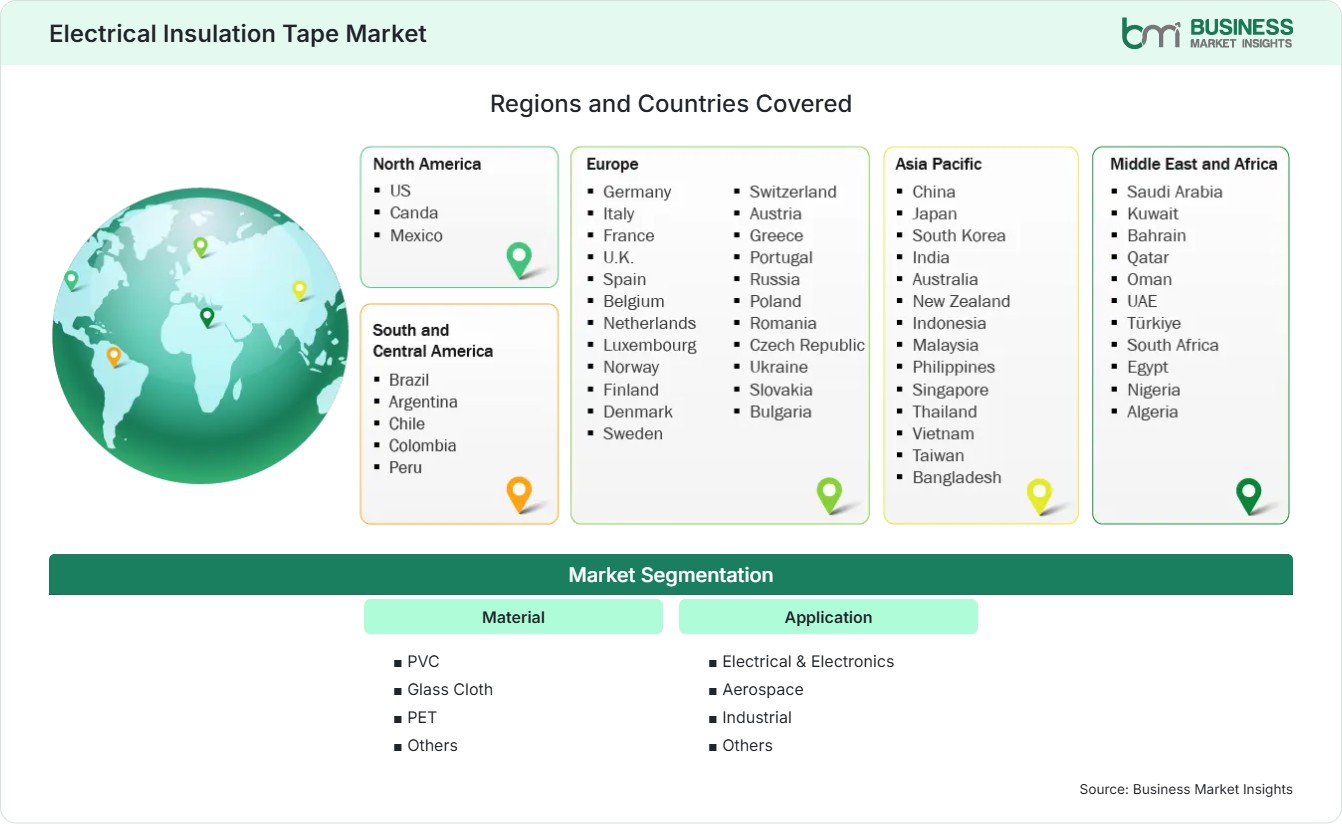
Global Market Geography
FREE PDF
Request your free sample
Request free sample
Segment Analysis

Electrical Insulation Tape Market Segmentation

Material

The Material segment represents a critical component of market development, with PVC accounting for approximately 41%–44% market share in 2025 and advancing at a 5.2%–5.6% CAGR through 2033. Product selection is influenced by thermal resistance, flexibility, dielectric strength, environmental compliance, and end-use requirements. The Electrical Insulation Tape Market scope continues expanding as industries require specialized materials capable of supporting sophisticated electrical systems and demanding operating environments.

  • PVC: PVC remains the most widely adopted material because of its affordability, flexibility, flame resistance, strong insulating properties, and suitability across industrial, commercial, residential, and utility-based applications.
  • Glass Cloth: Glass cloth products are preferred in demanding environments requiring excellent heat resistance, mechanical strength, and long-term durability, especially within industrial equipment, motors, generators, and aerospace systems.
  • PET: PET-based solutions benefit from superior dimensional stability, chemical resistance, and electrical performance, supporting increasing usage across electronics manufacturing, automotive systems, and advanced electrical assemblies.

Application

The Application segment is led by Electrical & Electronics, contributing approximately 47%–50% share in 2025 and projected to grow at a 6.2%–6.8% CAGR through 2033. Expansion of semiconductor manufacturing, consumer electronics production, industrial automation, and electric mobility is increasing demand. The Electrical Insulation Tape Market trends indicate rising preference for specialized products supporting compact, high-performance, and safety-critical electrical systems.

  • Electrical & Electronics: The segment benefits from increasing electronics production, semiconductor investments, smart device adoption, and growing requirements for insulation, bundling, protection, and electrical safety management.
  • Aerospace: Aerospace applications require lightweight, flame-resistant, and high-temperature insulation products capable of maintaining reliability under demanding environmental and operational conditions.
  • Industrial: Industrial demand is supported by automation projects, manufacturing modernization, machinery installations, motor systems, and power distribution equipment requiring dependable electrical protection solutions.
Market Forces

Electrical Insulation Tape Market Dynamics

Key Market Drivers

Accelerating Grid Modernization and Power Infrastructure Investments

Rising investments in transmission and distribution infrastructure continue to strengthen demand for electrical insulation products globally. Utilities are updating old networks in order to increase reliability, minimize power losses, and accommodate renewable sources of energy. Electrical insulation tapes have become essential in joining cables, wiring harnesses, protecting conductors, and conducting maintenance on equipment. The rise in smart grid installations and substation modernization projects means that more durable insulation that can withstand temperature and environmental changes is required. At the same time, developing countries are building their electrification and grid projects in order to cope with rising electricity demands.

Expanding Electric Vehicle and Electronics Manufacturing Base

Due to the fast-paced growth of electric vehicle production, there is a huge demand for quality insulating products in batteries, wiring systems, power electronics, and even charging stations. Tapes providing flame retardancy, dielectric strength, and temperature resistance are required by the producers of such electric vehicles. Furthermore, as the number of consumer electronics, industrial electronics, telecommunications devices, and semiconductors produced grows, the need for quality insulation becomes even greater. Electrical Insulation Tape growth is therefore closely linked to accelerated electrification trends, while Electrical Insulation Tape Market trends increasingly reflect requirements for enhanced safety, thermal management, and long-term electrical performance across next-generation technologies.

Industrial Automation and Manufacturing Modernization

Industrial facilities worldwide are adopting automation technologies to increase productivity, operational efficiency, and production quality. Highly sophisticated machineries, robots, motor control devices, and electrical assemblies need highly reliable insulating products that can enable them to function consistently. Modernization initiatives in the industries related to automobile, electronics, chemical, pharmaceutical, and other industries involve the increased use of electrically operated machinery. Increasing emphasis on occupational safety also plays a part in increasing the demand for insulating products meeting regulatory norms. Industrial adoption of the fourth industrial revolution is leading to long-term prospects for specialized insulating products for the modern industry. The industrial revolution is a key contributor to market growth and innovations in the forecast period.

Key Market Opportunities

High-Performance Materials for Renewable Energy Systems

Renewable energy installations require electrical components capable of operating under demanding environmental conditions while maintaining long-term reliability. Solar power systems, wind turbines, energy storage facilities, and supporting transmission equipment all utilize specialized insulation solutions. Manufacturers are increasingly developing products that provide superior UV resistance, moisture protection, and thermal performance. As governments continue prioritizing clean energy development, project pipelines are expanding across both developed and emerging economies. Electrical Insulation Tape Market Forecasts indicate growing investment in renewable infrastructure that will necessitate advanced insulation technologies. Companies capable of delivering durable and environmentally compliant solutions are likely to secure attractive growth opportunities within this rapidly developing application segment.

Development of Halogen-Free and Sustainable Product Portfolios

Environmental regulations and corporate sustainability initiatives are encouraging greater adoption of eco-friendly materials. End users increasingly favor insulation products that minimize environmental impact while maintaining performance characteristics. This transition is creating opportunities for manufacturers to develop halogen-free, recyclable, and low-emission alternatives. Sustainability considerations are becoming especially important within electronics manufacturing, automotive production, and construction applications. Product innovation focused on improved environmental performance can provide differentiation and support premium pricing strategies. As procurement teams place greater emphasis on sustainability metrics, suppliers offering compliant and high-performance solutions are positioned to strengthen market presence and attract long-term customer relationships.

Emerging Manufacturing Hubs Across Asia and Middle East

Industrial development initiatives across India, Southeast Asia, the Gulf region, and selected African economies are generating substantial demand for electrical components and supporting materials. Governments are investing heavily in manufacturing capacity, energy infrastructure, industrial parks, and transportation networks. These projects require extensive electrical systems protected by reliable insulation solutions. Global supply chain diversification strategies are also contributing to establishment of new manufacturing facilities outside traditional production centers. Companies expanding regional production, distribution capabilities, and technical support networks can capitalize on growing local demand. Increasing localization of electronics, automotive, and industrial production creates favorable conditions for long-term market expansion and customer acquisition.

Market Restraints and Challenges

Raw Material Price Volatility and Margin Pressures

Factor: Fluctuating prices of petrochemical derivatives, specialty adhesives, synthetic polymers, and related raw materials directly influence manufacturing costs.

Impact: Cost volatility limits pricing predictability, creates procurement challenges, and reduces profitability for manufacturers operating under long-term contractual agreements. Suppliers frequently face difficulty passing cost increases to customers because of competitive market conditions. Unstable raw material markets can also disrupt inventory planning and investment decisions. Smaller manufacturers are particularly vulnerable because of limited bargaining power and purchasing scale. As end users continue emphasizing cost efficiency, producers must balance performance improvements with affordability. These pressures can constrain expansion plans and influence product portfolio decisions across multiple geographic markets.

Stringent Compliance Requirements Across End-Use Industries

Factor: Increasing regulatory requirements concerning fire safety, environmental compliance, chemical composition, and product certification create additional operational complexity.

Impact: Manufacturers must dedicate substantial resources toward testing, certification, documentation, and product reformulation activities. Meeting diverse regulatory requirements across countries and industries extends product development timelines and increases operating costs. Non-compliance can result in delayed market entry, reputational risks, or restricted sales opportunities. Aerospace, electronics, and automotive customers often demand rigorous qualification processes before approving suppliers. These requirements present barriers for new entrants while increasing investment needs for existing market participants. Compliance management therefore remains a critical operational challenge influencing competitiveness and long-term profitability.

Company Analysis

Competitive Landscape

The competitive environment is characterized by product innovation, global distribution networks, and expanding specialty insulation portfolios. Electrical Insulation Tape Market analysis indicates that leading manufacturers are focusing on advanced adhesive technologies, sustainability initiatives, and high-performance insulation solutions targeting industrial, utility, electronics, and transportation sectors.

Company Name

Overview

Products and Services relevant to this market

3M Company

Global diversified technology company with strong presence in industrial materials, electrical products, and specialty adhesive solutions across multiple industries.

Electrical insulation tapes, vinyl tapes, specialty adhesive systems, industrial protection solutions, cable management products, and electrical maintenance materials.

Nitto Denko Corporation

Major manufacturer of industrial materials and functional tapes serving electronics, automotive, healthcare, and industrial sectors worldwide.

Insulation tapes, industrial adhesive products, electrical protection solutions, electronics materials, and specialty conversion technologies.

tesa SE

Leading adhesive technology company supplying industrial, automotive, electronics, and construction sectors with specialized tape solutions.

Electrical insulation tapes, wire harness solutions, industrial bonding products, specialty tapes, and electronics assembly materials.

Avery Dennison Corporation

Global materials science organization focused on innovative labeling, packaging, and adhesive technology platforms.

Pressure-sensitive materials, industrial tapes, insulation products, adhesive technologies, and specialty engineered materials.

HellermannTyton Group PLC

Specialized provider of cable management and electrical installation solutions supporting industrial and infrastructure markets.

Insulation tapes, cable accessories, identification systems, wiring protection products, and connectivity solutions.

Scapa Group Limited

Manufacturer of engineered bonding and adhesive products serving industrial, healthcare, and electronics applications.

Electrical tapes, specialty adhesive materials, insulation products, industrial tapes, and customized engineered solutions.

Intertape Polymer Group Inc.

Packaging and industrial solutions provider with broad expertise in adhesive and protective material technologies.

Industrial tapes, specialty insulation materials, performance adhesive systems, and protective electrical applications.

Shurtape Technologies LLC

Tape manufacturer supplying professional-grade solutions for industrial, construction, and electrical markets.

Electrical tapes, masking products, specialty adhesive solutions, maintenance tapes, and industrial protection products.

Plymouth Rubber Europa S.A.

Established supplier focusing on premium electrical insulation and utility-oriented protection products.

Electrical insulation tapes, splicing products, utility maintenance materials, and wire protection solutions.

Berry Global Group, Inc.

Global manufacturer of engineered materials and specialty products serving industrial and infrastructure customers.

Technical films, insulation materials, pressure-sensitive products, specialty tapes, and industrial protective solutions.

Trust & Transparency

Research Methodology

The market analysis combines proprietary research with secondary data from government agencies, company disclosures, regulatory filings, industry databases and expert interviews. Market estimates are validated through data triangulation, cross-market benchmarking and analyst review.

View Full Research Methodology

Questions Answered

Frequently Asked Questions

What does an Electrical Insulation Tape Market Report typically analyze?

A comprehensive report evaluates market size, demand patterns, segment performance, competitive positioning, regional developments, technology trends, supply chains, investment opportunities, and long-term industry outlook.

How are sustainability requirements influencing product development?

Manufacturers are increasingly developing halogen-free, environmentally compliant, and recyclable products that satisfy safety requirements while helping customers achieve sustainability and regulatory objectives.

Which material category currently dominates industry consumption?

PVC remains the leading material segment because it provides a balanced combination of affordability, flexibility, flame resistance, dielectric strength, and broad applicability across industrial and electrical installations.

Which region is expected to experience the fastest expansion during the forecast period?

Asia Pacific is projected to record the strongest growth due to rapid industrialization, electronics manufacturing expansion, rising electricity demand, renewable energy investments, and increasing electric vehicle production.

What are the primary factors driving demand for electrical insulation tapes?

Demand is primarily supported by expanding power infrastructure, renewable energy installations, electric vehicle manufacturing, industrial automation, and increasing production of electrical and electronic equipment worldwide.

Access the Full Electrical Insulation Tape Market Report

Get segment-level forecasts, regional estimates, competitive benchmarking, company profiles and downloadable Excel datasets.

Access the full Electrical Insulation Tape Market Report
350 pages PDF & Excel | 2026-09-16
Similar Research

Related Market Reports